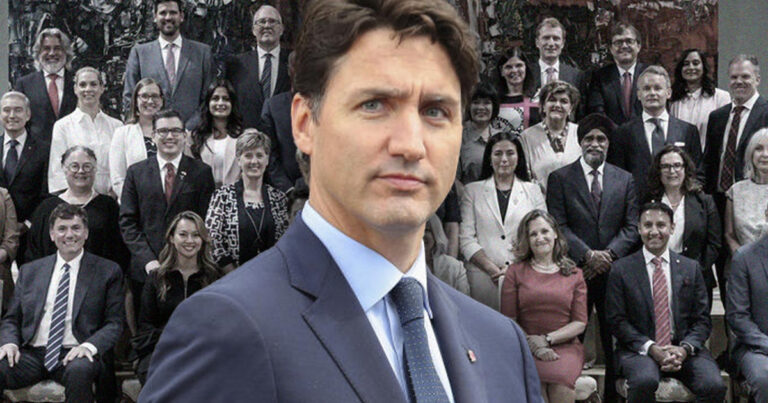
Last week, a secret report from the National Security and Intelligence Committee of Parliamentarians was released and alleged that several MPs wittingly colluded with hostile foreign nations. One MP is alleged to have given top secret information to a known foreign intelligence officer. To date, the Trudeau government has gone out of its way to shield and protect the names of the alleged traitors from being released to the public.
Canadians are once again being kept in the dark over this major national security scandal. These MPs are accountable to Canadians, but it seems knowing whether or not they are actively committing treason against the country is not something we as Canadians are privy to.
The question that should be asked now is, why does Canada allow dual citizens to become MPs in the first place?
Watch the latest episode of Ratio’d with Harrison Faulkner.
Western Canadian premiers are frustrated after Ottawa handed Quebec $750 million to deal with the immigration crisis while offering nothing to struggling Western provinces.
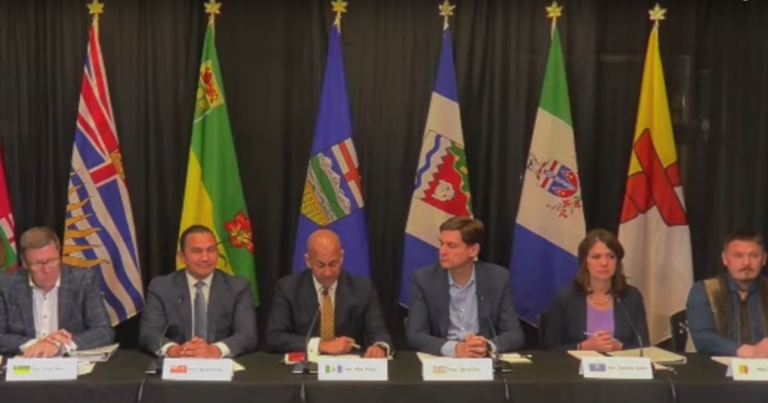
BC Premier David Eby and Alberta Premier Danielle Smith blasted the federal government at Canada’s Western Premiers Conference in the Yukon on Monday afternoon. Their comments came just hours after Ottawa inked a deal with Quebec to help pay for a surge in temporary immigrants to the province.
Eby said the funds are being given to Quebec at the expense of Western Canada, adding that he sensed frustration “around the table” when the new deal was raised.
“I won’t put this on anyone else, but I’ll say for British Columbia, how frustrated we are, to see the money being showered down on Quebec and Ontario,” Eby said.
“And us scrabbling around for what’s leftover. It’s not acceptable, it is not okay.”
Eby said 10,000 newcomers arrive in BC every 37 days. His province — especially young people looking to purchase homes — are feeling some “major pressures,” he said.
“That announcement today with Quebec, frankly, is, is the straw that broke this camel’s back,” he said. “I look forward to the call from the prime minister to share with us the details of their immigration funding for British Columbia on a per capita basis, the exact same as Quebec got today.”
Smith chimed in saying that over 20% of newcomers to Canada are choosing Alberta, which isn’t being given more monetary support from Ottawa.
“We also are host to 70,000 of the newcomers from Ukraine, the Ukrainian evacuees, and we have not seen the same kind of support for those new arrivals in the same way that Premier Eby has talked about,” she said.
Smith reiterated calls she made in March for Alberta to have more control over immigration after the federal government declined to increase the number of skilled workers awarded to the province. She’s been urging Ottawa to reconsider its decision to limit allocations for Alberta’s provincial nominee program.
“So it does seem to me they need to give us the tools if they want us to be able to settle newcomers, then they need to support us with the finances to do that,” she said Monday.
Yukon Premier Ranj Pillai, who hosted the meeting, said the premiers discussed affordability, especially as it relates to housing.
“We want to see an engaged federal partner working with us on a solution,” he said.
He also announced that the provinces agreed to develop a memorandum of understanding on shared and strategic infrastructure priorities.
“This infrastructure will not only bring a wide range of western Canadian products to market, they will bring jobs and economic advancement to the people in our jurisdictions,” he said.
Calgary Mayor Jyoti Gondek formally apologized to residents on Sunday for the city’s failure to communicate effectively during the ongoing water crisis.
The apology comes as the city struggles to repair a critical 78-inch feeder main that fractured last Wednesday, leading to widespread water restrictions and a boil water advisory for the Bowness neighbourhood.
For the boil water advisory, all residents and businesses in Bowness are advised to bring water to a rolling boil for a full minute before drinking, brushing teeth, cleaning raw foods, preparing infant formula or juice, and making ice. Water in all other Calgary communities is safe to drink.
Gondek explained that information had come slowly and was confusing. She said that despite the stressful situation for everyone involved, she’s heard Calgarians’ concerns.
“In a nutshell, we need to do a lot better for Calgarians,” said Gondek.
“Going forward, we will do a much better job of explaining what’s happened, the expected timeline to get back to normal, and what we need from you in the way of water conservation,” she said.
This improved communication promises a daily livestreamed update to the media and all Calgarians at 8:30 am from Gondek. The Emergency Operations Centre will also brief the media daily in the afternoon on the progress of the repairs.
During her first update, Gondek informed Calgarians that on Sunday, they used 457 million litres, which she said was great given the supply available was 620 million litres. Before the water main break last Wednesday, Calgarians were consuming 650 million litres a day.
“Please keep this up. The reason that we have to have this extra supply on hand is also for any emergencies that we might face that the Calgary Fire Department has to deal with. So, I am incredibly impressed with how well Calgarians have done,” said Gondek.
She said all data provided was preliminary and that finalized numbers would be provided at the afternoon conference at 2:00 pm.
The water main break in the Montgomery/Bowness area on June 5 has significantly disrupted water services, necessitating a city-wide effort to conserve water. Calgary’s infrastructure has been unable to keep up with demand, prompting urgent calls from city officials for residents to reduce their water usage.
The manager of drinking water distribution with the City of Calgary, Chris Huston, explained that the water break resulted in Calgary losing 40% of its water supply.
Comparatively, at a press conference on Saturday, Calgary’s director of water services, Nancy Mackay, said that Calgarians had used about 480 million litres of water the day prior, compared to a supply of about the same.
“I can’t stress this enough: we will run out of water if we don’t take action individually right now. This is not a joke. It is not some conspiracy. It is a fact,” said Gondek.
During a visit to Bowness, Mayor Gondek engaged with residents and volunteers, who emphasized the need for clearer communication and more visible signage regarding the boil water advisory and locations of water trucks. In response, the Mayor promised to enhance the city’s communication strategy with plain language and multilingual updates.
Calgarians initially reduced their water consumption by 25% and are now closer to a 30% reduction.
Calgary’s water restrictions remain at Stage 4, which is the highest the scale goes. All outdoor water use is completely banned. Calgarians are encouraged to keep showers to three minutes or less, do dishes or laundry only with full loads, scrape plates rather than rinsing or use paper plates, turn off the tap when brushing teeth, flush the toilet much less than usual, and more.
Fines for violating the restrictions start at $3,000.
Chief of Calgary Emergency Management Agency Susan Henry said on Saturday that 61 warnings of water misuse had been issued and that 1800 calls related to the restrictions had been dialled to 3-1-1. 34 calls came concerning the fire ban, which remains in place so that the fire department can save water for emergencies.
The agency said they are emphasizing an education-first approach but will move towards issuing tickets if those warned do not change their behaviour.
On Saturday’s update, Gondek said that the best-case scenario would see the water conservation remain in place for a minimum of five to seven days. No worst-case scenario timeline was provided.
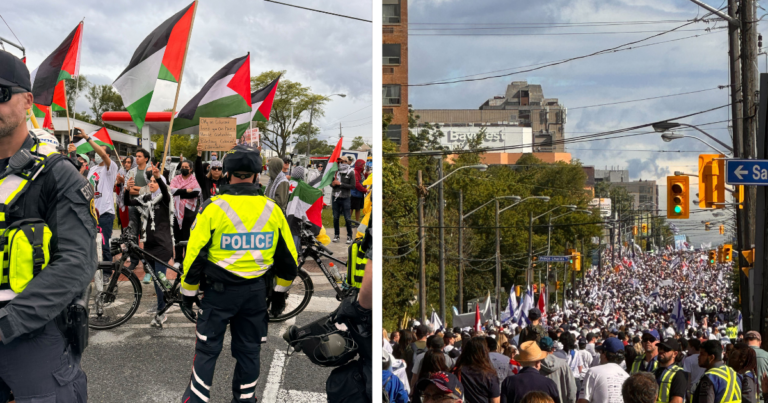
A day after Israeli Defence Forces announced the rescue of four hostages from Hamas in Gaza, thousands showed up to support Israel in Toronto, but that didn’t prevent anti-Israel activists from trying to disrupt the march.
The United Jewish Appeal Federation of Greater Toronto organized the Walk for Israel, a fundraising and solidarity event that, according to them, broke records for the highest number of participants in the rally’s 55-year history. An estimated 50,000 people attended on Sunday.
In an email, UJA told True North its record-breaking turnout “speaks volumes” about the Jewish community’s pride, resilience and determination to live in peace and security.
UJA lauded the event as a family-friendly celebration which involved a symbolic walk in solidarity with Israel followed by a festival celebrating Jewish and Israeli culture.
The group said all $1.2 million dollars in proceeds made by the event will be directed to supporting the mental health of those recovering from trauma from terrorism and the Oct. 7 massacre.
“Today was a powerful demonstration that we have many allies who stand with us in support of democracy, freedom, and the right of Israelis and our Jewish community to live in peace and security,” Adam Minsky, President and CEO of UJA Federation of Greater Toronto said.
Contrary to UJA’s estimate, the Toronto Police Services told True North in an email it estimated 20,000 attendees at the walk.
TPS was tipped off that anti-Israel protesters would attempt to disrupt the event. As a result, police from Hamilton, Durham, York and Niagra joined Toronto police to ensure the safety of all participants.
Police made six arrests related to the event in the Bathurst Street and Sheppard Avenue area on Monday afternoon and released the names and charges of those arrested.
32-year-old Lou-i Bou-Chahine was charged with public incitement of violence after allegedly displaying antisemitic messages and calls to violence.
Syed Raza, 27, was charged with public incitement of hatred and resisting a peace officer.
Raza reportedly stomped on an Israeli flag, which police said caused a “breach of the peace.” Police then tried to separate him from the pro-Israel marchers. When officers attempted to arrest Raza, he allegedly resisted the arrest.
Another man, Eric Brazay, 59, was charged with causing a disturbance. Police accused Brazay of repeatedly pushing a camera mounted on a stick in counter-protesters’ faces despite being cautioned “several times” against it.
After allegedly refusing to leave someone’s private property and then allegedly assaulting an officer when asked to leave. Sharez Bin Salman Salman Hydri, 37, was charged with failing to leave the premises when directed, obstructing and assaulting a peace officer.
A 75-year-old man Michael Burszstejn was charged with assault after he allegedly bumped into a woman wearing a keffiyeh holding a child on purpose which caused her to stumble.
Omar Elkhawass, 22, accused of attempting to steal an Israeli flag from an event participant, was charged with mischief to interfere with property.
Notably, some frequent fliers in the anti-Israel protest circuit showed up to have their voices heard at the march as well.
Firas Al Najim, a pro-Hamas protester who was recorded calling Hamas “the only way forward,” a month after the organization’s Oct. 7 massacre of Israelis, was in attendance and was reportedly handcuffed.
Naveed Badahur, who goes by other names online such as Naved Awan was present as well. Badahur took up a leading role in the protest manning the microphone and organizing rides to intercept the pro-Israel crow.
In the past Badahur has worn pro-Hamas symbolism, such as an upside-down red triangle referencing Hamas military videos, has called for Zionists everywhere to be “held accountable” including at synagogues and has been recorded yelling at a Jewish person through a fence that “never again is now.”
When the protesters failed to intercept the marchers, a contingent of them, including Badahur, trekked through the woods between the West Don River and Maxwell Street in North York to reach them, but they were stopped by police.
The Conservatives’ calls for the release of the names of parliamentarians implicated in foreign interference has intensified.
Conservative House leader Andrew Scheer has asked Justice Marie-Josée Hogue, the commissioner of the inquiry into foreign interference, to look into the same findings reached by NSICOP, the National Security and Intelligence Committee of Parliamentarians.
“We request that the Hogue Commission be asked to issue a finding of fact for each case in the Special Report where a member of the House of Commons or the Senate of Canada, past or present, is alleged to have knowingly participated in ‘foreign interference’…and that any such individuals found to have done so be named in a report to Parliament,” Scheer wrote.
The NSICOP report stated that the federal government has undermined the integrity of Canada’s parliamentary and democratic processes, along with resulting public trust. The report also noted that some Canadian elected officials are knowingly assisting foreign state actors in political interference, primarily on behalf of China and India.
“It is not likely that they would make these findings unless there were significant and credible evidence. However, the names of the individuals involved have been redacted at the direction of Prime Minister Justin Trudeau,” wrote Scheer.
Scheer said that the findings need to be weighed and assessed by an independent body immediately. The Hogue Commission is currently investigating similar facts, said Scheer. Hogue released the initial report into foreign interference last month.
“These findings of fact would not constitute findings of criminal guilt but would be intended to serve as an aid to the House and the Senate in the exercise of their respective privileges, immunities, and powers; to each political party whose members may be implicated; and above all to the Canadian public to strengthen its confidence in our political institutions,” said Scheer.
To accomplish the investigation, Scheer requested that the Hogue Commission be provided with all the unredacted evidence, and that the findings be tabled in Parliament and published online by Oct. 1, 2024.
“This is what Canadians deserve. Anything less risks fuelling public suspicion about a cover up of information known to this government about members of parliament working for foreign states against the interests of Canada,” concluded Scheer.
The Bloc Québecois took a similar approach, tabling an opposition motion calling on the Hogue Commission’s terms of reference to be expanded to allow for the investigation of electoral interference among elected officials.
The opposition motion, sponsored by Bloc MP René Villemure, will be debated on Monday afternoon and voted on Tuesday.
“This is a public-interest subject; it’s something really serious,” said Villemure. “This should not be a partisan issue; foreign interference has no colour, and we’re putting this motion forward hoping for unanimous consent.”
The federal NDP has suggested that their party would support the motion.
“Canadians deserve to know who these MPs are who are working to undermine our democracy,” said NDP deputy leader Alexandre Boulerice. “We must restore confidence in our democratic process, institutions, and those who represent them.”
The motion can pass if all opposition parties support it, however, it is non-binding.
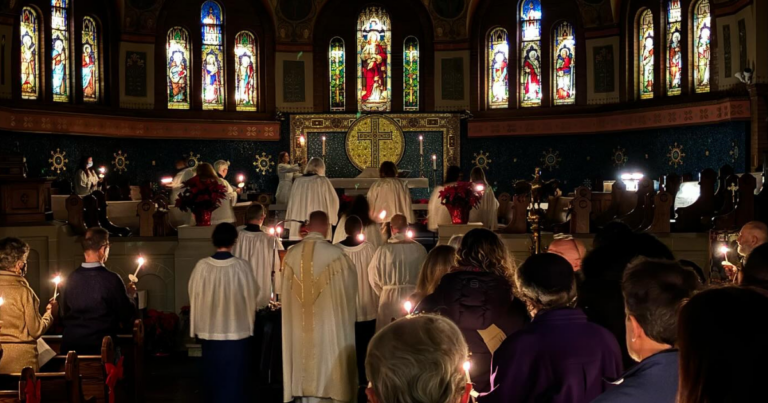
Police are investigating after a historic church in Toronto containing artwork by Canada’s famous Group of Seven was completely destroyed by a fire on Sunday.
St. Anne’s Anglican Church, in Toronto’s Little Portugal neighbourhood was constructed between 1907 and 1908.
The church was designated as a national historic site in 1996 and was given heritage protection by the City of Toronto that same year.
Toronto police arrived on the scene around 8am on Sunday morning and found the church “fully engulfed in flames.” No one was injured by the fire.
“The building is completely destroyed right now, as are all the artifacts inside,” Deputy Fire Chief Jim Jessop told reporters.
While Jessop said that it’s still “way too early” to speculate what the cause of the fire may have been, Toronto police have set up an online portal for people to submit photos or videos which may help with the investigation.
“This is incredibly devastating for my congregation. It’s devastating for this community,” Father Don Beyers, a priest at St. Anne’s, told reporters during a press conference on Sunday. “I cannot express how far-reaching (the impact of) this church fire is.”
Beyers said that beyond Sunday services and weddings, the church hosted music and arts programs, events for various communities, dinners and was a “vital resource” for the community.
The church was built in a Byzantine revival style style, replacing a previous church on the same site that was built in 1862.
St. Anne’s also continued a number of notable artworks by prominent Canadian artists, including a series of murals done by three members of the Group of Seven, all of which were lost in the fire.
The murals were the only religious works of art known to be done by the Group of Seven, commissioned by the group’s founding member J.E.H. MacDonald in 1923.
Group members Fred Varley and Frank Carmichael were also contributors.
“The elaborate interior mural decorations, designed by J.E.H. MacDonald, cover the walls and ceiling of the apse, the main arches, the pendentives and the central dome,” reads the Parks Canada website.
Parks Canada called the murals a “remarkable cycle of paintings” which belonged to the “revival of mural decoration that emerged in the last quarter of the 19th century and is a manifestation of the Arts and Crafts movement which sought to ally architecture with the sister arts of painting and sculpture.”
In describing the church’s heritage value, Parks Canada said St. Anne’s decorative Byzantine art was integral to the church’s architectural style.
“This is the only church that featured artwork by members of the Group of Seven, and I’m sorry to say, but that’s been lost from what I can see,” said Beyers, who called the incident “devastating” and “heartbreaking.”
“Not only was the art important, but the church itself was important architecturally. It was one of the rare Anglican churches that was in the Byzantine style, an Eastern Christian style.”
Davenport city councillor Alejandro Bravo said that St. Anne’s was not only important to the local community but also to Canada’s history and culture as well.
“It’s something that we cannot replace in Canada, and in the world, but this is much more than just a building. This is a place that has provided support, home, love, brought people from the community together, served (the) needs of people who needed it and provided the spiritual support that people so desperately needed in times where they’ve also fallen on hard times,” said Bravo at Sunday’s press conference.
“Davenport has lost something that can never be replaced, and the grief that people are expressing to our office is tremendous.”
There is only one flag that matters to the future of Canada – the Canadian flag. Full stop. Tout court!
No other flag, whatever its beauty or the cause it represents, can obviate this basic truth: we all live in Canada, and our fate as a people and country will be determined by increasingly difficult realities and decisions on the ground, in the second largest state on Earth.
The proliferation of foreign flags, external causes and alien hatreds – including a wretched, incipient antisemitism – on Canadian soil has conspired to confuse the Canadian political and strategic imagination at a time of already heightened national disorientation and underperformance. Our great country is barely emerging from a devastating pandemic period – one that resulted in seven to eight major systems crises spiralling across state and society.
Post-pandemic, we cannot even properly educate our own kids – but the protagonists of faraway conflicts are strangely top of mind. Post-pandemic, we toil amid the rubble of disintegrated Canadian business and enterprise – but upheaval in some distant land will somehow vindicate us in all moral respects. Post-pandemic, our country has grave domestic threats to its national unity and social cohesion – but a radical change in leadership and ideology on another continent will apparently save us from ourselves.
Let us cease with these degenerate escapisms. We are all Canadians. And only by reinstating the “Canadianness” of all things can we begin to regain our eroding national sanity.
This sanity turns on two elements: first, that Canadian decision-makers always know and feel the national (Canadian) interest; and two, that there is always a large portion of the Canadian population thinking about – and defending – the national interest.
To be clear, I love all of Canada’s diasporas. I am of the diasporas. I am of Soviet-Jewish parents. I speak English, French, Russian and German, and am highly functional in several other languages. I can swear in some 20 tongues – a function of my street-wise upbringing on the soccer fields and hockey rinks of the Greater Toronto Area. And my friends are, without complexes, from all corners of Canada and the world.
But the diasporas must not govern. Ever. Their passions, fancies and caprices must never be dispositive in official Canadian decision-making, and their missions never central to our national imaginary. For if our country is, today, “thinking” and “dreaming” mostly about Israel-Palestine or Russia-Ukraine or Kalistan or Iran or Taiwan or Venezuela or Alabama or California or Country Y or X or Z, then who, pray tell, is thinking about Canada?
Answer: No one. Or not nearly enough people. More to the point – not nearly enough Canadians!
An absurdity of biblical dimensions obtains: we risk seeing Canada, one of history’s greatest political-constitutional constructions, die a fast, quiet death – a function of post-pandemic systems collapse in multiple areas – while it foolishly flails foreign flags, speaks to itself in fetishistic code and slogans about patent marginalia, and fantasizes about distant climes.
If Canada “stands with” every diaspora and every passion, then who stands for Canada? Who is for us? Who?
We must, post-pandemic, immediately reassert a Canadian understanding and rhythm of things – Canadian vocabulary, Canadian concepts and, in the end, Canadian ambitions, interests and projects.
I adduce three basic propositions.
First, the schools. If they do not function properly, we cannot assimilate the next generations into Canadiana, and they will not dream about our country. Let us, as a national mission, reconsolidate quality and comprehensive Canadian education for all kids and youth across this great land. Otherwise, we have no future.
Second, immigration. We need it, at scale, but with conditions and choreography. Consider Canada’s vast northern and Arctic spaces, which are fast opening up through climate change, but grossly underpopulated. If we do not populate the north – some 40% of our national territory – we will be destroyed strategically. Full stop. And so our immigration must be very deliberate, and all immigrants to Canada must be selected, distributed and assimilated assiduously, with care and purpose.
Finally, Canadian rule of law, institutions and norms. The pandemic collapsed many of these. We must, with huge energy and without sentimentality, return to pre-pandemic understandings and standards of proper Canadian lawfulness, behaviour, responsiveness, and duties and rights among ourselves as Canadians, and as between Canadians, communities and government at all levels.
In short, we must fight for Canada and all things Canadian. No one will do it for us. But this is a country well worth the fight.
Finance Minister Chrystia Freeland has inadvertently conceded that middle class Canadians are worse off now after nine years of her and Justin Trudeau’s power in government, defending the capital gains tax increase by saying the wealthy have to live in gated communities and fly on private jets to stay away from the angry ordinary folks. True North’s Andrew Lawton weighs in.
Also, it’s not just the super rich who are being targeted – Canadian doctors are raising alarm bells about what the capital gains tax increase means for them given so many doctors use their professional corporations to save for retirement. Canadian Medical Association president Dr. Kathleen Ross joins the show to discuss.
Plus, it’s Monday, so Kris Sims from the Canadian Taxpayers Federation is back to talk about the federal government trying to gag oil and gas companies.
A True North exclusive reveals Elections BC has been telling students not to call the use of the Emergencies Act as “unprecedented” in a disinformation guide.
Plus, a Conservative motion compelling the CBC to show the Edmonton Oilers Stanley Cup playoff games fails thanks to the Liberals, NDP and Bloc.
And Canadian Journalism Collective wins control over Google’s $100 million media bailout.
Tune into The Daily Brief with Lindsay Shepherd and Isaac Lamoureux!
Progressive Conservative MPP Lisa MacLeod has declined a meeting with the University of Ottawa for enabling a pro-Palestinian encampment to stand on their campus grounds.
In a post on X, the Nepean MPP said that after more than a month of the pro-Palestine encampment standing on the University of Ottawa’s campus, she would not be accepting a meeting with the university.
“I just declined a meeting with @uOttawa until the antisemitic encampment is ordered off campus,” said MacLeod.
“It’s been over a month since the protestors started squatting and vandalizing the school.”
I just declined a meeting with @uOttawa until the antisemitic encampment is ordered off campus. It’s been over a month since the protestors started squatting and vandalizing the school.
The University of Ottawa did not respond to a request for comment from True North.
MacLeod, a self-described Zionist and ardent supporter of Israel, is one of a few PC MPPs who have been outspoken advocates of Israel as its war with Hamas enters its ninth month.
When the Ontario NDP had attempted to overturn a ban on the keffiyeh in the Ontario legislature, MacLeod was among the PC MPPs who shot down the motion.
At the beginning of May, pro-Palestinian students began to contruct an encampment on uOttawa’s campus, with the goal of pressuring the university to divest from companies who have ties with Israel.
In late April, the University of Ottawa released a statement clearly saying it would not tolerate the establishment of any unlawful encampments or occupations on its campus.
“While peaceful protest is permitted in appropriate public spaces on campus according to our policies and regulations, encampments and occupations will not be tolerated,” read the statement.
Message to the uOttawa community on freedom of expression.
— Université d'Ottawa | University of Ottawa (@uOttawa) April 29, 2024
However, as students began erecting tents and a wider encampment on campus grounds, the university did not take action to disband the encampment, as had been done previously with other university occupations across the country.
In mid-May, Calgary police cleared out an unlawful encampment established on the University of Calgary’s campus grounds. A couple of days later, a similar encampment was similarly disbanded by Edmonton police on the University of Alberta’s campus.
The University of Ottawa has been attempting to negotiate with the encampment’s main organizers, a group named INSAF, to have the encampment removed in exchange for promises to release a list of the university’s investments, including those in Israel.
As reported by True North, the uOttawa encampment had been decorated with antisemitic, anti-police, and pro-Hamas messaging, including phrases like “no peace on stolen land,” “all the Zionists are racist,” and “ACAB,” an acronym for “all cops are bad.”
Red triangles, a symbol meant to express support for Hamas’ military wing the Al-Qassam Brigades, were displayed prominently on encampment tarps and a protester was photographed proudly wearing a flag with Hamas’ logo on it.