LEVY: 50,000-person strong Walk with Israel raises $1.2 million

Security was extremely tight Sunday  as tens of thousands of members of the Jewish community and several allies took to the streets of Toronto for the annual Walk with Israel.

Some 50,000 people — several wrapped in the Israeli flag, others carrying Israeli and Canadian flags along with pictures of the hostages still in Gaza and most dressed in the blue-and-white Israeli colours — danced, marched and sang their way along the five-kilometre Bathurst St. route.

Source: Sue-Ann Levy

The walk raised $1.2 million.

It will go to help Israelis rebuild their lives following the atrocities of Oct. 7 and to support the victims of terror.

Toronto councillors James Pasternak, MPP Robin Martin and MPs Kevin Vuong and Ya’ara Saks were spotted marching.

TDSB trustee Weidong Pei marched with a contingent. Jewish trustees Shelley Laskin and Rachel Chernos Lin were MIA.

Source: Sue-Ann Levy

Conspicuous in her absence was Toronto Mayor Olivia Chow, who also refused to attend the Israeli Independence Day flag-raising on May 14, claiming it would be “divisive” due to the now eight-month Israeli-Hamas conflict.

Several marchers Sunday agreed Chow has made it clear that she does not represent the 200,000 members of Toronto’s Jewish community and has enabled the horrible antisemitism in this city.

Source: Sue-Ann Levy

Police on horseback, on bikes and on foot and officers from not just Toronto but Durham, York, Hamilton and Niagara lined the route and kept the hateful pro-Palestinian protesters contained to a very small area.

Barricades blocked every cross street along the route and special barricades were set up at Wilson and Shepard to prevent cars from driving through those major intersections.

Despite threats from anti-Israel protesters on social media to instigate Jews on the walk and to take their pictures for some sort of “list,” the police did an excellent job of containing the protesters.

The only heated confrontations occurred at the corners of Bathurst and Shepard and Bathurst and Wilson where about 200 protesters — many of their faces covered in keffiyehs — shouted at the marchers and played the sounds of flushing toilets.


Source: Sue-Ann Levy

Canada can save $32 billion by eliminating interprovincial trade barriers: report

Cutting red tape for trade across provinces could save taxpayers much-needed funding. 

Canada stands to gain around $32 billion a year worth of savings by eliminating interprovincial trade barriers, according to a new report from the Fraser Institute.

The report, published on Thursday, said that interprovincial trade barriers add between 8% to 14.5% to the prices of goods and services in Canada and contribute to slower economic productivity growth. 

“Barriers to trade and labour mobility also contribute to slower productivity growth from foregone economies of scale and scope (among other factors), which roughly doubled the overall cost of those barriers,” reads the report.

The report raised concern about rising protectionist trade measures in the United States and how the upcoming election could heighten such concerns. 

Canada’s trade between territories and provinces has been around 18% of GDP in recent years, almost 10% lower than its 27% share in 1981.

Interprovincial trade features numerous agreements, such as the Canadian Free Trade Agreement, which was signed by Canadian ministers and all 13 provinces and territories and came into effect in 2017. The New West Partnership Trade Agreement was implemented in 2013, which features the Western provinces of British Columbia, Alberta, Saskatchewan, and Manitoba.

“Leveraging the CFTA or NWPTA to more closely integrate Canada’s domestic market are not mutually exclusive options,” reads the report.

However, the most lucrative approach to improving the CFTA, according to the report, is through mutual recognition. Mutual recognition would allow goods and services that meet regulatory requirements in one province to be automatically accepted in another, reducing compliance burdens and eliminating duplicative testing.

A previous report conducted by the Macdonald Laurier Institute estimated that mutual recognition could result in increasing Canada’s economy by between 4.4 and 7.9%. This increase would result in an additional $110 to $200 billion annually, or $2,900 to $5,100 per capita, by eliminating trade barriers with mutual recognition policies. 

While the benefits of mutual recognition are palpable, there are trade-offs worth considering. 

For example, sectors in some provinces that would have to begin struggling with lower-cost imports would pay the price and be forced to shrink. The report also notes that workers may move to different regions in response to changing wages and prices. 

The Macdonald Laurier Institute suggested that this change would result in 1.3 to 1.7% of Canada’s workforce migrating to a different province. 

“In the long-run, these moves are productivity enhancing for the overall economy but are not costless in the short-run for the individuals involved,” reads the report.

The time to improve interprovincial trade is now, according to the author of the Fraser Institute’s report, Steven Globerman, who warned that the upcoming election south of the border could generate concerns about trade and investment policies.

Former President Donald Trump previously threatened to remove the United States from the North American Free Trade Agreement. He also imposed tariffs on some Canadian imports, such as steel and aluminum. He threatened to impose a 10% across-the-board tariff on manufactured imports if re-elected, according to Globerman.

Tariffs imposed on Canada or Mexico would violate the Canada-United States-Mexico Agreement. A review of the agreement is scheduled for 2026.

Globerman said that while current President Joe Biden has been less protectionist than Trump, he has focused on U.S. trade unions and environmental issues, posing a risk to Canadian energy exports.

“Indeed, one of his first acts after taking office was to revoke the permit needed to build the Keystone XL oil pipeline that would have brought Canadian crude oil to the U.S.,” said Globerman.

Regardless of who’s in power, an “America First” approach seems to be the way forward for the United States. Canadian government and policymakers should focus on enhancing Canada’s trade liberalization to bolster Canada’s economic growth.

Life sentence for Syrian refugee who murdered, raped Burnaby teen

A Vancouver court handed Syrian refugee Ibrahim Ali a life sentence without the possibility of parole for 25 years after being convicted of the first-degree murder of a 13-year-old Burnaby, B.C. girl. 

The case has gripped the nation since the girl’s body was discovered discarded in a woodland park in 2017 with signs that she was sexually assaulted before death. 

The identity of the young victim remains protected under a publication ban.

The sentencing was marked by victim impact statements from the girl’s family, laying bare the enduring grief and turmoil they have faced since Ali’s crimes. 

The father’s statement recounted the moment he learned of his daughter’s disappearance and death. 

“I felt like a light suddenly went out and my mind went black,” said the father. 

During the proceedings, Ali, who was connected to the courtroom via video, visibly disengaged from the emotional testimonies by pacing in his cell.

Amidst the legal proceedings, the girl’s brother painted a picture of a family shattered beyond repair, with a mother described as “utterly destroyed.” 

Instead of apologizing Ali maintained his innocence to the court, insisting he was not present at the scene where the girl’s body was discovered in Burnaby’s Central Park. 

The case has not only been a legal battle but also drew attention to Canada’s immigration policies under Prime Minister Justin Trudeau. 

Ali’s refugee status and the subsequent protests outside the courthouse in 2019 sparked heated debates on national security, with demonstrators calling for greater accountability and stricter penalties for violent crimes.

Authorities identified Ali after a sweeping investigation involving over 2,000 potential DNA matches and tens of thousands of evidence documents. 

LAWTON: Have schools gone too woke?

The Heterodox Academy at Wilfrid Laurier University is hosting a discussion later this month featuring education researchers who will explore the current initiatives promoted by the Ministry of Education in public schools. Professor Geoff Horsman joined True North’s Andrew Lawton to explain the significance of investigating these initiatives and their impact on the education system.

Conservative motion compelling CBC to show Oilers Stanley Cup playoff games fails

Canadian hockey fans might have to visit a sports bar or pay to watch the upcoming Stanley Cup playoffs featuring the Oilers thanks to the Liberals, NDP and Bloc Quebecois.

Conservative MP Rachael Thomas proposed a motion at a Canadian heritage committee meeting on Friday which would force the CBC to broadcast the final games of the Stanley Cup playoffs.

The Conservatives and one NDP MP, Niki Ashton, were the only ones to support calling on CBC to show the Edmonton Oilers play in the Stanley Cup Finals.

“The CBC chose not to broadcast the Edmonton Oilers game that sent them to the Stanley Cup Finals. The committee calls on the CBC to commit to broadcasting all Stanley Cup Final games and report this finding to the House. That is my motion that I wish to move on behalf of all Canadians so that they can watch the Stanley Cup,” said Thomas.

True North previously reported that Canadian fans were outraged that the CBC chose not to broadcast some NHL playoff games. One fan couldn’t watch their favourite team play as they cannot afford Sportsnet. 

Liberal MP Taleeb Noormohamed argued with Thomas that the CBC had been broadcasting Oilers games and would be broadcasting the Stanley Cup Finals. 

The Liberal MP said it was misinformation to say that the CBC would not be broadcasting every game of the final series, as he was certain they would. Yet, he still voted against the motion that would compel them to do so.

The CBC did not broadcast game six of the Edmonton Oilers versus Dallas Stars series. The national broadcaster also chose not to broadcast some of the Edmonton Oilers versus Vancouver Canucks games. 

Instead of broadcasting the NHL games, which have been setting viewership records, CBC decided to air Just for Laugh reruns, the Canadian Screen Awards, and Canada’s Ultimate Challenge, a cross-country reality show.

One Conservative MP on the committee criticized CBC’s CEO directly.

“Mrs. Tait stood in this room and talked glowingly about CBC And Hockey Night in Canada. Yet, for game six involving the Edmonton Oilers and the Dallas Stars, they decided to not televise it. There would have been a riot, madam chair, if they would have done this with the Toronto Maple Leafs or Montreal Canadians,” said Conservative MP Kevin Waugh. 

Eleven MPs voted on the motion. The vote failed with five votes for – Ashton and the four Conservatives on the committee – and six against.

Bloc Québecois MP Sébastien Lemire voted against the motion despite saying he would show solidarity with the Edmonton Oilers during the committee’s meeting.

While Sportsnet holds the right to broadcast all hockey games in Canada, Rogers Media, which owns Sportsnet, struck a seven-year deal with CBC, allowing them to broadcast all Hockey Night in Canada and Stanley Cup playoff games from the 2019-20 to 2025-26 seasons.

Canada’s unemployment rate up in May

0

Canada’s unemployment rate increased by a tenth of a percentage point last month, rising to 6.2%, according to the latest labour force survey from Statistics Canada.

While the economy added 27,000 jobs to the market, it wasn’t enough to keep the country’s overall unemployment rate from increasing. 

“A lower proportion of unemployed people transitioning into employment may indicate that people are facing greater difficulties finding work in the current labour market,” the report said.

According to the survey, of those who were unemployed in April, less than 25% found work in May, which is below the pre-pandemic average of 31.5% over the same period in 2017, 2018 and 2019. 

The Statscan labour force survey suggests that the Canadian job market has remained on its path of softening, amid high interest rates. 

While more Canadians are now working part-time, it’s not by choice, but rather as a consequence of fewer full-time options being available, with 18.2% of Canadians finding themselves in that position. 

That cohort of the labour population was only 15.4% last year, however.

“In May, the proportion of involuntary part-time workers was up on a year-over-year basis among certain demographic groups,” reads the report. “It was up 2.9 percentage points to 22.6% among women aged 25 to 54, and up 2.4 percentage points to 10.4% among women aged 55 and older.”

“In addition, a greater share of young men (aged 15 to 24) worked part-time involuntarily in May (17.7%), an increase of 5.6 percentage points compared with May 2023 (not seasonally adjusted).”

Wage growth remained strong last month with average hourly wages increasing 5.1% from a year ago, reaching $34.94. 

Employment in the health care, social assistance, finance, insurance, real estate and food service sectors all increased. 

Meanwhile, sectors such as construction, utilities, transportation and warehousing all saw a decline in employment. 

The labour force survey was published two days after the Bank of Canada decided to lower interest rates for the first time in four years based on core inflation beginning to ease. 

The central bank’s key rate was lowered from 5% to 4.75% on Wednesday.

The decision to reduce interest rates by a quarter of a percentage point reduction makes the Bank of Canada the first G7 central bank to begin its easing cycle. 

“We’ve come a long way in the fight against inflation. And our confidence that inflation will continue to move closer to the two per cent target has increased over recent months,” said Bank of Canada Governor Tiff Macklem on Wednesday. 

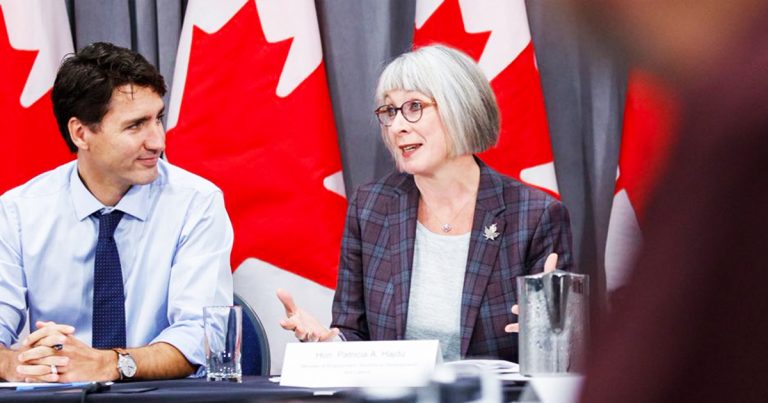
Patty Hajdu claims common expression is “violent language”

Liberal MP Patty Hajdu attempted to have the Speaker force a Conservative MP to apologize after he used the common metaphor “ammunition” in reference to having a strong argument. 

Hajdu claimed that the rhetorical phrase was “violent language” after Conservative MP Rick Perkins said, “Thanks for the ammunition” in the House of Commons

Perkins commented in response to the Liberal House Leader Steven Mackinnon evading questions regarding an ongoing ethics investigation. 

Conservative MP Dane Lloyd was grilling Mackinnon about the “Other Randy” scandal.

The scandal surrounds a potential conflict of interest involving Employment Minister Randy Boissonnault’s business ties to Global Health Imports, a personal protective equipment company he co-founded in 2020.

Leaked text messages revealed that Boissonault may have continued dealing with the company after he took office, a violation of federal law. 

While the name “Randy” was used in the text messages, Boissonnault claims that it does not refer to him.

“I’m not that ‘Randy,’” he said on Wednesday.

“Canadians want to know, ‘Who’s Randy?’ The mysterious Randy is in control of a fraudulent company called Global Health Imports and his business partner Steven Anderson says he’s a public official,” said Lloyd on Friday. 

“And by pure coincidence, the minister of employment by the same name founded Global Health Imports and is a 50% shareholder. Now we just heard the minister say that he’s not involved, but isn’t he at all curious about who this Randy fellow is that’s committing fraud at a company he owns 50% at? Why won’t he tell us who this Randy is?”

Mackinnon responded by saying that Lloyd must have toiled all morning over his witty dialogue, wishing that it would get him noticed by Conservative Leader Pierre Polievere and hoping that it would lead to an exchange that would go viral but did not answer the question regarding the identity of the other Randy.  

“He’s going to put it on Facebook, but what he won’t do is put this answer on Facebook, happily saving me from a thousand trolls online,” said Mackinnon. “But this member should know better, that he has asked those questions which presumes the dishonour of this member.”

This led to a drawn-out reaction from both sides, in which Perkins can be heard saying, “Thanks for the ammo,” as the jeering began to die down.

The comment likely referred to the fact that the clip now presumably would go viral given Mackinnon’s dodging of the question about who “Randy” was.

The Minister of Indigenous Services Patty Hajdu later responded by making a point of order that Perkins’ comment was akin to “violent language.”

“After our house leader answered a question and spoke of troll swarming that occurs online, the member from South Shore – St. Margarets (Perkins) shouted at him, ‘Thank you for the ammo’,” said Hadju.

“This violent language does not help in a climate where there is an 800% increase in threats of violence towards elected officials and I ask that the member apologize and retract his comment,” she added. 

However, House Speaker Anthony Fergus didn’t buy Hadju’s interpretation.

“I have a different interpretation of that statement, of what might have been meant,” said Fergus. “I think we’ll just leave it there.”

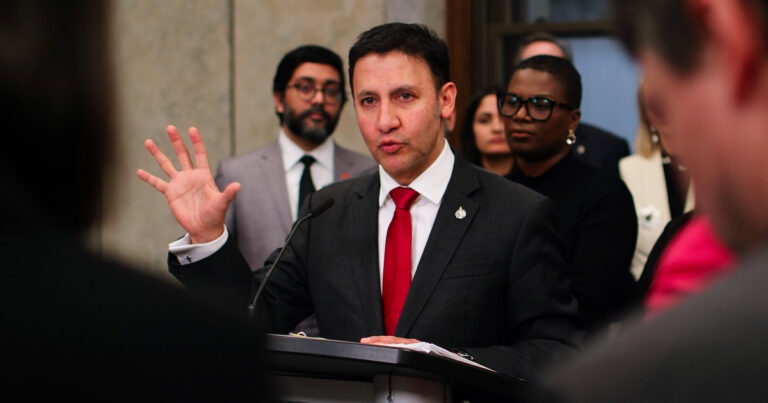
As House debate begins, Liberals defend online harms bill as necessary to fight extremism

The debate surrounding the Liberals’ online hate law ranged from outright rejection of Bill C-63 to a desire to have the bill split into multiple parts.

Parliamentarians began debating Bill C-63, the Online Harms Act, on Friday. The Conservatives called the bill “irremediable,” while other parties wanted the bill reformed.

The Liberal justice minister, Arif Virani, said the bill was a “measured approach” to an “alarming spike in extremism” and a response to a growing number of Canadians who are “pleading for relief from online hate.”

He said the bill was essential to protecting potential victims, such as Amanda Todd, a 15-year-old British Columbia girl who killed herself after being a victim of cyberbullying.

“It enhances free expression by empowering all people to safely participate in online debate,” Virani said. He said the rise of extremism and hate crimes was evidence that “online dangers do not remain online,” and should therefore be regulated.


The Bloc Québécois, NDP and Conservatives agreed that there are aspects of the bill, regarding protecting children from sexual exploitation and revenge pornography online, that are necessary additions to the Criminal Code. But the other parts of the bill require further debate.

Bloc Québécois MP Claude Debellefuille affirmed that the Bloc supports “part one” of the bill, which deals with sexual crimes and exploitation. However, her party has objections to the sections regarding free speech and wants the government to split the bill.

“We think these reservations are reasonable, and we’d like to be able to debate them on the committee,” Debellefuille said. “Perhaps the government could accuse other parties of being partisan on part two (the part dealing with hate speech) but that’s not the case for the Bloc Québécois.”


The NDP said they want an in-depth study of the legislation at a committee hearing, though have indicated that they agree with it in principle.

Conservative MP Michelle Rempel Garner criticized the Liberals for not making “small amendments” to the Criminal Code that could protect Canadians against revenge porn and deep fakes. Instead, they lumped it in with the bill which she called an “onerous and widely panned approach.”

She criticized the liberals for treating all “harms” online as one homogeneous issue which necessitates the same solution and legislation.

“Harms that occur online is an incredibly heterogeneous set of problems requiring a multitude of tailored solutions,” she said.


Rempel Garner warned that the bill would introduce unprecedented measures such as life imprisonment and pre-crime punishments for speech.

The bill would allow peace bonds to be applied to those who are feared within “reasonable grounds” to be in danger of committing future acts of “hate speech” online.

She raised concerns about the bill’s subjective definition of hate speech and how the bill would incentivize and allow Canadians to make anonymous reports against offenders of the new law.

“The subjectivity of defining hate speech will undoubtedly lead to punishment for protected speech,” Rempel Garner said. “The mere threat of human rights complaints will chill large amounts of protected speech, and the system will undoubtedly be deluged with a landslide of vexatious complaints.” 


She argued that the bill lacked provisions which could prevent the new law from punishing Charter-protected speech.

She noted that Canadians don’t fully know the scope and cost of the bureaucracy proposed in the bill, but she has requested that the Parliamentary Budget Officer file a report about how much it would cost the taxpayer.

“C-63 creates a new three-headed yet-to-exist bureaucracy. It leaves much of the actual rules (it) describes to be created and enforced under undefined regulations, to be created by said bureaucracy at some much later date in the future,” she said.

“We can’t wait to take action in many circumstances, as one expert described it to me ‘it’s like vaguely creating an outline and expecting bureaucrats not elected legislators to colour in the picture behind closed doors without any accountability to the Canadian public.’”


Virani said that he was “open to amendments that would strengthen the bill if made in good faith.”

But Conservatives said the bill cannot be improved in a way that would be acceptable to them.

“I’ve laid out in detail why this bill is irremediable, it’s not fixable,” she said “To be clear, Canadians should not be expected to have their right to protected speech chilled or limited in order to be safe online, which is what C-63 asks of them.”

Vancouver drug advocates who handed out free drugs charged with trafficking

A B.C. advocacy group known for handing out free drugs in 2021, faces a legal battle as its founding members has been indicted on charges of drug trafficking

The Vancouver Police Department revealed it had been closely monitoring the Drug Users Liberation Front’s activities, particularly after the group openly distributed controlled substances such as heroin, cocaine, and methamphetamines. 

The move by DULF, intended as a statement for drug policy reform, drew the attention of law enforcement and led to a year-long investigation.

As exclusively reported by True North, former Vancouver City Councillor Jean Swanson joined the group in distributing drugs in front of the Vancouver police’s Downtown Eastside detachment.

The inquiry reached its zenith in October when VPD raided the group’s main office and the homes of its founders, resulting in their arrests. 

The organization had previously come under fire for its financial practices, especially concerning the funding of its “compassion club program.”

This initiative involved acquiring and testing drugs for alleged safe consumption by members, raising questions about the legality and transparency of the funding sources.

Charges against Jeremy Kalicum, 28, and Eris Nyx, 33, were confirmed by the Public Prosecution Service of Canada, with both facing multiple counts related to drug possession for trafficking purposes. 

Their court appearance is set for July. In an interview with True North in July 2021, Nyx denied that the funding for the drugs came from organized crime. 

“We are not sourcing money from organized crime,” said Nyx. “We are trying to do this as above-board as possible.”

The charges have ignited protests and outcry from supporters, who argued that the arrests exacerbated the problem of overdoses rather than solving it. 

A rally in November last year saw speakers decry the war on drugs and demand systemic reforms. 

LAWTON: Irresponsible residential school reporting major cause of distrust in media

In a new column, Peter Menzies underscores the media’s irresponsible handling of the Kamloops Indian Residential School story as a glaring example of why trust in Canada’s legacy media is plummeting, with no signs of recovery. Menzies joined True North’s Andrew Lawton to discuss if trust can be restored, and whether the government should continue to subsidize newsrooms that have lost public support.