Today on the Alberta Roundup with Rachel Emmanuel, Rachel interview the Alberta Director of the Canadian Taxpayer Federation Kris Sims about the Alberta government’s proposal for a highspeed railway to connect the province. Rachel wonder if anyone is asking for this railway plan and how useful it would be. Kris says the Taxpayers Federation is trying to find out more about the cost.
The two also discuss when fuel tax relief and the government’s promised income tax reduction will be implemented.
Finally, Kris reveals the big winners of the Taxpayer Federation’s Teddy Waste Awards.
A House of Commons heritage committee meeting was abruptly halted by Liberal MPs after CBC CEO Catherine Tait refused to disclose her taxpayer-funded performance bonus, sparking a heated exchange with Conservative MP Rachael Thomas.
Tait’s refusal to divulge details about her bonus came under intense scrutiny during Tuesday’s committee session, with Thomas pressing the CBC CEO for transparency regarding executive payoffs.
“As of the end of March of 2024, what is the recommendation for your 2023 bonus?” asked Thomas.
“As I’ve said previously, these conversations are subject to internal deliberations by the management team to the board of directors. We have not had that conversation with the board that is scheduled for June 12 and 13th,” said Tait.
“We will have that conversation, at which point, the final results will have been audited and reviewed by the auditor general, we don’t simply precipitously pre-announce results when we haven’t had the privilege of the auditor and our internal audit process.”
CBC CEO Catherine Tait continues to refuse to tell Canadians what her 2023 executive bonus will be.
CBC itself recently reported that Tait is entitled to $120,000 in bonuses on top of her six-figure salary. pic.twitter.com/NF5OyB3bAX
Thomas then highlighted Tait’s influential role within CBC’s Board of Directors, particularly in discussions concerning executive bonuses.
During the committee session, Tait said Canadian media needs even more “long-term funding” due to an ongoing crisis in the sector.
“Canada’s domestic media industry is facing an unprecedented crisis, with job losses and company closures,” said Tait.
“(We’re) proposing sustainable long-term funding as a potential solution.”
Now CBC CEO Catherine Tait tells MPs at the Commons heritage committee to stop focusing on her bonuses and asks the federal government for "sustainable long-term funding" of the media. pic.twitter.com/XC1xXOQbji
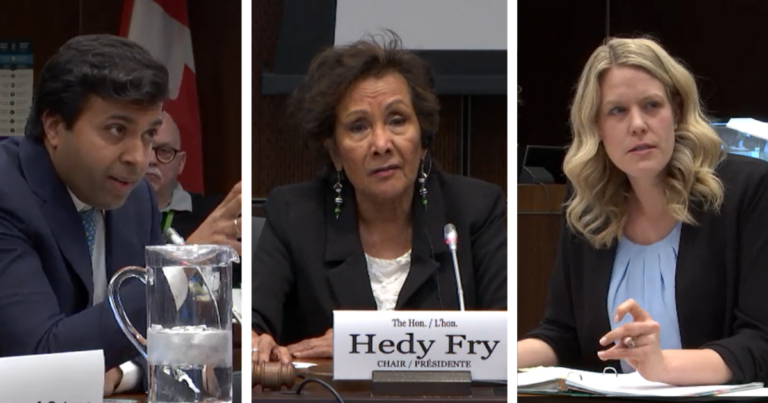
However, as the dialogue intensified, Liberal MP and Committee Chair Hedy Fry abruptly adjourned the meeting following a point of order raised by Liberal MP Taleeb Noormohamed against Thomas.
During the ongoing debate, Fry accused Thomas of a “penchant for arguing with everyone,” leading to a contentious exchange between the MPs.
This is ridiculous. The Liberals just hastily shut down the questioning of CBC CEO Catherine Tait by @RachaelThomasMP on a bogus point of order by @Taleeb.
Chair and Liberal MP @HedyFry even personally insulted Thomas while it was her turn to speak. Unbecoming behaviour. pic.twitter.com/utznmJElmG
“Thomas. You seem to have this penchant for arguing with everyone who makes any suggestion,” alleged Fry.
“You accused me and I’ll use your words of ‘interrupting everyone.’ That’s a superlative, ‘interrupting everyone,’ which is unparliamentary. So Madam Chair, I would bring that to your attention and I would ask you to make a ruling as to whether or not that should be withdrawn,” responded Thomas.
The contentious exchange unfolded against a backdrop of mounting concerns over potential layoffs at the state broadcaster. Recent reports suggested that hundreds of CBC employees nationwide were facing job cuts at the same time executives were awarding themselves generous bonuses.
Conservative MP Philip Lawrence asks CBC CEO Catherine Tait on her to reveal how much she received in bonuses. pic.twitter.com/IGO4t5qWmS
In a statement put out by Conservative leader Pierre Poilievre’s office, Poilievre accused Tait of presiding over the network’s “rock bottom.”
“Under Tait’s leadership, the CBC has also begun cutting even more news programming. The CBC is no longer relevant to Canadians,” the statement reads.
Conservative MP Rachael Thomas accused CBC CEO Catherine Tait of lying for misleading the committee on the timeline for performance pay bonuses for CBC employees. pic.twitter.com/ddksKlkA0a
“The last thing that Catherine Tait deserves is a bonus. She has presided over the CBC’s rock bottom, which resulted in her having to fire 600 of her employees. But this last summer, Tait awarded herself a $60,000 bonus anyway – more than most Canadians see in an entire year.”
In the 2024 federal budget, CBC was awarded an additional $42 million in taxpayer funding, on top of the $1.2 billion it receives each year to offset the layoffs.
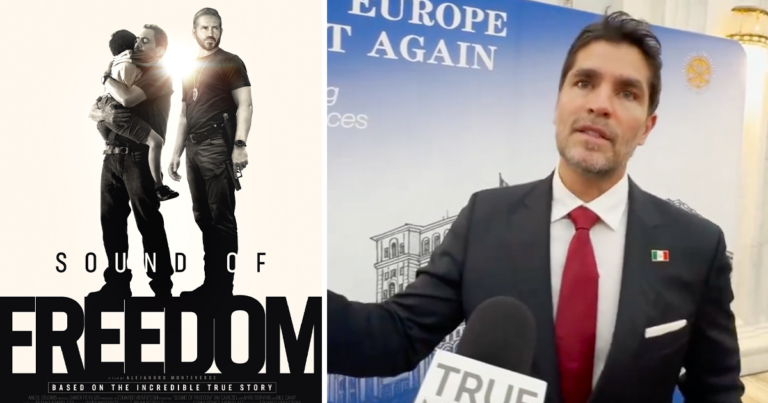
Mexican actor and producer of Sound of Freedom Eduardo Verástegui spoke with True North’s Harrison Faulkner at the Make Europe Great Again Conference in Bucharest, Romania about the issues of child trafficking in Canada and around the world.
Upon the release of Sound of Freedom, CBC movie critics panned the film as a “dog-whistle for xenophobic, pro-life types.”
Verastegui also announces that he plans to make a trip to Canada to speak with political leaders about the cause he is committed to standing up against.
Mandatory breath tests are becoming the norm for policing on Canada’s roads, but are they legally sound? One accomplished criminal defence lawyer told True North that they hold up to scrutiny and are likely here to stay.
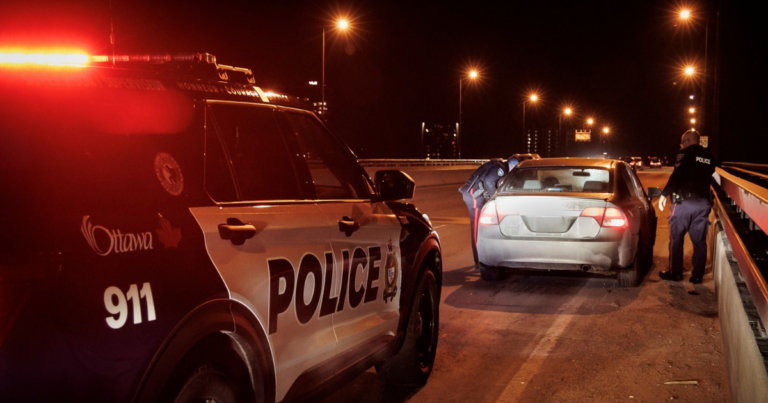
Ottawa was Canada’s most recent jurisdiction to alert drivers that they may be subject to a mandatory breath test, administered with an approved screening device, if they are pulled over, regardless of the reason for the initial stop.
Approved screening devices are commonly referred to as breathalyzers. However, the ASD is a small device that police have on hand to determine grounds for a breathalyzer. It provides the results from a breath sample provided at the scene.
Breathalyzers are larger machines usually found at police stations or inside checkstop vehicles and are used to verify blood alcohol readings for those who have been arrested. Tests with breathalyzers take more time.
“Under Canada’s Mandatory Alcohol Screening law, drivers must comply with a police officer’s demand for a sample, even in the absence of any suspicion that they have consumed alcohol,” said Acting Sergeant Amy Gagnon of the Ottawa Police’s Impaired Countermeasures Unit.
Canada’s Mandatory Alcohol Screening was amended in 2018 to allow police to demand a breath test of any driver, regardless of suspicion.
“Officers are also trained to request drivers to submit to a series of roadside tests if they suspect that the driver is impaired by drugs,” she added.
The potential consequences listed by the Ottawa police for being drunk are the same as refusing to provide a breath sample.
Consequences include having your license suspended for a year, an ignition interlock for one to three years, enrollment in Ottawa’s Back on Track program for rehabilitation, and acquiring a criminal record.
Fines include a $550 penalty, a license reinstatement fee, a minimum fine as part of federal consequences, increased insurance premiums — a minimum of $5,000 a year for at least three years, and legal costs.
The RCMP in Halifax and Saskatchewan previously announced that they would implement mandatory breath tests for all drivers pulled over. The Ontario Provincial Police also did the same.
Each jurisdiction where this rule has been implemented has seen an increase in impaired driving offences. For example, Ontario has seen a 30% increase in impaired driving crashes and charges so far this year. They hope that this measure will bring the numbers down.
Criminal defence lawyer Sean Robichaud said this law is not controversial and is very well settled in the legal sphere.
“What I’m often dealing with as a criminal defence lawyer is explaining to people that you don’t have the right to refuse. You have an obligation to provide a sample to the police when a request is made,” Robichaud told True North in an exclusive interview.
However, Robichaud said that an argument for rights could be made if a police officer made a demand without an approved screening device in their possession. He said police forces are beginning to equip all officers with an approved screening device.
“As far as the Supreme Court of Canada is concerned, it’s minimally intrusive,” he said.
Section 8 of the Canadian Charter of Rights and Freedoms states, “Everyone has the right to be secure against unreasonable search or seizure.” Section 9 states, “Everyone has the right not to be arbitrarily detained or imprisoned.”
While some lawyers have raised Charter concerns surrounding this legislation, Robichaud said it is a “very simple document.”
Although both clauses apply to roadside screenings, Robichaud said that the Charter will provide no defence to civilians as the courts determine how these rights can be applied. He added that the courts up to the Supreme Court of Canada have validated this legislation.
“I don’t see anyone succeeding at the Supreme Court of Canada on challenging that legislation. And if they do, it would cost hundreds of thousands of dollars. So, if you’re sober, I mean, it really takes five minutes,” said Robichaud. Police forces have said it takes even less, with some citing that administering the approved screening device’s breath test will take a mere 90 seconds.
“As much as Canadians may not like it, that’s a legislative change. People don’t get to decide the law; that’s for the legislation to decide. And that’s why we have all sorts of laws that we don’t agree with, but we have to live in a society where we comply with them.”
While Robichaud sees a tenuous chance of someone succeeding in challenging this law as it stands, he said that if some civil libertarians were appointed to the Supreme Court of Canada in the future, it could result in changes.
Until then, the mandatory breath tests administered with roadside approved screening devices are here to stay, with or without cause for suspicion.
EDITOR’S NOTE: This article has been updated to clarify that an ASD and a breathalyzer are two separate devices.
While the Trudeau government claims it is cracking down on the surge of auto thefts across Canada, the problem has been hitting home for the government as well, newly released documents detail.
As many as 48 government vehicles have been stolen from 14 departments and agencies between January 2016 and February 2024, according to documents tabled in the House of Commons on Monday.
Between 2021 and 2023, the official vehicle of the minister of justice has been stolen three times, proving that no one in Canada is immune to this escalating problem.
The majority of vehicles were stolen in Ontario, with 10 being taken in Ottawa and two in the Greater Toronto Area.
Reports of stolen government vehicles were also made in Alberta, British Columbia, Manitoba, Quebec, Saskatchewan and Nunavut.
The government department hit the hardest by auto theft was the RCMP, with 19 of its vehicles stolen over that period, predominantly in the Prairies.
The Parks Canada department was next on the list with seven vehicles stolen, then Agriculture and Agri-Food Canada, which reported four stolen vehicles.
The Canada Border Services Agency and Indigenous Services Canada each reported three vehicles stolen as well.
Other government departments that fell prey to having a vehicle stolen include, the Canadian Revenue Agency, Environment and Climate Change Canada, Employment and Social Development Canada, the Finance Department, Transport Canada and Global Affairs Canada.
According to the documents, of the 48 stolen vehicles, two were stolen twice and 34 have since been recovered.
Police data compiled by the Equite Association in February found that over 70,000 vehicles were stolen last year in Canada. According to the report, between 2021 and 2023, stolen vehicles increased by 48% in Ontario, 58% in Quebec and 34% in Atlantic Canada.
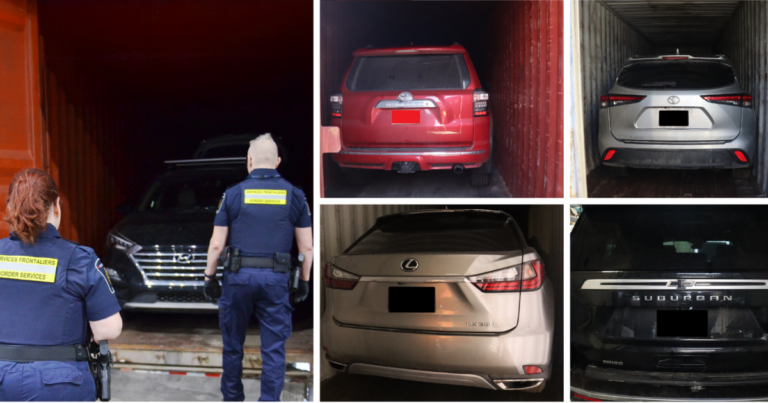
Around one-third of all stolen vehicles are then resold within Canada, however the majority are ferried out of the country via organized crime syndicates in shipping containers often bound for Africa and the Middle East.
Investigators who are part of a multi-jurisdictional investigation into Canada’s auto theft crisis announced the recovery of 598 stolen vehicles last month since their investigation was launched in December 2023.
“In Canada, a vehicle is stolen every five minutes,” said Bryan Gast, vice president of investigative services for Équité Association at the press conference in Montreal. “Auto theft has reached crisis levels in Canada.”
Auto theft claims have skyrocketed since 2020, up 319% nationally, which prompted the Ontario Provincial Police’s Auto Theft and Towing team to partner up with the Canada Border Service Agency to recover vehicles and intercept them before they’re illegally exported out of the country.
The ongoing investigation, which has been billed “Project Vector,” is being carried out in collaboration with the Sûreté du Quèbec, Montreal Police, and the Équité Association.
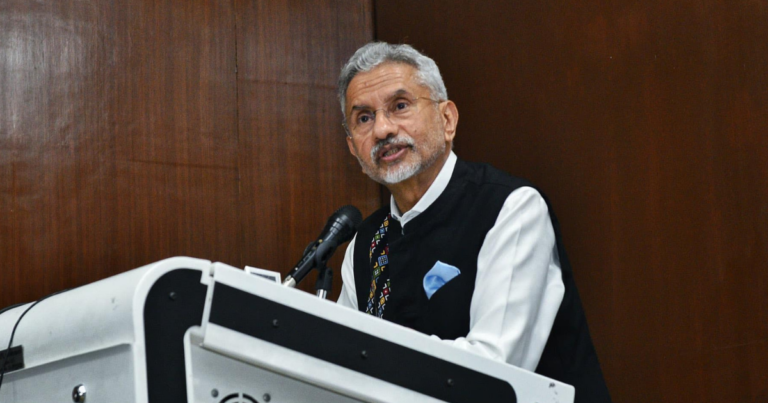
India’s Foreign Affairs Minister accused Ottawa of welcoming in criminals from India in the wake of the RCMP arresting three Indian nationals believed to be involved in the murder of Sikh activist Hardeep Singh Nijjar.
Subrahmanyam Jaishankar also called Canada the primary driver of what he described to be a violent movement of Sikhs seeking to carve their own country within India.
Sikh separatists refer to this desired state as Khalistan.
“It’s not so much a problem in the U.S.; our biggest problem right now is in Canada,” said Jaishankar at a forum for intellectuals in Bhubaneswar, India on Saturday.
The day before, RCMP charged three men in connection with the murder of Nijjar, who was assassinated outside a Sikh temple in Surrey, B.C. last June.
Nijjar was an outspoken Khalistani activist and his murder launched a major diplomatic fallout between Canada and India.
Prime Minister Justin Trudeau accused New Delhi of orchestrating Nijjar’s assassination in the House of Commons last September, further escalating tensions between the two nations.
Domestic protests against the Indian government were spurred on by the alleged assassination as well as investigations into murders of Sikh activists involving the U.S. authorities and the Federal Bureau of Investigation.
Jaishankar was asked during Saturday’s forum if countries like Canada and the U.S. should be allowed to continue partnering with India while also allowing people to support the Sikh separatist movement, a stance the Indian government has deemed to be unconstitutional.
He responded by saying that the federal Liberals and other unspecified political parties “pander” to Sikh separatists for votes and have granted “these kinds of extremism, separatism, advocates of violence a certain legitimacy in the name of free speech.”
A protest against Indian Prime Minister Narendra Modi’s government last year included posters calling for people to “kill India” and offering financial rewards for information on the home addresses of Indian officials.
Jaishankar said he addressed these concerns with Foreign Affairs Minister Melanie Joly, according to CTV News.
“I tell the foreign minister (Joly) saying, ‘Suppose it happened to you. if it was your diplomat, your embassy, your flag, how would you react?’ So, we have to keep our position strong,” said Jaishankar .
“Somebody may have been arrested; the police may have done some investigation. But the fact is (a) number of gangland people, (a) number of people with organized crime links from Punjab, have been made welcome in Canada,” he said, referencing the Indian region the Khalistan movement wants to take over.
The Trudeau government has insisted that India has not provided any evidence of their claims that Sikh separatists are involved in terrorism that would meet the threshold necessary to press charges under Canada’s criminal code.
“These are wanted criminals from India; you have given them visas and yet you allow them to live there,” Jaishankar added. “It’s no longer a world which runs as a one-way street. There will be a reaction; others will take steps or counter it.”
Calgary City Council voted 12-3 on Tuesday to repeal a bylaw mandating businesses to charge for single-use items and bags, responding to strong public backlash and concerns about its effectiveness and necessity.
The controversial bylaw, first enacted on Jan. 16, had required retailers to impose a minimum bag fee and offer single-use items only upon request. The fees were $0.15 per paper shopping bag and $1 per reusable shopping bag, which was set to increase to $0.25 and $2 on Jan. 16, 2025.
On top of minimum fees, shopping bags and foodware accessories were to be provided by request only.
The fees will end immediately.
However, despite repealing the bylaw, city councillors will work on new recommendations for a new single-use bylaw to curb the waste going into Calgary landfills.
11 Councillors and Mayor Jyoti Gondek voted in favour of repealing the single-use items charter bylaw. Only councillors Walcott, Penner, and Carra voted against it.
“Calgarians spoke loud and clear; they don’t support the bylaw. They’re not convinced, and neither am I, that this bylaw is actually accomplishing what it was designed to do,” said Councillor Sonya Sharp.
“People are getting really tired of politicians and ‘experts’ telling the uneducated masses what to do, that we know best. And if you don’t like it, well, that’s just too bad. We know the vast majority of Calgarians do not like the single-use items bylaw for many reasons. They think it’s overreaching. They think it’s ridiculous,” said McLean.
Alberta Premier Danielle Smith had previously said she did not support the single-use item bylaw.
“I’m not supportive of the decisions in both Calgary and Edmonton, but I’ve put it to my Minister of Municipal Affairs to see if they’ve gone outside the realm of the (Municipal Government Act),” said Smith. “I think there’s a little bit of ideology getting ahead of common sense here.”
Alberta’s provincial government recently passed Bill 20, which allows them to repeal or amend municipal bylaws.
Smith said that in “rare circumstances,” the province needs to review municipal decisions that may be unconstitutional or fall outside of a municipality’s control.
Smith used the example of Calgary recently trying to pass a motion that extends voting to non-citizens. “That is simply not appropriate nor within their authority,” she said.
While previously ordering Alberta’s Minister of Municipal Affairs, Ric McIver, to investigate the legality of the single-use item bylaws, Smith has not said whether she will repeal them.
Vancouver similarly had a single-use cup fee that they repealed in June 2023. City councillors argued that it failed to accomplish its objectives and simply cost the taxpayers more.
According to the city of Calgary, even with the bylaw being repealed, it does not mean that businesses will be able to use plastic bags, cutlery, or straws as these items still fall under the Government of Canada’s Single-use Plastics Prohibition Regulations.
“The regulations ban the manufacture of plastic shopping bags, plastic straws, stir sticks, utensils, foam cups, and other types of plastics that are difficult to recycle,” said the city.
The Federal Court overturned Ottawa’s ban on single-use plastics back in November.
The city said the ruling has raised questions about the federal single-use prohibition, but the regulations remain in effect.
Several Canadian politicians have spoken out about the radical anti-Israel encampments occupying the country’s university campuses.
Encampments have been set up at several post-secondary institutions, including McGill University, the University of Toronto, the University of Ottawa, the University of British Columbia and the University of Victoria. Student activists want their respective schools to “divest” from companies with ties to Israel.
The protests are inspired by similar protests by far-left students at Ivy League colleges in the United States like Columbia. Both Canadian and American campuses have been home to chaotic and antisemitic scenes, as well as hateful messages.
The hateful language used to describe this Jewish professor has no place on a university campus.
“We need to remove those people … these universities have to make a move,” said Ford. He said events have occurred on the encampments that he deems “disturbing” and “unacceptable.”
“I can’t stand some of the nasty stuff I’ve been seeing out there,” Ford noted.
“The hatred I have seen at these protests. I’ve never seen before in my entire 60 years, not quite, 59 years, of living here in Toronto.”
The premier also said that those who have a hateful ideology should not move to Ontario. “You want to be here in Ontario, you live in peace and love,” he said. “You don’t come to Ontario, no matter what culture you are, and stir things up. It’s as simple as that.”
Quebec Premier Francois Legault:
Source: Facebook
Quebec Premier Francois Legault denounced the encampments last week, calling them illegal and asking police to clear them out. As of Tuesday, the encampment at McGill remains in place.
“There are all kinds of very legal ways to demonstrate,” but “to set up an encampment on the grounds of a university that doesn’t want that encampment, that’s illegal,” said Legault.
He added that he “counts on the police to dismantle in the way they think is best, and then at the time they think is best.”
Prime Minister Justin Trudeau:
Prime Minister Justin Trudeau recently addressed the encampments during a media event. He said that post-secondary institutions are places of learning and that “we have to trust” universities to deal with the encampments and to ensure that “everyone is safe.”
“I think we have to remember what universities are. Universities are places of learning,” said Trudeau. “Universities are places where freedom of speech, the freedom of ideas, the challenge of debate, of dialogue, of discussion about how to shape the world, how to see the world … are a core part of what campuses are all about.”
“At the same time, we need to make sure that as part of that everyone can feel safe on campus, whether you’re a Jewish student, whether you’re Palestinian, whether you have strong feelings on one side or the other,” he added. “And, on that we have to trust both universities to manage their campuses right, and local police of jurisdiction to do their work to make sure that everyone is safe.”
Trudeau had also previously denounced the targeting of Jewish students on campuses.
Very pleased to see the clear statement by @JustinTrudeau making clear how Jewish students are feeling at McGill & other campuses. Je suis très heureux de voir la déclaration claire de PM sur comment les étudiants juifs se sentent à McGill et sur d’autres campus. pic.twitter.com/J1mCyEccKc
In a statement to True North, Pierre Poilievre spokesperson Sebastian Skamski said he and the Conservatives denounce the “glorification of terrorism and antisemitism” on campuses and said students deserve to feel safe.
“Common sense Conservatives denounce unequivocally the glorification of terrorism and antisemitism in our streets and on our campuses,” said Skamski, who went on to describe Hamas as “a terrorist death cult bent on destroying the Jewish people, using Palestinian citizens as human shields.”
Canadians have a right to demonstrate in this country peacefully and lawfully. It is not a right to harass, intimidate, or restrict access to students and faculty at our universities. The law must be enforced when laws are broken,” Skamski added.
“Canadians deserve to feel safe in their communities and on their campuses.”
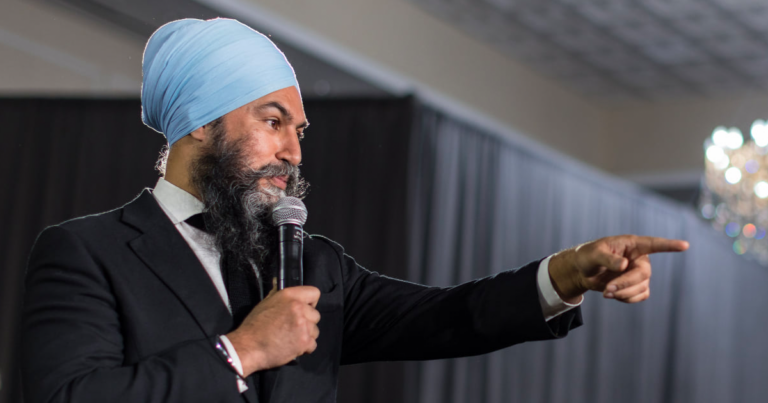
NDP Leader Jagmeet Singh:
Jagmeet Singh spoke out in favour of the encampments, calling the protesters “anti-war advocates” and denouncing the removal of encampments on American campuses.
I stand in solidarity with students and anti-war advocates.
What is happening in the US right now is very dangerous and alarming.
In Canada, I want students to know this:
It is your right to peacefully protest – and I will defend that.
“I stand in solidarity with students and anti-war advocates,” said Singh on X (formerly Twitter). “What is happening in the US right now is very dangerous and alarming.”
“In Canada, I want students to know this. It is your right to peacefully protest, and I will defend that,” he added. “New Democrats will continue to stand for peace and justice, for protection of your Charter rights and for ensuring every student feels safe and welcome on campus.”
Liberal MP Anthony Housefather:
Source: Facebook
Prominent Jewish Liberal MP Anthony Housefather has denounced the radical encampments on numerous occasions.
“Encampments are a violation of university policy,” wrote Housefather in a Apr. 27 X (formerly Twitter) post. “I call upon university administrators, police (and if needed provincial governments) to act. We can’t allow what is happening in the US to happen here.”
Regarding the McGill encampment, Housefather also said he is “hopeful the skillful (Montreal) police will work with the administration to resolve the situation ensuring everyone’s security and well being.”
British Columbia Post-Secondary Education Minister Lisa Beare:
Source: Facebook
The NDP minister in charge of BC universities commented on the encampments that have occupied the provinces’ universities, noting that she expects schools to find a “balance” between letting students protest and ensuring students feel safe.
“Universities, colleges and institutes across the province do have the policies in place to allow for a peaceful protest, while also ensuring everyone on campus is safe and I expect all the institutes to find that balance,” Lisa Beare said.
NDP leader Jagmeet Singh is being called out for a slew of misleading social media posts alleging Conservative leader Pierre Poilievre was trying to block women’s right regarding access to contraceptives.
Plus, the feds announced it would approve the B.C. government’s request to recriminalize the use of illicit drugs in public spaces.
And a Toronto Police Service superintendent pleads guilty to helping Black officers to cheat on their promotions exam.
Tune into The Daily Brief with Cosmin Dzsurdzsa and Lindsay Shepherd!
British Columbia spends more on the healthcare and education sectors than on any other sectors, yet performance in the two areas has decreased, according to data revealed in a Fraser Institute study.
According to the authors of the study, Ben Eisen and Milagros Palacios, healthcare accounts for 38% of B.C.’s provincial expenditures. Per-person spending has increased by 13.9% between 2016/17 and 2023/24.
Despite this, the median wait times have increased between 2017 and 2023, from 26.6 weeks to 27.7 weeks.
Despite the national average increasing, access to health care providers also worsened in B.C. In 2015/16, 83.4% of British Columbians had regular access to a healthcare provider, compared to the national average of 83.6%. In 2019/20, however, this percentage decreased to 81.7% in B.C., while the national average improved to 85.6%.
The second highest area of public spending in B.C. is K-12 education. Between 2016/17 and 2020/21, spending per student increased by 12.9% in B.C., marking the second largest increase in Canada behind only Quebec.
“B.C. once led the country in province-wide standardized testing and demonstrated strong performance. However, in 2018, the province started to replace a mandatory exam based on course content in Grade 10 Math and English linked to graduation with broader low-stakes assessments in these topics,” read the study.
The Programme for International Student Assessment administers a worldwide assessment for 15-year-olds across various learning domains.
PISA equates a 20-point drop to a year of lost learning. Since 2015, British Columbia’s student scores have dropped at least 20 points in all three categories — reading, math, and science.
Despite spending more than any other English-speaking province, throwing money at the problem has not made B.C. immune to student performance and healthcare decaying.
“This proves that throwing more tax dollars at a problem isn’t the solution,” said federal director of the Canadian Taxpayers Federation, Franco Terrazzano. “Governments need to reform health care and education systems instead of taking more money from taxpayers.”
While the province’s spending hasn’t yielded fruitful results in healthcare or education, their public sector has flourished, potentially at the expense of the private sector.
Government sector job growth in British Columbia has greatly improved, while private sector job growth has remained stagnant. Using the most recent data, government employment in B.C. increased 29.6% between 2018 and December 2023. Meanwhile, private-sector employment has grown by only 5.8%.
Total private sector jobs as a share of the population over 15 years old has fallen by 2.4%, the largest decline in Canada.