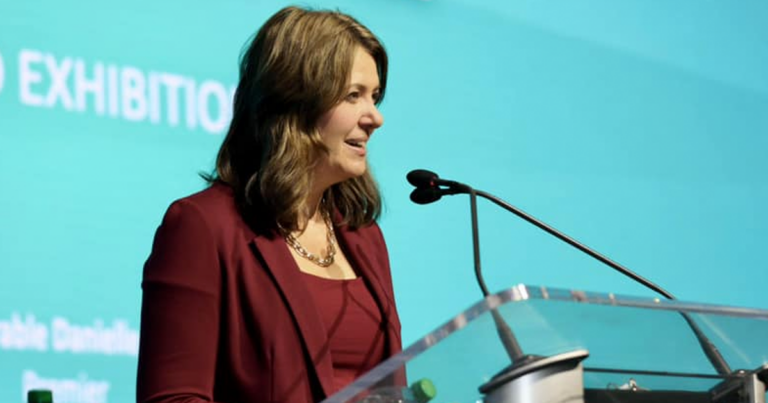
United Conservative Party members will have an opportunity to oust Alberta Premier Danielle Smith at the party’s upcoming annual meeting. Do you think Smith deserves to stay on as leader?
Plus, the Alberta government is launching a nationwide advertising campaign to warn Canadians about the consequences of a federal cap on the oil and gas sector.
And the federal pharmacare plan, which will cost taxpayers billions annually, could overlap with existing provincial offerings.
These stories and more on The Alberta Roundup with Isaac Lamoureux!
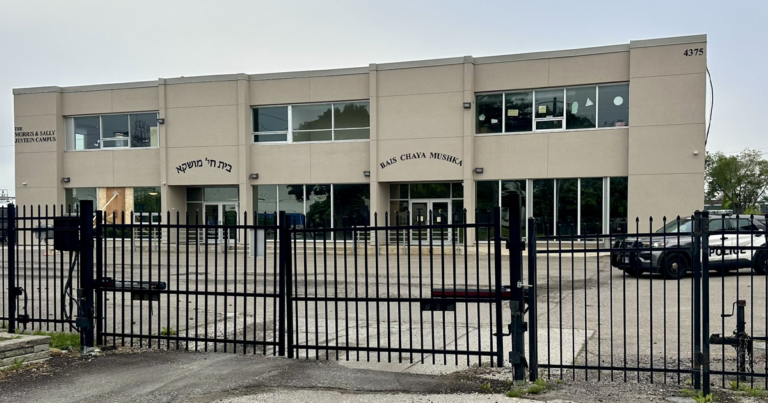
The Toronto Police Services announced it had arrested a man and youth in connection with a firearm discharge targeting a Jewish girl’s elementary school for the second time.
A TPS report said that police found 14 shell casings at Bais Chaya Mushka school, and no one was injured.
“Our Forensic Identification Services, in collaboration with the Centre for Forensic Sciences, and the ministry of the Solicitor General, played a critical role in this investigation,” Deputy Chief Robert Johnson said at TPS headquarters Friday. “Their meticulous examination of the evidence was key in identifying and charging the individuals involved.”
Deputy Chief Johnson of the Toronto Police announces the arrest of two individuals connected to the October 12th shooting of the Jewish school in Toronto, Bais Chaya Mushka Elementary. pic.twitter.com/9HE8oE2MD7
The incident occurred on Yom Kippur, on Oct. 12, a solemn day during the Jewish High Holidays.
“Nearly a week ago, (around 4 am) police were alerted to a smashed window at a school,” the report said. “Upon arrival, they discovered evidence of gunfire, determining that shots were fired from a vehicle on Chesswood Drive, striking the window.”
Johnson said that since this incident, the Integrated Gun and Gang Task Force, led by Inspector Paul Tkachuk, supported by the Hate Crime Unit, led by Inspector Roger de Roche, has been “working tirelessly to identify those responsible.”
Police charged Helder Antonio De Ameida, 20 with 11 alleged firearms offences and a 17-year-old male youth with firearm offences, property obtained by crime and failing to comply with release orders.
The male youth’s identity is protected under the Youth Criminal Justice Act. Johnson said he could not reveal the nature of the previous incident that led to the youth allegedly failing to comply with release orders.
“Both males, face multiple charges, including unauthorized possession of a loaded firearm, a Glock handgun modified to be fully automatic,” Johnson said.
He said it’s unclear at the moment whether both suspects discharged firearms at the scene.
No hate crime charges have been laid at this point in the investigation.
“While I can’t share details on the motivation behind this incident due to the ongoing investigation, we are thoroughly exploring why these two individuals committed these crimes and any connection to the previous shootings at this school on May 25,” Johnson said. “I can assure you that if we find evidence that this is motivated by hate, we will explore the aggravating nature of this with our partners in the ministry.”
The first firearm discharge incident happened at Bais Chaya Mushka school in May, though the incident is still under investigation.
Johnson told reporters that the fact that the shootings occurred at the same address was the only obvious connection he was able to comment on at the time and that the school was targeted twice and that this time it was on Yom Kippur made it “even more devastating.”
“The safety of our community remains our top priority, particularly as global tensions rise and the Jewish community observes the High Holidays,” said Johnson. :The safety of the Jewish community and all communities in Toronto remains our top priority. Our increased police presence will continue as long as necessary.”
Chief Myron Demkiw, who is in Boston at the International Association of Police Chiefs conference, reiterated that investigations are ongoing and charges can be laid at any time, whether immediately after the incident or in the days and weeks that follow.
Demkiw vowed to increase police presence in Jewish neighbourhoods earlier this month as the one-year marking of the Oct. 7 Hamas-led terrorist attack approached.
Johnson noted that police have relocated a mobile command post to the school’s neighbourhood and are in “constant communication” with Jewish school administration, parents, and various groups to “help alleviate” safety concerns felt by the community.
“Since Oct. 7 (2023), we’ve arrested 167 people and laid about 411 charges. And so this is something that is problematic,” Johnson said. “This rise since October 7 is something that we had not anticipated or planned for, and it is a problem.”
A significant number of Vancouver residents blame immigration for housing unaffordability in British Columbia’s largest metropolitan area.
In a recent survey conducted by Research Co. that garnered insights from 700 adults between October 10 and October 14, 2024, 41% of participants said they view immigration as a significant factor in the region’s housing shortage.
This perspective is most prevalent in areas such as Surrey and White Rock, where 38% of respondents link the crisis directly to immigration levels.
Over half (52%) of people living in Metro Vancouver reported housing as a key issue. Housing was followed by crime and the economy (both 19%) and the environment (4%).
“Most Metro Vancouverites aged 35-to-54 (57%) and aged 55 and over (58%) look at housing as the biggest municipal challenge,” said Research Co. president Mario Canseco in a press release.
“Those aged 18-to-34 are worried about both housing (39%) and the economy and jobs (30%).”
Greater Vancouver Area residents also want governments to pursue any available avenues to fix the problem.
Approximately 28% of those surveyed support government-led initiatives to construct new housing, while 20% are in favour of rezoning measures to enable further development.
Economic factors, including interest rates and bank policies, are also considered influential by 18% of respondents, with tackling foreign investment speculation noted as a priority by 17%.
The survey highlights a sense of urgency among Metro Vancouver residents, with 52% citing the housing crisis as the most pressing municipal issue, especially in the North Shore, Burnaby, New Westminster, and the Tri-Cities.
As for accountability, the federal government is deemed most responsible by 44% of those surveyed, followed by the provincial (33%) and municipal governments (6%).
The data suggests that opinions on the crisis and its solutions are shaped by age and geographic location, with older residents and those living in the North Shore expressing greater dissatisfaction with the federal government’s approach to managing the situation.
Canadians are being forced to make “difficult sacrifices” due to high living costs to make ends meet.
As inflation continues to weigh heavily on households, more than half of Canadians are adjusting their spending habits to make ends meet, with many resorting to sharing expenses and cutting back on essentials.
According to the latest MNP Consumer Debt Index, 28% of Canadians have resorted to eating less to save money.
Almost one-third of Canadians have turned to bill-splitting techniques like carpooling, buying in bulk, sharing subscriptions and childcare, and living with others.
“These measures reflect the harsh reality of soaring living costs, compelling Canadians to find new ways to save,” said Grant Bazian, president of MNP Ltd. “It’s particularly concerning that nearly three in ten report cutting back on food to make ends meet.”
The majority of Canadians have cut back on discretionary spending.
Over half (51%) of Canadians have tried to save money by grocery shopping more strategically, while 48% are actively trying to avoid impulse purchases. Additionally, 44% of Canadians said they have stopped going to restaurants or ordering takeout.
These cost-saving measures are more common among Canadians aged 18 to 34 years old and those living in Alberta and British Columbia.
Cohabitation is also most common among younger Canadians, with British Columbians and low-income Canadians being the most affected. 13% said they were living with friends, partners, or family members or seeking additional roommates to save money.
“We’re witnessing a bill-splitting boom as Canadians adapt to the high cost of living,” Bazian noted.
He emphasized that the cost-saving strategies showcase resourcefulness and highlight the severe financial pressures many face.
Despite the cutbacks and sacrifices Canadians are making, the report highlighted that the recent decline in interest rates has seen some report relief and improvements in their financial situations.
Canada’s inflation rate rose at its slowest pace in over three and a half years in September, reaching 1.6%.
However, rent and food prices have continued to outpace overall inflation, rising by 21% and 20.7%, respectively, between Sep. 2021 and 2024. Overall inflation has risen 12.7% during the three years.
The Bank of Canada has already cut interest rates three times this year. Economists have predicted a 50 basis points rate cut on Oct. 23 following the inflationary decrease.
MNP’s report highlighted that more than 40% of Canadians say they are $200 or less away from financial insolvency, the lowest proportion since Sep. 2018.
The MNP Consumer Debt Index survey was conducted by Ipsos between Sept. 6 and Sept. 11, 2024, and polled 2,000 Canadians aged 18 and over.
Alberta’s Minister of Municipal Affairs Ric McIver announced the latest proposed regulations for Bill 20, the Municipal Affairs Statutes Amendment Act, set to take effect on Oct. 31, almost a year ahead of the 2025 municipal elections.
The Act, tabled during the spring 2024 legislative session, permits local political parties, sets campaign expense limits, expands special ballot use, and bans electronic tabulators. Rules and processes for scrutineers are clarified in the Act, and municipalities can require criminal checks for local candidates.
“My ministry has been hard at work over the summer consulting and developing these regulations. We’ve been consulting with municipalities and stakeholders on the regulations in the bill, including Alberta municipalities, rural municipalities of Alberta, and mid-size city mayors,” said McIver. “I believe that municipalities will see much of their feedback reflected in these regulations.”
However, McIver later clarified that while his government will take feedback from everybody, the changes aren’t intended for people getting elected but for the five million Albertans voting who want more accountable and transparent elections. He added that the changes aim to help voters make more informed decisions.
Local political parties will be first tested in the Oct. 2025 municipal elections in Calgary and Edmonton. Candidates will also be able to register in slates. Neither parties nor slates can be formally affiliated with provincial or federal political parties, nor can they receive donations from such parties. They cannot have names or acronyms that resemble such parties.
While political parties will only be able to register in Edmonton and Calgary for the 2025 municipal elections, the provincial government will review the process and determine whether it should be extended to other municipalities or terminated.
Local candidates are not required to join political parties or slates to run for office.
Candidates can register as either slates or local parties. Local parties must have 1,000 members and field candidates in at least one-third of the municipality’s seats.
“We want political parties, if and when they form, to be legitimate and do the work of engaging their communities on local issues,” said McIver.
Therefore, to run in Calgary or Edmonton, with 15 and 13 seats, respectively, a local political party would need to have candidates run in at least five wards.
Alberta Premier Danielle Smith previously defended Bill 20, saying it could stop non-citizens from voting.
The new regulations establish campaign expense limits tied to municipal populations. Mayoral candidates can spend $1 per person based on the population of their municipality, while councillor candidates’ limits are the same but based on average ward populations.
McIver noted that there will be a minimum baseline amount of $20,000 for campaigns in municipalities with less than 20,000 residents.
“We are using the local population as our guiding principle for expense limits, tying them to municipal populations so they automatically adjust as the population changes over time,” McIver said.
Third-party advertisers face a $0.50 per-person cap, while local parties can spend $1 per person in each ward based on the average population of all wards in the municipality for each ward the party has candidates running in.
In non-election years, the limits are $0.50 per person or $10,000, whichever is greater. However, candidates and local political parties cannot incur expenses during the two subsequent years after an election year. Operational expenses for local political parties, like office maintenance and staff salaries, will still be permitted during this “cooling-off period.”
“The overall purpose of the expense limits regulation is to ensure elected officials focus on governance and keep the campaign activities focused on the year leading up to and the year of an election,” McIver stated.
Because Bill 20 prohibits using automated voting equipment, including electronic tabulators, in local elections, votes will be hand-counted.
McIver cited a Leger poll, which showed that over one-third of Albertans oppose using electronic tabulators. Some legacy media attacked him, suggesting the poll proves that two-thirds of Albertans did support them; however, this is not true. Based on the same poll, only 36% of Albertans supported using them, 1% more than the 35% opposed.
“What’s most important is that the day after the election, that hopefully as close to 100% of Albertans as possible respect and trust the results that are reported and consequently respect the people put in place to make decisions on their behalf,” said McIver. “That’s pretty important to our democracy.”
Bill 20’s regulations will take effect on Oct. 31, 2024, with property tax provisions effective Jan. 1, 2025. The next municipal elections in Alberta are set for Oct. 20, 2025.
A video posted to social media appears to show a BC NDP supporter vandalizing a British Columbia Conservative Party campaign office window in Vancouver a day before the provincial election.
The executive director of the BC Conservatives, Angelo Isidorou, shared a video on X Friday morning of him confronting an unidentified man appearing to deface a poster of BC Conservative leader John Rustad at one of his candidate’s campaign offices in Vancouver.
Caught a BC NDP supporter vandalizing private property.
Not only does he admit to it when I caught him, but he proudly wears a David Eby pin.
Everyone is entitled to their opinion, but damaging property is totally unacceptable and illegal.
Isidorou told True North that the campaign office had been repeatedly targeted with incidents of vandalism, with costs for repairs and cleanup reaching thousands of dollars.
BC Conservative press secretary Shon Amayev told True North that BC NDP supporters “have repeatedly engaged in illegally defacing” signs.
“Throughout this entire campaign, we have witnessed a consistent pattern of egregious behaviour from BC NDP supporters. They have repeatedly engaged in illegally defacing our signage, demonstrating a blatant disregard for democratic norms and civic responsibility,” said Amayev. “This is not just poor sportsmanship – it’s a direct assault on fair principles that should underpin any democratic process.”
The incident occurred at the MLA candidate for Vancouver–South Granville, Aron Lageri’s office at 2160 West Broadway in Vancouver.
“Caught a BC NDP supporter vandalizing private property. Not only does he admit to it when I caught him, but he proudly wears a David Eby pin,” Isidouro said in the post. “Everyone is entitled to their opinion, but damaging property is unacceptable and illegal.”
The video starts with Isidorou honking at a grey-haired man in a black trenchcoat and hat who appears to be writing on a picture of Rustad’s face on the window of the campaign office.
“Stop vandalizing windows,” Isidorou told the man. “You’re entitled to your opinion but you can’t vandalize windows. This is private property. I have you on camera vandalizing windows.”
The man evades Isidorou at first but then approaches his vehicle.
“Well, I will face the consequences, unlike people who deny climate change,” the man said.
Isidorou told True North that a police report had been filed about the incident this morning.
Neither the Vancouver Police Department nor the BC NDP were immediately available for comment. Currently, the VPD has not iwhether the incident is being investigated or if charges have been pressed.
The BC NDP campaign manager, Marie Della Mattia, posted in the comments denouncing the act of vandalism.
The incident occurred just one day before polls were open to the general public in the BC provincial election, Though early voting has already passed.
As reported by the Canadian Press, Elections BC said more than a million B.C. residents have already cast their ballot in advanced polls, which ended Wednesday, “smashing” a record set four years ago in a pandemic election.
Elections BC said 1,001,331 people have voted, representing 28% of registered voters in the province. It said BC was on track for the biggest overall voter turnout in its election history.
A week prior, Chip Wilson’s property was the target of a slew of vandalism incidents after the founder of the multi-billion dollar flatware company Lululemon placed anti-NDP signs on his property.
Though weeks ago, the BC Conservatives pulled ahead of the BC NDP in provincial polls, a recent Leger 360 poll conducted on October 14 and 15 shows the NDP have regained a narrow four-point lead over the BC Conservatives.
The poll asked a statistically weighted sample of 1,017 adults in B.C. about their voting intentions for the upcoming election.
Though no margin of error can be associated with a non-probability sample, Leger 360 states that a probability sample of that size would have a margin of error of over or under 3.1%, 19 times out of 20.
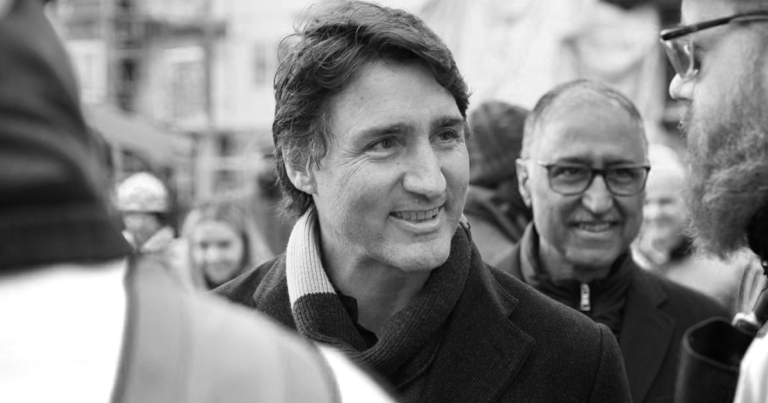
Are we witnessing the end of days for the Trudeau government? It certainly seems that way with cabinet ministers announcing they won’t be running again and reports indicating that Liberal MPs plan to call on Prime Minister Justin Trudeau to step down at their next caucus meeting. Despite Trudeau clinging onto the carbon tax, this punitive tax is one of the reasons the Liberals are so unpopular right now.
Plus, Trudeau claimed that former and current Conservative officials are implicated in foreign interference. But Pierre Poilievre says Trudeau is “lying.” Who’s telling the truth? Why won’t Trudeau just release the names of the alleged traitors?
And is Alberta Premier Danielle Smith’s leadership at risk? United Conservative Party members will have an opportunity to oust Smith at the party’s upcoming annual meeting.
These stories and more on Off the Record with guest host Kris Sims, Rachel Parker and Noah Jarvis!
The federal budget watchdog estimates that the Liberal government’s deficit will reach a whopping $46.8 billion this year.
“Based on our analysis, the government will not meet its fiscal commitment to keep the deficit below $40 billion in 2023-24,” said Parliamentary Budget Officer Yves Giroux in his latest Economic and Fiscal Outlook report.
However, it won’t be until Giroux publishes the PBO’s annual public accounts report later this fall that the government’s deficit will be fully accounted for.
Finance Minister Chrystia Freeland vowed to keep the deficit capped below $40 billion last year, stating in her spring budget that the government was on track to keep their promise.
“As bad as the budget was, the independent budget watchdog is showing federal finances are in even worse shape,” said Franco Terrazzano, federal director of the Canadian Taxpayers Federation in a statement.
“The Trudeau government continues to mismanage our finances and that means more money wasted on interest charges, higher taxes and more debt that Canadians’ kids and grandkids have to pay back.”
After seeing an increase from Budget 2024’s deficit of $39.8 billion, the CTF is calling on the federal government to “immediately cut spending” now that the deficit is already $6.6 billion over budget.
“The government must cut spending,” said Terrazzano.
Freeland’s pledge to keep the budget under $40 billion was part of an effort to detract from the narrative that the government was overspending, which is at odds with the Bank of Canada’s quantitative tightening practices to reduce inflation.
“Compared to our March 2024 outlook, we project budgetary deficits that are $4.1 billion higher, on average, over 2023-24 to 2028-29,” reads the report. “This increase is largely due to new spending measures announced by the Government.”
A spokesperson for Freeland released a statement on Thursday following the news of the financial spillover, however, she failed to acknowledge whether further increases would continue.
“Our federal government is making historic investments in the priorities of Canadians — in housing, affordability, and economic growth — and we are doing this in (a) fiscally responsible way,” said Katherine Cuplinskas on Thursday.
The PBO report estimates that if no further measures are announced, the federal deficit may decrease slightly to $46.4 billion for the 2024-25 fiscal year.
However, the PBO noted that economic growth will likely remain tepid through 2024 before potentially rebounding next year as Canada’s central bank cuts interest rates to stimulate spending and investment.
“PBO projects growth in the Canadian economy to remain tepid in 2024. Interest rates will continue to restrain growth in consumer spending and business investment,” reads the report.
“We expect real GDP growth will rebound to 2.2 per cent in 2025, as lower borrowing costs provide a boost to consumer spending and business investment, and exports pickup.”
Additionally, it estimates a steep decline in the temporary resident population as a result of the federal government’s recent policy changes but still believes it will fall short of its 5% of the population target.
According to Statistics Canada, there were around three million non-permanent residents in Canada as of July 1, which represented about 7.2% of the population.
The PBO report also forecasts that the Bank of Canada will continue cutting interest rates until its policy rate reaches 2.75% in the second quarter of next year.
The central bank’s next rate announcement is scheduled for Wednesday.
The PBO noted that taxpayers will be on the hook for paying $52.8 billion in interest on the deficit this year and nearly 11% of the government’s revenue will go to paying interest on the debt.
“It’s 2024, the pandemic is over, so it’s ridiculous and unacceptable for the government to be running a $40-billion deficit,” Terrazzano said. “Massive deficits for years mean debt interest charges now blow a $1-billion hole in the budget every week.”
Prime Minister Justin Trudeau will have to reshuffle his cabinet once again in the wake of four cabinet ministers announcing that they won’t be seeking reelection. This comes as Trudeau faces a growing movement within the Liberal caucus calling for him to step down as leader.
Plus, Vancouver police arrested a repeat offender for allegedly assaulting a woman tourist outside of the city’s cruise ship terminal while he was out on bail.
And Trudeau accused Dr. Jordan Peterson and Tucker Carlson of being funded by Russia without any evidence to back up his claims.
Tune into The Daily Brief with Cosmin Dzsurdzsa and William McBeath!
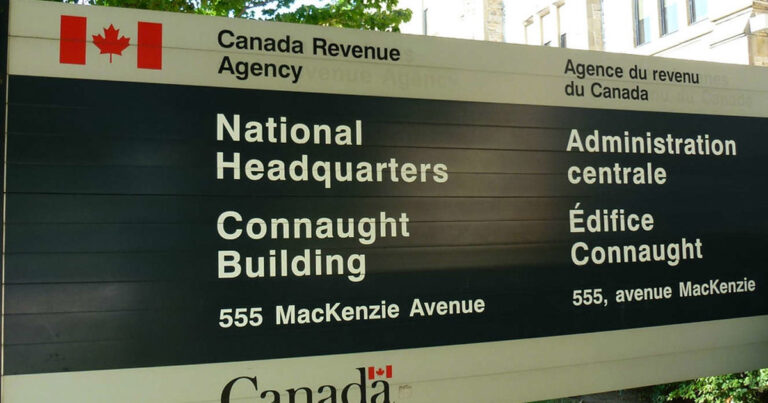
The Canada Revenue Agency terminated 330 employees for inappropriately receiving the Canada Emergency Response Benefit during the COVID-19 pandemic, after completing its final internal review on the matter.
The government tax agency launched an internal review in June 2023, after several employees were found to have illegitimately received CERB payments.
The inquiry ultimately led to as many as 600 employees being investigated.
“Starting in July 2024, for individuals who have not responded or co-operated, and who have been determined to have the financial capacity to pay, legal warnings will be issued and legal measures could be taken to recover monies owed,” wrote the CRA in a statement released in June.
According to the agency, only people who have already been contacted about repaying their debt are the ones who should be worried.
“Legal measures are only taken when there is no cooperation from an individual with ability to repay the debt,” reads the release.
The firings come after the Trudeau government called for the CRA to begin automatically filing Canadians’ taxes in 2024, an idea it first announced as part of its 2020 budget speech.
The Liberals claimed the proposed change would help Canadians deal with the cost of living.
A pilot program was announced again in the federal government’s 2023 to 2024 fiscal budget as part of its goal of “Making Life More Affordable” for Canadians.
However, the Canadian Taxpayers Federation pushed back on the initiative.
In a video posted to social media, the organization asked, “do you trust the federal government with your wallet?”
“The CRA’s job is to squeeze every penny from you, not maximize your refund,” said the CTF. “And let’s not forget, this government is broke.”
The monthly CERB payment of $2,000 was offered to Canadians who lost their job during the pandemic as a result of lockdown and other restrictions.
While the CRA said there were another 185 individuals who were not terminated for receiving CERB, 40 have faced disciplinary action, such as suspension.
An additional 135 employees were found to have been eligible and were not subjected to punishment, many of whom were students or contract workers.
According to the agency, employees who received CERB inappropriately are required to pay back the money they received.
The CRA noted that a small number of cases remain ongoing, including employees on medical or extended unpaid leave.