Doug Ford urges feds to crack down on Chinese EVs, other imports

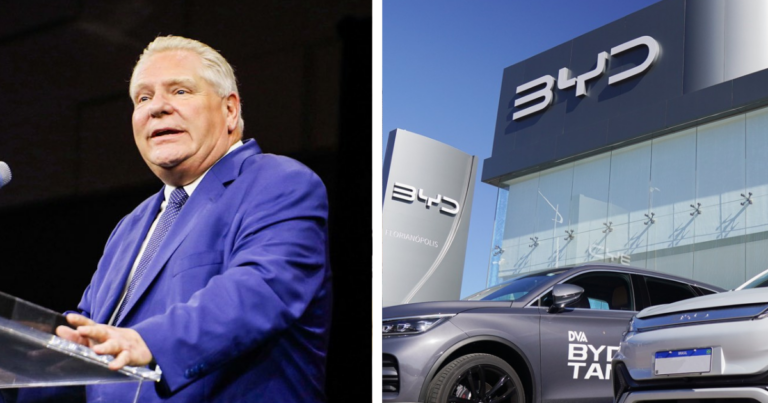
Ontario Premier Doug Ford is calling on the federal government to match or even outdo the harsh tariffs the United States has put on Chinese-made electric vehicles and other imports.

Ford boasted on X that his government had secured $43 billion in handouts for the EV industry in Ontario. To protect those investments from China’s “artificially cheap” EV production, he wants Canada to follow the U.S. and make Chinese EVs unwelcome in the Canadian market.

“I’m calling on the federal government to immediately match or exceed U.S. tariffs on Chinese imports, including at least a 100% tariff on Chinese electric vehicles,” Ford said. “Taking every advantage of low labour standards and dirty energy, China is flooding the market with artificially cheap electric vehicles. Unless we act fast, we risk Ontario and Canadian jobs.”

The U.S. announced tariffs on $18 billion in imported goods from China, including a quadrupling of taxes on EVs, bringing the duties that China would have to pay to do business up to over 100%.

Ford honed in on the billions his government has helped spend on the EV industry and the importance he sees in protecting those investments.

“This has been an all-hands-on-deck achievement, working side-by-side with the federal government and our private sector labour partners,” Ford said. “As governments, we need to do everything in our power to protect their jobs and the paycheques they take home.”

Jerome Gessaroli, a senior fellow at the Macdonald-Laurier Institute, told True North in an interview that although he’s generally opposed to tariffs, in this instance, it’s “complicated.”

He said the tariffs would effectively stop the importation of Chinese EVs into the Canadian market. 

After the U.S. announced the tariffs, China threatened retaliation immediately. Gessaroli said Canada can expect the same.

Due to the cheap cost and “sophisticated technology” of China’s EVs, Gessaroli said that if the vehicles were permitted into Canada, China would take a “non-trivial” share of that Canadian market.

He said cutting Chinese competition out of Canada could cause domestic companies to become less aggressive in designing more cost-competitive vehicles.

Despite the adverse effects that the tax could have on the free market, Gessaroli thinks that the federal government should listen to Ford and impose a tariff on Chinese EVs.

He said that although industry reasons were a significant factor for the U.S. when they imposed tariffs on Chinese EVs, privacy and security concerns were noted as well.

“These electric vehicles are connected, so they’re all wirelessly connected together to different sources. Insert information is always transmitted,” Gessaroli said. “There are all kinds of sensors and cameras on EVs, and there are concerns about whether some of this information from these Chinese EVs that would operate in North America could lead to privacy issues if that information got back to the Chinese government.”

Though Gessaroli generally believes in the benefits of a free market, he thinks national security should be prioritized over free -market trading.

“At the end of the day, I believe that Canada will fall in line with the United States and have similar tariffs on Chinese EVs. To me it would be too much to go against the Americans on an important part of the economy, the automotive sector,” Gessaroli said.

Ford noted this relationship as well in his announcement on X.

“Now’s the time to work with our U.S. partners to deepen and strengthen home-grown, U.S.-Canada supply chains. Now’s the time to protect good, hard-earned Ontario and Canadian jobs by matching U.S. tariffs on Chinese imports.”

However, according to Gessaroli, Canada’s EV policy is currently at odds with that of its American counterpart on the EV front in relation to China.

Canada’s provincial and federal governments subsidize the purchase of EV vehicles without distinction of origin, so tax dollars can be used to purchase Chinese-made vehicles in Canada.

In the U.S., only EVs made in North America have been eligible to receive EV purchase subsidies.

“We’re actually subsidizing Canadians, potentially to buy an automobile that’s been produced in China. Right now, there’s a discrepancy between Canada—U.S. policy.”
Toronto police hate crime unit investigating Rebel News billboard truck

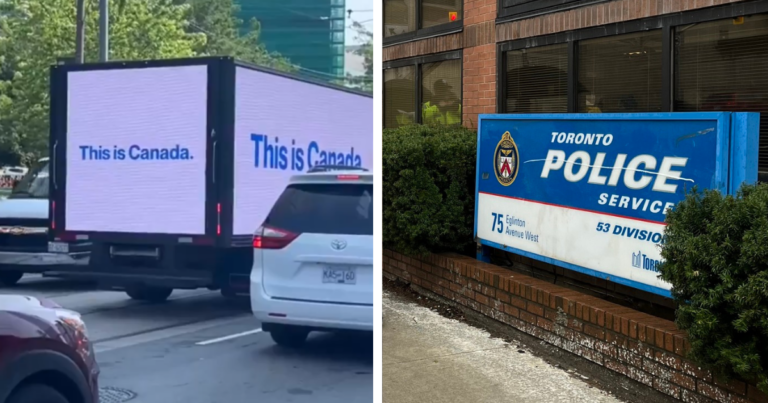
Rebel News founder Ezra Levant says he could face up to two years in prison for allowing an anonymous group to run video advertisements on a truck he owns.

The Toronto Police Service announced that its Hate Crime Unit is investigating the truck, which was filmed displaying video footage of anti-Israel protesters shutting down the streets in Toronto.

In between video segments showing various demonstrations, the truck ads read, “Is this Yemen? Is this Syria? Is this Iraq? No. This is Canada. Wake up Canada. You are under siege.”

Levant said that he was simply running ads “for another group of loyal Canadian citizens who felt totally abandoned by the police and politicians. Real Canadians don’t shoot schools or take over campuses,” said Levant. “They run ads on our truck. It’s called free speech — you can look it up in our Charter of Rights.”

If convicted for hate speech, Levant, said he could be jailed for up to two years.

“And don’t think they won’t try. Our Rebel News reporters have been arrested by Toronto police several times just for asking Hamas supporters questions,” said Levant. “The police hate us because we’re not silent and obedient, which is what they’ve told the Jewish community to be.”

Levant criticized the Toronto police for “two-tier policing.”

Others voiced similar concerns on X, showcasing that when a similar truck promoting hatred against Jews drove through the streets of Toronto, the Toronto police allegedly did nothing. The video ads on that truck read, “From the river to the sea.”

The American Jewish Committee said that the saying  “calls for the establishment of a State of Palestine from the Jordan River to the Mediterranean Sea, erasing the State of Israel and its people.”

Mohamad Fakih, the founder of the Paramount food chain, initially offered $25,000 to whomever could reveal the identity of the truck owner.

After revealing that Rebel owned the truck, Levant publicly demanded his $25,000 reward. He told Fakih that he could pay in falafel and shawarma. 

Toronto Mayor Olivia Chow condemned the truck.

“Let us continue to work together, unite against hate of all kinds and build a city where everyone is treated with dignity and respect — a city where everyone belongs,” she said.

“No surprise — she’s a pro-Hamas NDP mayor, who has refused to attend key Jewish community events,” said Levant.

Liberal MP Salma Zahid joined the calls for an investigation.

Other supporters of Levant posted videos of Hamas supporters calling for the death of all Israelis and America in the streets of Ottawa.

Some Rebel News employees stood with Levant.

“Imagine if police in Canada took mass church arson, calls for genocide and shots fired at Jewish schools as seriously as billboard trucks,” said Rebel News journalist Adam Soos.

The truck driving through the streets came just a few weeks after a Jewish girls’ school in Toronto was shot up. Antisemitism has also been widespread at on-campus encampmenets across the country, including in Toronto.

Levant claims that he has broken no laws and stands by the messaging.

Ratio’d | Large majority of Canadians want Justin Trudeau to RESIGN!

New polling from Ipsos Polling shows that 68% of Canadians now want Justin Trudeau to resign as prime minister. This figure also includes 33% of Liberal supporters. Day after day, both Trudeau and his cabinet ministers sound more and more defeated and to make matters worse, Trudeau’s once-loyal legacy media propagandists are fanning the speculation of his imminent departure.

Every interview that Trudeau gives to the legacy media he is peppered by questions about his potential resignation. With a less than 1% chance of winning the next election and basically no way back, why is Trudeau holding on?

Watch the latest episode of Ratio’d with Harrison Faulkner.

International student visa program on track to be reduced by half

Should Ottawa maintain its pace of international student visa approvals following the recent cut, it might surpass its goal to reduce the number of permits significantly.

The education recruitment company, ApplyBoard estimated based on data from Immigration, Refugees and Citizenship Canada that if the number of students who were approved in the first four months of 2o24 remains constant, then study permits would drop to 229,000.

That would make for a 48% decrease from last year when the federal government approved 436,678 study permits.

There has been mounting pressure on the Trudeau government to curb its explosive growth of temporary immigration, which many believe is affecting the housing crisis and the overall high cost of living. 

The Trudeau government announced it would reduce temporary immigration in January, cutting the number of study permits by 35% when compared to 2023.

New restrictions were also placed on post-secondary education institutions, which were largely responsible for bringing in temporary foreign students as an immigration pathway for students, with the majority arriving from India.

However, the recent cap on international students has led to some pushback from postsecondary schools and provincial governments, including Colleges Ontario and B.C. Premier David Eby. 

Eby wants to see exemptions in occupational areas where there is high demand, such as nurses, early childhood care and truck drivers.  

“We can’t have this cap impacting our healthcare system or the availability of childcare, or the ability to build the homes that we need,” Eby told reporters in January.

B.C. and Ontario will feel the cap more than other provinces as they take in the greatest number of international students every year, even though the cap is applied on a per capita basis equally across all provinces. 

Colleges Ontario, an association representing 24 public colleges across the province, said that there will be “long-lasting repercussions” as a result of the cap in a statement released at the time of the government’s announcement. 

“The federal government’s cap on study permits for international students is essentially a moratorium by stealth that is already causing significant and unnecessary upheaval for students, employers and communities,” reads the statement

“Ontario’s public colleges are calling for the federal government to treat the post-graduate credentials at public colleges the same way it treats the post-graduate credentials at universities and to exempt them from the cap.”

Almost one-third of all postsecondary students in B.C., about 545,000, are international, and with a number that high, postsecondary institutions are going to feel the loss in tuition fees. Especially since some institutions may charge as much as 10 times the amount in tuition fees to an international student as they would to a Canadian student.

However, Ottawa conducted a probe into 2,000 suspicious student visas last year and discovered that approximately 1,485 applicants had issued fake letters of admission into colleges and universities. The bulk of the fraudulent applicants involved came from India, China and Vietnam. 

The federal immigration department then had to identify which students legitimately travelled to Canada to study and which ones were linked to fraud. 

“The CBSA will continue to focus inland investigative resources on high-risk cases, with criminality and national security being the highest priorities,” said Guillaume Bérubé, a spokesman for the CBSA last summer. 

“The CBSA is responsible for investigating alleged violations of the Customs Act and the Immigration and Refugee Protection Act (IRPA), focusing on complex cases such as organized crime, and primarily targeting the organizers, facilitators and perpetrators of crimes that pose a threat to the integrity of Canada’s border legislation,” said Bérubé.

The scam initially came to the attention of CBSA in 2018 when a probe into the abuse of the student visa system revealed that such visas were being used by others as a means to get to Canada, only to join gangs.

Majority of Canadians oppose costly election delay

Most Canadians oppose the government delaying the next federal election by a week. The delay would mean that 80 MPs would then qualify for taxpayer-funded pensions.

A Leger study commissioned by the Canadian Taxpayer Federation, a non-profit government watchdog, found that 63% of Canadians oppose the government delaying the election by an extra week for Diwali, a Hindu holiday.

The fixed general election date is set to Oct. 20, 2025, which happens to be the first day of the five to six-day celebration of the Hindu Festival of Light.

Critics of the motion, such as Franco Terrazzano, the federal director of the CTF, said the delay could cost Canadian taxpayers up to $120 million.

“Delaying the election by one week means 80 additional MPs could be eligible for a taxpayer-funded pension. That could cost up to $120 million in pensions over their lifetime. The annual starting pension ranges from $32,000 to $49,000,” Terrazzano told True North. “Some MPs could serve for just six years and receive a pension of more than $2 million over their lifetime.”

Leger asked 1,536 Canadians aged 18 or older in mid-June whether they supported or opposed the delay that would cost taxpayers tens of millions.

The survey found that only 6% of Canadians strongly supported the move to delay the general election to accommodate Diwali celebrations. While nearly half said they strongly opposed the idea.

When survey data was adjusted to remove the 21% of Canadians who said they were unsure or didn’t know if they opposed the delay or not, 80% of Canadians opposed it. Three in five Canadians strongly opposed moving the election date.

“The poll is clear: the vast majority of Canadians don’t want the government delaying the election so dozens of extra MPs can take pensions,” Terrazzano said. “All MPs should listen to Canadians and oppose this pension trickery and election delay.”

Out of those who had opinions on the issue, “Black, Indigenous and People of Color” (BIPOC) Canadians were more likely to support moving the election date with 37% of BIPOC Canadians supporting it, though 63% of the same demographic opposed the motion.

Conversely, after discounting those with no opinion from the survey, 85% of Caucasian Canadians were opposed to the delay in general. 64% of Caucasians strongly opposed it.

This comes as an increasing number of Canadians feel that the cost of living in the country continues to worsen.
“Canadians are struggling, so MPs shouldn’t rig the system so more politicians can collect lucrative, taxpayer-funded pensions,” he said. “If politicians don’t want to look shady, then they shouldn’t do shady things like this.”

Brampton city council shrugs off concerns over “gender inclusive” changerooms

Brampton, Ont. councillors shrugged off a concerned citizen’s issues with the building of several all-sex changrooms in the city’s recreation centres. 

Beata Kostka, a mother and Brampton resident, helped to organize a delegation to a city council meeting in which she spoke about her experience of sexual harassment at one of the “universal” changerooms that had been built in recent years.

As part of an initiative to revitalize the city’s community centres, Brampton has been doing away with male-female changerooms at several of its swimming pools, with five of the city’s ten pools exclusively providing an all-sex changeroom. 

Kostka told True North and Brampton city councillors that she took up this fight after her daughter was forced to see five men’s genitals in the pool changeroom, an experience she says was “shocking.”

Kostka says the rec centre’s manager told her there had been numerous similar complaints made.

Accompanied by a small group of individuals who shared her concerns, Kostka urged the city council to reverse course.

“Our simple request is to reinstate the safety of separate changerooms for everyone while also providing a separate space for all those who require it in a cost-effective manner,” said Kostka. “It is possible to promote inclusivity without compromising the comfort of all individuals.”

While every delegation beside Kostka’s was met with questions and active interaction from the city councillors, no councillors were willing to engage with her on the issue. After her remarks, she was immediately dismissed by meeting chair Rowena Santos.

Some councillors even left the council chamber briefly while Kostka was delivering her remarks, including Mayor Patrick Brown. 

Kostka says that she was “not surprised” that the council had expressed indifference to her concerns because of what she calls an ideological push for the building of these changerooms.

Kostka says that before attending the council meeting, she had attempted to let the city know about the problems with all-sex changerooms by emailing councillors, the mayor, the relevant city department, and even presenting a petition to Brown in-person.3

Kostka is not alone in her fight, as she has received support from a group of like-minded groups such as Hand Off My Kids – who had helped to organize the Million Person March – and We are the Change. 

One of Kostka’s supporters expressed concern that all-sex changerooms could be used by sexual predators and sex offenders to victimize women and children. 

One concerned mother said she became interested in this issue after discovering that these sorts of changes were not only happening in the United States, but in the very community she lives in. 

A bylaw officer even expressed support for the remarks Kostka delivered, telling the group that he didn’t know American-style bathroom politics had made its way to Canadian cities. 

Kostka says that if the city does not take any action to address the change-room problem, she will consider taking legal action against the city.

GTA bust leads to 295 charges and $2.5 million in drugs seized 

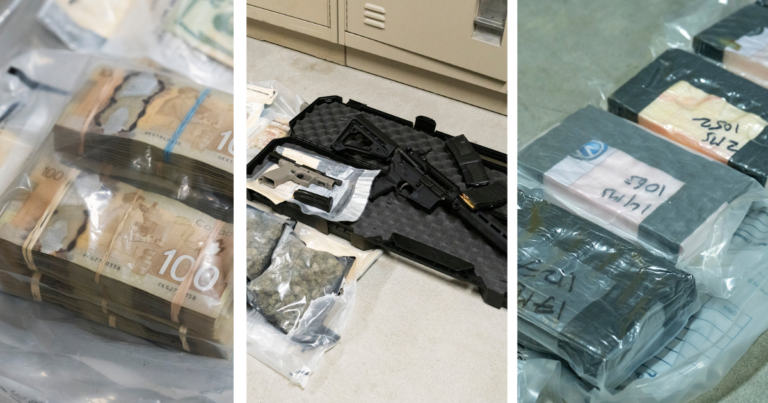
York Regional Police made a major drug bust in the Greater Toronto Area, seizing around $2.5 million worth of drugs, 18 firearms, vehicles and cash as part of an investigation targeting a “large-scale” gun and drug trafficking network.

The investigation called “Project Lookout,” targeted the street gang known as the Haywan Gang, spanned across 14 months and led to charges being laid against 20 people.

“The arrest and seizures made during Project Lookout will save lives and make a significant impact in our community,” said Insp. Richard Gaudet during a news conference on Wednesday.

The joint forces operation to target the gang was formed in April of last year and involved investigators from York, Toronto, Peel, OPP, the Canada Border Services Agency and the Financial Transactions and Reports Analysis Centre of Canada.

“This street gang originated in the City of Toronto, but was now believed to be involved in the trafficking of firearms and drugs in the southern part of York Region,” said Gaudet. 

“The team identified a sophisticated criminal network that trafficked large quantities of firearms and high quality cocaine across the GTA.”

Investigators managed to identify the Haywan Gang’s alleged firearm and drug supplier according to police. 

The bulk of the cocaine was being trafficked within the City of Vaughan. 

Over 200 police officers carried out coordinated search warrants at 33 locations across the GTA on June 5. 

Those arrested in the investigation now face a total of 295 combined charges, including drug offences and a range of weapons charges.

Deputy Chief Alvaro Almeida said the results of Project Lookout are “likely to significantly disrupt the operations of this criminal group.”

Police seized 19.8 kilograms of cocaine, 4.8 kilograms of cannabis and a quantity of MDMA, Xanax pills and oxycodone pills.

“The cocaine seized during this investigation has been analyzed as well. It was found to be between 89% to 97% pure, which suggests that the arrested suppliers are linked to the highest levels of organized crime cocaine importers,” said Gaudet. 

“We believe that these drugs were destined for the street level dealers who will peddle these dangerous substances in our community after diluting them with fillers to maximize profits.”

In addition to the drugs, police seized $244,335 in Canadian currency, four vehicles and luxury watches thought to be valued at $255,000.

The guns seized primarily originated from the United States and were smuggled into Canada illegally.

The investigation remains ongoing and police are asking anyone with further information to contact York regional police or call crime stoppers anonymously.

The Andrew Lawton Show | Government’s indifference to foreign interference is alarming

It’s an established fact that foreign actors have interfered in Canada’s democracy and are likely to continue to do so. And yet the federal Liberal government hasn’t been interested in figuring out, let alone disclosing, which parliamentarians have made this easier. In this edition of The Andrew Lawton Show, Andrew catches up with Macdonald-Laurier Institute managing director Brian Lee Crowley for a discussion about foreign interference and the state of Canadian democracy.

SUBSCRIBE TO THE ANDREW LAWTON SHOW

“Tree equity”: Ottawa wants race-based tree planting

The City of Ottawa hopes to dictate which neighbourhoods deserve more trees based on race and other identity factors, ensuring that even the urban forest canopy aligns with its diversity, equity, and inclusion priorities.

A report by Ottawa’s climate change and forestry officials is headed to City Council on Jun. 26. The report calls on the city to undertake a “tree equity analysis” across all urban areas to govern Ottawa’s tree planting strategy. 

“The distribution of urban tree canopy is frequently associated with socio-economic factors, with lower canopy cover neighbourhoods often having a strong representation of equity-deserving communities,” the report reads. 

“The City requires a methodology to identify areas of tree inequity and to prioritize tree planting in areas of the city that need it the most.”

The proposed methodology is called a “Tree Equity Score” and was established by the U.S. non-profit American Forests

“The Tree Equity Score method uses tree canopy cover data in conjunction with socio-economic and health measures of inequity. This approach produces a score that will identify neighbourhood-level gaps in the urban forest,” the report reads. 

The identity factors that the score takes into account are race, age, language, employment, health and income, among other things. 

“Neighbourhoods with lower Tree Equity Scores will be priority areas for tree planting. The lower Tree Equity Score for these areas indicates a need for increased tree planting to provide urban forest services and benefits,” the report reads. 

While the report asserts that neighbourhoods won’t be denied access to tree planting initiatives the “Tree Equity Score” will “guide the prioritization of tree planting and the development of neighbourhood-specific planting plans and programs, helping to ensure trees are planted where they are needed the most.” 

Other proposed scoring mechanisms include one proposed by Nature Canada that maps “the relationship between tree cover and income, as well as tree cover and proportion (of) racialized populations.” 

Meanwhile, the “Nature Score” was also floated which is based on public health measures.

If the proposal is approved by council, the resulting analysis will be used to determine priority areas for future tree planting.

The Daily Brief | Canada’s population continues to grow, driven by immigration

Canada surpassed 41 million people in the first quarter of 2024 as the country continues to experience rapid growth driven almost exclusively by international migration.

Plus, the Trudeau government underestimated the cost of electric vehicle subsidies by $6.3 billion.

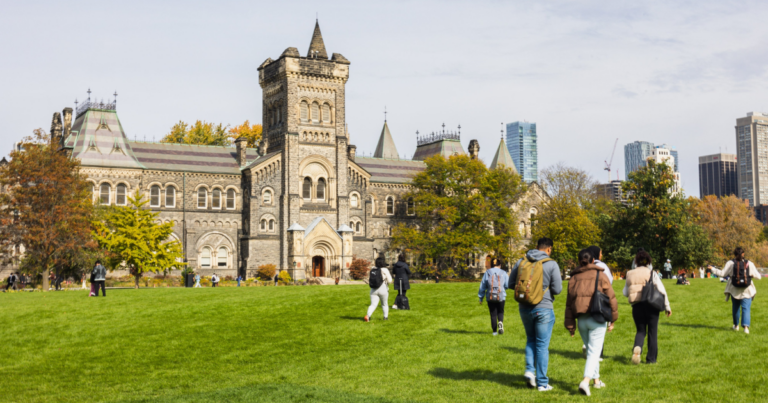
And dozens of Canadian university professors have signed a letter to Parliament calling on the federal government to end mandated “diversity, equity and inclusion” initiatives in universities.

Tune into The Daily Brief with Cosmin Dzsurdzsa and Noah Jarvis!

SUBSCRIBE TO THE DAILY BRIEF