Can’t fight for unborn without fighting for free speech, pro-life activists argue

As several Ontario municipalities try to ban pro-life activists from showing images of fetuses on public streets, Ontario pro-life groups are making a push for their Charter rights to be upheld.

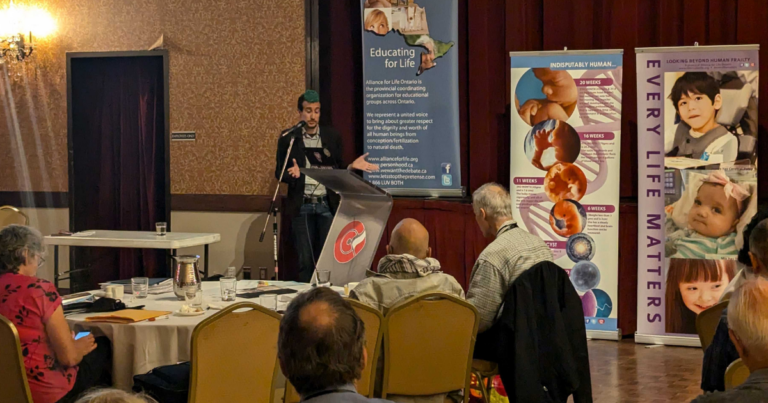
The practical ways pro-life activists can fight back against legal limits some municipalities are placing on their activism were a main topic of discussion at an educational conference in Mississauga, Ont. on Saturday.

The City of London passed a bylaw in 2022 which banned the distribution of leaflets with fetal imagery to residents of the city. The city is currently trying to ban all fetal imagery from being displayed on the streets.

Many activists view their ability to share these images as crucial to the conversation surrounding abortion.

“We need to be able to defend our voice to stand up and defend the right to freedom of expression so that we can share the pro-life message,” Blaise Alleyne from the Canadian Centre for Bio-ethical Reform, a national educational pro-life group, told True North.

Alleyne was one of the speakers at the conference. He discussed the barriers that the movement faces and how he thinks his fellow pro-life activists can “push back” both politically and legally. 

“We need to defend (freedom of expression) from government censorship, discrimination against pro-lifers and unfair treatment, and unfortunately, in some cases, from pro-choice, violence, people who take it into their own hands, literally, to try and stop us from speaking,” he said.

He said the nature of pro-life beliefs compels those who hold them to engage in conversations with people who don’t want to hear their message.

“In order to do the educational work, we’ve got to do the freedom of expression work so that we still have a voice,” Alleyne said. 

He said the movement faces many hurdles whether it’s from activists on the opposite side of the debate or from the government which could “discriminate against pro-lifers” by “censoring and suppressing the pro-life message.”

The municipalities of Hamilton, Toronto and the Region of Niagara have all passed or proposed motions banning the use of fetal images on signage and leaflets. 

St. Catherines. Ont. and several other municipalities have passed by-laws restricting the use of “graphic” images of fetuses on flyers. However, in February, one group challenged the by-law in St. Catherines at the Ontario Superior Court. The decision in that ongoing case could affect all the others.

“If people support freedom of expression. They should support it for everyone, even if they don’t necessarily agree with the pro-life movement on abortion,” Alleyne said. “In particular, this battle around fetal imagery is a battle around victim photography.”

Alleyne argued that the pro-life movement is not the only group to use victim photography in its mission to persuade citizens.

“Take the the war in Gaza, both the Israelis and the Palestinians use victim photography to plead their case to the public,” he said.

He pointed to historically successful movements that used victim photography, such as British abolitionists using visual evidence of slavery, the National Child Labor Committee taking photos of children working in factories, and the American Civil Rights Movement using photos of the victims of racism.

“We see photos of the victims being key to ending injustice and even if you disagree with a movement, it’s an important part of the conversation,” Alleyne said.

He said pro-lifers need to continue using the Charter of Rights and Freedoms to defend their ability to share their message and, from a pro-life perspective, save lives.

In a case involving a student who alleged she was discriminated against by student unions for her pro-life beliefs at what was then Ryerson University, the Human Rights Tribunal of Ontario ruled that a pro-life stance “fits squarely within the ground of creed,” allowing it to be protected by the Charter of Rights and Freedoms.

Alleyne also believes that pro-life groups need to continue to sue anyone who physically attacks them for their activism.

“We should be able to have civil disagreements in society without resorting to violence and to be able to see justice when someone assaults someone else because they disagree with the message,” he said. “We don’t always win but it’s a lot worse if we don’t stand up.”

Jewish community protests TDSB “anti-Palestinian racism” motion

Jewish students, teachers, parents and other community members are sounding the alarm over  a Toronto District School Board staff report which would update the board’s anti-racism strategy to include “anti-Palestinian racism.”

A few hundred demonstrators gathered outside the TDSB head office Tuesday evening as trustees voted five to three to pass the “combatting hate and racism,” or CHR, strategy on for a final vote before the full board of trustees.

Protesters objected to the vague definition of anti-Palestinian racism and the lack of emphasis on combatting antisemitism in the plan.

Reports of antisemitic hate crimes more than doubled in 2023, increasing from 65 reported instances in 2022 to 135 in 2023.

“The number one concern expressed by parents, students, teachers and other community members has been that the CHR does not entirely address antisemitism which has experienced several drastic and sharp rises,” Centre for Israel and Jewish Affairs diversity, equity and Inclusion director Jess Burke told True North in an interview.

“This strategy does not adequately address the current hate crime statistics we see, and we know that schools are a microcosm of general society.”

Protesters said they want to see a proportionate educational response to the rise of antisemitism in this strategy.

Burke would like the school board to mandate education about Jewish personhood. She would also like to use Jewish History Month, observed in May, as an opportunity to educate students about Jewish culture and the positive contributions of Jewish people.

The inclusion of a vaguely defined anti-Palestinian racism was another reason for the community’s outrage.

TDSB spokesperson Ryan Bird told True North the report did not suggest a definition for anti-Palestinian racism, though Burke said it’s very likely the board will adopt the Arab Canadian Lawyers Association’s definition of it as anti-Arab racism that silences, excludes, erases, stereotypes, defames or dehumanizes Palestinians or their narratives.

TDSB trustee Alexandra Lulka Rotman, one of the three who voted against accepting the strategy in its current form, raised concerns that the inclusion of the word “narratives” in the definition could be abused to silence anyone questioning one side of the debate.

Burke said racism in all of its forms is adequately defined and protected by the Ontario human rights code, which the school adheres to, but there are “huge walls” within the Jewish community and others regarding the ACLA’s definition of anti-Palestinian racism.

One of the main issues for Burke is the methodology used in the development of the definition.

She said the ACLA comprises a “handful of localized regional people” as opposed to the large international community which developed the International Holocaust Remembrance Alliance definition of antisemitism.

The ACLA has opposed IHRA’s definition of antisemitism saying it does not allow for criticism of Israel. Burke noted that the definition explicitly states that criticism of the Jewish state is not antisemitism.

“The anti-Palestinian racism definition was developed immaculately fast, almost overnight, by ACLA with very little methodology that those of us in the research community and the socio-educational community would accept as being a consensus definition and with very little input from the Palestinian people themselves.”

Burke’s main issue with the anti-Palestinian racism definition is it attempts to redefine antisemitism without regard for Jewish perspectives on what it means.

“As an anti-oppressive educator, as soon as a definition seeks to define, dispute, redefine, distort or revise, the experience of another equity-deserving and multi-marginalized group. I see an enormous red flag,” Burke said.

The ACLA definition states that “defaming Palestinians and their allies” as being “inherently antisemitic” is racist.

Burke said that if the CHR strategy passes without further consideration and modification, the next steps may include Jewish rights groups such as CIJA seeking legal action against the school board.

LEVY: Absentee Toronto teachers are costing taxpayers millions

Toronto District School Board teachers took nearly 20 days sick leave last year compared to the provincial average of 16 days, a report to trustees on the planning and priorities committee heard recently.

The obscenely high absenteeism rate cost the TDSB $131 million in replacement costs last year and some $213 million in total. 

The report says the cost per day to replace teachers who don’t show up to work is about $6.7 million — which over the course of a year is $25 million higher than the provincial average.

The replacement costs have been 8 to 9% of the board’s payroll over the past two years, the report adds.

But executive officer Melissa Kennedy said the good news is that year over year the spread has remained the same.

Not sure that is good news but that’s the way the TDSB tries to manipulate the narrative.

Trustees heard that there are a number of factors that have contributed to the high absentee rates, most specifically teachers being in areas where there are greater proportions of high income families, racialized students, students with special education needs – and the length of time a teacher has to commute.

That sounded like a bunch of convenient excuses – again to manipulate the narrative – especially considering there are a pile of recent graduates just itching to take these jobs. 

Many other people have to commute to their jobs.

I suspect it is more that teachers’ unions protect them and that “absenteeism acceptance” – a phenomenon mentioned in the report – has set in.

That refers to a “teacher’s tendency to accept absenteeism” as if it’s the norm.

TDSB officials admitted that the board has done very little to clamp down on the culture of absenteeism but that is all about to change. Or so they say.

The board’s proposed attendance support program acknowledges there are “tremendous savings” to be realized by “reducing unnecessary absences” and promoting a “healthy, safe and respectful” workplace.

Well duh, and these people purport to be educators!

The new, improved program will better track attendance (suggesting tracking was extremely loose up to now); better clarify the “appropriate use” of sick leave; and address “culpable behaviour where appropriate.” (Given the muscle of unions, I’m guessing that will never happen.”

To better track attendance and address areas of concern in a “timely manner,” the People and Culture department (fancy name for Human Resources) will create attendance dashboards for schools and departments.

I suppose I should be shocked that this is not being adequately tracked now but remember this is the TDSB where feelings (specifically those of visible minorities) take precedence over accountability.

The report says the board’s public affairs people will create an “attendance awareness campaign” to teach teachers the impact of absenteeism and the appropriate use of sick leave.

“Staff are regularly committed to ongoing and creative thinking that can contribute to positive change,” said Kennedy.

I must stop right there.

Has this board sunk to such levels of incompetence and negligence and do administrators have such a laissez-faire attitude that staff have to be reminded that they need to show up to work?

I know the answer to the question. It is yes.’

I should add that under education director Colleen Russell-Rawlins’ obsessive DEI/anti-black racism focus, many teachers have told me that morale is at an all-time low and stress at an all-time high.

She recently announced she is departing in November – not a moment too soon – but it will depend on who the board’s woke trustees choose as her successor.

I’m not optimistic at this point.

Trustee Weidong Pei, who has been dogged about trying to make his colleagues more accountable and has faced an uphill battle doing so, said he’s worried about the report because not much data was presented.

He chided administrators for making it obvious the problem emerged in 2018 and that the board is “just starting to think about it.”

Russell-Rawlins called it a “very complex and complicated” issue that is an “international trend.”

She pontificated slowly as if her entire audience was five years old.

Pei noted that constituents have reported to him that some teachers take up to 60 days sick leave per year and there is no continuity.

“I’m so disappointed,” he said, sounding very frustrated.

Associate director Leola Pon defended the report saying it is a “starting point” and very important.

Pon said it is “highly disrespectful” of staff to suggest staff are taking advantage of sick leave. She called Pei’s tone “inappropriate.”

Therein lies the problem.

Costs, but no benefits for companies pursuing high ESG rankings: study

Despite being championed by activists as good for business, high ESG scores have no bearing on companies’ stock market returns, a new study finds.

A study by the Fraser Institute found no positive correlation between Canadian companies with high ESG ratings and their overall market performance.

ESG ratings take into account how a company runs in relation to environmental, social, and governance issues.

The environmental rating refers to a company’s commitment to climate action. The social rating relates to metrics such as what demographics the company hires and how it pays those employees. Governance is about how the company is run.

ESG ranking companies measure several factors along those three dimensions, aggregate the data, and give businesses an overall rating. According to the study, business leaders and government officials alike often advertise these rankings as something investors care about.

“We looked at the relationship between the change in the ESG rating across our sample of companies and the stock performance, which includes dividend payments and any stock splits over the next up to 12 months beyond the rating change…and there’s no statistically significant relationship,” study author Steven Globerman said on True North’s Andrew Lawton Show on Tuesday.

Because of government securities regulations, publicly traded companies in Canada must disclose their ESG-related information so everyone can know if they are fulfilling their commitments to environmental impact, human rights, and “equity and inclusion.”

The study tracked 310 companies on the Toronto Stock Exchange from 2013 to 2022.

It was the first empirical analysis of the relationship between the changes in ESG rankings of publicly traded companies in Canada and the price of shares and dividend income in those companies, although similar studies on American companies have revealed the same trend, Globerman said.

Globerman said it’s useful to analyze the change in the price of stock market returns because it reflects what millions of investors think about the future profitability of a publicly traded company.

He said there was no clear correlation between the ESG rankings and the profitability of those companies on the Canadian stock market. 

Because there were no trends in relation to that data, any changes could have been attributed to other factors, such as luck. 

“Advocates for greater ESG disclosures cannot accurately claim, based on Canadian evidence, that requiring companies to provide more information for ESG rankings will significantly affect the financial performance of Canadian investors,” he said.

According to Globerman, companies pay out of pocket for ESG rating companies to rank their organizations in terms of their sustainability performance, and use those ratings to promote how progressive their companies are.

In the report, Globerman questioned why investment managers would continue to pay for these ratings if they have no connection to investment performance. 

The report said the extra administrative cost that would be needed to pay for ESG-themed investments is likely to be passed on to the customers of those firms.

“It raises an obvious question: why are people investing in ESG-themed mutual funds? They’re paying higher fees to invest in those funds. They don’t appear to be getting the net returns that people are getting who are investing in conventional asset categories,” Globerman said.

He said it’s likely that people are investing out of goodwill as there aren’t any clear financial benefits. In fact, he said, there is a cost because the costs of ESG ratings are passed on to customers by investment managers.,

“The more relevant version of the question is why customers are willing to pay higher administrative fees for ESG-themed investments when they would earn similar gross returns, and therefore higher net returns if they invested in non-ESG themed alternatives,” he said.

“If people continue to want to get psychic benefits or more glow feelings from how they’re investing. That’s their business, but they should be informed about what the expected returns were.”

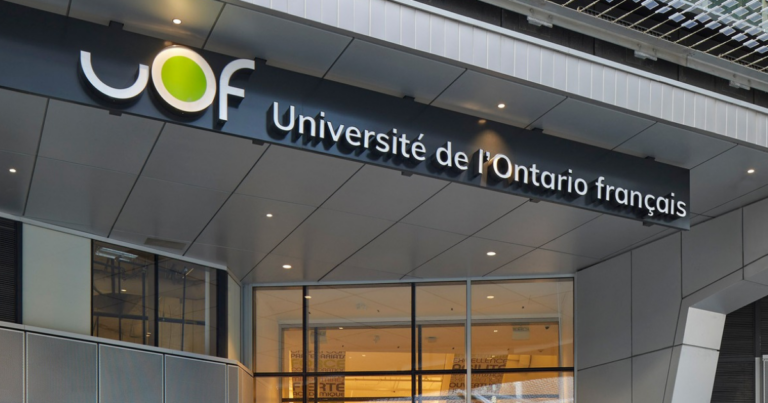
Toronto’s $126M French university has just one Ontario student enrolling this year

Toronto’s Université de l’Ontario français is continuing to struggle with low enrollment numbers – with just one Ontario student set to join this year.

The enrollment figures are grim for the French university, whose recent opening was made possible due to political pressure from Franco-Ontarians and progressive activists and $126 million of taxpayer money from the provincial and federal governments.

New data from the Ontario University’s Application Centre shows that just one Ontario student has accepted an offer to join the university’s four founding programs or its bachelor of business administration for the 2024-2025 academic year.

This marks a 75% decrease from the previous year when four Ontario students accepted offers to study in the flagship programs.

The university did see 113 applicants who are not from Ontario secondary schools accept offers, but even this number represents a decrease of 43% from the year prior, when 198 out-of-province students accepted offers.

The university’s bachelor of education degree, which was launched in Nov. 2022, was excluded from OUAC’s data. That program has shown to be more popular.

Université de l’Ontario français gave out around one hundred offers to the bachelor of education program, and the 80 spots the program has have all been filled up by Canadian citizens.

The struggles of the Université de l’Ontario français, which opened in 2021, are not new. 

The university saw just 19 Ontario students apply for the inaugural 2021-2022 academic year and just 14 applications for the following 2022-2023 year.

The university did see an increase in applications for the 2023-2024 year amidst the launch of the new bachelor of education program. However, figures appear to again be on the decrease.

Overall, the university received 861 applications as of June 5, a 31% decrease from last year when it received 1245 applications. The total number of students who ended up enrolling at the university also decreased by 44%.

The Université de l’Ontario français was announced back in 2017 by Kathleen Wynne’s Liberal government. It was promoted as Ontario’s first fully francophone university.

While Ontario did not have a fully francophone university at the time, it had and continues to have several bilingual universities, including the University of Ottawa, Laurentian University and the University of Sudbury.

The project was then initially cancelled by the Ford government in 2018, as part of budget cuts. The move, along with other cuts to francophone services, led to mass outrage and protest among the Franco-Ontarian community as well as progressive activists.

The Ford government later reversed its decision and announced it would build the university after all. The Ford and Trudeau governments teamed up to fund the university to the tune of $126 million over eight years.

Neither the Université de l’Ontario français nor the office of Ontario Minister of Colleges and Universities Jill Dunlop responded to a request for comment.

The Alberta Roundup | Calgarians turn to pandemic-era snitch lines

Today on the Alberta Roundup With Rachel Emmanuel, Rachel reports the latest news on the water crisis still ongoing in Calgary. Rachel has a disturbing update about the thousands of Calgarians ratting on their neighbours, and explains how the city is gaslighting Calgarians.

Tune into the Alberta Roundup now!

SUBSCRIBE TO THE ALBERTA ROUNDUP

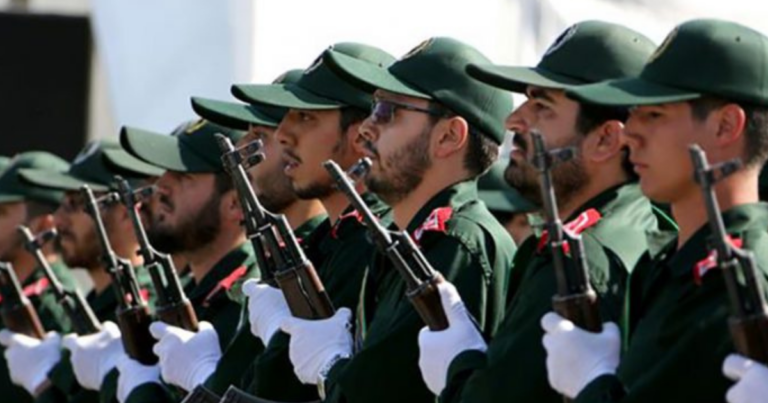
Liberals finally list Iran’s IRGC as a terrorist entity 

Canada has finally listed Iran’s Islamic Revolutionary Guard Corps as a terrorist organization under Canada’s Criminal Code, six years after the House of Commons initially called for such a listing.

Media reports began to circulate that the Liberals would list the IRGC as an official terrorist group hours before the official announcement.

During the official announcement, Minister of Foreign Affairs Mélanie Joly warned Canadians in Iran to return to Canada immediately. She also said that anyone planning to go to Iran should not.

“With today’s decision, there’s a much higher risk of arbitrary detention for Canadians who go to Iran,” she said in French.

Public Safety Minister Dominic Leblanc said that Canada “has also designated the Islamic Republic of Iran as a regime that has engaged in terrorism and systematic or gross human rights violations.”

The announcement bars thousands of senior Iranian government officials and top IRGC members from entering Canada. Those who are already in Canada can be investigated and removed, said Leblanc. 

Listing a group as a terrorist organization grants the police the ability to charge anyone who supports the group financially or materially. Police can also freeze supporters’ assets. However, Justice Minister Arif Virani clarified that Canadians would have to know where the money’s going and that it is intended to support terrorist activity to be charged.

The calls to list IRGC as a terrorist entity intensified in January, following the anniversary of the downing of flight PS752, which claimed 176 lives, including 55 Canadian citizens and 30 permanent residents.

In May, MPs voted 327 to 0 in favour of a motion calling for the designation of the IRGC as a terrorist entity and the expulsion of an estimated 700 Iranian agents operating in Canada.

Conservative leader Pierre Poilievre renewed his call for Trudeau to “ban” the IRGC terrorist group on Tuesday.

However, Leblanc said that the decision to list an organization as a terrorist entity wasn’t made because of the calls. 

“It’s made based on the advice of our security services. It’s made based on foreign policy considerations… It’s a deliberative process. It’s a threshold that has to be met under the Criminal Code of Canada,” said Leblanc. “I’m told there’s literally a monthly review by the security agencies of different entities around the world, and whether or not the threshold has been met and whether or not they’re in a position to recommend to the government the listing under the criminal code.”

Poilievre’s renewed call came just a day after the Iranian Justice Collective urged the Liberals to sanction Iranian officials who sentenced Iranian rapper Toomaj Salehi to death for criticizing the Islamic Republic. 

Nazanin Afshin-Jam, an international human rights and democracy activist and member of the Iranian Justice Collective, said that the House of Commons called for the IRGC to be added to the terrorist list six years ago, and reiterated this decision just a few weeks ago.

“They are the ones that are responsible for beating women on the streets that are not wearing a veil, dragging them into police vans, raping them, sending them to jail, and God forbid, sentencing them to death. They are the representation of everything that is evil in the world,” she said.

She added that the IRGC is the biggest state sponsor of terrorism in the world, providing the most funding to Hamas, Hezbollah, and the Houthis.

Conservative MP and Shadow Minister of Foreign Affairs Michael Chong criticized the Liberals for moving at a snail’s pace in listing the IRGC as a terrorist entity.

“Because of the government’s inaction over the last six years, the Iranian regime’s capabilities here in North America have only increased,” said Chong.

Chong said that the information being leaked by the CBC before the Liberals’ announcement would have allowed the IRGC to avoid the upcoming sanctions by moving assets.

“The manner in which the government is making this announcement is another example of their complete abdication of responsibility to protect this country’s national security,” he said.

The Faulkner Show | Nationwide anti-mass immigration protests planned for Canada Day

Poll after poll shows Canadians have had enough of the Trudeau government’s mass immigration plan, but it doesn’t look like the government will be stopping any time soon. In fact, it was revealed today that Canada’s population reached 41 million people in the last quarter, almost exclusively driven by international migration. How can Canadians show their dissatisfaction with the government’s immigration plan?

On the latest episode of The Faulkner Show, Harrison sits down with Ethan Duggan, the leader of Take Back Canada, an organization that is planning to host nation-wide peaceful protests against mass immigration in Canada.

Tune into the latest episode of The Faulkner Show.

Follow Take Back Canada on X

Take Back Canada website

BC United candidate abandons party for BC Conservatives

British Columbia’s official opposition, BC United, continues to bleed support to the provincial Conservatives. 

This time the struggling party lost a candidate to the BC Conservatives as the fledgling party positions itself as the main competitor to the BC NDP.

On Wednesday, former District of Sechelt councillor Chris Moore abandoned BC United to run as a BC Conservative after multiple BC United MLAs ditched the party for the Conservatives.

The BC Conservatives celebrated Moore’s decision to join the party.

“Chris has an outstanding record of service to this community and will be a strong advocate for the people of Powell River-Sunshine Coast,” said BC Conservative Leader John Rustad. 

Moore said that the BC Conservatives are the only way that the BC NDP would be displaced in the coming provincial election.

“I believe that the NDP have done little to address serious problems such as affordability, crime and healthcare,” said Moore.

“I believe the BC Conservatives under the leadership of John Rustad are the only way we can get BC back on track.”

Moore marks another prominent BC United member to defect from the party and join the BC Conservatives, along with MLAs Lorne Doerkson and Elenore Sturko.

In a statement released by BC United, the party claims that Moore had disagreed with BC United attempting to compete against the BC Conservatives and how they’ve criticized the rival centre-right party.

“Chris had fundamental differences with BC United in terms of not competing against the BC Conservatives and defending BC United from criticisms levied by political opponents,” reads BC United’s post on X. 

“Additionally, Chris felt that BC United releasing factual information on extremist candidates within John Rustad’s BC Conservatives would hurt his chances of winning his own seat, which has been held by the NDP since 2005.”

After the BC Conservatives had recruited former MLA Sturko to join their party, BC United assembled a nine-page document to attack Sturko’s crossing of the floor, trying to frame the lesbian MLA as opportunistic for joining an “anti-LGBTQ+ rights” party.

The upcoming BC election will be held on Oct. 19 of this year.

The polling aggregation site 338Canada currently projects the BC NDP winning a majority government, with the BC Conservatives forming a solid official opposition, and BC United losing all of their legislative seats.

Majority of Canadians say it’s time for Trudeau to step down: poll

From out west to Atlantic Canada, most Canadians would like to see Prime Minister Justin Trudeau step down.

Ipsos polling asked Canadians ahead of the House of Commons summer break whether or not they would like to see Trudeau return in the fall, and 68% of respondents said it was time for him to resign.

That sentiment was felt highest in Alberta (79%) and Atlantic Canada (76%). 

“This is as bad as we’ve seen it for Trudeau. It’s close to rock bottom,” Ipsos CEO Darrell Bricker told Global News, who requested the poll. 

Ipsos conducted the poll between June 12 and 14, speaking with 1,001 Canadians about what an election outcome might look like if it were held tomorrow. 

Respondents revealed that the Conservatives would snag a “comfortable victory” with 42% of the decided vote.

The Liberals came in second, but with nearly half the support at 24% and the NDP trailed behind at 18%.

While the poll revealed that Trudeau may be single-handedly “dragging the success of his party down with him,” the opposite proved true for Conservative leader Pierre Poilievre.

Poilievre’s popularity “has grown his lead even ahead of his own party,” said Ipsos, with almost half of Canadians (44%) saying he would make the best prime minister. 

Another cohort of 75% said they want to see another party take power regardless of who they are, while only 25% said that the Liberals “deserve reelection.”

“What’s worse is that they have thrown everything they can think of at changing this dynamic,” said Bricker. “Nothing has worked. It’s frozen in solid.”

Yet Trudeau himself dismissed the opinion of the vast majority of Canadians, telling CBC’s David Cochrane in an interview that they weren’t in “decision mode right now.”

The sentiment appears to be championed by the prime minister’s inner circle as well, with Trudeau’s Treasury Board President Anita Anand telling reporters to look at his policy achievements, not public opinion. 

“We’re not focused on the polls. We’re focused on the fact that we need to continue to put forward dental care, pharmacare, housing supports, supports for families and students,” Anand said on her way into cabinet Tuesday.

Deputy Prime Minister Chrystia Freeland responded to plummeting poll numbers with similar messaging. 

“This is a really, really challenging time in the world, in the global economy,” Freeland told reporters on Tuesday. “We’re the people right now whose job it is to help steer our country through this.”

Freeland’s answer echoed that of Trudeau’s from his CBC interview days before, when asked whether or not he bore any responsibility for the angry mood of the country. 

“Everywhere, people are struggling,” responded Trudeau, before saying “we are doing better than most countries.”

However, some Liberal backbenchers appear more in tune with the majority of Canadians. 

Liberal MP for Charlottetown Sean Casey was also asked on Tuesday whether his party can change course for the better before an election. 

“I don’t know,” said Casey, “We’re doing good things. It seems as though the electorate has tuned out. I don’t know what we can do except to continue to do good things.” 

While the next federal election won’t be until October 2025, the riding of Toronto–St. Paul’s is slated for a byelection next week. 

It’s been a Liberal stronghold since the 1990s, however, for the first time in nearly 30 years the Liberals are at risk of losing a key political battleground.  

According to the latest 338Canada poll, the Liberals are projected to win the riding, but they are only ahead of the Conservatives by a small margin, who have steadily been gaining favourability in Toronto – St. Paul’s since 2019.