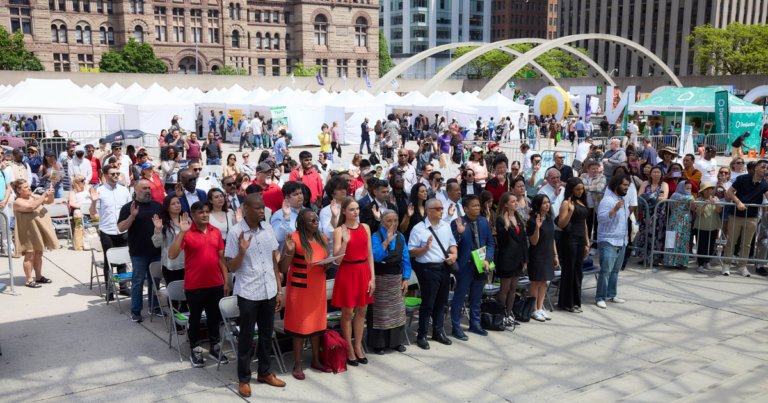
Immigration is top of mind for Canadian voters, eclipsing even climate change as one of the most pressing issues at the polls.
This is according to a national survey by Abacus Data, which conducted a poll in early June following the Bank of Canada’s interest rate cut, asking Canadians to rank their top social and economic issues.
According to the poll, immigration overtook climate change as the fifth top issue sometime in April, with 26% of Canadians polled ranked immigration as a key priority.
The top issue remains the rising cost of living with 73% of Canadians ranking it as their highest priority, followed by housing affordability at 47%, healthcare at 44% and the economy generally at 34%.
Abacus Data also found that the Conservative party has gained a substantial lead following the recent interest rate cut, leaving the Liberal party’s popularity dwindling to its lowest since 2015.
Federal vote intention for the Conservatives sits at 42% with the Liberals holding onto a meager 22%. Another 19% of Canadians said they would be voting for the NDP.
Canadians also largely preferred the Conservatives’ approach to immigration, economic management, crime prevention and international relations, particularly regarding China and Russia.
A recent Leger poll also revealed that recent immigrants were expressing apprehension over high immigration levels, potentially swaying their allegiance towards the Conservatives.
This sentiment is further compounded by the perception that the Liberal party’s current immigration strategy is overly permissive, with 42% of immigrant respondents advocating for a more measured intake.
The Conservative party has proposed a plan to align immigration numbers with the availability of jobs and housing, a move that could see a reduction in immigration. However, Conservative Leader Pierre Poilievre has not provided an exact immigration target.
Conservative immigration critic Tom Kmiec recently voiced a commitment to establishing what he called sustainable immigration levels that reflect the country’s capacity for integration without providing a number.
“Whatever it comes out to, that will be the number,” Kmiec said on the Andrew Lawton Show in April. “If it’s lower, it’s lower. If it’s higher, it’s higher.”
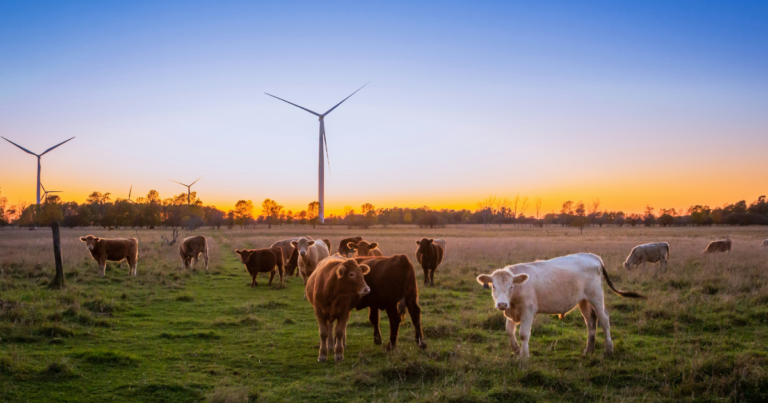
Prime Minister Justin Trudeau’s capital gains tax will have far-reaching effects, including for the agriculture industry.
The Liberals’ upcoming capital gains tax hike will increase taxes by 30% on family farms, according to the Grain Growers of Canada.
The 2024 budget tabled by the Liberals raises the inclusion rate for capital gains tax from 50% to 66% for Canadians on amounts exceeding $250,000, coming into effect on June 25.
Finance Minister Chrystia Freeland claimed the capital gains tax increase is a “fair” way to fund Liberal spending that would minimize harm to low and middle-income Canadians.
The Grain Growers of Canada’s research says otherwise. The group found that the average grain farm in Canada is family-owned and operated. However, family-owned farms have already been decreasing, falling 2% between 2016 and 2021 and the capital gains tax increase could make it worse.
“The hike targets farmers’ retirement plans, complicates intergenerational transfers, and threatens the long-term viability of family farms across the country,” said Kyle Larkin, Executive Director of Grain Growers of Canada.
The national voice for Canada’s grain farmers partnered with farm tax accountants to highlight case studies from several provinces; however, they emphasized that there was no “average” farm.
Farmers who bought their land in 1996 and decided to sell in 2023 would face increased capital gains taxes of 31% in Alberta, Saskatchewan, Manitoba, Ontario, and 30% in Quebec.
The average capital gains tax paid by farms in the five provinces would be $4,621,903, an increase of $1,089,993 thanks to the Liberals’ change.
There will be a lifetime capital gains exemption for those who sell their small businesses or farms by up to $1.25 million.
“These farm profiles assume that the seller has their full lifetime capital gains exemption available for use. For many farmers, they may have already used up a portion of it in previous tax years,” reads the research.
Andre Harpe, the chair of the Grain Growers of Canada and an Albertan grain farmer, said that despite the Liberals labelling their 2024 budget as “Fairness for Every Generation,” the change would actually burden the next generation of farmers.
“With over 40% of farmers nearing retirement over the next decade, this tax increase introduces substantial uncertainty into their retirement planning,” said Harpe.
Grain Growers of Canada noted that farmers are often touted as “cash poor, asset rich.”
“Farmers regularly invest in their operations by expanding their acreage, upgrading grain bins, and purchasing the newest and most innovative equipment, such as tractors or combines,” said the Grain Growers of Canada.
Larkin said that the tax increase would also increase the cost of farms dramatically, pricing out many.
“This puts the family farm at risk, as the only ones that will be able to afford to pay millions of extra dollars will either be corporate farms or development companies,” said Larkin.
The number of farmers in Canada has already been decreasing drastically over the past few decades as they become older and fewer in number, according to research done by RBC.
In 2001, 346,000 Canadians, with an average age of 50, farmed 166 million acres. This number has decreased every five years, reaching its lowest point in 2021 of 262,000 farmers with an average age of 56 that farmed 153 million acres.
Furthermore, the research predicts that by 2033, 40% of Canadian farm operators will retire. All of these farmers’ retirements will be around 30% less valuable, thanks to the capital gains tax increase.
Leaders in the tech and healthcare industries have called on the Liberals to cancel their increase, warning that tech and healthcare professionals alike will flee the country. Alberta joined the chorus, warning that the policy would risk “weakening our standing in the world and the standard of living of our people,” according to Alberta’s Finance Minister Nate Horner.
Many Canadians added their voice to the growing opposition, fearful that the tax increase would affect their already poor access to healthcare.
Larkin requested that the Liberals exempt intergenerational transfers from the capital gains tax inclusion rate, allowing them to be taxed at the original rate.
“This will ensure that farmers’ retirement plans remain secure, and that the next generation can afford to take over, enabling family farms to continue being the backbone of Canada’s agricultural sector,” he said.
Canadians from coast to coast and various industries are calling on the Liberals to cancel their capital gains tax hike.
The Liberals don’t seem interested in answering the call.
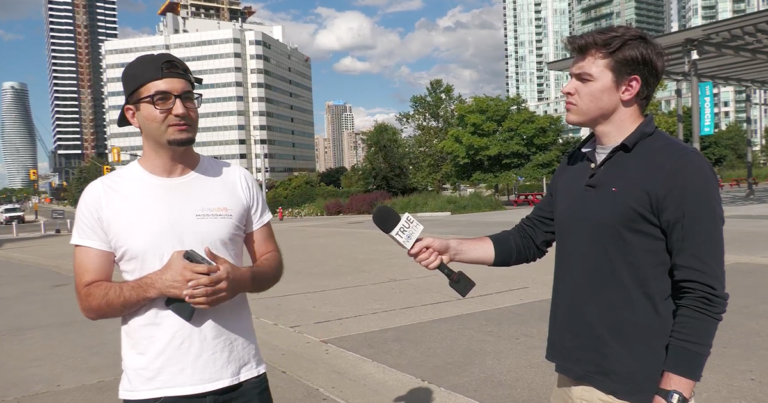
Harrison Faulkner went to Mississauga to ask Canadians what they think about mass immigration. The Trudeau government has forced record levels of immigration over the past 6 years and Canadians have had enough. Polling indicates that a majority of Canadians, including immigrants, want to see the government reduce immigration levels.
What did people in downtown Mississauga have to say?
Pandemic rules are largely a thing of the past, but some Calgarians have found a new reason to snitch on their neighbours.
Following a breach in one of the city’s water feed mains, the City of Calgary implemented level Stage 4 water restrictions, which bar residents from watering outside and filling hot tubs and pools.
But nearly 2,000 Calgarians think their neighbours aren’t doing an adequate job of following the rules and have called the city bylaw office to complain.
“Bylaw officers continue to take an education first approach to complaints under the outdoor water restrictions,” Coby Duerr, deputy chief of Calgary Emergency Management, said in a briefing Monday afternoon.
Duerr said Calgary bylaw officials have received 1,976 calls since June 6, the day after the feed began leaking. Of those, 117 are pending investigation. Officers have issued 552 written warnings and 685 verbal warnings. Two violation tickets were issued to corporations.
Calgarians can submit a suspected water misuse complaint to city bylaw online or by calling 311. The city says it is “encouraging” such reports.
Under stage 4 water restriction, Calgarians can’t wash outdoor surfaces such as buildings, sidewalks and driveways. They are also barred from filling fountains or other decorative water features, washing cars, or using water for construction purposes like dust control.
The city is also recommending a number of indoor water saving measures such as using dishwashers and washing machines only with full loads, limiting showers to three minutes or less, turning off humidifiers and ice machines, and turning off the tap when brushing teeth or shaving.
City officials said Monday that the Calgary Stampede will not be cancelled, but encouraged all tourists to take short showers and to take laundry home.
Calgary Mayor Jyoti Gondek has said the city doesn’t know why the feeder main began leaking.
Initially, the city said the repairs would take about a week, but that estimate grew to three to five weeks after the city announced Friday that the main requires repairs in an additional five locations.
In an emergency briefing Monday morning, Gondek said all the repairs are being done at the same time. She also said all necessary parts are either on the way or have already arrived in Calgary.
The repairs are ongoing in the northwest Calgary neighbourhoods of Bowness and Montgomery.
The emergency is also impacting Airdrie, Strathmore and Chestermere.
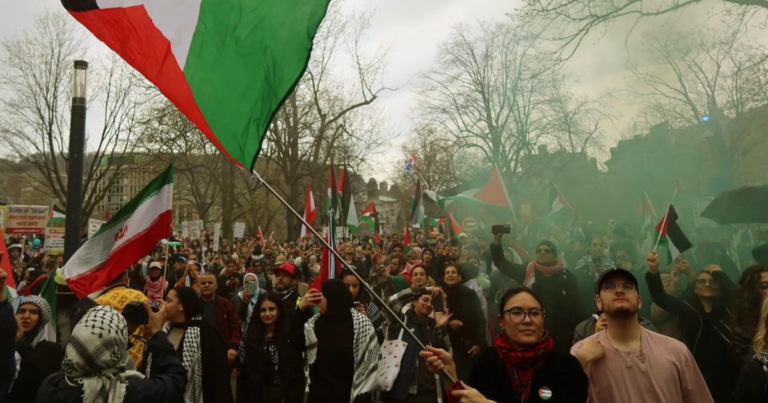
Montreal police announced an investigation into the McGill encampment’s “revolutionary” youth summer camp with lessons on “Islamic resistance” and a poster showcasing Palestinian militants brandishing machine guns.
Montreal police announced their investigation at a Monday afternoon press conference.
Montreal police inspector David Shane said the encampment poster in question, “which invites young people to take part in workshops at the camp,” is “a cause of concern, as it features an image of an assault rifle.”
SCREENSHOT: SPHR poster promoting an anti-Israel “summer camp.” The description contains multiple typos. Instagram
“We’re investigating the matter and we’ve been in contact with the Royal Canadian Mounted Police,” he noted. “We understand the fears this publication may arouse.”
As previously reported by True North, a “Youth Summer Program” will run from June 17 to July 12 at the McGill encampment, a place the organizers now refer to as “Tiohtià:ke Popular University.”
The camp is being organized by Solidarity for Palestinian Human Rights McGill and Solidarity for Palestinian Human Rights Concordia.
The camp’s first week, starting Monday, will be all about “the history of Palestinian resistance,” and will feature a lesson on so-called “Islamic resistance.” The second week’s theme is set to be “the ongoing Nakba.” Nakba refers to the Palestinian experience when Israel was created in 1948.
The third week will be about the “different fronts of the movement,” with the fourth week covering “media after Oct. 7.”
Several prominent Canadian politicians have condemned the summer camp.
In a social media statement, Conservative Leader Pierre Poilievre called the organizers’ glorification of Hamas an “abomination” and called for the camp to be shut down.
“This glorification of the genocidal terrorism of Hamas is an abomination,” said Poilievre. “Antisemitism has become a plague on Canadian university campuses. Shut it down.”
This glorification of the genocidal terrorism of Hamas is an abomination.
Anti-semitism has become a plague on Canadian university campuses.
Liberal Immigration Minister and Montreal-area MP Marc Miller also denounced the summer camp as hateful.
Enough is enough, this is hate speech and incitement to hate, pure and simple! Freedom of expression and the right to protest have their resonable limits and they have been reached. De-escalation at McGill has clearly failed. This needs to end! @SPVM@mcgillupic.twitter.com/u9RYOGSE7f
— Marc Miller ᐅᑭᒫᐃᐧᐅᓃᐸᐄᐧᐤᐃᔨᐣ (@MarcMillerVM) June 14, 2024
Miller’s colleague, Liberal MP Anthony Housefather also joined in the condemnation.
The encampment was a violation of @mcgillu rules from Day 1. McGill has asked the police to take action and i support its request. it is time for @spvm to enforce the law. This is incitement. This is glorification of violence. This is hate. https://t.co/Gsl24CNOuE
Others including Quebec’s CAQ higher education minister, Pascal Dery, called the camp “very disturbing, even alarming.”
“The situation is escalating, and it has to stop. Freedom of expression is one thing, but this is provocation, explicit incitement to violence, even indoctrination,” she wrote in French. “I repeat: this camp must be dismantled.”
While Dery and her boss, Premier Francois Legault, have called on the encampment to be dismantled, the police have opted not to clear it with McGill having failed in its efforts to get an injunction.
The “revolutionary” summer camp was also covered by international news outlets, including British newspaper the Guardian and Israel’s Jerusalem Post.
In a statement to True North Friday, McGill University said the anti-Israel summer camp was “only the latest escalation in SPHR’s long-standing strategy of intimidation and fear.”
McGill added that “imagery evoking violence is not a tool of peaceful expression or assembly” and that the university reached out to municipal, provincial, and federal public safety authorities to flag SPHR McGill’s post and other recent activities “as matters of national security.”
The university also said it would increase the presence of security staff near the encampment and elsewhere on campus, and continue to pursue legal action against SPHR and internal disciplinary measures.
SPHR McGill previously openly praised the Oct. 7 attack against Israel as “heroic” and “monumental” while celebrating the launching of rockets and taking of hostages.
SCREENSHOT: SPHR McGill celebrates Hamas’ attack on Israel
SPHR also posted a graphic featuring a photo of a man smashing windows on the eve of the anniversary of Kristallnacht, a 1938 wave of violent riots against Jewish businesses, synagogues and homes in Nazi Germany.
In December, SPHR was ordered to stop using the McGill name. The group has, however, chosen not to comply and continues to use the university’s name to this day.
Prime Minister Justin Trudeau won’t say whether or not Liberal MPs were implicated in the bombshell NSICOP report on foreign interference.
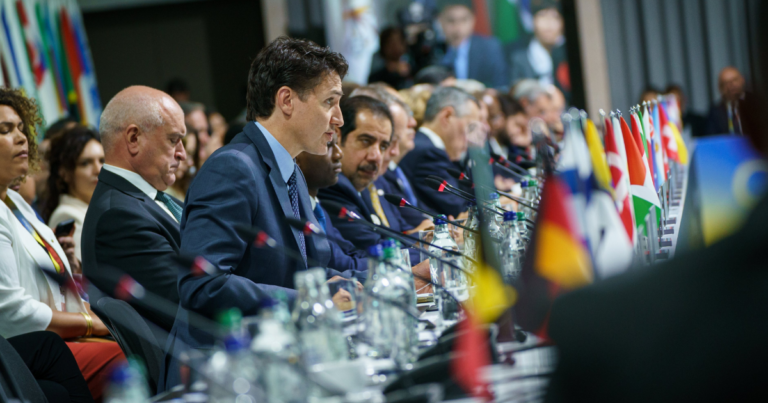
Attending this year’s G7 conference held in Italy, Trudeau was asked several questions about the findings in NSICOP’s Special Report on Foreign Interference in Canada’s Democratic Processes and Institutions.
The report concluded that several MPs had collaborated with foreign governments for personal gain.
Upon being asked whether or not any Liberal MPs were named as witting or semi-witting participants in aiding foreign governments, Trudeau boasted about his government’s record in creating NSICOP in 2017 and establishing the public inquiry on foreign interference.
“It’s important that Canadians have confidence in our ability collectively as a democracy to defend the institutions, the processes around our elections and our democracy,” said Trudeau.
Both NDP leader Jagmeet Singh and the Green Party leader Elizabeth May have read an unredacted version of the report and confirmed that none of their MPs had been named, leaving Trudeau as the only party leader who has read the report and not given a similar reassurance.
When pressed further, Trudeau said that he didn’t agree with some of the conclusions that NSICOP had drawn in their report, suggesting that the committee had jumped to conclusions.
“Many of those conclusions and reports are varied in the conclusions they draw, in the level of assumptions and conclusions they make around what they say,” said Trudeau.
The prime minister went on to justify his interpretation of events by pointing to the wildly different perspectives that the NDP’s Singh and Green Party’s May drew from their reading of the report.
“The government has already highlighted there are a number of the conclusions of the national security and intelligence committee of parliamentarians report that we don’t entirely align with. And that actually is demonstrated by the fact that two party leaders in Elizabeth May and Jagmeet Singh who read that report in its entirety come to differing conclusions on the interpretation of what it means.”
While both Singh and May were given access to a classified version of the NSICOP report, May concluded that the allegations were overblown, while Singh said that reading the report made him more concerned about foreign interference, not less.
Trudeau and Singh have attacked Conservative Leader Pierre Poilievre for refusing to read the unredacted version of the document, as the Tory leader maintains that he would be limited in his ability to oppose the government otherwise.
Alberta has declared yet another one of the Liberals’ environmental initiatives unconstitutional.
In a statement released on June 14, Environment Minister Rebecca Schulz argued that the federal Liberals had no right to dictate the management of Alberta’s land or resources.
“Any plan for our province must reflect the social, economic, and environmental values of Albertans, not Ottawa; especially when Ottawa’s ultimate goal is to sterilize our land and resources, which hinders economic opportunity and resource development projects before they can even be proposed,” wrote Schulz.
The Liberals introduced the Nature Accountability Act in Parliament a day before Schulz’s statement. The bill provides steps to achieve Canada’s vision for 2050, including the 2030 nature strategy.
The strategy seeks to implement all 23 Kunming-Montréal Global Biodiversity Framework targets.
Some of the 23 targets include restoring 30% of all degraded ecosystems and conserving 30% of land, waters, and seas. Other targets include spending at least $200 billion annually on biodiversity and ensuring “gender equality and a gender-responsive approach for biodiversity action.”
One target that the provincial and federal leaders may find agreement on is the sixth target, which would reduce the introduction of invasive alien species by 50%. Alberta recently raised the fines for various methods that historically brought invasive species into the province.
Schulz argued that the Liberals’ nature strategy disregards provincial viewpoints and exacerbates concerns about federal encroachment on provincial jurisdiction.
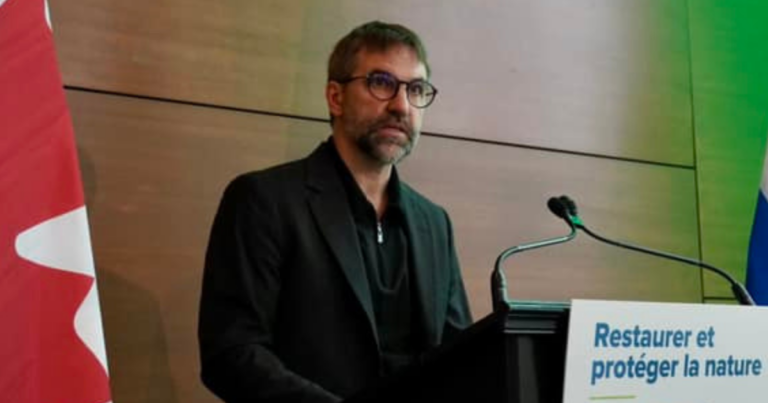
“This report is yet another example of Minister of Environment and Climate Change Steven Guilbeault blatantly ignoring the Canadian constitution and pretending to engage with provinces to carry out his radical, ideological agenda,” said Schulz.
According to Schulz, 76% of Canada’s landmass is provincial and territorial, while only 6% is federal lands.
“Despite this, the federal government is setting targets and making grand plans that they cannot execute, as it is once again outside of their area of jurisdiction,” said Schulz.
The Nature Accountability Act aims to establish a national biodiversity strategy and action plan, requiring regular progress reports and establishing an advisory committee.
Guilbeault confirmed while speaking in Parliament that Canada is the second country in the world to introduce such an act, following Chile.
“Ottawa needs to stay in its own lane. Albertans — including communities, Indigenous people, farmers, ranchers, hunters, resource workers, and stewards of our beautiful province — will decide how to best manage provincial lands,” said Schulz.
“Steven Guilbeault lied to Canadians. He must resign, and if he won’t, then Justin Trudeau must fire him and start telling Canadians the truth,” reads the federal Conservatives’ news release.
Justin Trudeau has refused to say whether any Liberal members of Parliament are implicated as collaborators with foreign governments in the unredacted NSICOP report. True North’s Andrew Lawton discusses with law professor Ryan Alford, who has a lawsuit against the government seeking immunity for parliamentarians who divulge classified information within parliamentary proceedings.
Also, Canadian Taxpayers Federation Alberta director Kris Sims return to talk about why the government seems to wish its carbon tax calculations were a state secret.
Plus, most of Canada’s poor are white, so are DEI programs missing the mark? David Hunt from the Aristotle Foundation joins to discuss his findings.
Pro-Hamas McGill encampment organizers will be running a “revolutionary” summer camp for youth that will include a lesson on “Islamic resistance.”
Plus, it will cost over $750 billion for Prime Minister Justin Trudeau to fulfill his pledge to build four million new homes by 2031. Is Trudeau’s housing pledge yet another broken promise?
And nearly 20% of Canadians now know someone relying on food banks.
Tune into The Daily Brief with Lindsay Shepherd and Isaac Lamoureux!
Canada’s top soldier is warning that commitments to defence spending are not happening “fast enough” for the global threats that the country is facing.
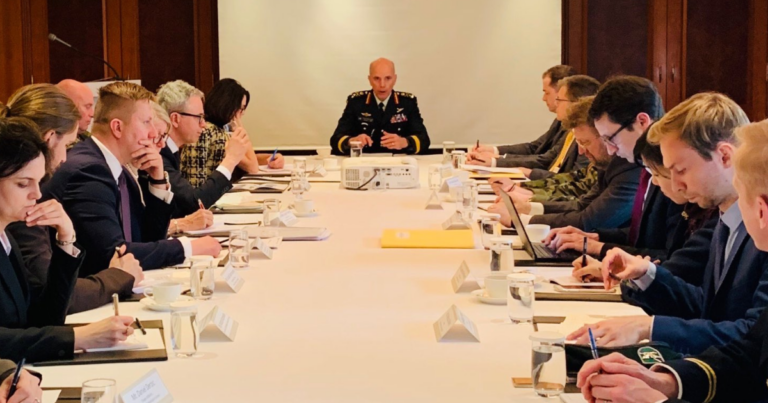
Chief of the Defence Staff Gen. Wayne Eyre told Global News host Mercedes Stephenson that while he’s “cautiously optimistic” about the Canadian Armed Forces being on the “upswing” with defence spending, there is still a long way to go in terms of recruitments and national security.
“There still remains lots of work to do,” said Eyre.
Foreign interference and domestic extremists were among the threats Eyre said Canada is up against, as well as technological advancements by Russian and Chinese forces.
According to Eyre, the time for Canadians to remain “naive” about these threats is over.
“We’ve been relatively isolated here, thankfully, in this country — (we’re) protected by three oceans and a superpower to the south,” he said. “Well, security is becoming global. We live in a globally-integrated threat environment, and we need to be prepared for it.”
Eyre warned of attempts already made by hostile foreign states, most notably China, to recruit current and former CAF members to gain information that would leave the country vulnerable.
China has been “aggressively” targeting western military personnel to help train fighter jet pilots in its People’s Liberation Army, according to Five Eyes intelligence.
The House of Commons passed new legislation last week to add military intelligence to the list of classified information that is illegal to share with foreign state actors.
“We know we’re a target,” said Eyre. “We know our members have some coveted information, skills, experience. And so it’s something we have to be very much on the lookout for.
“This is real. The threat is real,” he added.
Eyre described his view of Canada’s military to be “a history of unpreparedness,” after 40 years of service.
He said that Canada would have to “scramble” in rising to the occasion of these threats.
He believes this is part of the prolonged period of peace Canada has been able to enjoy, saying that from 1998 to 2020 the country hasn’t felt pressure to compete with other powers.
“Well, history is back, and we need to take a long-term view of history and have that sense of tragedy that goes along with it,” he said in the Global interview.
“History has not been kind to many countries over the arc of conflict.”
Eyre would not comment on whether or not he thought the Trudeau government was prepared for these renewed threats.
“That’s not my place to say,” he said.
Eyre said he’s warned the government that it must increase the CAF’s readiness before 2030, as China and Russia both continue to build up their military forces.
“We need to, as our top national security objective, avoid great power war,” he said.
“That’s best done through the ability to collectively deter adventurism, expansionism, imperialism. And so that is the endpoint that we are looking at internal to the Canadian Armed Forces: everything we can do to build up our deterrence … by that time.”
He said that pursuing NATO targets will give Canada a collective advantage but that if Canada continues to fail in meeting its required spending of 2% of its GDP, the United States will further grow angry and the country will lose its credibility on the world stage.
“We need to ensure that we maintain our influence, our credibility with that group, continue to cooperate, continue to be able to interoperate around the world with our closest allies,” said Eyre.