A day after the Ontario government called on Toronto to end its bid for decriminalization, Ottawa turned down Toronto’s request, citing concerns about its effectiveness and threats to public safety.
In a statement released on Friday, Minister of Mental Health and Addictions Ya’ara Saks explained that the proposal “does not adequately protect public health and maintain public safety.”
Saks highlighted issues with the feasibility of law enforcement implementing the proposed model, the protection of youth, and the lack of support from key stakeholders, including the Province of Ontario.
This decision comes shortly after the Ontario government demanded that Toronto reversed course labeling decriminalization as “misguided” and “disastrous.”
In a letter to Toronto’s top doctor, Dr. Eileen de Villa, Health Minister Sylvia Jones and Solicitor General Michael Kerzner said the province would oppose any effort to decriminalize drugs.
Premier Doug Ford echoed this sentiment in his correspondence to Prime Minister Justin Trudeau on Thursday.
“As we’ve already indicated to Toronto Public Health, we do not, and never will, support their application to decriminalize illegal drugs,” Ford stated. “Please consider this our formal confirmation to the federal government that we are 100 per cent opposed to their proposal.”
Federal Conservative Leader Pierre Poilievre also joined the chorus of opposition, urging the prime minister to reject Toronto in his own letter.
Since British Columbia reversed course on its decriminalization pilot, public support for it has faltered
In response to the opposition, de Villa defended the request.
“At the end of the day, I will continue to do my job as a physician to provide the advice and then to leave the decision-making to the elected officials,” de Villa told CP24 on Thursday.
The City of Toronto has yet to respond officially to the federal government’s decision.
Premier Ford has since expressed approval of Ottawa’s decision on X.
A panel of multimedia experts have been selected to advise Heritage Minister Pascale St-Onge as she renews what the future role will be for the CBC/Radio-Canada amid plummeting revenues and relevancy.
According to the Canadian Heritage department, the panelists will offer policy advice on funding and governance, having already completed its consultation with the Canadian public.
“Canadians need a strong, innovative and independent public broadcaster that is ready to meet the challenges of this period of transformation and upheaval in news and content creation,” said St-Onge in a statement Monday.
The panlists who’ve been selected to “modernize” the CBC were picked for their diverse perspectives, which St-Onge says will help with “adapting to our rapidly changing broadcast and digital landscape.”
CBC president Catherine Tait has been calling for a long-term multi-year financial agreement from the federal government, akin to what the BBC has with the British government.
“Sustainable long-term funding is one of the solutions” to combatting the “crisis” media face,” Tait told the House of Commons committee during a recent appearance, bemoaning the competition the state broadcaster must face from international tech giants.
“I’ve been in this business 40 years and never before have I seen so great pressure on our domestic industry, and it is very worrisome,” said Tait. “We see people disappearing, companies disappearing, production houses shutting down.”
Tait recently came under fire over giving out $14.9 million in executive bonuses while laying off CBC staff.
When she refused to divulge information about the bonuses at a recent heritage committee, it was ultimately shut down by Liberal MPs.
Tait predicts the CBC will have a shortfall of $20 million for the 2024-25 fiscal year, despite laying off hundreds of employees and eliminating 205 vacant positions over the past several months.
Aside from the $1.2 billion the broadcaster gets from the federal government annually, it also receives money through advertising, subscriptions and has other commercial enterprises.
“In the past CBC/Radio-Canada had an employee body of about 10,000. Today we’re at 7,500,” Tait said. “Ninety per cent of our budget is dedicated to our workforce, so if something hits us, an economic hardship or financial hardship, the only lever we have is through workforce adjustment.”
However, critics of the CBC don’t see it that way.
“The Trudeau government doesn’t need a bunch of panelists to talk about the role of the CBC,” Franco Terrazzanno, federal director Canadian Taxpayers Federation told True North Wire. “The Trudeau government needs to stop taking so much money from taxpayers and completely defund the CBC.”
Conservative leader Pierre Poilievre has said that he would defund the public broadcaster, if elected.
“Common sense Conservatives will defund the CBC and we will restore balance for small, local, and independent voices in the media that have been crushed after nine years of Justin Trudeau,”
Sebastian Skamski, a spokesperson for Poilievre’s office, told True North.
“After nine years of Justin Trudeau, the CBC has become the propaganda arm of the Liberal Party and they are now being used as a political tool for him in the dying days of his flailing government,” said Sebastian Skamski, a spokesperson for Poilievre’s office.
The Trudeau government said it plans to redefine the CBC’s role ahead of the next federal election, slated for October 2025.
“The CBC already receives more than $1 billion a year to be the Prime Minister’s personal stenographers instead of fulfilling their basic mandate to Canadians. Amid plummeting viewership and growing irrelevance to Canadian audiences, it is clear that Justin Trudeau’s handpicked CEO for the CBC is driving the broadcaster into the ground,” said Skamski.
“Despite poor performance, political bias, and the announcement of layoffs for hundreds on employees, she continues to give out millions in taxpayer funded bonuses to executives and herself.”
Among the panelists are University of Southern California’s associate professor of communication and journalism Mike Ananny and Jennifer McGuire, managing director for Pink Triangle Press.
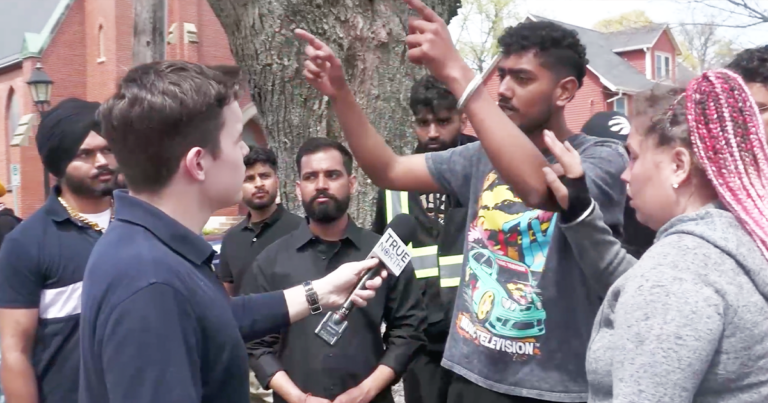
Harrison Faulkner went to Charlottetown, P.E.I to report on the ongoing Indian student protest taking place in the city. For over a week, protesters have been demanding that they be given permanent residency in the province after P.E.I changed their rules to try and slow down the population growth of the province.
After a viral episode of Ratio’d on Monday about the protest, Harrison decided to follow up his reporting by going to the protest and speaking with the demonstrators. It didn’t take long before things fell off the rails and protesters had a meltdown upon seeing him.
Watch it all unfold on the latest episode of Ratio’d with Harrison Faulkner.
Conservative Leader Pierre Poilievre is requesting that the Trudeau government suspend all federal gas taxes to give Canadians a “summer break” from inflation.
“The vast majority of Canadians are struggling just to eat, heat and house themselves, a vacation is not even in the cards,” said Poilievre.
“If they do go on a family vacation, they’re forced to pay $2 a litre here in British Columbia, and it’s not much better anywhere else.”
Poilievre made the request while speaking at a gas station in Vancouver on Thursday, asking for a pause from Victoria Day to Labour Day.
“Justin Trudeau may be able to fly off to a luxury resort for a $230,000 taxpayer-funded vacation, but most Canadians are having to scale back or cancel their road trips after Trudeau’s carbon tax made fuel and groceries unaffordable,” said Poilievre in a press release.
“Canadians deserve relief, not more taxes. Families should be able to afford a simple road trip,” he added.
According to the Conservatives’ estimates, removing all federal taxes on gas would reduce the price by 35.6 cents per litre on average across Canada, saving Canadian families around $670 over the suggested suspension period.
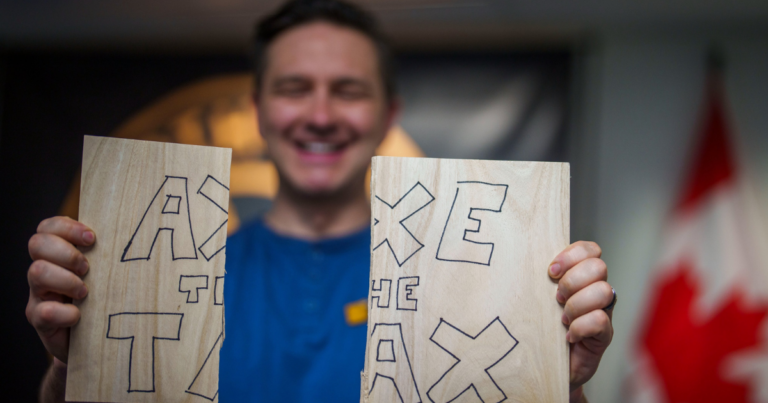
Poilievre has been beating his party’s ‘axe the tax’ drum for some time now, saying that the federal government could recoup any losses from its removal by cutting back on hefty consultant fees, as evident by the ArriveCan application scandal.
“If you wonder how we could pay for it, this prime minister is spending $21 billion dollars on consultants,” said Poilievre. “Money that could be in the pockets of Canadians.”
“Conservatives will axe the tax on everything for everyone in a carbon tax election, but until that can happen, Trudeau must adopt this common-sense measure to give Canadians a summer break,” reads the party’s press release.
Some provinces have already removed provincial gas taxes temporarily to alleviate financial stress, a pause that was set to expire at the end of June but has since been further extended until at least the end of the summer.
Ontario announced it would be extending the pause until the end of this year in its latest budget and Manitoba extended its gas tax cut until the end of September.
Alberta reinstated its gas tax in full last month, however the province reserves the right to reduce it or remove it entirely if the price of a barrel of oil surpasses a certain threshold.
B.C. has had its own carbon pricing system in place since 2008.
The Saskatchewan government officially refused to send Ottawa federal carbon levy funds from natural gas in January, promising taxpayers some financial relief.
The Canada Revenue Agency later threatened to audit Saskatchewan for not paying carbon levies on home heating to the federal government.
“If the Prime Minister thinks he’s going to start sending agencies after provinces that have had unanimous votes in their legislation to pass legislation… Provinces are not subservient governments to the federal government. We have areas of jurisdiction, and we intend on using it,” said Saskatchewan Premier Scott Moe earlier this month.
It’s Friday – kick back, grab a drink and enjoy the latest episode of Off the Record with Andrew Lawton, Rachel Emmanuel and Isaac Lamoureux!
“Climate disinformation, get that immunization, the vaccine for bad meme infiltration!” This was the type of hot fire that was being spat at the Canada Pavilion at the COP28 summit — and taxpayers had to pay for it. We think Canadians would’ve enjoyed a rap about defunding the CBC instead.
Plus, while this show is supposed to be fun and light, Isaac wants to talk about how angry Canadians are.
Also, how do you feel about volunteering to work for Shoppers Drug Mart?
These stories and more on Off the Record! Tune in now!
Shoppers Drug Mart is giving Torontonians the honour of volunteering at one of their locations for free.
On Wednesday, the Shoppers Drug Mart at King Street West and Peter Street in Toronto, Ont., placed an ad for a volunteer position on the social networking site Linkedin.
The ad stated that to get the volunteer position, applicants must have flexible work hours and be willing to work evenings and weekends.
Previous customer service and retail experience are assets, it said.
“As a volunteer, you will be responsible for assisting with various tasks and providing support to the staff. This may include helping customers find products, restocking shelves, organizing inventory, and maintaining a clean and organized store environment,” the ad said. “Your role as a volunteer is crucial in ensuring that our customers have a positive and seamless shopping experience.”
OMG!! This is real!
Shoppers Drug Mart seriously posted an ad trying to find workers who will work for free! They've lost their minds. What a joke society has become. https://t.co/t1DxIQtPa0pic.twitter.com/NtOZLegLaH
According to Owler Shopper’s Drug Mart, it makes an estimated $10-50 billion in revenue.
When asked why the company was offering this position, Loblaws, the owners of Shoppers Drug Mart, did not respond before the deadline given.
One explanation might be that high school students at the Toronto District School Board and the Toronto Catholic District School Board must work 40 hours of “community involvement” to graduate in June.
For students who have waited too long, a co-op placement at a Shoppers Drug Mart might be their best option if they want to graduate with their peers.
Typically, co-op students apply for positions themselves, and organizations don’t advertise that they’re looking for free labour.
Emil Harba, the pharmacist and owner of that specific store listed the job.
His LinkedIn account appears to no longer be operational, and after one day of being online, the listing says it is “no longer accepting applicants.”
Under the Employment Standards Act, Ontario’s government distinguishes between volunteers and employees.
“Volunteers are not employees under the ESA. However, the fact that someone is called a ‘volunteer’ does not determine whether that person is an employee and entitled to the protections of the ESA,” it says.
Ontario uses two main factors to determine whether someone is a volunteer or an employee.
They ask how much the employer benefits from the individual’s services and how much the individual views the arrangement as being in pursuit of a living.
“The fact that no wages were paid does not necessarily mean that someone is a volunteer,” it says on the government website.
This position might not meet the government’s standard for what constitutes a “volunteer,” If the person Harba was employing took the job in hopes of one day getting paid to make a living and because of how “crucial” the job listing said the volunteer position was to the store.
In the days leading up to murderer Luka Magnotta’s transfer to a medium-security prison, Correctional Services Canada told staff not to notify the public of the move.
Plus, the BC Conservatives have downplayed media speculation that there could be a merger with BC United after the latter’s leader hinted at working together to defeat the ruling NDP.
And the Ontario government shut down any provincial support for decriminalization in Toronto as the city awaits on the outcome of its application.
Tune into The Daily Brief with Cosmin Dzsurdzsa and William McBeath!
Banning large outdoor gatherings was a reasonable restriction of Charter-protected rights, says a Saskatchewan court.
A constitutional rights group was disappointed to hear that the Saskatchewan Court of Appeal dismissed an appeal against the provincial government’s 10-person outdoor gathering restrictions, arguing these restrictions violated their Charter rights.
The presiding judge agreed that they did violate the Charter rights, but in an acceptable way, according to the recent ruling.
The three-panel hearing went before the court and a unanimous decision was released on Wednesday by Justice J.A. Kalmakoff.
The plaintiffs, Jasmin Grandel and Darrell Mills were ticketed eight times and once, respectively, for violating outdoor gathering restrictions of Saskatchewan’s public health order between December 19, 2020, and May 15, 2021.
While the outdoor gathering restrictions were in place, the province permitted numerous public indoor gatherings that greatly exceeded ten people.
The Justice Centre for Constitutional Freedoms provided lawyers to represent the two plaintiffs.
Grandel played a prominent role in organizing the protests and was a speaker at them, according to the decision. Mills attended five of the protests and was issued a single violation ticket.
The plaintiffs’ initial court filing argued that the restrictions violated sections 2 (b), (c), and (d) of the Charter of Rights and Freedoms.
Sections 2 (b), (c), and (d) of the Charter protects freedom of expression, peaceful assembly and freedom of association.
A Court of King’s Bench judge, sitting in Chambers, dismissed the initial application. He found that the two appellants’ Charter rights were infringed, but the infringement was justified under Section 1.
Section 1 of the Charter reads: “Canadian Charter of Rights and Freedoms guarantees the rights and freedoms set out in it subject only to such reasonable limits prescribed by law as can be demonstrably justified in a free and democratic society.”
“In a state of public health emergency wreaking severe havoc on the health of Saskatchewan residents, [the Government] was burdened with the immense task of balancing multiple interests,” wrote the Chambers judge, Justice D.B. Konkin, in his initial ruling.
Konkin went on to say that the government’s public health orders violated section 2 (b) of the Charter; however, he said the government had met its burden to establish that the restrictions were reasonable and demonstrably justifiable in a free and democratic society, therefore protected under Section 1 of the Charter.
The two plaintiffs began their appeal by saying that the judge made numerous mistakes.
They argued that the judge failed to grant them standing to challenge outdoor gathering restrictions beyond those they were charged with violating. They also contested the decision not to strike an affidavit filed by the Government and claimed that the judge improperly handled an expert witness’ evidence.
Additionally, the two plaintiffs argued that the judge treated the violations of Sections 2(b), (c), and (d) of the Charter as a single violation rather than analyzing them cumulatively. Lastly, they argued that the judge incorrectly applied the analysis required under Section 1 of the Charter,
Kalmakoff’s Wednesday ruling found that he believes the Chambers judge did not make a single one of these errors. He, therefore, dismissed the appeal completely.
The Justice Centre for Constitutional Freedoms said that the rule of law means laws should be enforced equally, but they were not.
“While the 10-person outdoor gathering restrictions were in effect, the Government of Saskatchewan, including Premier Scott Moe and Chief Medical Health Officer Saqib Shahab, publicly supported large Black Lives Matter protests in violation of outdoor gathering restrictions. Meanwhile, Canadians attending protests against Covid gathering restrictions were targeted and fined only six months later by the same government,” said the Justice Centre for Constitutional Freedoms.
At trial, an infectious disease specialist provided expert evidence suggesting that outdoor transmission of COVID was negligible, especially with physical distancing, but the government relied on the precautionary principle to justify the restrictions.
The lawyer for Grandel and Mills said, “We are carefully reviewing the Court’s decision and advising our clients accordingly.”
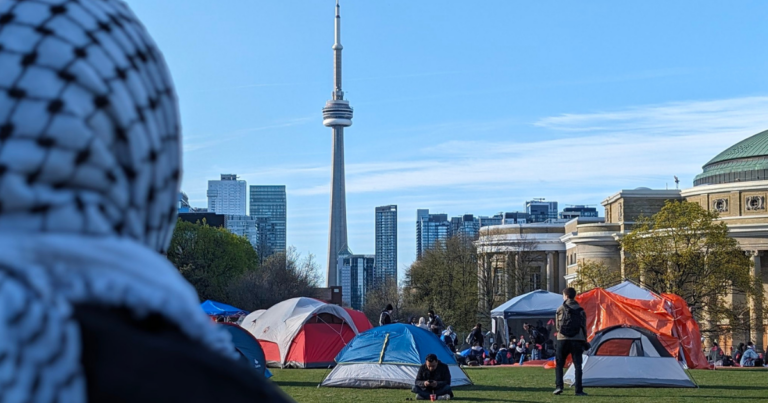
Protesters said they are making “clear” progress with the University of Toronto administration at a press conference they held at the anti-Israel encampment on campus Thursday.
“They are shaking in their boots, and I like to see that.” one protester said.
Their demands remain the same: disclose all investments linked to Israel, divest from those commitments, denounce the state of Israel, and cut off all ties with academic institutions in Israel.
One protester, Mohammad Yassin, said cutting ties with Israeli universities was one demand the university was upfront about having no intention of budging on.
“They claim that it’s because of academic expression that they don’t want to stifle,” Yassin said.To placate the students, the school said it would possibly “appoint two chairs of Palestinian Studies in U of T” and increase funding for the “Scholars at Risk” program for Palestinian students.
But for Yassin, these are just empty platitudes if the school does not stop indirectly funding Israel in its defensive war against Hamas.
“One or two chairs of Palestinian studies in a university this big with this much of a Palestinian population, students and faculty that is neglected this much, needs to have a whole institute of Palestinian studies,” he said. “We wanted something in the vein of Columbia University. We wanted a whole institute of researchers and faculty coming together and sharing their knowledge of Palestinian studies.”
Yassin said professors and researchers would be brought in from Palestine to staff the institute.
“They’re the same people that are currently being killed on the ground in Palestine by the bombs and the tanks that we were funding at the university,” he said.
Yassin said the Palestinian Studies Institute wouldn’t help the Palestinian people if the university doesn’t give in to their other demands.
“If the university gives us this reconciliation prize without divestment, without disclosure and without cutting ties, the Palestinian Studies Institute won’t be an institute for Palestinian people. It’d be an archeology Institute for the study of Palestine. There’ll be a past tense, a diorama of a long-gone tragedy,” he said.
When pressed for further information about this Columbia University-style Palestinian Studies Institute, a representative of U of T directed True North to a public statement. The statement does not mention Palestinian studies.
“We’re not saying more at this time to enable continued dialogue with student representatives of the encampment,” they told True North.
The protesters said the university was trying to bog them down in bureaucracy.
Kalliopé Anvar McCall, a diaspora studies major at U of T, said the university offered to “begin the process for considering disclosure and transparency alongside investment.”
McCall said the process would take six and a half months to complete.
The result would be a recommendation the university’s president could refuse anyway.
“So there are no guarantees on our demands,” McCall said.
McCall and her “comrades” say there is no need for all the bureaucracy to end the university’s investments.
“President Gertler, who presides over the University of Toronto Asset Management Corporation board, could simply directly push for disclosure on a personal level. Alternatively, a simple vote by business board members would suffice,” she said. “In other words, we could have disclosure by the next business board meeting on June 19th.”
The protesters are also pushing for a written commitment from the school not to involve police.
“The university has made a verbal commitment or at least promised that they do not want to call the police. They’ve repeatedly said, ‘We are not Calgary, we are not Edmonton, we don’t want that to happen,’” Yassin said.
He said when asked for a written agreement to not forcibly dismantle the encampment, the university said they could not provide one.
“We’d like to reaffirm that the University of Toronto has made it clear that they want to end things peacefully,” Yassin said. “We, as protesters, have maintained a peaceful protest without harming anybody.”
At the beginning of the month, however, a man was physically attacked at the protest for wearing an Israeli flag, and it’s standard practice for protesters to bar anyone they think might disagree with them from entering the encampment.
Canada’s participation in the COP28 summit in Dubai cost almost $3 million, according to newly released government records.
The figures, tabled in the House of Commons in response to an order paper question from a Conservative MP, reveal that of the nearly $3 million spent, $1.3 million was forked over so that the government could host a “Canada Pavilion” while at the summit.
The pavilion featured a rapper who performed a song about “climate disinformation.”
“Climate disinformation, get that immunization, the vaccine for bad meme infiltration,” said Canadian rapper Baba Brinkman in his opening verse. “Climate misinformation, it leads to polarization, which leads to radical conspiracy ideation,” he continued before giving Environment Minister Steven Guilbeault a shoutout.
Brinkman is the son of Liberal MP Joyce Murray.
The Trudeau government funded a COP28 pavilion that featured a “climate disinformation” rap.
The Trudeau government sent at least 193 people to the COP28 summit to stay in lavish hotels from Nov. 20 to Dec. 12 last year in Dubai, United Arab Emirates.
The majority of hotel expenses came from the Dubai Marriott and the Premier Inn at the Dubai Investment Park, where a room costs anywhere from $150 to $400 per night.
However, some attendees booked suites at the Pullman Dubai Jumeriah Lakes Towers, a “five-star hotel offering upscale accommodations” with rooms at $816 per night.
Additionally, the delegation handed out $650 worth of gifts during the trip.
While initial reports estimated that the total cost for Canada’s delegation cost at $1.4 million, the latest records show the bill is $2,954,188, at least for now.
According to the records, the trip cost $825,466 for transportation, $472,570 for accommodations and $295,455 for meals and incidentals.
However, the records leave room for added expenses which are still to come as some invoices and travel claims “have yet to be processed.”
“Nothing screams fighting climate change like flying around the world burning through jet fuel and millions of tax dollars,” said Franco Terrazzano, the taxpayer group’s federal director.
“Here’s a crazy idea: maybe the feds don’t need to spend $3 million flying 182 politicians and bureaucrats to Dubai.”
The $1.3 million Canada Pavillion intended to “showcase the breadth of Canadian climate leadership.”
“Really? Hosting a rapper half-way around the world to drop rhymes at a government podium will help the environment?” questioned Terrazzano.
In the words of Brinkman, “Let the message get exposed, let the human mind follow the evidence wherever it goes.”