Fourth Indian national arrested in Canada in connection to Hardeep Singh Nijjar’s murder

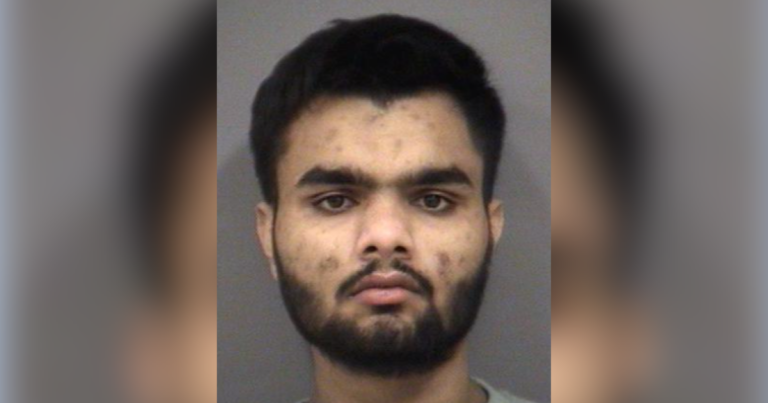
A fourth Indian national living in Canada has been charged for alleged involvement in the murder of Hardeep Singh Nijjar, a Sikh activist who was gunned down outside a B.C. temple last June. 

Amandeep Singh, 22, was already in the custody of Peel Regional Police on unrelated firearms charges before any connection was alleged between him and Nijjar’s murder.

After further questioning by the Ontario Integrated Homicide Investigation Team, the agency contacted the B.C. Prosecution Service, which police say gave “sufficient information” to charge Singh with “first degree murder and conspiracy to commit murder.”

According to police, Singh lived in Brampton, Ont. and Surrey, B.C.

No further details on the arrest have been made public yet however, as the investigation and court processes remain ongoing. 

Singh’s arrest marks the fourth arrest of an Indian national living in connection to Nijjar’s killing, with three others arrested in Edmonton earlier this month. 

Karan Brar, Kamalpreet Singh and Karanpreet Singh were all arrested and charged with first-degree murder and conspiracy to commit murder.

Protesters from the Surrey temple where Nijjar was killed gathered outside Surrey’s provincial court house last Tuesday as the three men made their first court appearance. The Canadian government has suggested the Indian government is complicit in Nijjar’s assassination.

However, Indian Foreign Affairs Minister Subrahmanyam Jaishankar accused Ottawa of welcoming in criminals from India, in response to the RCMP arrests. He also called Canada the primary driver of what he described to be a violent movement of Sikhs seeking to carve their own country within India. 

Sikh separatists refer to this desired state as Khalistan. 

“It’s not so much a problem in the U.S.; our biggest problem right now is in Canada,” said Jaishankar at a forum for intellectuals in Bhubaneswar, India on Saturday.

Nijjar was an outspoken Khalistani activist and his murder launched a major diplomatic fallout between Canada and India.

Prime Minister Justin Trudeau accused New Delhi of orchestrating Nijjar’s assassination, further escalating tensions between the two nations. 

Domestic protests against the Indian government were spurred by the killing as well as investigations into murders of Sikh activists involving the U.S. authorities

Additionally, the arrests sparked criticism of Canada’s international student visa program after a 2019 video of an India-based immigration consultancy showed Brar saying his “study visa has arrived” along with a photo of the suspect holding what appeared to be a study permit. 

Immigration, Refugees and Citizenship Canada said it was unable to comment on active investigations or individual cases when asked about Brar’s immigration status.
Ottawa’s amended Impact Assessment Act still unconstitutional, Alberta charges

The federal government’s changes to its Impact Assessment Act aren’t enough to save the law, Alberta claims.

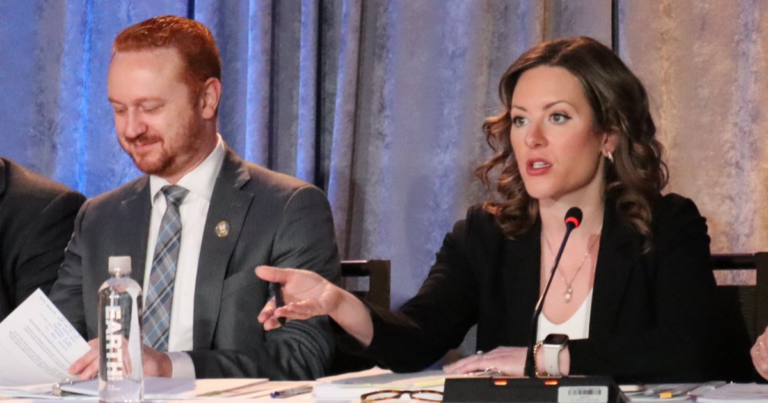
“Even with these amendments, the act is still unconstitutional,” reads a joint statement from Alberta Premier Danielle Smith, Environment Minister Rebecca Schulz, and Minister of Justice Mickey Amery.

The Supreme Court previously ruled that the federal government’s Impact Assessment Act was “largely unconstitutional.” The act is a part of the federal government’s environmental assessment process for what it calls “designated projects,” but critics maintained that the legislation was meant to encroach into provincial jurisdiction.

The Liberals tabled several proposed amendments last month in response to the Supreme Court decision to “ensure the IAA is constitutionally sound and restore regulatory certainty for industry and investors.”

Amendments focused on the five categories of project designation, screening decision, public interest decision, definition of federal effects, and cooperative federalism. Each section showed the current version, the court’s decision and the proposed changes on a fact sheet provided by the Liberals.

The changes aim to align the legislation more closely with areas of federal jurisdiction under the constitution. Despite the amendments, the Alberta government maintains that the amendments do not keep the feds out of provincial jurisdiction. 

“This will put projects like in-situ oil sands developments, major highways within our borders, and power plants at risk from federal interference. This is simply unacceptable, and Alberta, when it comes to intra-provincial projects, will not recognize the Impact Assessment Act as valid law,” reads the statement from Smith, Schulz, and Amery.

Smith and her colleagues said that the situation could have been avoided if the federal government had consulted the province following the Supreme Court’s ruling rather than “sending vague letters and blank templates.” 

“The federal government did not even inform Alberta when they were tabling these amendments in the House of Commons,” reads the statement.

“The failure to work collaboratively with Alberta is a choice made by Prime Minister Justin Trudeau and Minister Guilbeault.”

Alberta previously threatened to take the feds to court for the government’s proposed plastics registry and production cap.

The federal court had already sided with Alberta and Saskatchewan in another case, finding that Ottawa’s listing plastics as toxic for the purposes of banning single-use plastics was “both unreasonable and unconstitutional.” 

“Choices have consequences. Alberta has won in court twice in the past year, and we are ready to win again,” concluded the joint statement. 

When asked for comment, Guilbeault’s office directed True North to the Impact Assessment Agency of Canada, but the agency did not respond.

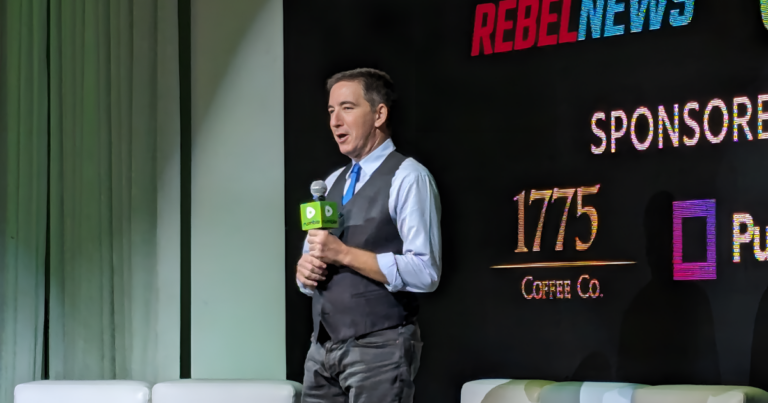
Journalist Glenn Greenwald challenges Canadian audience on free speech

At a free speech event hosted by Rebel News in Toronto, journalist Glenn Greenwald challenged a Canadian audience to defend the free speech of those whose views they most oppose.

The Rumble Live event promoted Rumble’s exclusive shows, including Donald Trump Jr.’s “Triggered” and Greenwald’s own “System Update.” Speakers focused heavily on the Trudeau government’s Bill C-63 and its potentially disastrous impact on free speech in Canada.

“I just want to urge you to realize that any anti-establishment view, whether on the right or the left, is considered dangerous to establishment power,” Greenwald said. “And I know probably most of the people in this room are supportive of the Israeli cause and look at these pro-Palestinian protesters as menaces, as people who are expressing hateful ideas.“

Greenwald noted that many on the left view those in attendance similarly. 

“That’s how liberals saw the trucker protest. ‘Oh, these people are impeding our streets. They’re breaking the law. Of course, they need to be shut down. They’re hateful. They’re endangering the public health,’” Greenwald said. “For people on the left, Those are right-wing fanatics. They’re racist. They’re spreading hatred against minority groups who are vulnerable. We can’t allow that.”

He warned of the temptation to use the same tactics when it’s others who are using their freedom of speech in ways that can be viewed as hateful, in particular, the anti-Israel protesters.

“I think it’s extremely important that if we’re to have credibility in this cause that I believe supersedes all other causes. Because if we don’t have free speech, we have nothing,” he said. “The crucial thing is to unite on principle and defend the right of human beings of citizens of Western societies to express their views no matter what they are, without having bureaucrats and commissions and judges and presidents tell us that our opinions for some reason are illegal or criminal, or can even subject us to prison.”

Greenwald said Bill C-63 could be used to imprison people for supporting either side of the Israel-Hamas war if the law was applied equally. There’s a part of the bill which would give life sentences to those who advocate or promote genocide.

In his speech, he pointed out that some view support for Israel’s war in Gaza as promoting genocide, while others view calls to destroy Israel as advocating for genocide. He thinks the right to speech on either side should be protected.

Canadian lawyer and livestreamer David Freiheit, better known as Viva Frei, was a guest speaker at the event. He explained how he believes some of the protesters crossed a line.

“To the extent that these protests remain peaceful, non-harassing, and allow students to get the education they paid for, they’re fine,” Freiheit told True North. “When it becomes outright harassment refusing to allow Jewish students to access the campus, we’re into something totally different.”

He said that given the way the media “misrepresented” the Ottawa protest, he is hesitant to paint all of the protesters with the same brush based on video clips going around social media which can be interpreted as antisemitism.

“The other issue is demanding negotiation for international affairs, which is far different than demanding discussion for domestic policy,” he said. “I also see a bit of hypocrisy in that politicians have been discoursing a lot more with these students than they ever did with the truckers.”

Salman Sima, a survivor of torture at the hands of the Iranian government, was also in attendance.

“As a former political prisoner in Iran under the Sharia law, I know the value of free speech,” he said, affirming the importance of defending speech as a human right.

Sima is a frequent counter-protester of pro-Palestine demonstrations, he thinks some of the anti-Israel protesters have crossed the line beyond free speech as well.

“It has nothing to do with free speech, chanting for globalizing Intifada chanting in favor of genocide and clearly they said they stand with Hamas, Hamas is a designated terrorist organization,” Sima said. “(If) you defend terrorism, you should be in jail. You must be accountable for defending terrorism and these (protests) on campuses. These are not peaceful. These are not free speech.”

Ratio’d | Indian students PROTEST against DEPORTATION from Canada

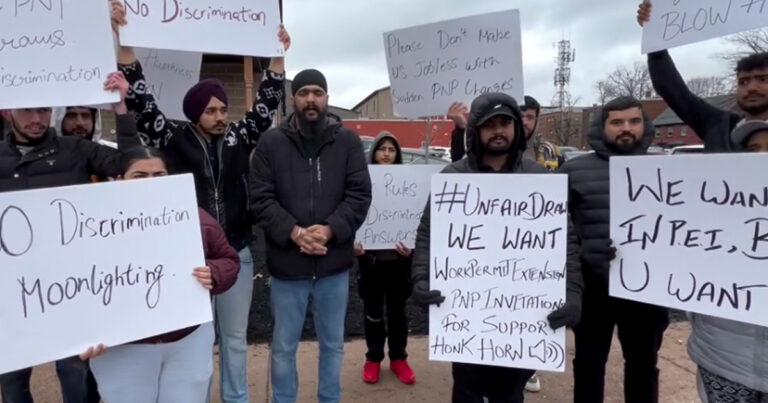
International students, who are no longer eligible for postgraduate work permits and will be slated for deportation from Canada, are now protesting in large numbers against provincial and federal governments to let them stay in the country. New rules put in place by the P.E.I government last year mean that permits are only being given to students with qualifications in construction and healthcare.

The reality is, Canada does not need anymore service workers. There are too many temporary residents in Canada and even Prime Minister Justin Trudeau has acknowledged that.

However, when this exact same protest happened in Manitoba a few months ago, the federal government granted the students a 2-year extension. Will the same thing happen again in P.E.I or will these people have to go back home?

Watch the latest episode of Ratio’d with Harrison Faulkner!

Trudeau’s capital gains tax receives failing grade from policy expert

Prime Minister Justin Trudeau released a video to X on Monday, explaining and defending the increase in capital gains, claiming that the policy change affects a minimal number of Canadians. 

Aaron Wudrick, director of the Macdonald-Laurier Institute’s domestic policy program, isn’t convinced. He highlighted the flaws with the policy change in an interview with True North.

“We all know that old saying about if you’re explaining, you’re losing,” said Wudrick.

He said that Trudeau had to release a three-and-a-half-minute video explaining the increase because it’s not obvious to Canadians how taxing residents who pay the most taxes, take the most risks, and contribute the most to the economy will build more houses or pay for programs.

Finance Minister Chrystia Freeland announced plans alongside the 2024 federal budget to tax Canadian companies and individuals on two-thirds of their capital gains, an increase from 50%.

Trudeau claimed that this tax change would only affect 0.13% of Canadians.

“At a time when the richest are only getting richer, I think it’s fair to ask those people to pay a little more,” said Trudeau. 

He said the tax increase would generate $20 billion in new revenue, which would pay for building housing, a national school food program, prescription contraception and insulin, and a national dental care program.

Wudrick said the richest Canadians already pay a “massively disproportionate share of income taxes in this country… And his changes are going to cause some of those people to divest or not invest further or leave Canada… You can’t build a tax system around the ultra-wealthy and then not care if they leave, so I find it a little bit contradictory.”

Trudeau did differentiate between taxation on income and assets, said Wudrick. But, he should want people to invest in assets and not make it harder for them to do so.

“He’s trying to make assets less attractive. This is completely contradictory for a government that says it wants to encourage risk-taking, entrepreneurship, and economic growth; taxing wealth is a way to discourage that,” said Wudrick.

The lawyer and director at the Macdonald-Laurier Institute said he believes this is not so much a policy as a campaign wedge.

“He wants to be seen as soaking the rich. In so doing, he’s actually sending a very dangerous message to a lot of entrepreneurs and business types that he’s saying, I’ll throw you under the bus if I need to scoop a few votes,” said Wudrick.

“This is not a serious policy. This is just a campaign tactic. If there’s any good news, it doesn’t appear that most Canadians are even listening to it anymore,” he said.

Healthcare leaders, tech entrepreneurs and CEOs, and Canada’s largest business groups have pleaded for the Liberals to reverse their capital gains policy, warning that it will force entrepreneurship out of the country and cause “irreparable harm.”

While Trudeau claimed this would only affect 0.13% of Canadians, Wudrick warned that it’s not the 0.13% complaining about the change.

He said that if 0.13% of these Canadians decide to leave Canada, then regular Canadians will have to shoulder the added burden.

The capital gains tax change was not included in the 2024 federal budget; it will be presented as a separate bill. 

“Part of the reason they separated these measures from the main budget bill is they know they have to tweak it. It’s going to hit groups that they never thought of, and that’s going to be very damaging to them. I think they came up with this on the back of a napkin,” said Wudrick.

“If you have apple seeds, the government is entitled to tax you on your seeds. They can take their share of the seeds, but when you plant the seeds, and they grow into other things, they’re coming back for more. They’re coming back for another round of tax based on the same assets that you built up,” said Wudrick.

He added that the Liberals have it backwards with their housing model, thinking they need public money for housing.

“They don’t. They just need to allow and encourage. Lots of people are willing to invest their own money in housing, but the government’s getting in the way of that.”

Wudrick explained that many Canadians will be surprised they fall into the “0.13%.” For example, this capital gains tax will affect a person whose entire life savings is in a family cottage.

“These are not people flying around on private jets. These are people who spent decades investing in a single property but are now going to get hammered by this,” said Wudrick.

The lawyer said he doesn’t expect the Liberals to back off now. He said he expects some adjustments, at which point Trudeau will reveal who he thinks the real villains are.

“Unfortunately, it’s a cheap political gambit that isn’t even going to pay off political dividends and will do a lot of economic damage in the process. So, basically a zero out of ten, pretty bad policy,” concluded Wudrick.

RCMP officers uncomfortable with political pressure, Emergencies Act during Freedom Convoy: internal report

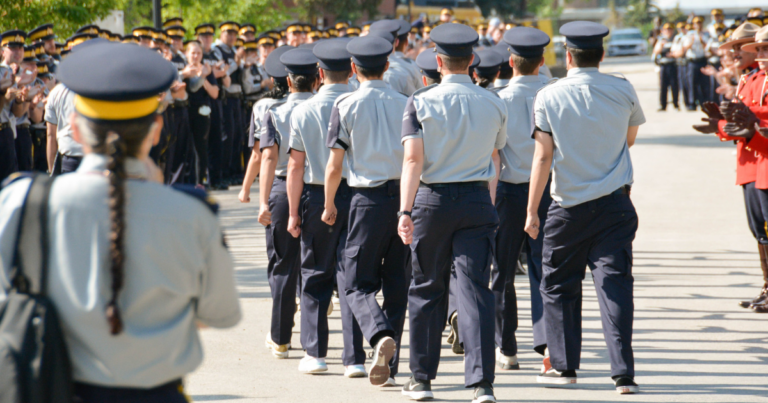
An RCMP review of the federal police response to the 2022 Freedom Convoy reveals that officers were uncomfortable with the unprecedented invocation of the Emergencies Act and felt immense pressure from government officials. 

The report titled, “National After-Action Review into the RCMP’s response to the 2022 Freedom Convoy,” was made public last week. 

One of the key concerns raised by officers involved in the response was that they were uncomfortable in exercising the additional powers granted to police by Prime Minister Justin Trudeau’s invocation of the Emergencies Act.

“Respondents felt it was unclear what impact the invocation of the Emergencies Act had on the police response and police authorities. Furthermore, some respondents expressed they felt uncomfortable applying the peace officer authorities granted once the Emergencies Act was invoked as they did not feel that they had a clear understanding of those authorities,” wrote the RCMP. 

“Some respondents who were deployed in the National Capital Region also indicated they felt uncomfortable enforcing certain legislation because the police of jurisdiction did not appear to be taking enforcement action.”

Although the Liberal government maintained that the police were independent and at arm’s length from government officials, officers responding to the protest reported that the need to provide hourly intelligence updates for ministers and the government’s politicization of policing harmed their efforts.  

“Interviewees also indicated that there were issues with information and intelligence that was disseminated to external Government of Canada agencies. Specifically, some Government of Canada partners would misrepresent the information or misattribute third-party information as RCMP information,” the report reads.  

As noted by the report, federal ministers often requested intelligence from the police and misinterpreted the data for their own ends. 

“Interviewees often noted that various Government of Canada partners would reach in directly to specific intelligence teams and or individuals for information which did not respect the RCMP chain of command or established protocols for requesting information from the RCMP,” it continued.

At the height of the Liberal government’s response to the Freedom Convoy, then public safety minister Marco Mendicino claimed the police faced no pressure from the government and were entirely independent. 

“The community expects the law to be obeyed and public safety to be upheld. The federal government has been there from day one to support the City of Ottawa and the Ottawa Police Service, and the RCMP has provided officers and other additional resources. It is important to note that operational decisions are made by the police, independent from the government,” Mendocino assured the House of Commons on Feb. 7, 2022. 

Except respondent RCMP officers expressed in post-response interviews that they felt the pressure from the Liberals was “high” and their role was becoming “highly politicized.”

“The pressures from government and the public to resolve the blockades were high during the convoy,” the report reads. 

“Interviewees and survey respondents felt that the police response to the convoy events were highly politicized. This was particularly the case with respect to the convoy events in the National Capital Region, where various elected officials and senior Government of Canada officials were of the view that it was the RCMP’s responsibility to resolve the blockades in Ottawa.”

Additionally, RCMP respondents said that the intelligence provided to their respective task force was of dubious quality and had an overreliance on legacy media reports. 

“According to survey results, intelligence dissemination was not always timely or accessible. Specifically, respondents noted that they would receive information about various threats through media reporting and various social media pages rather than directly from the RCMP,” the report reads.

At the time the legacy media frequently cited partisan groups like the Canadian Anti-Hate Network whose director was found to have spread a false narrative that an antisemitic flyer was present at the protest. In reality, the photograph was from an unrelated protest in Miami. 

Media also reported a false claim that protesters involved with the Freedom Convoy were responsible for an attempted arson of a downtown Ottawa apartment building. Later investigation showed it had nothing to do with the protest.

Media reporting that relied on misinformation was even criticized by the final report produced by Public Order Emergency Commissioner Paul Rouleau.

“I am also satisfied that there was misinformation about the Freedom Convoy, which was used as a basis to unfairly discredit all protesters,” wrote Rouleau.

“Where there was misinformation and disinformation about the protests, it was prone to amplification in news media.”

Anti-lockdown doctor facing “caution” by regulatory college to appeal after court quashes challenge

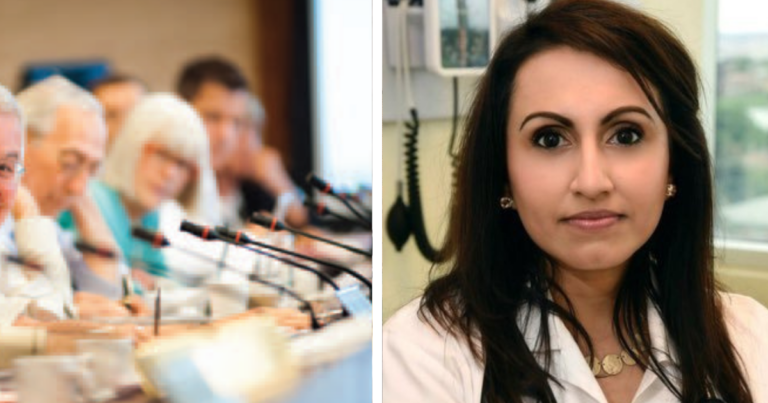
An Ontario court struck down a doctor’s judicial challenge of “cautions” ordered against her by the College of Physicians and Surgeons of Ontario.

The Ontario Superior Court ruled against Dr. Kulvinder Kaur Gill’s application for judicial review, which sought to have the admonition removed from her professional record. Gill now plans to appeal the decision to the Court of Appeal for Ontario.

The cautions were ordered in February 2021 regarding comments Gill made on X in 2020 criticizing COVID policy and some public health guidance.

The court ordered Gill to pay the college $6,000 in legal costs.

Gill is seeking leave to appeal the decision with financial support from X; the tech company financed her judicial review, keeping with a policy announced by X owner Elon Musk to support anyone penalized or sanctioned for comments made on the platform.

Though other complaints against her were dismissed after her comments were found to be reasonable given the evidence available at the time, two posts she made on X were cited as reasons to maintain the warnings on her record.

The court called one “the vaccine tweet,” in which Gill said, “If you have not yet figured out that we don’t need a vaccine, you are not paying attention.”

Gill argued that it was a response to a comment from Canada’s chief public health officer, Dr. Theresa Tam, saying vaccines were not a “silver bullet” and other restrictions would likely persist for another two to three years.

“(Dr. Gill) did not provide any evidence to support her statement indicating that a vaccine is not necessary. It would be expected and understandable if a certain proportion of the general public who read this statement decided to decline the vaccine with the assurance that they were acting on the guidance of a physician. For this reason, the Committee considers it irresponsible, and a potential risk to public health, for (Dr. Gill) to have made this statement in the middle of the pandemic,” the college’s investigative body said of Gill’s comment.

The other is referred to as “the lockdown tweet,” in which Gill states, “There is absolutely no medical or scientific reason for this prolonged, harmful and illogical lockdown.” 

Gill argued that her lockdown post was accurate as the lockdown policies at the time did not account for the negative costs to mental health and healthcare due to delayed or cancelled medical appointments.

The college’s investigative committee looked into Gill’s original posts and argued that it is valid to “point out that there are drawbacks to lockdowns” but that Gill did not raise these points.

The court upheld the college’s decision that the posts spread misinformation and found they did not provide enough qualifying context or evidence, which could have led people to make medical decisions contrary to public health recommendations.

While Gill was ordered to be cautioned and not reprimanded, Gill’s lawyer, Lisa Bildy, argued that this stains Gill’s otherwise spotless record as a physician.

The cautions could influence the college’s future decisions and tarnish the doctor’s public reputation, Bildy said.

The court, however, determined that the “suggestion that it will threaten her reputation, and thus her livelihood, amounts to no more than mere speculation.”

In a thread posted on X, Gill said she was “compelled by (her) conscience to first do no harm and oppose the lockdowns.”

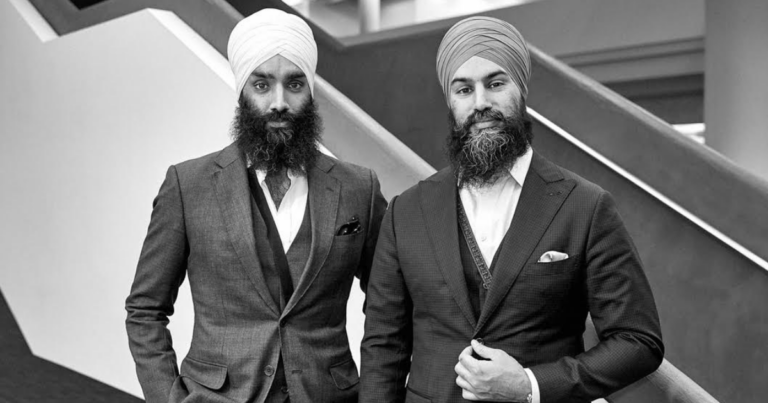
Pierre Poilievre calls for an investigation into Jagmeet Singh’s brother for connection to firm lobbying for Metro

Conservative Leader Pierre Poilievre says Jagmeet Singh might want to give his own brother a call if he has an issue with grocery store lobbyists.

Poilievre has asked Prime Minister Justin Trudeau to support an investigation into the lobbying activities of Jagmeet’s brother, Gurratan Singh, for being the vice-president of a firm that lobbies for the grocery chain Metro.

This comes after Jagmeet Singh has accused the Conservatives of cozying up with grocery lobbyists.

During Question Period on Wednesday, Poilievre addressed a previous question raised by the leader of the NDP.

“The prime minister is giving $25 million to Loblaws and Costco when they’re making record profits. What’s it going to take for this prime minister to understand? These big grocery chains are raking in billions. They really don’t need the handouts,” Jagmeet said.

Poilievre noted that the Trudeau government could only give handouts to the grocery industry because of NDP support. He questioned if Jagmeet’s close ties to a grocery lobbying group were a conflict of interest.

“Not a single penny of that money could have gone without the vote of the NDP coalition partner,” Poilievre said. “But we learned something else: This might have been due to the influence of the NDP leader’s spokesman and brother, whose company is a lobbyist for Metro.”

The NDP leader has frequently accused Poilievre of being beholden to grocery store lobbyists.

The leader of the NDP’s brother, Gurratan, was hired as vice-president at Toronto-based Crestview Strategy last May.

Gurratan’s profile on the company’s website promotes his former work as MPP for the riding of Brampton East in the Ontario legislature and his experience and knowledge in dealing with government, community, and labour union leaders.

When Poilievre asked Trudeau in the House of Commons to support an investigation into whether or not Jagmeet’s “spokesman and brother has been unduly influencing the leader of the NDP,” Trudeau claimed it was Poilievre who had the lobbyist problem.

“We can see very clearly that all the stories out about the lobbyists’ connections with the leader of the opposition are actually hurting (Poilievre), which is why he’s asking this question to the NDP,” Trudeau said.

Conservative ethics critic Michael Barrett wrote a letter to the Commissioner of Lobbying of Canada, saying that Gurratan was not registered as a lobbyist, which he stated would breach theLobbyists Code of Conduct.

The letter questions whether there are communications between the two brothers that would require Gurratan to register as a consultant lobbyist.

A look into the transcripts of the House of Commons shows that Jagmeet only mentioned Loblaws twice in 2022. But after his brother was hired, Jagmeet mentioned the grocery giant five times in 2023 and nine times in the first five months of 2024, Barrett noted.

In contrast, Jagmeet mentioned Metro on four separate occasions since his Gurratan was hired by Crestview: in three out of four, Loblaws was mentioned in the same statement.

According to the Lobbyist Registry, Jagmeet met with lobbyists 39 times over the last 12 months. The meeting registrations did not mention Metro.

This comes days after Singh criticized the opposition leader for meeting with lobbyists.


Poilievre called on corporate leaders to “fire lobbyists” in an open letter last week, though the registry of lobbyists shows Poilievre has met with lobby groups 29 times over the last year. However, not all of the groups are corporate.

He said business leaders relying on “their useless and overpaid lobbyists” to meet Chrystia Freeland or Trudeau, hoping they can convince them while the Conservatives fight them in the House of Commons, “just won’t cut it.”

Crestview Strategy also lobbied for Rogers, along with other groups and corporations. Singh has attacked Rogers in the past for its high prices and lack of competition in the market. 

Over half of Canadians want cell phone use in classrooms banned completely: poll

Over half of Canadians believe students should be banned from using cellphones while in classrooms, according to a new survey. 

A Leger poll conducted between May 3 and 5 revealed that 55% of Canadians think an outright ban on cellphone use in the classroom is needed, while another 35% don’t think cellphones should be permitted in class unless their teacher allows it.

The data published on Monday, comes shortly after the Ontario government announced plans for a province-wide policy to deal with the issue of cellphone use in schools that will take effect in the 2024-25 school year.

“It’s rare to see such a strong consensus on a particular issue,” said SecondStreet.org spokesperson Dom Lucyk. “It’s clear ‒ whether it’s a total ban or something slightly more permissive, Canadians think cell phones are a distraction and should be restricted in classrooms.”

A small minority of respondents, 5%, said they think students should be allowed to use their cellphones in class. 

Respondents aged 35 years and older were more likely to respond in favour of restricting cellphone use in the classroom while those 18 to 34 years old were more likely to disagree. 

Canadians over the age of 55 years were felt the strongest about a ban in schools, with 63% responding in favour of keeping devices out of the classroom.

Those most in favour of an outright ban were in Quebec, with 68% calling for their removal, while respondents in B.C. were the least opposed to the ban, at 48%.

Opposition to cellphone use in classrooms unless permitted by a teacher was lowest in Quebec at 40% and highest in Alberta and B.C. at 40%.

In Ontario, the only province to announce coming restrictions to cellphone use in classrooms, saw 50% of respondents in favour of the ban, with 39% saying their use should be acceptable upon their teacher’s discretion. 

Ontario’s policy takes a hybrid model of both approaches, with students in kindergarten through Grade 6 having phones completely removed from the classroom and students in Grade 7 and above allowed to use them with a teacher’s permission.

If students are caught using their phones, they will have to hand them over to staff and their parents will be notified.

“We have heard loud and clear from parents and teachers alike that cellphones in classrooms are distracting kids from learning,” said Ontario Education Minister Stephen Lecce in a statement released last month.

“When it comes to cell phones, our policy is ‘out of sight and out of mind,’ as we get students back to the basics by restoring focus, safety and common sense back in Ontario schools.”

Social media sites will be banned from all school networks and devices under the new policy as well. 

The government will also ban recording and sharing videos or photos of individuals without explicit permission. 

Paige MacPherson, associate director of education policy at the Fraser Institute previously told True North that the research around phone use in the classroom and declining test scores, especially with math, is crystal clear.

“Just having the presence of a smartphone in a kid’s pocket actually serves to distract them  enough to impact their cognitive ability and ultimately affect their math scores in particular,” she said. “The research on this is so clear that they really shouldn’t be avoiding it,” she said. “Kids just do not have the brain ability to not be distracted by this.”

Alberta is currently holding consultations on what policy its provincial government will take on the issue.