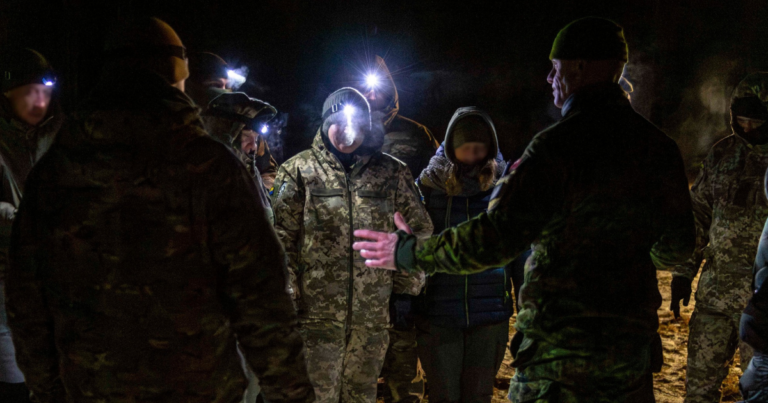
The Canadian Armed Forces will be part of an extreme heat scenario exercise in communities throughout Huron County, Ont. next week that will see soldiers and police knocking on people’s doors to perform “wellness checks.”
The exercise, called “Trillium Venture” will take place from May 3-5.
According to an OPP press release, the purpose of the exercise is to “enhance interoperability with other governmental departments, as we work together to respond to a simulated extreme heat scenario.”
Huron County Ontario Provincial Police will be working alongside members of the 31 Canadian Brigade Group.
“Members of the public will see the deployment of Domestic Response Companies (DRCs) and Territorial Battalion Group (TBG) sustainment equipment, and vehicles to validate the ability to deploy and sustain in real time,” reads the Huron OPP release.
“This is being done to create a more challenging, realistic training exercise, and will see soldiers conducting fire training, wellness checks, simulated search and rescue operations, cooling centre establishment, as well as other related activities.”
According to Maj. Paul Pickering of 31 Canadian Brigade Group, the exercise will simulate a realistic scenario that involves a 13-day heat wave with a severe storm that causes power outages, damage to infrastructure and homes, as well as water shortages in some communities.
Pickering addressed Bruce County council on April 4, to tell them that he expects around 800 military personnel, predominantly reservists, to be deployed in Huron and Bruce County next week.
“All measures are being taken to ensure minimum inconvenience to those in the area,” reads the release. “Members of the public are asked to take extra caution if approaching military vehicles and troops and are thanked in advance for their understanding and cooperation.”
According to Pickering, the goal of the exercise is to get to as many area communities as possible, with soldiers going door-to-door in towns.
Four are dead, including two grandparents and an infant, following a police chase on an Ontario highway.
A police chase that began in Bowmanville, Ont. following a liquor store robbery led to a six-vehicle collision resulting in the deaths of the driver police were pursuing and three other victims – an infant and the child’s 55- and 60-year-old grandparents.
Police were chasing a suspect who was driving in the wrong direction on Highway 401 in Whitby, Ont. at the time of the collision.
According to the Special Investigations Unit, all four individuals involved in the crash were killed, including the driver of the suspect vehicle.
The suspected vehicle was fleeing a robbery in Bowmanville when it entered Hwy. 401, driving in the wrong direction, confirmed Durham police, who were called to the scene of the crime around 7:50 p.m. Monday evening.
Their pursuit is now the subject of a probe by the SIU.
Dashcam footage obtained by CP24 revealed a vehicle in the right lane pulling off the highway to avoid a van speeding towards it, followed by a police cruiser with its lights flashing.
The crash also involved a transport truck with the front cab caved in, which shut down a stretch of the 401 from exit 406 to exit 410.
The closure lasted through the night and into morning traffic. Some lanes were reopened by 8 a.m. with all lanes operational again by 9:45 a.m., according to the OPP.
The federal government’s payment program for the vaccine-injured is getting a $36 million top up from the feds, but accessing that money is proving difficult.
Of the 2,233 claims made to the Vaccine Injury Support Program, just 138 – a little over 6% – have been approved by the medical review board for the program, which has paid out $11.2 million so far.
The Liberals have allocated an additional $36 million in the recent budget to the Vaccine Injury Support Program, over the next two years.
Oxaro administers the Vaccine Injury Support Program for the feds for all provinces and territories, except Quebec, which has its own program.
Ross Wightman, who was diagnosed with Guillain-Barre system after receiving a COVID vaccine, was one of the recipients, getting a one-time payout of around $250,000, the maximum offered by the program. He also receives $90,000 annually in income replacement.
“I don’t know if there’s even an amount that would ease the pain,” said Wightman.
Despite being poked, prodded, and tested for months, doctors were fearful of the consequences they might face from superiors if they officially declared that the vaccines caused Wightman’s injuries.
He has permanent nerve damage in his hands from the Guillain-Barre. He can no longer work or do simple tasks around the house, resulting in his wife no longer being able to work, as she needs to take care of the household tasks and children.
“Given the extent of the permanent life-changing injuries, a couple hundred thousand dollars isn’t much, that’s for sure. No. It’s just a wake of destruction that’s left behind for family and all that stuff,” he added.
It took months of struggle and jumping through hoops for Wightman to get paid. Even still, he’s struggled with being reimbursed for expenses. He said that he finally received $15,000 for his expenses after “hounding them for four months,” but it was only a quarter of what he’d had to spend.
Waiting years for payment from the vaccine injury program is the best some could hope for.
Julie Gamble has been dealing with the program for years, only to face being hung up on by the phone and not getting replies to her emails.
She’s connected with many others through various vaccine-injured support groups, only to find that they’ve faced the same struggles — having submitted all of their medical records and hearing “nothing but excuses as to why they’re not getting back to us.”
“Our families have been destroyed. We stepped up to the plate and did what was asked of us. Nothing about this is fair to any of us,” said Gamble.
Gamble says she was permanently injured by the vaccine with polyneuropathy, estimating she has lost hundreds of thousands of dollars in expenses and lost income.
She said that her short-term memory is very poor, and she has almost no muscle remaining in her hands. She does not think she will ever work again.
“It’s the biggest regret of my life that I got this vaccine,” she said.
She almost didn’t get her second shot. After having a “horrific reaction” to the first dose, she said her pharmacist did not want to give her the second. She went to see an immunologist at the pharmacist’s recommendation. Instead, she was admitted to the hospital waiting room and consulted by a doctor, who encouraged her to get the second shot, which she did.
“On my way home, I knew I’d made a mistake,” she said. “That night, I ended up blind in my right eye. My bladder let go. My eyes were swollen like eggs. I had a rash all over my body, and I couldn’t stay awake. I tasted metal in my mouth.”
Since her injury, Gamble has been trying to connect with people in similar situations online. Any time she posts about vaccine injuries, she said she gets suspended from Facebook and other social media platforms for “false and misleading information.”
Despite her husband working as much as he can and receiving CPP disability payments, Gamble has had to use food banks to get by.
True North reached out to Health Canada, the Vaccine Injury Support Program, and Oxaro but received no response.
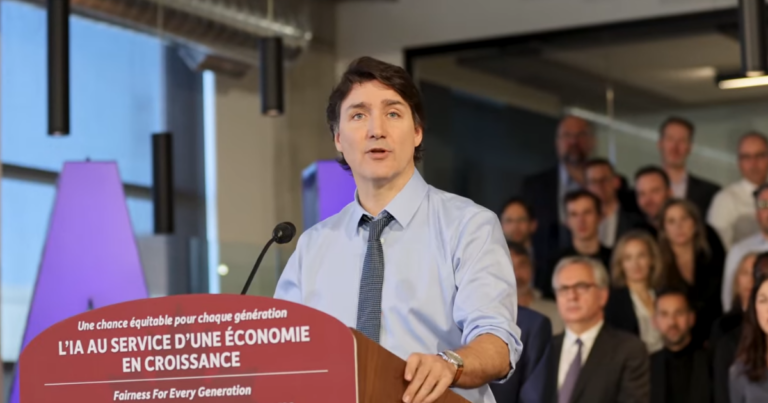
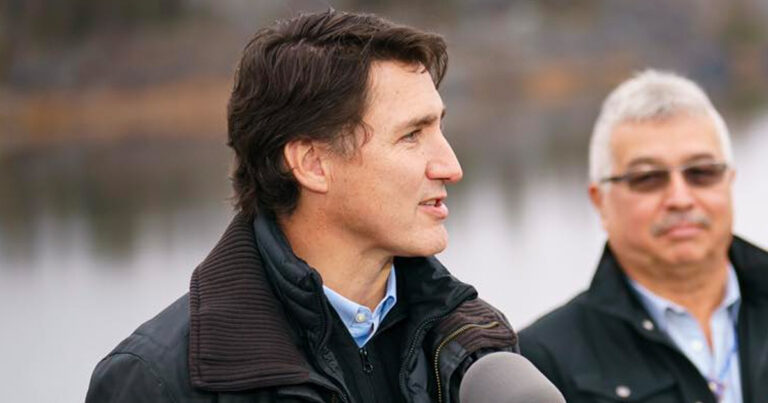
Prime Minister Justin Trudeau told his Liberal MPs in a caucus meeting that they should not be expecting much improvement in the public’s support for his party.
This comes after reports circulated that the Prime Minister’s Office had set an internal goal to shave the Conservatives’ lead in the polls by five points every six months, aiming to hit their first goal deadline by July.
The Liberal Party has not been faring well in recent public opinion polls, as the Conservatives under their leader Pierre Poilievre has seen a massive uptick in support at the expense of the Liberals.
According to a report from The Hill Times, an anonymous Liberal MP said that Trudeau told his MPs that they should not expect to catch up to the Conservatives in public opinion polls anytime soon at the Liberals’ national caucus meeting in mid-April.
“He’s [Trudeau] trying to downplay expectations,” said an unnamed Liberal MP.
“It’s like treading water when you’re drowning. [He was telling us] to not freak out while you’re drowning, that you stay calm, and you can get back to the top for a lot of the Members who are below water.”
Since autumn 2022, the Conservative party has been edging out the Liberals in nearly every single public opinion poll, with the Tory lead widening substantially in late 2023.
Prime Minister Trudeau and the Liberals were hoping that their 2024 budget and the flurry of announcements that accompanied it would buoy support for the party, especially among younger Canadians frustrated with the state of the economy and housing market.
Now the Liberals are resorting to linking Poilievre to the “far-right” by playing up an endorsement the American commentator Alex Jones gave Poilievre and linking the Conservative leader to Diagalon.
The Liberal government revealed that they would be funneling billions more dollars into resolving Canada’s housing crisis, improving the state of the Canadian Armed Forces, and creating a federal school lunch program while announcing an increase to the capital gains inclusion rate.
However, a recently released poll from Angus Reid conducted after the 2024 federal budget reveal found the Liberals had made no gains with the public and young Canadians, and perhaps took another step backwards.
The poll found that if an election were held just after budget 2024’s release, the Conservatives would gain 43% of the vote, while the Liberals would win only 23%. The NDP are not far behind the Liberals, as they poll at 19%.
The same poll found that Canadians are not satisfied with the federal government’s budget, as 56% of Canadians say that the recent budget announcements makes them pessimistic about Canada’s economic future.
The Prime Minister’s office did not respond to True North’s request for comment.
Phones have no place in the classroom, the Ontario government says as it announces a sweeping province-wide ban.
The Ontario government announced on the weekend that electronic devices must be silenced and out of sight for the entirety of the school day, starting next year for students from kindergarten through to Grade 6.
Students Grade 7 and up will have more access to their phones throughout the day, with their use only being prohibited during class hours.
If students are caught using their phones, they will have to hand them over to staff and their parents will be notified.
“We have heard loud and clear from parents and teachers alike that cellphones in classrooms are distracting kids from learning,” said Ontario Education Minister Stephen Lecce in a statement released Sunday.
“When it comes to cell phones, our policy is ‘out of sight and out of mind,’ as we get students back to the basics by restoring focus, safety and common sense back in Ontario schools.”
Social media sites will be banned from all school networks and devices under the new policy as well.
The government will also ban recording and sharing videos or photos of individuals without explicit permission.
However, the policy does not elaborate on how these measures will be monitored or enforced.
Lecce told reporters that the government’s new measure will be left up to teacher’s discretion and that they may decide when and how smartphones will be used in classrooms.
“This is about restoring focus during instructional time,” said Lecce. “Outside of that, during lunch or recess or spares, we’re going to try to treat kids with a sense of personal responsibility.”
Additionally, a section on student’s report cards will be dedicated to grading students’ distraction levels in the classroom.
“While I think it’s certainly a good thing that the government is looking to strengthen their policies on this, they really could have gone quite a bit further,” Paige MacPherson, associate director of education policy at the Fraser Institute told True North.
MacPherson thinks it’s laudable that the Ford government is looking to crack down on smartphone use in the classroom but as far as grading distraction levels on report cards, she feels the effectiveness of this new measure will be too little, too late.
“This is something the parents should be hearing about long before the report card arrives,” she said. “There should be a more consistent environment of parental conversation between schools.”
The Ford government, in 2019, asked individual school boards to come up with their own policies restricting phone use in the classroom to improve educational and mental health standards but MacPherson sees little innovation from that initial failed policy.
“When you get into the details of this policy, it has a lot of the same issues as the previous policy,” she said. “In 2019, they left the specifics up to school boards and at that time the teachers had made it clear in their response that the policies were almost impossible to enforce. So the ban was ultimately thought to be pretty ineffective and the same enforcement issues remain.”
MacPherson suggested that students could hand over their phones upon entering the classroom and, once the lesson is over, teachers can return them.
“Anybody who’s been to a comedy show or a concert that’s being recorded for Netflix has had to put their cell phone in a pouch so they can’t record the material, they can’t post it online, and they also can’t do anything else with their cell phone while they’re at that show,” she said. “As a result people probably enjoy the show a lot more because they are distraction-free. Then, at the end, they’re given their cell phone back.”
According to MacPherson, the research around phone use in the classroom and declining test scores, especially with math, is crystal clear.
“Just having the presence of a smartphone in a kid’s pocket actually serves to distract them enough to impact their cognitive ability and ultimately affect their math scores in particular,” she said. “The research on this is so clear that they really shouldn’t be avoiding it,” she added. “Kids just do not have the brain ability to not be distracted by this.”
Lecce said that the main difference between the 2019 policy and this latest one is that the phone ban in classrooms is now province-wide.
Conservative Leader Pierre Poilievre has vowed that his efforts to keep criminals behind bars will be constitutional, telling the Canadian Police Association he will “make them constitutional using whatever tools the constitution allows me to use to make them constitutional. I think you know exactly what I mean.” It looks like he’s teasing the first ever federal use of the Charter’s notwithstanding clause. True North’s Andrew Lawton weighs in on why that matters.
Also, the capital gains tax hike proposed in the federal budget is the ‘final nail in the business investment coffin,’ one economic analyst says. Jake Fuss from the Fraser Institute joins to explain why.
Plus, British Columbia has asked the federal government to reverse its pilot project on decriminalizing drug use in public spaces just one year into the three year trial. Is this finally a recognition of failure on the part of the drug-permissive B.C. government? Centre for Responsible Drug Policy founder Adam Zivo joins to discuss.
Young Canadians reported the second-largest decline in life satisfaction according to a new survey, making Canadians under 30-years-old the least happy cohort of their peers among other G7 nations.
Plus, even if Prime Minister Justin Trudeau finds himself taking a walk in the snow by Canada’s next federal election, he said that he will remain a social activist focused on causes he’s championed while in office.
And London taxpayers are paying $1 million a year as asylum seekers crowd out shelter spaces.
Tune into The Daily Brief with Cosmin Dzsurdzsa and Noah Jarvis!
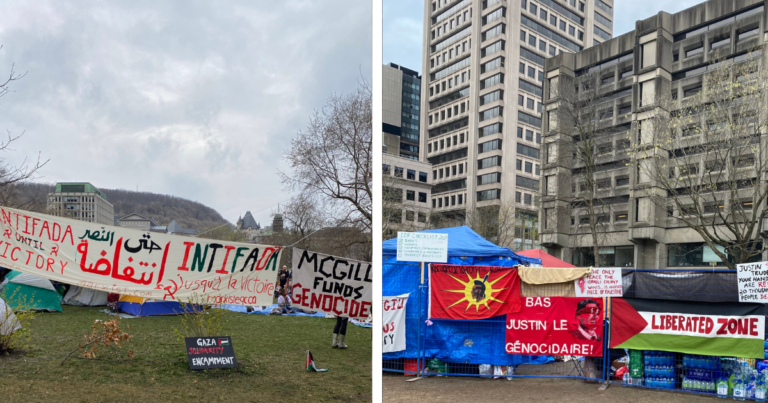
A pro-Palestinian student organizer affiliated with an anti-Israel encampment occupying McGill University’s campus is refusing to condemn Hamas and its Oct. 7 attack on Israel or call for the return of hostages still held captive after nearly seven months.
The spokesperson for Solidarity for Palestinian Human Rights McGill, who would not provide her name, instead opted to condemn Israel, Canada and the United States, and claimed that the Jewish state does not care about the hostages held in captivity by Hamas.
Solidarity for Palestinian Human Rights is one of several groups involved in the encampment.
“We condemn the Israeli regime for sustaining a 75-year-old violent occupation and besieging an entire strip and caging 2.2 million people in essentially atrocious conditions,” said the spokesperson in response to a question about Hamas.
“We condemn the United States and the Canadian government for complicity in this occupation and this genocide,” she added. The spokesperson also condemned McGill and Concordia administrators.
The spokesperson said that her organization supports “the Palestinian people’s right to resist this occupation.”
When asked if that right to “resist occupation” included resistance through Hamas, as some have stated in the past, she said Palestinians “have the right to resist the occupation by means that they deem necessary.”
Hamas is designated as a terrorist organization by the Canadian government, as well as the U.S. government and the European Union.
On Oct. 7, Hamas terrorists killed over 1,200 Israelis in the biggest attack on Jews since the Holocaust. Among other things, terrorists slaughtered babies, raped women, burned families and also took hundreds of innocent civilians hostage.
The Solidarity for Palestinian Human Rights spokesperson, however, would not condemn Hamas’ actions on Oct 7, instead referring True North to social media statements issued by the group in October on the matter.
The day after Oct. 7, the group had come under fire for publishing a Facebook post that praised Hamas’s action as “heroic” and “monumental.” The group also cheered on the launching of rockets and the taking of hostages and encouraged Montrealers to “celebrate the resistance’s success.”
SCREENSHOT: SPHR McGill celebrates Hamas’ attack on Israel
The spokesperson also attempted to contextualize attacks against Israel, noting “we reject taking this out of context, which is the context of a 75-year-old occupation.”
She also refused to call for a return of the hostages, accusing Israel of not caring about the safety of those hostages and claiming it was not in the country’s best interest for the hostages to be returned.
“We have also seen that the Israeli regime is not interested in the safety of their hostages. We have seen some of these hostages being specifically targeted by the Israeli forces on the ground and through air strikes,” the spokesperson claimed. “It’s not even in the interest of the Israeli regime to have these hostages returned.”
Three Israeli hostages were accidentally killed by Israeli forces in December, amidst IDF soldiers thinking they were being ambushed by Hamas. The Israeli government apologized to the families of those hostages.
“There is a direct link between the sad and very unfortunate mistake in killing those Israeli former hostages and the other ambush incidents,” IDF spokesperson Lt. Col. Jonathan Conricus told NBC news at the time.
The anti-Israel encampment at McGill was set up on Saturday but has since tripled in size. Protesters say they will remain there indefinitely, despite being asked to leave.
It is inspired by similar encampments seen at U.S. universities, such as Columbia University and New York University.
“Our universities have become instruments of violence and instruments that are essentially supporting occupation and genocide,” said the Solidarity for Palestinian Human Rights spokesperson.
In a document, students say McGill has investments with 50 companies that have “links to the ongoing Palestinian genocide.”
The spokesperson added that students are ”reclaiming their campus” with this encampment, and “transforming their campus into a popular university… that is open for the community, where it is a site of solidarity and a site of collective knowledge.”
However, in addition to signs calling for a divestment of funds and for a free Palestine, signs calling for Intifada (armed uprising) and praising Aaron Bushell, a U.S. airman who set himself on fire for Gaza, were seen at the encampment. People wearing mock suicide vests and people affiliated with far-left communist groups were also in attendance.
— dahlia kurtz ✡︎ דליה קורץ (@DahliaKurtz) April 29, 2024
The spokesperson however asserted that the space is inclusive of different members of the community. “This is open to the community as a whole,” she said.
She was however hesitant to say whether Zionist Jews were welcomed into the space to share their experience. “It is a space for the community and people of conscience in Montreal to congregate,” she said.
The McGill administration has shared concerns with the encampment and actions of pro-Palestinian protesters. It also noted that it believes many of the occupiers are not McGill students.
“The situation on the ground has shifted significantly. The number of individuals who have set up tents on campus has tripled,” said McGill in a statement to True North. “Additionally, we have become aware that many of them, if not the majority, are not members of the McGill community.”
The university also said it had seen evidence of “unequivocally antisemitic language and intimidating behaviour” that has taken place at the encampment, and that they “condemn this in the strongest possible terms and will act quickly to investigate.”
McGill also said they are currently communicating with lawyers retained by students in the encampment, but claims these students are refusing to collaborate.
Similar anti-Israel protests have since popped up at the University of British Columbia and the University of Ottawa.
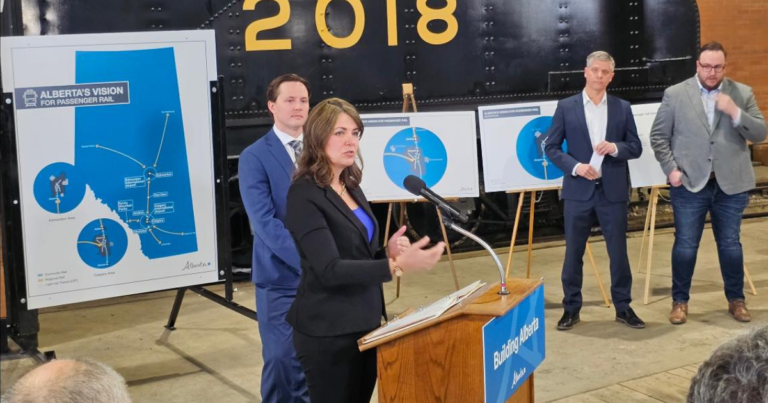
The previous projects may have failed because they stood on their own, but this time, Alberta is taking a holistic approach, said Alberta’s Minister of Transportation, Devin Dreeshen.
Alberta’s six-part vision for its passenger rail system encompasses a blend of public, private, and hybrid rail services designed to transform regional connectivity.
The plan includes commuter rail systems connecting the Calgary and Edmonton areas to their respective downtowns and international airports, regional rail lines linking both cities to the Rocky Mountain parks and each other with a stop in Red Deer, and municipal-led Light Rail Transit systems in Calgary and Edmonton that integrate seamlessly with the provincial network.
Additionally, strategically placed rail hubs in major cities will facilitate connections between commuter, regional, and municipal transit systems, enhancing overall mobility across Alberta.
The Alberta government will consider the feasibility of implementing hydrogen-powered trains.
“That’s why we’ve separated it into six different projects; some of them are feasible right now. Some may be more feasible in a few years from now, and some may be feasible further out,” said Alberta Premier Danielle Smith.
The premier said that Alberta’s population grew last year the most it had since 1981, by more than 202,000 people. She added that while the newcomers are a blessing, additional newcomers equate to mobility challenges, with congestions on busy roads and highways.
“Unlike federal Environment Minister Steven Guilbeault, we are willing to invest in those roads as well,” added Smith.
However, she said that expanding every highway to six, eight, or ten lanes may not be feasible or wise. A cost-benefit analysis will be done to identify which elements of a passenger rail system should proceed and when.
The Alberta government will introduce a provincial crown corporation, similar to the Metrolinx in Ontario. This crown corporation is intended to withstand the test of time, including changing governments. It will develop the infrastructure and oversee daily operations such as fare collection, system maintenance, and future system expansion planning.
“We’re also very open to having the private sector collaborate with us so that we can build out certain parts of the line without it being 100% on the public sector’s tax dollar,” said Smith.
“Nothing about this plan is going to be unilateral. It will take shape only after consultations with municipalities, industry, indigenous communities, and all Albertans interested in the future of passenger rail,” she added.
The Passenger Rail Master Plan aims to be completed by Summer 2025. Before this completion date, studies and stakeholder forums will be held to inform the final plan.
$9 million from Budget 2024 have been allocated towards the first stage. The Alberta government has earmarked $43 million in new funding to support Calgary’s Blue Line LRT expansion towards the airport. This is in addition to the province’s ongoing commitment of $3 billion to support the LRT expansions in both Calgary and Edmonton.
A comprehensive feasibility assessment identifying the passenger rail system elements will be conducted. Financial and delivery model options, including private, public, or hybrid services, will be explored. This includes assessing options to ensure the effective governance and operations of the passenger rail system.
A 15-year delivery plan with options and recommendations to the government will be presented, aiming to see the projects completed by 2040.
A free speech-loving video platform is taking its fight against censorship to the streets.
The Canadian site Rumble is hosting its first-ever live event in Toronto in protest of the Canadian government’s Bill C-63, which bans online “hate speech” and allows for life sentences for any crime deemed to be motivated by hate.
The May 10 event will feature live editions of four Rumble exclusive shows, including Donald Trump Jr.’s Triggered and Pulitzer Prize-winning journalist Glenn Greenwald’s System Update.
Canadian lawyer Viva Frei, who rose to prominence for his live streaming during the Freedom Convoy, will also host a show.
Free speech will be front and centre.
“Rumble is known for holding and being the lead on freedom of expression,” said Rumble founder Chris Pavlovski. “We are huge believers in human rights, which is Article 19 of the UN Declaration of Human Rights. We firmly oppose the new bill (C-63), which violates those rights,” Pavlovski said in an interview with True North.
The UN defines freedom of expression as a human right: “Everyone has the right to freedom of opinion and expression; this right includes freedom to hold opinions without interference and to seek, receive, and impart information and ideas through any media and regardless of frontiers.”
“We believe freedom of expression as a human right, and so does the United Nations,” he said. “Democracy and freedom are extremely important. One of the pillars of that is freedom of expression.”
Pavlovski said this will be the first of many events. He plans to take it across the U.S. as well.
Pavlovski noted that civil liberties groups such as The Canadian Civil Liberties Association and the Canadian Constitution Foundation have warned that the bill could erode the right to free expression in Canada.
“This bill is absolutely in opposition to freedom of expression,” Pavlovski said. “There is no clear definition of hate speech that would be agreed upon by all parties and any authoritative government can take that to mean whatever they want.”
He believes Canadians should be very concerned about the state incentivizing its citizens to report one another for their speech online and adding jail sentences as a punishment for such speech.
Rumble has partnered with Canadian independent media company Rebel News for the event, which Rebel founder Ezra Levant said was a natural fit.
“The Rumble event is focused on freedom of speech, including Trudeau’s threatened C-63 censorship law,” Levant told True North. “Rumble is the leading free speech video platform. They believe in freedom of speech morally. And, of course, it is also essential to the success of their business.”
The event will be live-streamed on Rumble, but Levant said there’s nothing like being there.
“It’s a great chance for people in the Toronto area to be part of an exciting free speech moment and to attend the event live.”