Jagmeet Singh says he’ll win the next federal election

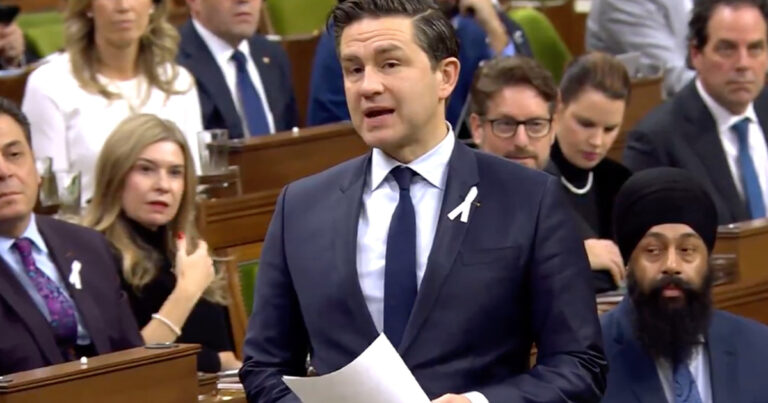
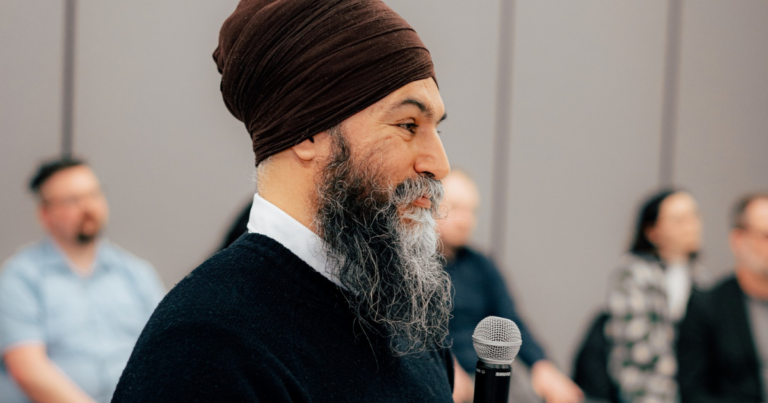
NDP leader Jagmeet Singh said in a speech Tuesday that he would not form another coalition with the Liberals after the next election because he will win that election and become Prime Minister.

Singh made the remarks at Carleton University’s Bell Lecture.

During the Q & A portion of his speech, Singh was asked if he would form another coalition with the Liberals,  to which he answered, “I want to say no right away, because we’re going to win the next election.”

“I defy the odds. We’re going to win because people need us to win. I genuinely mean it,” he added.

“I really want people to know I want to be the next Prime Minister of this country. I want to be the first labour prime minister, the first New Democratic Prime Minister,” said Singh.

He went on to boast about NDP accomplishments, including the ones claimed by his party over the last two years.

“Twenty-five MPs brought in pharmacare, diabetes coverage, diabetes devices coverage, birth control, brought in child care legislation, brought in dental care, brought in 10 paid sick leaves, anti-scab legislation,” said Singh.

He said it’s because of his coalition with Trudeau that they were able to implement these policies.

According to 338 Canada, Singh is averaging at 18% in the polls, while Poilievre conservatives are averaging at 42%. If an election were held today, Singh’s New Democrats would remain in fourth place, with just 24 seats.

Singh also discussed immigration in his speech, saying immigration levels should be “set at a level where we can ensure that people are able to be supported and welcomed to the country, we have enough infrastructure and resources… and that our immigration levels meet our needs.”

True North reached out to Singh’s office to ask what immigration numbers he felt would be reasonable, but they did not respond. 

Criticism of immigration has been mounting as the Trudeau government continues to let in very large numbers of immigrants into Canada. In 2023, the government let in 471,550 new permanent residents, in addition to approximately 660,000 as temporary foreign workers and 900,000 international students. There were also 143,870 people who entered Canada illegally to request asylum.

The Liberals have since announced measures to slow the trends down, including a cap on international students and a reduction of temporary residents and foreign workers.

Singh had previously criticized claims that immigration was a cause of the housing crisis, despite economists stating that it has been a contributing cause.

Singh also took aim at Conservative party leader Pierre Poilievre during his speech on Tuesday, accusing him of being opposed to abortion rights, being anti-worker and being against protecting the environment.

“Pierre Poilievre has made it clear that he is opposed to unions,” claimed Singh. “He wants to take away dental care from seniors, he wants to end pharmacare before it even begins, he doesn’t believe in birth control for women.”

Singh then went on to claim that Poilievre “allowed in legislation that was an attack on a woman’s right to choose from one of his Conservative members,” referring to Bill C-311, a bill which sought to protect pregnant women. The bill, introduced by Saskatchewan MP Cathay Wagantall, did not have the word “abortion” mentioned anywhere in its text. 

Singh also took aim at Poilievre’s belief in a small, limited government.

“The Conservatives believe that governments should do less, they should be smaller, they should be less in the way of large corporations,” said Singh. “That means they shouldn’t get in the way of them polluting or dumping toxins into the water, to the air, to the land… be less involved in big corporations ripping off Canadians.”

Singh says such a belief “only benefits the powerful,” while also sharing his vision for a more powerful government. 

“I believe the government has the power and the responsibility to make people’s lives better, to invest in solutions, to take on the powerful,” said Singh.
Diagolon founder denies ties with Conservatives despite Trudeau’s accusations

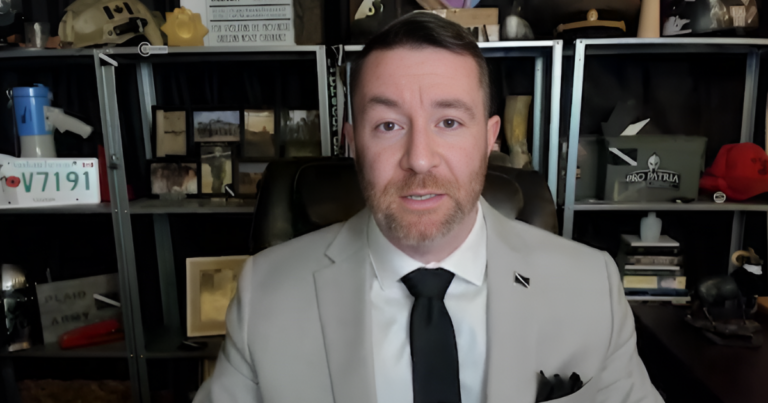
Jeremy Mackenzie, the creator of the internet meme country Diagolon, denied Prime Minister Justin Trudeau’s claims that he and the Conservative Party of Canada or its leader Pierre Poilievre are connected in any way.

“The CPC has no connections or affiliations with myself or anyone involved in my circles,” Mackenzie said on his podcast. “These claims by the Liberals are an outright and deliberately malicious fabrication in a desperate and pathetic attempt to sway support away from the Conservative Party’s momentum that appears overwhelmingly likely to crush the Liberals in any election held anywhere in this plane of reality.”

The claims, spurred on by Trudeau, came after Poilievre visited a legal carbon-tax protest encampment on the side of a highway in an Atlantic Canada border town. The flag of Mackenzie’s made-up country can be seen on the door of a camper Poilievre entered.

The Prime Minister accused Poilievre of meeting with Diagolon, and has since continued to levy accusations of “courting white supremacists” and “conspiracy theorists.”

The protesters denied any connection to Diagolon and told True North the drawing was made by someone who stopped in one time to get warm at the Freedom Convoy protest in Ottawa and was never seen again.

Mackenzie confirmed their claims. He said he asked Sam Field, who according to Mackenzie owns the trailer, to remove the drawing “immediately.”

“(The carbon-tax protest Pierre visited) was born out of a small orbit of perennial freedom protesters seemingly cornerbacked by Mr. Sam Fields,” he said.

Mackenzie said he has no relationship or recollection of any interaction with Fields. “My partner Morgan (Guptill) doodled a Diagolon flag on his trailer door over two years ago, during the Ottawa protest action meant as a friendly gesture of support, and nothing more,” he continued. “There is no connection between myself, Morgan, or any of the more prominent voices in our makeshift loose-knit community than that.”

“Any connections being made are tenuous at best and purely coincidental. There is no involvement whatsoever.”Poilievre denounced Mackenzie and Diagolon in September 2022, after Mackenzie made remarks about raping Poilievre’s wife, Anaida Poilievre. Mackenzie later claimed he was joking.

In an email to True North, Sebastian Skamski, a spokesperson for Poilievre said the Conservative leader stands by his disavowal of Diagolon.

“Frankly, like most Canadians, until about a month ago I never heard of Diagolon and these losers. They are all odious,” Poilievre wrote on Sept. 26, 2022.

Mackenzie said he and the Conservative leader do not see eye to eye, and Mackenzie will remain a “sharp critic” of the Poilievre.

“It is very clear to my audience as well as the CPC I’m sure and Mr. Poilievre himself that we are not mutual friends. There’s a very deep and I’m sure mutual disdain for one another,” he said. “It is my sincere hope that somehow Mr. Poilievre and his team will succeed in proving me to be impressively incorrect in my assessment of their character.”

In 2023, an investigative report done by independent journalist Caryma S’ad revealed that through internal communications between law enforcement and government officials, no notable criminal or violent activity was found in their thorough investigations of Mackenzie, and they could not define Diagolon as a group in any traditional sense.
The government has often alluded to extremist groups operating within the Freedom Convoy to justify its use of the never-before-used Emergencies Act to crack down on protesters.

“At its core, (Diagolon) is a tightly knit group of like-minded folks who enjoy my podcast and commentary. This government used this fantasy narrative painted by the Canadian Anti-Hate Network to enact the Emergency Measures Act in February 2022,” Mackenzie said.

The Liberal government gave the Canadian Anti-Hate Network $268,400 in 2022. The group has since asked for $5 million over five years from the government.

Despite being labelled as a violent extremist by politicians such as Jagmeet Singh, Mackenzie has not been convicted of any crime.

The Office of the Prime Minister did not respond to True North’s request to comment before the deadline provided.

The Andrew Lawton Show | Poilievre kicked out of Parliament for calling Trudeau a “wacko”

Conservative Leader Pierre Poilievre was ejected from the House of Commons yesterday after refusing to withdraw a comment that Justin Trudeau was a “wacko” (although he offered to replace it with “extremist” and “radical”). The pearl-clutching Liberals and journalists should be less focused on tone-policing and more on governing, True North’s Andrew Lawton says.

Plus, a new documentary, Covid Collateral, exposes the harms of lockdowns and the censorship of scientists throughout the pandemic. Filmmaker Vanessa Dylyn joins to discuss.

Plus, it’s the four year anniversary of the order-in-council that prohibited over 1500 types of firearm and promised a two year “buyback” that has so far never materialized. Rod Giltaca of the Canadian Coalition for Firearm Rights weighs in on where things stand

SUBSCRIBE TO THE ANDREW LAWTON SHOW

The Daily Brief | Poilievre gets booted from the House of Commons

Conservative Leader Pierre Poliievre was kicked out of the House of Commons after he refused to withdraw a claim that Prime Minister Justin Trudeau is a “wacko.”

Plus, the Alberta government unveiled its comprehensive plan to connect the province via a commuter rail network.

And the federal government’s payment program for the vaccine-injured is getting a $36 million top up from the feds, but accessing that money is proving difficult.

Tune into The Daily Brief with Cosmin Dzsurdzsa and Lindsay Shepherd!

SUBSCRIBE TO THE DAILY BRIEF

CRA to audit Saskatchewan for not paying carbon tax; Moe says they’re paid in full

The Canada Revenue Agency will audit Saskatchewan for not paying carbon levies on home heating to the federal government. 

However, in a post to X on Tuesday, Saskatchewan Premier Scott Moe said that the province is remitting an equivalent carbon tax on natural gas and electricity for residential home heating as the Liberals collect on home heating oil. 

“So we consider ourselves paid in full,” said Moe.

The premier added that while the CRA may think it is threatening Saskatchewan, he sees things differently. 

“If the Prime Minister thinks he’s going to start sending agencies after provinces that have had unanimous votes in their legislation to pass legislation… Provinces are not subservient governments to the federal government. We have areas of jurisdiction, and we intend on using it,” said Moe. 

Saskatchewan’s premier said that Trudeau has his views, but that he’s wrong.  

“He may think that he’s going to use federal agencies at his discretion to frighten provinces or frighten entities into acquiescing to his views, and that’s just simply not the case,” added Moe.

Trudeau maintains the carbon tax and related rebate help with affordability and fight against climate change. Trudeau said that eight out of ten families pay less than they receive from the rebate.

However, the Parliamentary Budget Officer showed that families in Saskatchewan will pay $525 more into the carbon tax than they receive in rebates in 2024. This offset will increase to $1,723 for Saskatchewan families by 2030. 

“Having an argument with CRA about not wanting to pay your taxes is not a position I want anyone to be in. Good luck with that Premier Moe. CRA is an independent organization that is very, very good at getting money it is owed from Canadians, from businesses and now provinces if it has to,” said Trudeau. 

Despite earlier statements from Energy Minister Jonathan Wilkinson indicating that the Saskatchewan residents would forfeit their rebates, Trudeau reversed this position. He said he would continue to issue a rebate of $1,800 to Saskatchewan families, despite Moe not paying levies to the federal government. 

Last December, the Saskatchewan legislature unanimously passed a law giving the province exclusive responsibility for compliance with the federal carbon tax on home heating. 

After ceasing the carbon tax levy collection in January, Saskatchewan’s inflation fell quicker than predicted. Manitoba saw a similar decline after pausing its fuel tax

Trudeau-appointed senator says Canada has no business in the Taiwan Strait

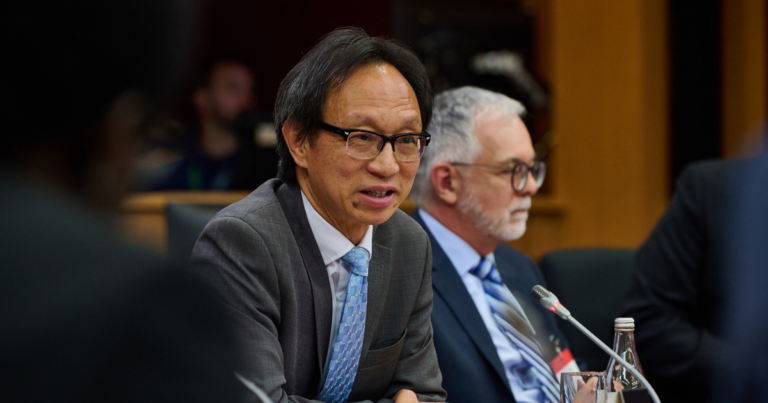
A Trudeau-appointed senator known for repeating communist China’s talking points recently said during a Carleton University lecture that Canada shouldn’t be involved in defence exercises along the Taiwan Strait and should forge further ties with countries like China. 

During the Vickers-Verduyn Lecture in Canadian Studies earlier this month, Sen. Yuen Pau Woo elaborated on his views on China. 

This statement comes in the wake of the Canadian Navy’s joint transit with the American Navy last year, an action that attracted close scrutiny from Chinese military forces.

“We are, as you know, in a geopolitical conflict primarily between the U.S. and China. There are certain actions the U.S. is taking with respect to China that make sense and that we might well want to follow,” said Woo. 

“However, there are other actions that do not align with our national interest. If we start considering our national interests, for instance, I’m not sure we should be sailing through the Taiwan Strait. I don’t think that’s necessarily in our national interests.”

The senator’s comments echo China’s official line – that Canada has no business in the Taiwan Strait. 

Woo also expressed dislike for trade prohibitions as well as bans on research collaborations between Canadian universities and Chinese institutions. This is despite the Chinese Communist Party employing various intelligence-gathering schemes like the Thousand Talents Program to attract research from abroad so that it can advance its own technological and military interests over its Western competitors. 

“Also, I’m uncertain about piggybacking on certain types of trade actions or prohibiting, as you mentioned, research collaborations with leading-edge universities and companies in countries that the United States deems taboo,” said Woo. 

“So, we have decisions to make, and they should be driven by our national interest rather than what our neighbour dictates.” 

In response to Woo’s comments, Jonathan B. Miller, the foreign policy director of the Macdonald Laurier Institute, stressed the significance of supporting Taiwan for regional security and stability in the Indo-Pacific region. 

Miller argued that Canada’s involvement in Strait transits with the U.S. aligns with its strategic interests and promotes peace in the region.

“Stability in the Taiwan Strait is crucial for regional security and is an international public good. This is not something that just impacts the U.S.-China rivalry, but its implications – both in security and economic terms – are massive for the world,” Miller told True North. 

“By supporting Taiwan on a range of issues, Canada can help maintain peace and stability in the Indo-Pacific region, which is in its strategic interest. This is precisely why Canada is pursuing Strait transits with the US. These should continue and be expanded to other international countries like France, Australia and Japan.”

This isn’t the first time Woo has echoed Chinese talking points. In Oct. 2021, he attended a ceremony in Vancouver commemorating 72 years of Chinese communist rule, where he appeared alongside Chinese deputy consul general Wang Chengjung. 

Furthermore, Woo has faced criticism for his defence of the Chinese government’s actions, including his reluctance to label the treatment of Uyghur minorities in Xinjiang as genocide.

Police to return to Edmonton schools following heated board meeting 

Edmonton Public School Board trustees have voted to reinstate school resource officers following a heated meeting where parents and educators argued about balancing children’s comfort and their safety. 

Trustees voted five to three in favour of a motion to ensure the Edmonton Police Service has a formal role in division schools to enhance student and staff safety on Tuesday.

Trustees Saadiq Sumar, Marcia Hole and Trisha Estabrooks voted against the motion, while chair Julie Kusiek, vice chair Jan Sawyer, Dawn Hancock, Marsha Nelson and Sheri O’Keefe voted for the motion.

Source: epsb.ca/

Kusiek said she was against school resource officers in the past, but she’s spoken to educators and better understands their needs. 

“What I heard was being pushed into the position of having to act in a jurisdiction that you don’t feel that you’re able to do,” she said. “That you are an instructional leader and that having to look at law enforcement side of things or look at the ‘when do we call police’ or ‘how long does it take for them to come.’” 

On the other hand, Hole said the motion doesn’t adhere to the board’s anti-racism policy or to reconciliation work. 

“My fear is that you know, making policies that’s ripe for the numeric majority and ignoring the very massive risks to minority groups who are quite frankly left out of these conversations,” she said.  

The school resource officer program was suspended in September 2020 amid concerns about the impact of police officers on racialized students. The board commissioned a review of the program which included consultation with students, parents and teachers. 

The motion to have police return to Edmonton schools was put forward by Nelson. 

Ahead of the vote, 37 members of the community registered to speak to the committee about the impact of school resource officers.

One educator and assistant principal urged trustees to vote in favour of the motion, saying staff at her school have dealt with situations they never thought they would face. She cited axe attacks, macing, bathroom fights, assaults with belts, bats and knives, students with airsoft and handguns, gang activity, online and in-person threats, extortion, sexual assault, and illegal substances. 

“Working with my colleagues at other schools. I can confidently say these are not isolated problems and not limited to my school,” she told the committee. 

Another present who spent years working with Indigenous communities said schools are responsible for ensuring the safety of students, and some schools require school resource officers.

“They provide a vital service to those students and to the public at large,” she said. 

Many parents opposed the policy, and even argued that school resource officers would target students of colour.

“We already know that (school resource officers) tend to target (Black, Indigenous, People of Colour) students, and those who are neurodiverse or identify as gender diverse,” a presenter told the committee. 

“And we know that interacting with a (school resource officer) can lead to higher chances of that student having additional involvement with the criminal justice system throughout their adolescence and into their adult years.”

Alexandre Da Costa, a professor of education at the University of Alberta with two kids in Edmonton’s public schools, said he opposed the motion to return policy to schools “in any form.” 

“Edmonton Public has purposely been underfunded at a time when many identified student and educator needs are exacerbated due to the COVID-19 pandemic,” he said. “Bringing police into the situation will further a law and order mindset in schools already promoted at the municipal and provincial levels of government.” 

Canadians support protests at city halls, universities but oppose at hospitals, schools: poll

Protesting in front of city halls and university campuses is acceptable in the eyes of most Canadians, but hospitals and abortion clinics are off-limits and protests held there should be illegal, according to a poll by the Angus Reid Institute.

The think tank created a survey to determine where Canadians feel it is appropriate – or not – to protest.

Of the many options, Canadians found protests most acceptable when they took place in front of city hall. 92% of Canadians said protests in front of city halls were acceptable. In comparison, 5% said that protests in front of city halls are never acceptable and it should be illegal to protest there. 

“While demonstrations are far from new phenomena in Canada, the last several months—and indeed—recent days, have put the question of where it is acceptable to protest under an increasingly intensified lens,” read the study.

Josh Dehaas, counsel for the Canadian Constitution Foundation, said that courts have found that the Charter protects all expression, regardless of its content, short of violence, however, governments are allowed to limit free speech if demonstrably justified in a free and democratic society. 

“That said, there are also time, place, and manner restrictions. To determine whether speech is protected in a particular location, the law says to consider the historical and actual use of the place,” said Dehaas. 

For example, speech has historically taken place outside city halls and speech is compatible with the use of that space, therefore it is almost always protected outside of city halls, he explained.

However, speech is not historically protected outside of a mayor’s office, as speech is not deemed compatible with the function of that space. “The mayor needs to work, so it’s not protected in that space,” he added.

Around the same time the survey was issued, protests on McGill University’s campus featured encampments with “evidence of appalling and antisemitic rhetoric and behaviours.” 

The university said it “cannot and will not tolerate this.” 

The McGill encampment organizer refused to condemn Hamas’ Oct. 7 attack on Israel, when the terrorist organization killed over 1,200 Israelis. 

However, 37% of Canadians said protesting on a university campus is always acceptable. 44% of Canadians said that it is acceptable but that there should be a 50-metre buffer between the location and the protestors, totalling 81% of Canadians who deem university protests acceptable.

Meanwhile, 13% of respondents said that protests on university campuses are never acceptable and that it should be illegal to protest there.

While protests at city halls and university campuses were deemed mostly acceptable, Canadians had other opinions concerning other common locations.

The majority of Canadians said that it is never acceptable and should be illegal to protest in front of hospitals and abortion clinics. An almost equal 54% and 55% of Canadians held that position for hospitals and abortion clinics, respectively.

Meanwhile, 9% of Canadians said that it was always acceptable to protest in front of hospitals, and 10% said the same for Canadians protesting in front of abortion clinics. 

33% of Canadians said it is acceptable to protest in front of hospitals, assuming there’s a 50-metre buffer between the location and the protestors. 30% said the same for abortion clinics.

The opinion of Canadians holding protests in front of houses of worship, such as churches, synagogues, mosques, and temples, and in front of public schools shared a similar distribution as well.

45% of Canadians said that it is never acceptable and should be illegal to protest in front of public schools, while 39% said the same for houses of worship. Only 11% of Canadians deemed it always acceptable to protest in front of public schools, while 15% said the same for houses of worship. Protests being acceptable with a 50-metre buffer zone was a view held by 39% of Canadians for protesting in front of houses of worship and 38% for protesting in front of public schools.

Dehaas said that the government needs a very strong justification to limit speech in places like outside of schools and hospitals.

“With places like sidewalks outside schools and hospitals, speech has historically occured (think striking workers) and speech is compatible with the function of those places as long as protestors aren’t blocking anyone from coming or going, or chanting so loudly that the patients can’t recover or the kids can’t hear their teachers,” said Dehaas.

Opinions on where Canadians should be able to protest varied with age and other demographics.

“Older Canadians are more likely to believe more locations should be off-limits to protestors,” read the survey.

Young men between the ages of 18 and 24 are the least likely to say a protest is unacceptable, irrespective of the venue, while women over 55 are the most likely.

Polled Canadians who were protestors themselves were more likely to be accepting of protests.

For example, 75% of Canadians who protested last month said it was okay to protest in front of a hospital, while only 33% of those who had never protested said the same.

The survey is the first release in what will end up being a series of surveys intended to explore Canadians’ views of protesting.

The online survey was conducted from Apr. 25-28 among 1,707 Canadian adults.

CAMPUS WATCH: Anti-Israel encampment erected at UBC, other universities take precautions

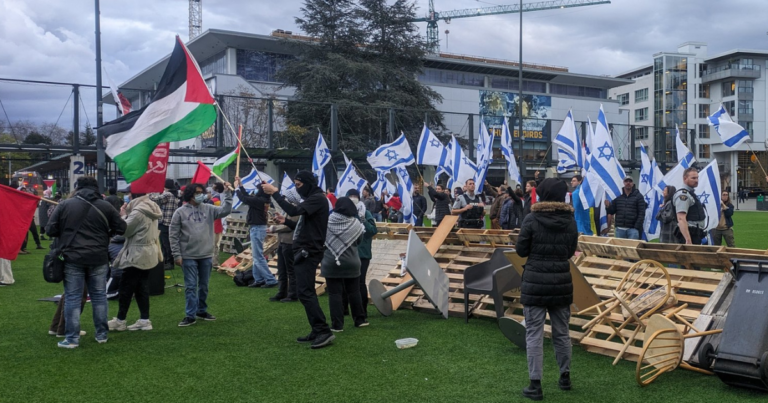
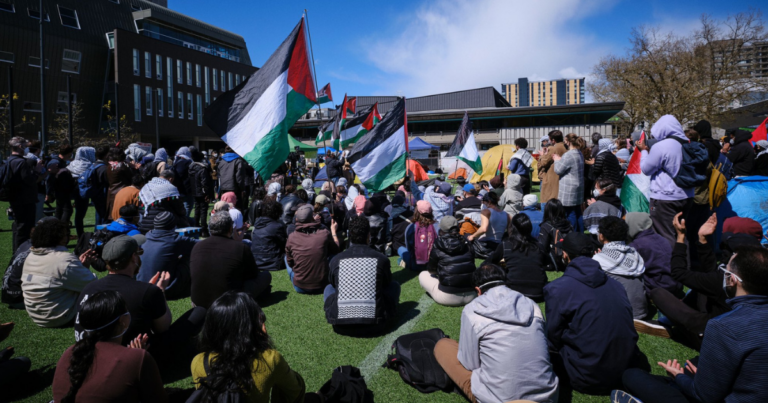
Radical anti-Israel protests have spread to several Canadian universities, including the University of British Columbia where a hostile encampment has been set up.   

Meanwhile, tensions have risen at McGill, the first Canadian university to get an encampment inspired by the one at Columbia University in the U.S.

Those taking part in the UBC encampment want the university “to divest from Israel’s settler colonial occupation, ethnic cleansing, and genocide of Palestinians, and to participate in global academic boycotts of Israeli universities,” as per a news release.

Footage of the UBC encampment shot by Global News shows activists wearing both keffiyeh scarves and N-95 masks. Protesters were also hostile towards the media, despite inviting them to their encampment.

Also seen at the UBC encampment were signs containing hateful messages, including one telling those who believe in the existence of a Jewish nation to “f**k off.”

In a statement, UBC said it “values freedom of expression and respects peaceful protest. We understand that some in our community want to protest the violence and war they see unfolding.”

“These actions must always be taken with respect for others and within the boundaries of university policy and the law,” UBC added.

“Any actions that create a health and safety risk, impede the university community (students, faculty and staff) from continuing learning, research, work and other activities on campus, or damage university property will be taken very seriously and investigated,” the university also noted.

Hillel B.C., a Jewish non-profit with a presence on UBC’s campus, said it has been in touch with the UBC administration “to express our concerns and to request measures that ensure the ongoing demonstrations remain peaceful and respectful.⁠”

The group wants to see the “enforcement of university policies that support a safe and conducive learning environment,” the taking of proactive measures “to prevent any disruption to student life and the educational process,” and for UBC’s campus to remain “a space where all students can feel secure and valued.⁠”

Other Canadian universities are meanwhile warning students that they will not tolerate encampments on their campuses.

At the University of Toronto, Vice-Provost Sandy Welsh issued a strong warning to students, threatening disciplinary action if they occupy the university’s campus.

“U of T’s lands and buildings are private property, though the university allows wide public access to them for authorized activities. Unauthorized activities such as encampments or the occupation of university buildings are considered trespassing,” the statement said.

“Any student involved in unauthorized activities or conduct that contravenes university policies or the law may be subject to consequences,” the statement added.

The University of Ottawa also issued a statement warning students that “encampments and occupations will not be tolerated.”

However, that statement did not stop University of Ottawa students from gathering on the front lawn of the administration building, Tabaret Hall, for a “sit-in” protest. Students were joined by controversial Ontario NDP MPP Joel Harden.

At McGill University, meanwhile, tensions have risen amidst students refusing to collaborate with the university administration, which has asked them to leave the premises. McGill is now asking Montreal police to get involved.

“As we have failed to reach a resolution, university leadership decided to take the final step in our protocol, and requested police assistance late afternoon yesterday,” said McGill in a statement. 

“Police representatives, who have expertise in skillfully resolving situations such as these, have now started their own process. We continue to work with them to resolve the matter,” the university added.

In an interview with True North Monday, a McGill encampment organizer refused to condemn Hamas and its Oct. 7 attack on Israel or call for the return of hostages

“It’s not even in the interest of the Israeli regime to have these hostages returned,” the organizer claimed.

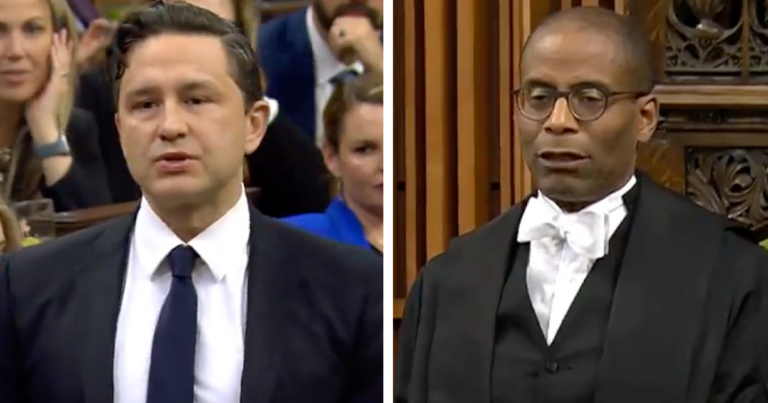
Poilievre ejected from House of Commons for calling Trudeau a “wacko”

Conservative Leader Pierre Poliievre was kicked out of the House of Commons after he refused to withdraw a claim that Prime Minister Justin Trudeau is a “wacko.”

The incident occurred during question period, when Poilievre referred to Trudeau as a “wacko” prime minister responsible for “wacko” policy – a term that raised the ire of House of Commons Speaker Greg Fergus.

Poilievre’s comments followed Trudeau accusing him of associating with far-right extremists and pandering white nationalists in order to acquire votes. Trudeau also went on to say that Poilievre was not fit to be prime minister. 

The two politicians exchanged barbs in the aftermath of Conservative MP Rachael Thomas being kicked out of the chamber for disregarding instructions from Fergus, whom Thomas called “disgraceful.”

Ferugs asked Poilievre to withdraw the use of the word wacko, which the speaker said “was not parliamentary.”

“Mr. Speaker, I replace wacko with extremist,” replied Poilievre. “He is an extremist.”

Fergus asked Poilievre again to withdraw his comment, “and simply, withdraw his comment,” to which Poiilievre instead offered to replace the word with “radical.”

Fergus asked Poilievre again to withdraw the comment, without replacing it with any other words. 

In the roar of frustration from the Conservative bench, an MP can be heard yelling, “they (the Liberals) can call us white supremacists.”

“I replace the word with extremist,” Poilievre replied.

“I will ask the honourable leader of the opposition one last time to please withdraw that comment, and simply withdraw that comment,” said Fergus. 

“I simply withdraw and replace with the aforementioned adjective,” answered Poilievre.

Fegus then ordered Poilievre to withdraw from the House for the remainder of the day’s sitting for disregarding the chair.

The majority of Conservative MPs left the chamber in protest.