MPs from all parties call for Trudeau to launch a foreign agent registry

A coalition of diaspora communities in Canada joined by MPs of all stripes took to the House of Commons to call upon the federal government to table legislation to create a foreign agent registry. 

Gloria Fung, a spokesperson for the coalition, told reporters in Ottawa on Tuesday that diaspora groups have been waiting since 2021 for the Trudeau government to act upon their request.  

“We are tired of empty promises. We need action now,” said Fung. 

The coalition is being supported by MPs from the Conservatives, NDP, Bloc Quebecois, Green and Liberal parties. 

They asked for a foreign agent registry that would require anyone involved in government or election influence to register their activities should they also work on behalf of a foreign power.

The coalition believes that failure to do so should result in jail time for foreign agents. 

“If you take money from a foreign government you should have to register in Canada. It’s time to do it,” said Conservative MP Tom Kmiec on Tuesday.

The Trudeau government started working on a suite of reforms last year to deal with foreign interference that included a foreign agent registry, as well as amendments to the Criminal Code and the Canadian Security Intelligence Act to make foreign interference an offence. 

While the reforms have yet to become legislation, Public Safety Minister Dominic LeBlanc said such legislation will be “coming soon” during Tuesday’s press conference. 

According to Leblanc,  additional measures will be introduced to counteract foreign interference in Canada from hostile states. 

“This is part of our ongoing effort to strengthen legislation with respect to foreign interference,” he said. “So, I’m confident that the foreign influence registry will be part of a broader effort to strengthen legislation with respect to countering foreign interference.”

Canada is lagging behind other nations like the United States and Australia, which have already implemented foreign agent registries, and the U.K. created a new law that will come into effect later this year. 

Under the U.S. Foreign Agents Registration Act, the Federal Bureau of Investigation was able to arrest Chinese agents who were intimidating Chinese citizens in the U.S. last year. 

Similar activity by Beijing has likely been underway in Canada for some time via the use of Chinese “police stations” located throughout the country. 

Certain members of the Chinese-Canadian community have voiced their opposition to implementing a registry, like Independent Senator Yuen Pau Woo. 

Woo, who was appointed to the upper house in 2016 by Prime Minister Justin Trudeau, claims that such a registry would do more harm than good and he fears that it will infringe on Canadians’ Charter rights. 

However, President of the Central and Eastern European Council in Canada Marcus Kolga doesn’t see how a foreign agent registry would differ from the already existing registry in place for domestic lobbyists who are required to register when they are trying to persuade the government. 

“100% Canada must enact a Foreign Influence Transparency Registry immediately to protect vulnerable Canadians, minority communities, the critics of the Kremlin, PRC and Iran and the sovereignty of our democracy,” said Kolga in a social media post on X. 

Palestinian group linked to anti-Israel protests receives Canada Summer Jobs funding

The Canadian government is subsidizing a full-time summer job for a “social events coordinator” with the Atlantic Canada Palestinian Society of Saint John through the Canada Summer Jobs program.

The organization is a chapter of the Atlantic Canada Palestinian Society, a non-profit Canadian-Palestinian organization that has shared a series of anti-Israel posts on social media and organized pro-Palestine protests and rallies across the region.

When asked by True North if the job, which offers $15.30 an hour for 35 hours of work per week, would involve organizing protests, the ACPS of Saint John did not respond.

The chapter’s parent organizations similarly did not answer a question from True North on whether the social events coordinator position helps organize protests or if it has a similar position.

“The Atlantic Canada Palestinian Society – Halifax does not currently have any CSJ positions available, nor have we applied for or received CSJ funding to hire individuals. It seems there may have been a misunderstanding or mix-up regarding this matter.”

Follow-up queries about the parent organization’s connection to the chapter went unanswered.

According to the Saint John chapter’s job posting, which was shared on Instagram, the social events coordinator will “organize and promote community events, coordinate volunteers, and support community initiatives.”

To qualify for the position the applicant must have a “passion for social justice and community advocacy.”

Justin Trudeau has opposed funding groups through the Canada Summer Jobs on the basis of differing politics before. In March 2018, he said his government wouldn’t fund groups focused on campaigning against abortion and LGBT rights.

The job posting has raised eyebrows from Canada’s Jewish community.

“There’s nothing wrong with charities whose work is designed to combat some of the humanitarian issues being faced by the Palestinian people. Those organizations are doing things completely in line with Canadian values,” Rich Robertson, the director of research and advocacy at B’nai Brith Canada, told True North. “The issue is when groups…are engaging in acts, whether through the events they’re hosting or through their online dissemination that are contributing to incitement here in Canada, that’s when such groups become problematic.”

On Jan. 6, the Atlantic Canada Palestinian Society called for a permanent ceasefire in Gaza. Two days later, the group shared a post that read “Intifada until victory, Communist Revolution.”

An intifada is an uprising. The second intifada, in the early 2000s, was characterized by dozens of suicide bombings and other attacks – many conducted by Hamas – on Israelis in public places frequented by civilians, such as buses, movie theatres, and hotels.

“Calls for a ceasefire in general that do not acknowledge the need for the removal of Hamas, a listed terrorist entity here in Canada, from power are problematic in and of themselves because they place sole responsibility for the conflict on the Israeli state as well,” Robertson said. “As well it is contradictory on the one hand, to be demanding a ceasefire while also continuing to advocate for violent resistance.”

The ACPS promotes videos of pro-Palestine protests that call Israel’s war against Hamas a genocide and chants such as “From the river to the sea Palestine will be free,” which is commonly understood to be a call for the destruction of Israel.

In another post, the organization says the chant is a call for equal rights for Arabs in Palestine and to suggest otherwise is “Islamophobic and racist.”

The organization also posted a clip from an interview with Israeli-American activist Miko Peled in which he calls Israel a “racist apartheid regime that needs to be dismantled.”

Under the articles of agreement for the Canada Summer Jobs program, organizations engaged in partisan political activities are ineligible for the government subsidy, and the job cannot involve partisan political activities. 

A spokesperson for Employment and Social Development Canada, the department overseeing the program, would not comment on how or if it assessed the Atlantic Canada Palestinian Society of Saint John for compliance, or if the job involved protest organization.

“We can only speak for ESDC therefore, we won’t have any information on your question,” the spokesperson said.

Ontario addresses labour shortage with new pathways to enter skilled trades

Ontario students will be able to spend the majority of their senior years working in the trades while still completing a few compulsory academic courses.

The Ontario government announced on Wednesday the introduction of the Focused Apprenticeship Skills Training program, a new stream of the Ontario Youth Apprenticeship Program aimed at accelerating the training and employment of young Ontarians in the skilled trades.

The FAST program will enable Grade 11 and 12 students to engage in apprenticeships by allowing them to take up to 80% of their senior courses through co-operative education. The program will begin in September 2025, allowing students to access apprenticeships from 144 different trades.

Students currently take one to two Ontario Youth Apprenticeship courses. The change will allow students to take eight to eleven.

Successful graduates of the FAST program will receive a seal of distinction on their high school diploma. 

The press conference was held at Judith Nyman Secondary School, one of the partners where students in Ontario will go to develop their talents in the skilled trades.

David Piccini, Ontario’s Minister of Labour, said that the skilled trades allow students to bolster their future and take control of their destiny. 

“This is especially true for the students here and other young people who have been told that university is the only path to success. And we know that is fundamentally not the case,” said Piccini.

He added that Ontario projects it will need an additional 500,000 workers in the skilled trades over the next decade to meet demand.

At least one in three workers in Ontario with an apprenticeship certificate as their highest academic credential is nearing retirement. 

Working in the trades not only accelerates the passion for the work but can also help some students with standard courses. Piccini highlighted the importance of experiential learning.

“The number of youth I’ve met on job sites who are working with employer partners, school boards, and teachers who are saying math was challenging, but seeing it in a construction context, in building a Habitat for Humanity home has inspired me to get my math credentials that I will need,” said Piccini. 

Ontario has invested over $1.5 billion in the skilled trades since 2020. The Ontario Youth Apprenticeship Program has more than 72 recruiters across 800 schools. 

Melissa Young, CEO of Skilled Trades Ontario, said that one in five jobs in Ontario are projected to be in the skilled trades by 2026, a statistic she expects to increase even more. 

She added that as of October 2023, there were almost 94,000 apprentices in Ontario, more than the rest of the country combined.

The new program builds on Ontario’s announcement from last March, requiring students entering grade nine or ten to complete at least one technological education course to help them consider future careers in the skilled workforce, including the skilled trades. 

Ontario also announced a new online job matching portal to match potential apprentices, journeypersons, and employers. 

The provincial government is also launching a new pathway to trades policy for those with prior experience who may lack some academic entry requirements. 

Piccini recently met a Ukrainian refugee with previous work experience in the trades but lacked a secondary school diploma and credentials.  

“This policy will create a new pathway for people with work experience or relevant skill sets in the skilled trades by creating alternative criteria to assess competency,” he said. 

The Ontario government was the first provincial government to remove Canadian work experience requirements, Piccini said.

“I’m sick and tired of hearing of hopping in an Uber, hopping in a cab, and hearing the driver is an engineer, the driver has some competencies in the skilled trades, or is a doctor or a nurse. I’m sick of it. And we’re leaving no stone unturned to address that,” added Piccini.

He said that Ontario is the first province to implement such a policy. He expects that many provinces will follow suit.

Feds still considering decriminalizing drugs in Toronto despite B.C.’s reversal

As the B.C. NDP government petitions the federal Liberal government to recriminalize public drug use due to the overdose epidemic, Conservative politicians raised the alarm on Toronto’s ongoing application to decriminalize hard drugs in the city.

The City of Toronto has had a pending application to decriminalize hard drugs in Toronto since 2022. The plan was updated in 2023 to decriminalize hard drugs for children too.

A letter that prefaced “Toronto’s Model of Decriminalizing Drugs for Personal Use” to the government and signed by city officials said, “We are confident that the right model of decriminalizing the possession of drugs for personal use will lead to a safer environment for everyone,”

The letter explains their collective conclusion to decriminalize all drugs for all ages comes after convening with experts and listening to past and present drug users, and those impacted by addiction.

“As you know, the evidence demonstrates that criminalizing the possession of drugs for personal use leads to discrimination and stigma, and contributes to people hiding their drug use from their physicians, friends, family, colleagues, and community,” the letter said. “Being criminalized has negative mental and physical health impacts, and a criminal record can prevent access to meaningful employment, secure housing, and full access to the social determinants of health, including fair treatment in healthcare settings.”

The program requests that policing and justice system resources be used on drug traffickers rather than drug users.”

“The City of Toronto needs to get with the program, wake up to reality, and immediately withdraw this application,” Columnist Anthony Furey told True North.

“The evidence shows that the more of these policies we introduce, the more collateral damage we see in our communities, and the more we see people tragically dying of drug overdoses, it’s not the right direction the numbers are in.”

Furey is concerned with the city’s inclusion of minors in the decriminalization plan.

“Many law enforcement authorities have told me that they know what will immediately happen is that the drug dealers will conscript minors even more into their system,” he said. “This will only drag young people into the illegal drug nexus further.”

He believes the drug addiction and overdose crisis is multifaceted but the recent emphasis on harm reduction policies over addiction treatment is only making things worse.

“We’ve done the experiment. We’ve been doing it for 20 years. The first drug injection site opened in Vancouver over 20 years ago,” he said.“We’ve now learned a lot, and it’s time to go in a different direction and prioritize treatment.”

In the decriminalization plan, policymakers assure the public that “decriminalization will be accompanied by a full continuum of downstream mental health, harm reduction, and treatment services.”

City officials list several health and treatment services they hope to have in place before decriminalization is implemented.

“At least one location in the downtown core offering 24/7 health and social supports, to serve as an effective alternative to emergency departments…four crisis response services for Toronto residents staffed by health and social service providers and peers…and supervised consumption services in collaboration with acute care hospitals.”

But Furey thinks addiction treatment is not being prioritized in Toronto’s approach to the crisis.

“The system currently doesn’t have a mindset that prioritizes treatment. It has a mindset that prioritizes enabling and being reluctant to discourage the person from drug use and help them move on with their lives,” he said.

He said the City of Toronto’s “The Brave App” is an example of the city’s lack of attention to rehabilitation in its drug policies.

The app is intended for drug users to notify a “non-judgmental” community-based rescue team when they are using drugs, if they do not respond after a certain amount of time, the team can send emergency help to their location in case the user is overdosing.

“At no point in this app anywhere in all its modules…(are there) prompts for treatment. So we have an engagement with a drug user, and we don’t want them to die of an overdose, which I support that basic idea, but at no point in our engagement with them do we mention the idea of treatment,” Furey said.

CAMPUS WATCH: Anti-Israel students set up encampment at uOttawa

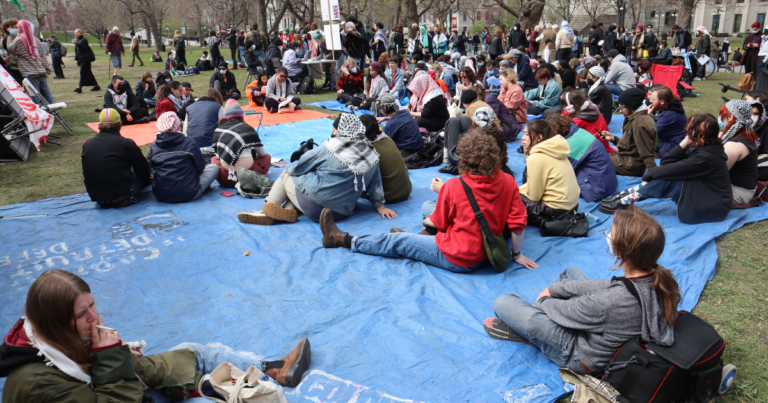
Anti-Israel student activists at the University of Ottawa have set up an encampment despite a university administration warning that occupations would not be tolerated.

Their encampment comes as Canadian universities continue to be plagued by radical anti-Israel demonstrations inspired by those seen at Ivy League U.S. colleges and universities, notably Columbia.

University of Ottawa students first held a sit-in protest on the lawn of Tabaret Hall Monday and Tuesday. By Tuesday, the daytime protest turned into an encampment, amid protesters being frustrated with administrative silence.

The encampment remained in place Wednesday.

Students at the encampment were seen wearing both keffiyeh scarves and medical masks, and chanted phrases like “uOttawa you can’t hide, you’re supporting genocide.” 

They call their encampment the “liberated zone.”

Signs seen at the encampment include one that states Israel does not have a right to defend itself. Other signs call on the university to “divest” funds from the Jewish state. 

At other universities, hateful signs have been seen at anti-Israel encampments.

At UBC, an individual brought a sign that tells those who believe in the existence of a Jewish nation to “f**k off,” while at McGill, signs calling for Intifada (armed uprising) and praising Aaron Bushell, a U.S. airman who set himself on fire for Gaza, were seen.

The University of Ottawa had previously warned that encampments would not be tolerated.

“While peaceful protest is permitted in appropriate public spaces on campus according to our policies and regulations, encampments and occupations will not be tolerated,” the university’s associate vice-president of student affairs Eric Bercier said in an Apr. 28 statement.

“We have forcefully and repeatedly affirmed that no incitement to violence or incidents of harassment or hate, including Islamophobia and Antisemitism, will be tolerated on our campuses,” the statement also said.

The university has not yet issued a public statement on the encampment, and did not respond to a request for comment from True North on the matter.

Meanwhile, over at McGill University, the first institution in Canada to get a woke American-style encampment, a bid to issue an injunction against those participating in the encampment was rejected by a judge Wednesday. 

The request for an injunction was filed by a lawyer representing two McGill students, and sought to ban five anti-Israel groups from protesting within 100 meters of McGill University buildings for 10 days.

The students argued that radical anti-Israel activists occupying their campus made them feel unsafe.

While Superior Court Justice Chantal Masse rejected the plaintiffs’s bid for an injunction, she did call out the hateful messages and slogans attributed to people at the encampment, saying they were “troubling”.

Masse called on members of the encampment to “review the words used during the demonstrations and to refrain from using those likely to be perceived, rightly or wrongly, as calls for violence or as antisemitic remarks.”

In an interview with True North Monday, a McGill encampment organizer refused to condemn Hamas and its Oct. 7 attack on Israel or call for the return of hostages

When asked about the encampments this week, Prime Minister Justin Trudeau called out the fact that Jewish students feel unsafe on their campuses.

“Universities are places of learning, places for freedom of expression, freedom of thought, freedom of ideas, but that only works if people feel safe on campus,” said Trudeau. “Right now, right across the country, Jewish students do not feel safe. That’s not right.”

LEVY: Where are the parents of the entitled anti-Israel tent-dwellers?

Watching the drama unfold on the campuses of pricey Ivy League U.S. schools and now at least five Canadian universities over the past few days, I keep asking myself this question:Where are the parents in all of this?

Parents who’ve paid up to $70K per year to attend these halls of upper learning have, for the most part, been strangely silent about the odious activities of their little darlings.

We’ve witnessed a motley collection of keffiyeh- and mask-clad students creating encampments on college and university property, shouting hateful chants about Jews, in the case of Columbia occupying a building and holding maintenance staff hostage, and at some American universities (UCLA being one) blocking Jewish students from entering the college grounds.

It took two weeks to clear out Columbia – the worst situation of all, where entitled students were upset that food was not being delivered directly to the building they occupied.

One PhD student – an avowed leftist – told the media students were going to die if they did not get humanitarian aid.

Encampments or sit-ins have also been set up at McGill, the University of Alberta, University of Ottawa, University of British Columbia, and most recently, Toronto Metropolitan University.

At McGill, the administrators claimed they were trying to “negotiate” with the protesters, who like all the others are not just denying the atrocities of Oct. 7 but goading Jewish students to “return to Europe.”

Their latest demands involve calling for university and college administrations to divest from Israeli companies and boycott Israeli academics – which is blatantly antisemitic.

There is no negotiating with these out of control brats.

I have wondered and continue to wonder how parents feel seeing their little darlings spouting hate on TV, or refusing entry to Jewish students or in the case of the leftist PhD student at Columbia, what they think about a daughter who expects food to be delivered to the building she and her colleagues trashed and vandalized.

Are they the slightest bit embarrassed when their semi-articulate progeny mouth the same talking points on TV and cite lies about the number of Palestinian deaths?

What do they think when their kids prevent Jews from entering the grounds of the colleges where they are students? 

Are they the slightest bit upset that their kids are protesting instead of completing their final exams or looking for a summer job?

Are they proud of their hateful little darlings?

Or are they in denial?

I know from covering the Toronto District School Board and other school boards in Ontario that there are many parents who have completely abdicated responsibility for their kids to the school system.

There are also parents who are invested in their kids’ schooling and have tried to stand up for what’s right.

They have found themselves shut out, patronized by school administrators, subjected to name-calling, or simply treated horribly. I have witnessed that at several school board meetings. Often the parents back off for fear it will impact on how their kids are treated in the classroom.

That said, these parents are at least invested and likely ensure their kids have boundaries.

But judging from what we’ve seen on college and university campuses in the past few weeks, it seems invested parenting is a thing of the past.

I’m certainly no expert but I have watched the decay of morals and respect during my journalism career.

Sadly, it doesn’t seem that kids are learning right from wrong. They have no moral compass, no direction and no boundaries.

In fairness, most of our political leaders lack a moral compass and the leftist professors at colleges and universities indoctrinate them with impunity. The administrators of these colleges and universities throw up their hands and do nothing, citing free speech rights.

Weak parents, like weak politicians, likely find it far easier to pander to their kids, to give them everything they want than to deal with the fallout (including childish temper tantrums).

Problem is, parents either want to be best friends with their kids or shower them with praise, cash and material objects as a substitute for actually spending quality time with them.

How many times have we seen entire families at a restaurant dinner playing with their iPhones – or allowing their kids to tune out and text or take selfies.

I’ve seen parents trying to reason with their brats when they act out.

I’m not at all saying they should engage in the kind of physical punishment that was common when I was growing up. But the pendulum has swung completely in the opposite direction.

They support them financially no matter what, there is no withdrawal of any privileges and as many have said, they likely bailed out the kids who’ve been arrested for their crimes at American universities.

It horrifies me to think that there may also be radical parents who think there’s nothing wrong with what their kids are doing because it is all in the name of free speech and democratic rights.

There are ignorant parents too, as we’ve seen from the crazy activities and pronouncements of our NDP politicians in Canada.

But there’s also the idea that some parents are simply afraid of their kids. 

Because of a soft upbringing with no consequences or through no fault of their own, these kids go off to university and become easily indoctrinated, easily swayed through peer pressure to belong to whatever cause–and come home mouthy and insolent.

Remember these are the potential leaders of tomorrow.

It makes me terribly sad to see this absolute abdication of consequences, boundaries and plain old discipline.

The kids are certainly not alright.

The Alberta Roundup | Calgarians outraged over rezoning plans

Today on the Alberta Roundup with Rachel Emmanuel, Rachel speaks with Calgary Ward 13 City Councillor Dan McLean about the city’s plan to amend land-use bylaw in neighbourhoods to allow townhomes and row houses where currently only single-family homes are allowed.

Rachel asks for clarification on what the proposal will mean for residents and how city infrastructure will support the new homes and people.

Tune into the Alberta Roundup now!

SUBSCRIBE TO THE ALBERTA ROUNDUP

The 2024 federal budget will pass with NDP support

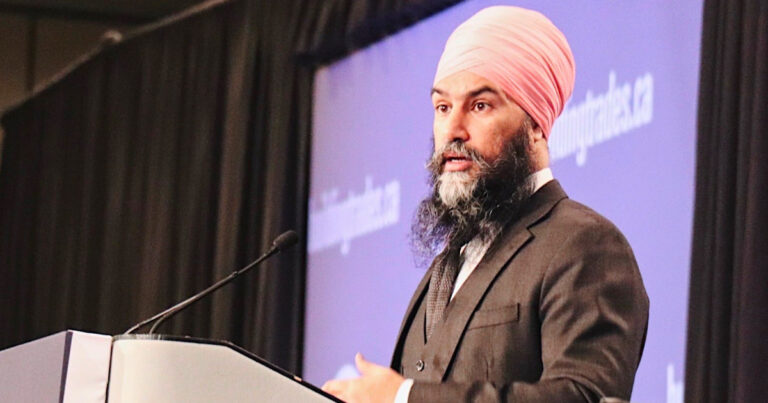
After weeks of speculation, NDP Leader Jagmeet Singh announced that his party would support this year’s budget despite raising outstanding concerns.

Finance Minister Chrystia Freeland unveiled the Liberals’ 2024 budget on Apr. 16. The budget proposed $111.2 billion in new spending over the next five years, a $40 billion deficit and no plans to balance the budget.

Singh held his tongue until Wednesday, when the bill is up for its first vote, to say that his party would support it when speaking with reporters at Parliament Hill. A lack of NDP support could trigger a vote of non-confidence for the minority Liberal government. 

“New Democrats fought for some concrete wins in this budget. They’re going to make life better for people,” said Singh.

The wins, categorized by Singh, were nutrition programs in schools, free birth control, free diabetes medication and devices, and a protection fund for renters.

However, the New Democrat leader raised some existing concerns that have yet to be addressed by the Liberals. 

“I made it very clear to the Prime Minister that I expect the Prime Minister and the Liberal government to fix these problems,” said Singh.

The first problem raised by Singh was related to disability benefits. He feels the amount is not high enough, not enough people will receive the benefit, and the clawbacks will result in recipients not receiving a dime after the provinces clawback the amount. 

“If they’re worse off because of this benefit, that is an abject failure,” said Singh.

He also raised concerns about “a massive gap in funding for Indigenous communities when it comes to housing and infrastructure.”

The NDP leader said that this funding gap is resulting in First Nations living in overcrowded homes with mould and substandard conditions. 

He added that the federal government fails to meet the standards set in 70% of the cases for the Jordan’s Principle — which aims to ensure all First Nations children in Canada have timely access to the products, services, and support they need.

Despite the issues raised, Singh confirmed that he would support the budget.

“The Prime Minister showed an openness to resolve these concerns. We are going to make sure we hold the government to account over the next weeks to make sure that these matters are addressed, and these matters are resolved,” he added. 

The NDP’s support is part of a confidence-and-supply agreement with the Liberals, under which the NDP agrees to back the government in key votes, such as the budget, in exchange for the Liberals’ consideration and action on some NDP policy priorities.

The other opposition parties said they would oppose the budget and vote against it.

B.C. Conservative bill to bar biological males from women’s sports shot down

A B.C. Conservative bill to prevent biological males from competing in women’s and girls’ sports was shot down on its first reading on Tuesday.

The Fairness for Women’s and Girl’s Sports Act was defeated in the B.C. legislature with 51 MLAs voting against it and 27 voting in favor.

B.C. Conservative leader John Rustad told True North he was “proud” to have introduced the bill, which he called a “first in Canada,” despite the NDP blocking it.

The bill would have required participation in publicly funded sports organizations to be sex-segregated and for all teams and events to be classified by sex.

“Participation in a sporting team or event must be limited to individuals of the biological sex that corresponds to the sex classification of the sporting team or event,” the bill said.

It provided an exception allowing women to participate in male sports but not vice versa; otherwise, male and female players could participate together in a co-ed league or event.

“Maintaining opportunities for female athletes to demonstrate their strength, skills, and athletic abilities and providing them with the opportunity to obtain recognition and accolades, university scholarships, and numerous other short—and long-term benefits that result from participating and competing in athletic endeavors in the province of British Columbia separate from their male counterparts is just common sense,” Rustad said at the first reading of the bill.

Along with preventing biological males from participating in women’s and girls’ sports, the act would have given sports teams and organizations the authority to request birth certificates and registration, and other forms of government identification to prove the biological sex of participants.

“There are inherent differences between males and females ranging from chromosomal and hormonal to physiological differences,” Rustad said. “But more than the obvious differences over time, women and girls have struggled to be identified as a person.”

He noted women’s collective struggles, such as their fight for the right to vote, to be allowed in certain places, and for fair pay, and said this vote was another example of women fighting for the right to be treated fairly.

“This legislation was a female-led initiative from start to finish. A team of women, including Conservative caucus research staff, female athletes, coaches, and advocates came together in defense of fairness in women’s and girls’ sports and pieced this legislation together,” Rustad said in an email to True North.

The bill would have also retroactively stripped recognitions of women’s sporting achievements from males from the records of relevant designated sports organizations.

The act would have prevented sports organizations from allowing retaliation by either the organizations or others against any players who raised awareness of a breach of the act.

The B.C. Conservatives promoted the bill with Canadian powerlifter April Hutchinson, who has been outspoken about the problems of allowing men to compete in women’s sports.

B.C. Conservative candidate and former NDP MLA Gwen O’Mahony told True North in an interview that she has heard from many women and girls in sports who experience unfairness with males, who, in one case went back to playing on a male team after winning in the female league.

“We need some rules; we can’t just leave it the way it is,” O’Mahony said. We need to answer two questions at the legislature when it comes to women’s and girls’ sports: Is it fair? And is it safe? That bill answered both those questions.”

The B.C. NDP told True North it would comment on its blockage of the bill but ultimately did not respond.

Gov didn’t consult with farmers on fertilizer emission target: Auditor General

In a scathing review, the Auditor General has condemned the federal government for its handling of emission reduction efforts within the agriculture sector, citing mismanagement and a lack of transparency.

The report, titled “Agriculture and Climate Change Mitigation,” focused on programs overseen by Agri-Food Canada, with particular scrutiny on the government’s voluntary 2030 target for farmers to decrease fertilizer emissions by 30%.

According to the Auditor General, one of the primary issues highlighted was the absence of consultation with stakeholders, including farmers and industry associations, before establishing the fertilizer emission reduction target. 

This oversight led to confusion among sector stakeholders, with some interpreting the target as a mandate to reduce fertilizer usage by 30%, rather than a reduction in emissions through improved application techniques.

“We found that the department did not consult with stakeholders (for example, farmers and industry associations) prior to establishing the fertilizer emission reduction target,” the report wrote. 

Furthermore, despite plans to establish voluntary agreements with various stakeholders to achieve the reduction target, the government had failed to implement any such agreements by January 2024.

“To achieve the fertilizer emission reduction target, the department planned to establish voluntary agreements with fertilizer manufacturers, agricultural stakeholders, provinces, and farmers. However, we found that it had established none by January 2024,” wrote the Auditor General.

The report also revealed that the programs examined had not quantified expected greenhouse gas emission reductions and failed to track any relevant data. Additionally, a lack of long-term vision and direction from the government further muddled the path to achieving these targets.

Among the programs scrutinized were the Living Labs program and the On-Farm Climate Action Fund.

Criticism from farming groups, such as the Saskatchewan Association of Rural Municipalities, has been constant. They’ve argued that the fertilizer emissions target would lead to reduced agricultural yield, directly conflicting with the government’s expectation for farmers to increase production to meet global food demands.

“Canada has set a target to increase agriculture exports from $55 billion in 2015 to at least $85 billion by 2025. This 55% increase will not be attainable if the federal government reduces nitrogen fertilizer use by 30%,” wrote the association.

In a document sent to Ottawa, the association outlined concerns about the feasibility of the government’s agricultural climate plan, particularly in light of global food security goals. 

The submission highlighted the disparity between the United Nations’ aim to eliminate world hunger by 2030 and Canada’s goal to increase agriculture exports by 55% by 2025, asserting that the proposed reduction in fertilizer use would undermine food security efforts.