GTA Convoy anniversary event draws large crowd

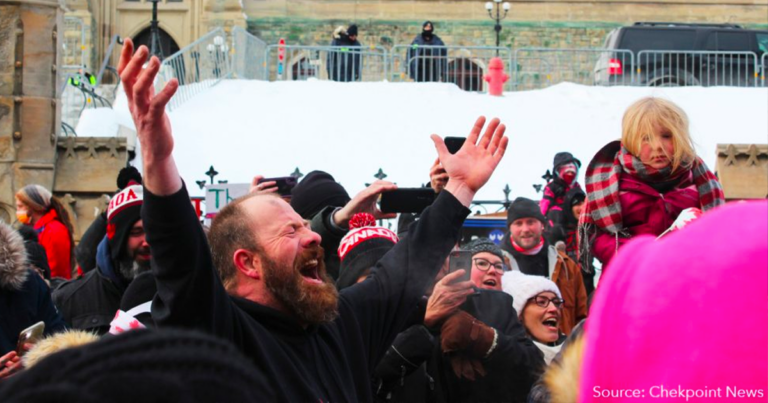
As thousands gathered in cities across Canada this past weekend to celebrate the one-year anniversary of the Freedom Convoy, a large crowd convened at Vaughan Mills – a shopping centre north of Toronto, situated at the southeast quadrant of Highway 400 and Rutherford Road interchange.

Local Vaughan organizers said that they were supporters to come from Ontario cities including Georgina, Simcoe, Muskoka, Barrie, Port Hope, Niagara and Hamilton.

Large trucks, Canadian flags and freedom signs filled the mall parking lot. Shouts for freedom and horn honks interspersed upbeat music playing from a parked flatbed truck.

Many of the attendees present at the anniversary celebration said they participated in the Ottawa Convoy last year. For them, gathering at Vaughan Mills presented an opportunity to commemorate the bravery of the “freedom fighters” on Parliament Hill. 

Evelyn Jaeger and her son-in-law were in Ottawa when Prime Minister Justin Trudeau called the Emergency Measures Act. Jaeger recalls feelings of fear and anxiety during the “intense” night. 

“It was freezing cold and our phone battery died right away,” she said. “As we walked to where the majority of the protesters were, a lady came crying and said ‘go the other way, they are trampling old ladies.’ We worked our way to the front of the line and for hours we were face to face with so many policemen in full battle gear. Even behind us, we saw more policemen with gas masks, big guns and horses. We didn’t know if we were the next ones that they would trample over next.”

Despite the heavy police presence in Ottawa, Jaeger said that there was “a good atmosphere among the people.” She noted many hugs with strangers, tears of joy and a feeling of unity. 

“We will make a point of celebrating this every year, like Remembrance Day. We have to remember how we fought for our freedom. Freedom is not for nothing,” said Jaeger.

Another protestor, who wished to remain anonymous, remarked how “unifying” the Ottawa Convoy had been.

“Although the intensity was palpable, it just brought tears to your eyes to be with another group of people who had been considered outcasts for so long. You no longer felt alone. Just being in the inside of a building where you could eat with other people without being questioned about your vaccination status was touching,” the protestor said.

Anne Marie Shirk, a registered nurse who was fired for not taking the vaccine, went to Ottawa to “help out.” She pointed out similarities between the Ottawa Convoy and the first anniversary celebration event. 

“In Ottawa, it was the best time ever. People were dancing, kids were in the bouncing castles, people were just having a good time smiling and laughing. This weekend– this day right now– is a great reminder of how it was last year. I am proud to be Canadian and I am proud to be here. Everybody here is like family, there is that friend feeling. There are smiling faces and no masks,” she said.

Jodie, who attended the Convoy in 2022, said that the one-year anniversary gathering should send a message to Trudeau. 

“I want him at least to sit down and have a conversation with the people who feel this way. When we first went into Ottawa, he kind of ran away. None of the politicians spoke to anyone. We felt like we didn’t have a voice,” she said. “In a democracy, you are supposed to gather and protest, but they want to take that away from us as well. We need to keep doing this, build our numbers and take the country back from tyranny.”

FUREY: Revisiting the Freedom Convoy one year later

One year ago, Canadians filled the streets of downtown Ottawa to protest the government’s pandemic response.

Canada had one of the most extreme lockdowns in the world. From vaccine mandates to school closures, many Canadians are looking back questioning why these extreme measures were necessary. Despite the media’s skewed coverage of the protest, the Convoy represented Canadians pushing back against these extreme measures.

Anthony Furey discusses the one-year anniversary of the Freedom Convoy in his latest video.

Crowd gathers on Parliament Hill for Freedom Convoy anniversary

Over a hundred people gathered on Parliament Hill this weekend to mark the one-year anniversary of the monumental Freedom Convoy.

True North was on the ground in Ottawa.

Demonstrators gathered around the centennial flame with Canadian flags – they sang the national anthem and chanted “Freedom.” There were also speeches, as well as music and a DJ. Organizers obtained a permit for the demonstration.

No major convoy figures or political party leaders were present. However, Alberta Conservative MP Arnold Viersen made an appearance.

The music continued into the evening, however the scene was nowhere close to the massive street dance parties that took place during the Freedom Convoy last year.

True North spoke with attendees who said they chose to come to Parliament Hill to commemorate the Convoy and to keep the freedom movement alive. One woman noted that she doesn’t want people to forget how life was during the pandemic.

Tensions arose a few times on Saturday, including when law enforcement told people they could not set up chairs in Wellington and removed flags from a snow bank. Altercations also took place between demonstrators and a counter protestor, who was seen hitting attendees with her megaphone.

Two teenagers who are part of the Save Canada organization were arrested after an altercation with the Parliamentary Protective Service. In total, authorities say they gave out 117 parking tickets and 47 Provincial Offences Act tickets and towed 19 vehicles on Saturday. 

The Ottawa Police warned in a tweet Thursday that “illegal activity or obstructing or impeding the flow of traffic with vehicles on any roadway will not be tolerated and will be met with swift and immediate action.” 

Meanwhile Ottawa-By Law implemented special parking restrictions and pledged focused enforcement actions against several activities; including open air fires, fireworks and the unauthorized use of speakers. 

Police told CTV News that they reported approximately 200 people in attendance at the Freedom Convoy anniversary event Saturday. A crowd also gathered on the hill Sunday.

Meanwhile, Police say a small convoy of vehicles entered Ottawa Sunday afternoon, but was redirected out of the city. 

HOUSING CRISIS: How Canadians are becoming serfs in a neo-feudal society

The following is part two of a two part feature on the Canadian housing crisis. Part one, on the role Covid-19 policies played in worsening renters plight, can be found by clicking here.

Vectored through the housing market, a cost of living crisis has gradually imposed upon Canadians a neo-feudal system that will invariably leave them poorer than their antecedents.

The Covid-19 crisis exacerbated years of mounting housing affordability woes in Canada’s major markets, namely Toronto and Vancouver, but it’s since spread through the nation like wildfire. 

Now, despite a dearth of sufficient purpose-built rental stock to house them, a growing number of young adults are either living with their parents or slated to become part of the country’s permanent renter class.

“Absolutely, there’s a permanent class of new renters. People are earning terrible wages and living with their parents,” New York-based Gerald Celente, a forecaster and publisher of Trends Journal, told True North.

Celente, a heterodox thinker whose vast body of work includes predicting, among other things, the Great Recession, likens the contemporary financial system to the plantation economy, only circumstances are far more propitious for today’s plantation owners because they don’t lodge and feed their serfs.

“You get a job at Walmart or Amazon or Home Depot or Lowe’s—any of the big chains—and you make nothing, go home, live paycheque to paycheque and can’t afford to buy food, so you eat crap, and then go back to work,” Celente said. 

“Look at the data that came from Oxfam at the beginning of the Davos meeting about the one per cent becoming, what, $27 trillion richer since 2020. Everybody is going down. The money is all being gobbled up to the top.”

The panacea to housing unaffordability today is preponderantly parents gifting children down payments for, or even outright purchasing them, starter homes so they can build equity. However, for the rest, affording a Toronto-area home that averaged $1,189,850 at the end of 2022 is insuperable—especially when factoring inflation, which shows nary a sign of dissipation.

“If you’re a person starting from nothing whose parents were renters, barring winning the lottery, your ability to put a down payment on a house in excess of a million dollars, or a small condo that’s $750,000, is increasingly difficult. Where will you find money to start the process?” said Ron Butler, owner of Butler Mortgage in Toronto. 

“It’s a neo-feudal society. We’re observing it: when the price of an average home is nine to 12 times average earnings, it’s not achievable. We’re sentencing people to never own a home. You could describe it as the new feudalism, that we’re going back to the middle ages when people’s parents had to own property for them to own property.”

Homeownership rates in many European capitals like Paris hover around 50% while Toronto’s is roughly 70%, but Canada’s largest city has paltry rental housing, driving up prices and creating overreliance on the secondary (condominium) rental market, where the vagaries of inadequate security of tenure loom large. 

Moreover, because rental supply is vastly outstripped by demand, renters, who must have impeccable credit ratings, engage in bidding wars for units that ultimately rent for hundreds over asking, and they frequently pay months of rent up front.

Speaking to the ramifications of never owning homes, which proffer wealth and familial stability, Butler said, “The incidence of people being childless is the highest it’s ever been in Canada,” adding that Canadians aren’t replacing themselves.

“It’s statistically abnormal that a couple has two children, and we’re seeing the outcomes of economic pressure on people, where they won’t reproduce. We’ve heard people talking about affordability, but nobody municipal, provincial or federal say the solution to helping society is getting house prices down.”

Canada’s unemployment rate was five per cent in December, however, many of the jobs created nowadays are part-time, bereft of benefits, and mean a growing number of Canadians work at least two of them.

Canada isn’t suffering alone. Celente noted that 41% of American children are born into single-parent households, and that 63% of the country’s workforce survive paycheque to paycheque.

“When you look at the details, we don’t have the nuclear family anymore.”

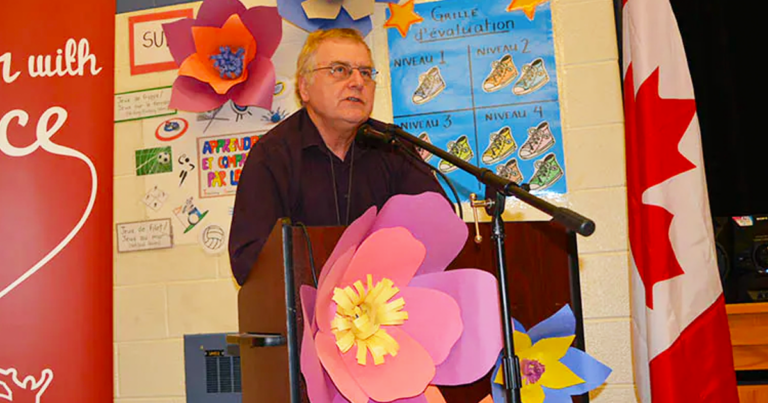
Court rules school board right to reprimand trustee over gender identity comments

After nearly three years of back-and-forth court proceedings, the Ontario Superior Court ruled on Jan. 13 that the Toronto Catholic School Board (TCDSB) had acted legally in reprimanding school trustee Mike Del Grande for comments made back in November 2019.

Del Grande came under public scrutiny when he opposed a motion, directed by the Ministry of Education, to include the terms “gender identity” and “gender expression” as protected grounds for discrimination to the TCDSB’s official Code of Conduct, attempting to mirror the already-in-place provincial Ontario Human Rights legislation. 

In the six-hour Nov. 7 meeting where trustees were voting to amend the code, Del Grande– who was also the TCDSB’s Vice-Chair – suggested that the terms “pedophilia”, “gerontophilia”, “bestiality” and “vampirism” should also be added along with the terms gender expression and identity. Although Del Grande later claimed that he was solely trying to illustrate the “slippery slope” argument of including such terms in the Catholic code, several trustees and members of the LGBTQ+ community took offence, inciting widespread public pushback.

“The point that I want to make is you wanted to add four terms. And my concern is that why stop at the four terms? Because it doesn’t cover everybody,” he said in the 2019 meeting.

Following an independent, board-led review of Del Grande’s actions in May 2020, an investigator found that he had contravened the code of conduct by “creating an unwelcoming and harmful environment for certain members of the Catholic school board community.” After a failed attempt in August 2020 to publicly censure Del Grande, the board voted again in November where a two-thirds majority ruled in favour of imposing sanctions.

Following the consensus of the Nov. 11 vote, the sanctions required the TCDSB trustee to issue a public apology to the LGBTQ+ community and undertake equity training. At the Superior Court, in front of a three-judge panel, Del Grande and his legal team had been mounting a challenge to revoke the sanctions. In tandem, they have also been fighting his case at the Ontario College of Teachers (OCT) the regulatory body for teachers in Ontario after Del Grande was accused of professional misconduct.

Campaign Life Coalition (CLC) has been supporting Del Grande since the controversy broke out in 2019. They have crowdfunded his legal defence fee at the Ontario Superior Court of Justice and the OCT. 

Jack Fonseca, Director of Political Operations for CLC, said that the decision was a “disgrace.” The socially conservative political lobbyist organisation hopes that Del Grande will appeal to a higher court. 

“I’m actually confident that if he appeals to a higher court whose judges are focused on the law and not politics, he’ll win. And if so, that’ll be good for Catholic education. If he loses however, and if that becomes a precedent, it’ll make every other faithful Catholic trustee in Canada an even bigger target of the cancel culture mob. It’ll be used to bypass our democratic process of voters electing their representatives. Instead, Codes of Conduct will be used by left-wing activists, most especially pro-LGBT activists, to sneakily reverse the results of democratic elections, and undo the will of the people,” said Fonseca.

Justice Sandra Nishikawa was the judge who handed down the executive decision which rejected Del Grande’s appeal against the TCDSB’s sanctions. Fonseca argues there was a conflict of interest and bias on the bench.

“The lead judge who authored the decision was appointed to the bench in 2018 by Justin Trudeau and is a pro-LGBT activist in her own right,” Fonseca says. “This judge had a bias against Del Grande’s Catholic beliefs on human sexuality, appears to have spent much of her adult life fighting against those beliefs, and she should have recused herself from the panel.”

Fonseca highlighted Nishikawa’s time on what he describes as “the radical feminist, pro-LGBT women’s legal group” LEAF and her position as Chair of the Equity Advisory Group of the Law Society of Ontario. The word equity in itself, Fonseca argues, signals a “vehicle for promoting LGBT ideology.”

“The stench from the bench is hard to bear,” he said.

The Corriere Canadese—an Italian-language paper published in Toronto has been closely following Del Grande’s case since 2019, attending most committee hearings and board meetings.

The paper’s editor Joe Volpe objected to the Superior Court ruling on legal grounds, reasoning that the TCDSB was wrong to suggest the implementation of the terms gender expression and identity because they do not have the constitutional authority to regulate matters pertaining to Catholic dogma.

“The TCDSB, like all ‘Catholic’ boards of education, has a specific role in the contract (the Constitution) that binds this country. The only ‘entity’ with legal authority under the Constitution to interpret what ‘Catholicism’ means in that context is the magisterium. Neither Boards nor individual trustees have any jurisdiction in this regard. In the case of the TCDSB, which claims to serve c. 90,000 students and their parents, those families expect their values to be upheld and promoted,” said Volpe, a former federal Liberal MP and cabinet minister.

Volpe condemns the TCDSB for its handling of the situation and its treatment of Del Grande.

“The TCDSB has suffered gravely thanks to the trustees and staff who egged on this attack on the value of the Catholic ethic – Del Grande is the soft target in that process. It’s a long process. Over the last three academic years, the TCDSB has lost some 9,000 students and the revenue that accompanies them. The Director and his ‘allies’ on the Board should have resigned for having brought the TCDSB into such disrepute,” he said. 

True North spoke over the phone to Del Grande’s lawyer, Dr. Charles Lugosi, who said that his legal team is in the process of filing an application called “leave to appeal.” Lugosi says this is the “next step in the process” and it would essentially ask permission of the court to bring an appeal to the Superior Court’s Jan. 13 ruling.

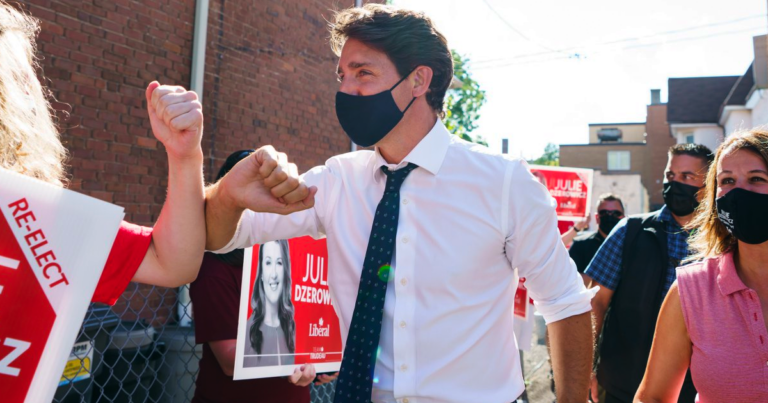
OP-ED: Trudeau’s no-fun, anti-prosperity, ban-everything government

Two interesting things happened last week. New Zealand Prime Minister Jacinda Ardern resigned, and public opinion polling continues to show Justin Trudeau’s Liberal party sinking rapidly.

There’s been a lot of talk about whether Trudeau will follow Jacinda Ardern’s lead in finally taking his walk in the snow – with many different reasons given as to why Canadians are slowly but increasingly becoming fed up with Prime Minister Trudeau.

Some have offered answers such as failing to deliver services. Which I think is accurate. Not being able to get a passport in a timely manner. Not processing immigration applications. Airports falling apart and so on. It’s maddening.

Others have pointed out that the numerous scandals have eroded people’s trust and patience. Blackface, WE, multiple MPs engaging in blatantly poor behaviour but then suffering no consequences. I think that’s starting to bother a lot of people. 

There’s also the economic angle. Raising the carbon tax during an affordability crisis. Out of control spending leading to inflation. While no one blames Trudeau entirely for this crisis, he could have helped; but instead made it worse.

But I think a perhaps simpler, albeit big, reason why the public is fed up with Trudeau is that his entire party’s agenda has become one giant no-fun, anti-prosperity, ban-everything government. 

Bent on shutting everything down that happens to go against their increasingly radical ideology. Using them as wedge issues, trying desperately to hold on to power.

There are three big “bans” that have backfired on the Prime Minister over the last several months. And I argue it’s because of these blunders that Canadian voters are fleeing for both the NDP, and in larger numbers, the Tories. 

Number one is the gun ban. The Prime Minister, in Elmer Fudd fashion, asked for everyone to be very, very quiet, while he was banning hunting rifles. I’m not sure if it was pride or some kind of contempt for hunters and farmers that led him to assume he could get away with it.

But it backfired, pun very much intended. Trudeau managed to get the NDP, Bloc, CPC, Assembly of First Nations, and Carey Price to unite against him. Quite the feat. 

Canadians want strong and smart gun laws. But they also understand how important hunting and sport shooting culture is to a lot of their fellow Canadians. Coupled with the Prime Minister’s disastrous handling of crime in this country – people are angry.

Number two would be oil and gas. He hasn’t outright said that he would ban it in Canada, but he’s come pretty close. And he has certainly spent the last seven years working diligently to make it so that starting new projects is nearly impossible and existing projects take way too long to complete. 

I think he assumed because Canadians care about the planet they’d go along with his radical schemes. But attitudes are shifting. In the wake of the invasion of Ukraine, the argument for Canadian oil and gas displacing Putin’s despot oil became very strong. Polling shows large majorities of Canadians want not only to become more energy self-sufficient, but to help our allies get off dictator energy. 

But then any time one of our allies comes here asking for help, the Prime Minister lectures them about wind and solar. Leaving them going to nations like Qatar – with questionable human rights records – and then those countries get to reap the rewards of the GDP growth. And I think that really ticks people off.

Number three is banning internet free speech. I bet you a decent amount of Canadians know what Bills C-11 and C-18 are – internet censorship bills. Designed to control your social media feeds, suppress content that doesn’t fit Trudeau’s agenda. And allow the government to pick winners and losers in the news business.

And boy did it backfire. On top of turning basically every Canadian digital influencer left and right against them, they even manage to have Youtube and others spending tens of thousands of dollars on a campaign against them. 

A ton of Canadians pushed back, sent letters to MPs and Senators, and testified in favour of free expression online. That’s a lot of peeved off voters.

Now that’s just three examples. There’s also the plastics ban, emissions caps, fertilizer reduction plans, gas-powered car bans, the list goes on and on. Ban, block, shut down. Trudeau might as well go plant a giant “no fun” sign on the lawn of Parliament hill.

Rather than funding or backing innovative ideas for improving people’s lives, this government just bans everything. And Canadians are noticing.

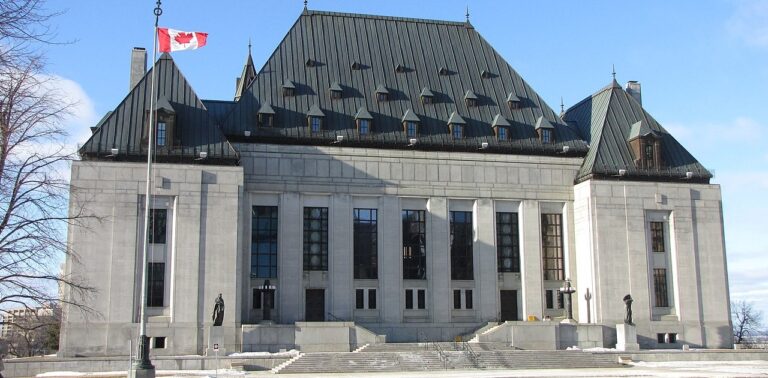
Supreme Court rulings support some, not all, mandatory minimum gun crimes

The Supreme Court of Canada (SCOC) passed down two seemingly conflicting rulings determining the constitutionality of mandatory minimums for firearms offences. 

The SCOC decisions evaluate the constitutionality of mandatory minimum sentences for firearms related charges like discharging a firearm into or at a home and robbery with a prohibited firearm. It also looked at whether or not half-decade sentences for these crimes constitute a violation of the Charter of Right and Freedom’s cruel or unusual punishment provision.

In the case R. v. Hills, the SCOC determined that a mandatory minimum sentence of 4 years for the crime of discharging a firearm into or at a house constituted a violation of the Charter of Right and Freedom’s section 12 clause that prohibits the government from imposing cruel or unusual punishments. The judgment reaffirms a lower court’s decision.

Mr. Hills, an unlicensed firearm owner, discharged a .303 Enfield bolt action rifle at a passing car and fired two shots into a neighbour’s home. In defence, Mr. Hill’s counsel proposed a hypothetical scenario in which a young person fires an airsoft gun or BB gun at home with nobody around. 

“The minimum would be grossly disproportionate in a hypothetical scenario where a young person intentionally discharges an air‑powered pistol or rifle at a residence that is incapable of perforating the residence’s walls,” reads Justice Sheila L. Martin’s majority decision. 

The ruling saw only one judge, Justice Suzanne Côté, dissent from the majority, arguing that a four year sentence does not constitute cruel and unusual punishment and that the majority failed to consider the dangerousness of a firearm. 

“In my view, a four‑year sentence cannot be said to be “so excessive” as to “be incompatible with human dignity” or otherwise “outrage standards of decency,” writes Justice Côté. 

The Justice added: “At bottom, intentionally shooting any firearm — which, by definition, must be capable of causing serious injury or death — into or at a building or other place, with knowledge of or recklessness as to the presence of occupants, is highly dangerous and culpable conduct. I reject the notion that an offence committed under s. 244.2(1)(a), properly interpreted, could be “at most, a minor form of mischief” or that the offence otherwise poses “little or no danger.””

Netherlands-based Leidan University assistant professor Yuan Yi Zhu says that the hypothetical on which the mandatory minimum was struck down was “far-fetched.” 

“The Supreme Court of Canada strikes down another mandatory minimum as ‘cruel and unusual’ because, although not disproportionate in this actual case, the appellants invented a far-fetched hypothetical which DID NOT HAPPEN under which the sentence would be disproportionate,” wrote Yi Zhu on social media.

On the other hand, the SCOC in the case R. v. Hilbach ruled that the mandatory minimum sentence for the crime of robbery with a prohibited firearm remains constitutional. 

In this case, Hilbach and his 13-year-old accomplice robbed a convenience store with a sawed-off rifle while Hilbach was already on probation and facing a firearms prohibition. 

The Court determined that while the sentence of five years may be harsh, ultimately the punishment was not “so excessive as to outrage standards of decency.”

While the court determined that the mandatory minimum law was not unconstitutional, the Liberal-led Parliament repealed the mandatory minimum sentence provision in November 2022. 

“After leave to appeal was granted, Parliament introduced and passed An Act to amend the Criminal Code and the Controlled Drugs and Substances Act, S.C. 2022, c. 15. The legislation received royal assent on November 17, 2022, and repealed the mandatory minimum sentence prescribed in s. 344(1)(a.1). When an ordinary firearm is used to commit robbery, it no longer attracts a mandatory minimum,” reads the majority decision. 

Howard Anglin, a lawyer and former deputy chief of staff to Prime Minister Stephen Harper, made mockery of the situation, writing on social media: “the Court upheld another mandatory minimum sentencing provision… that the Liberals just repealed because they said it was vulnerable to a Charter challenges, so there’s that hot mess too.”

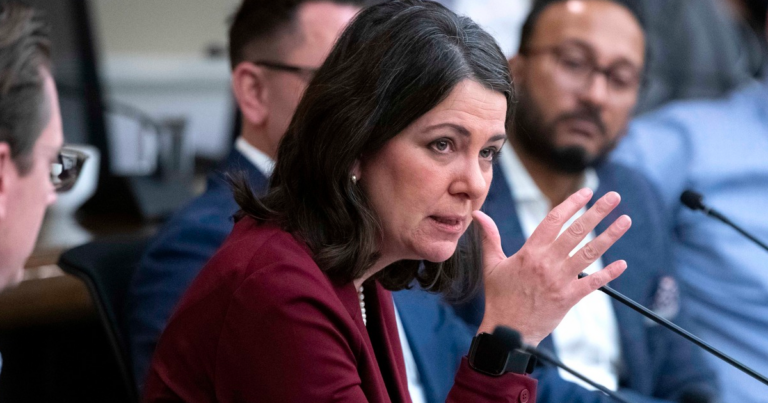
The Alberta Roundup | Smith calls out the CBC

This week on The Alberta Roundup with Rachel Emmanuel, Rachel discusses how Alberta Premier Danielle Smith is calling out the state broadcaster for “defamatory” reporting after the CBC alleged that staff in Smith’s office emailed Crown prosecutors challenging their assessment on Coutts border blockades cases. However, the CBC isn’t backing down and refusing to retract its story.

Plus, Smith continues her opposition to the Trudeau government’s “Just Transition” proposal. This week, smith proposed a sustainable jobs alternative to the feds’ controversial policy.

And Rachel talks about our newest documentary – The Freedom Occupation!

Tune into The Alberta Roundup!

SUBSCRIBE TO THE ALBERTA ROUNDUP

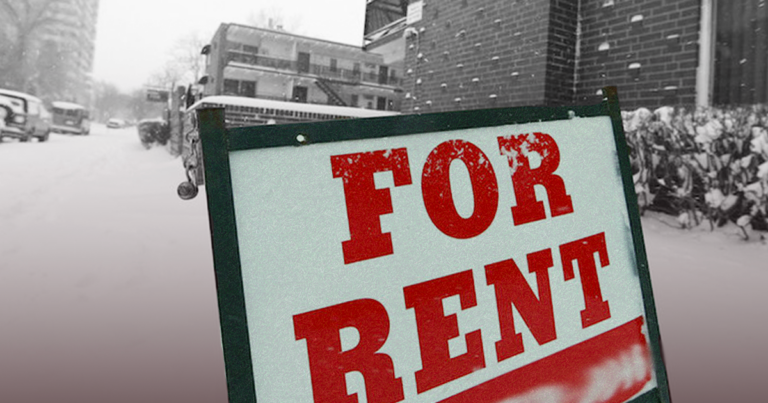
HOUSING CRISIS: How Covid-19 policies worsened renters plight

The following is part one of a two part feature on the Canadian housing crisis.

Nikolaus Petrogiani moved back to Toronto in May after five years in Australia, settling into a downtown condominium rental with his mom and brother until he found a place of his own. 

However, not only has his search been unfruitful, their landlord sold the condo and informed them just around Christmas they have until March to move out. Although Petrogiani is looking to move into an apartment alone, that’s proving difficult, so he and a friend are looking for a place they can share as roommates.

“We’re talking to a realtor who’s helping us find a place. We told him what we want and our budget, and we’ve gone to some viewings,” Petrogiani said, adding that they have put offers in and been “ghosted” by landlords spoiled for choice.

“It’s going down the wire and, personally, I’m sure I’ll be able to stay with someone in the city who could take me in, who would let me stay on their couch until I find a place. Not everyone’s as fortunate as I am to have supportive family. It can be very tough and scary. Maybe you eventually have to cave and live in a basement where your head’s hitting the ceiling, and with no windows, for $2,000. I’m staying positive but it is worrisome.

“It’s out of my budget to live alone. It’s too hard.”

Petrogiani’s struggle isn’t unique. 

The Greater Toronto Area has a paucity of purpose-built rental units, making investor-owned condos crucial. However, the Toronto Regional Real Estate Board (TRREB) reported there were 13,366 condo rental transactions in the third quarter of last year, decreasing by 17.3% from same quarter in 2021. 

Moreover, listings dropped by 25.6% during the period, causing one- and two-bedroom rentals to increase in price by 20.4% and 14.5% to $2,481 and $3,184, respectively.

“This means that it became more difficult for renters to find a unit to meet their housing needs compared to a year ago,” TRREB wrote in late October.

Known as quantitative easing (QE), the Bank of Canada responded to the pandemic by purchasing open-market securities and plunging its overnight lending rate to 0.25% while also printing more money. But in essentially making borrowed money free, asset owners leveraged commodities like housing to buy additional properties, which they’d rent out, and drove up prices.

And as housing prices increased, so did the rents carrying landlords’ mortgages.

“Quantitative easing has priced a lot of people out, particularly people who don’t already have assets,” housing market analyst and realtor Steve Saretsky said. “QE is ultimately designed to help support lower interest rates and boost asset prices, and those who benefit are those who already own assets, and if you already own a house or real estate, you do well. QE has been beneficial for your balance sheet but those who don’t have assets are those who have fallen behind. Now you see increases in wealth inequality and QE has played a part in that.”

Housing supply in the GTA has long been outstripped by excessive demand, partly owing to confounding government policies that have exacerbated the latter, but QE created a housing rush that was arguably more frenzied than before the pandemic.

The central bank’s QE regime began in April 2020 and concluded by December 2021, but by November 2020 it was reported that Canadian households were hoarding $90 billion of cash, a number which grew in excess of $200 billion by the following April, elucidating just how healthy the economy actually was.

“Prolonging it for as long as we did suppressed mortgage rates, which ultimately stoked a housing bubble and now we’re dealing with the cleanup, which is excess inflation and higher interest rates on people’s debts,” Saretsky said. “A lot of the blame ultimately belongs on the federal government, as well. They were the ones stimulating. The Bank of Canada was effectively monetizing the federal government’s deficits, so I think a lot of this is to blame on the federal government.

“The monetary base expanded by 20 to 25% at one point and house prices were up 30% too, so there’s no question when you run massive deficits and the central bank finances it, you get what we got, which is currency devaluation.”

Part two of this feature explores how Canadian housing policies have made people serfs in what’s becoming a neo-feudal society.

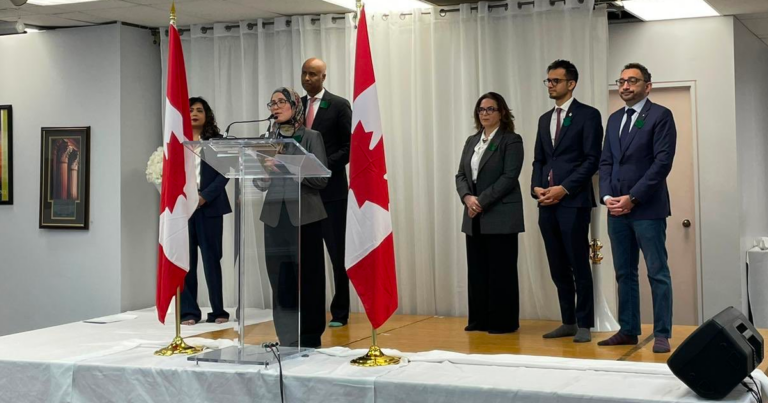
Trudeau Liberals’ new anti-Islamophobia rep says regulating “online harms” top priority

Canada’s new anti-hate appointee says bringing in laws to tackle “online harms” will be a priority for the job.

On Thursday, Prime Minister Justin Trudeau appointed Amira Elghawaby to be Canada’s first “Special Representative on Combatting Islamophobia.”

“Among some of the priorities that we’ve identified is addressing online harms,” Elghawaby told Politico in an interview that appeared on Friday. “Continuing to advance and advocate for strong legislation around that will be very important.”

The Liberal government is currently pushing several pieces of legislation aimed at regulating the online world. One move aims at “online harms,” which critics say is problematic because the broad definition may be used to regulate more than just hate speech. 

The federal government also plans to introduce a Digital Safety Commissioner, who could take-down offending content.

“If we don’t get a handle on the hate, the misinformation that’s fueling a lot of the extremist views that are harming us, and also fueling the stereotypes and myths about who Muslims are, then it’s almost two steps forward, three steps back,” Elghawaby said of online harms legislation.

Elghawaby said she will work with communities to inform government anti-hate policies, including the soon-to-launch National Action Plan on Combatting Hate (NAP). 

The government does not yet state how the NAP will work, but likened it with past anti-hate commitments, such as a promise to introduce online-harm legislation, and a program to promote a “healthy information ecosystem” online.

Elghawaby previously worked at the Toronto Star and CBC News as a journalist as well as at the National Council of Canadian Muslims and Canadian Anti-Hate Network.