LEVY: Pro-Israel supporters stand up to Jew hatred at the University of Toronto

About 150 pro-Israel supporters turned up at the scene of the months-long anti-Semitic UofT encampment — finally cleared in July — to tell the university’s administrators they’ve done a terrible job of containing Jew hatred on campus.

The star of the rally was Shai Davidai, the Columbia professor who has spent the last year fighting Jew hatred on his NYC campus.

He was in town Monday night and Tuesday to share ideas on how to deal with rampant Jew hatred on our campuses and on our streets.

Davidai, an Israeli, was banned temporarily from the Columbia campus last week for allegedly “harassing” college officials in a video calling out their failure to address hateful counter protests during an Oct. 7 memorial to the atrocities of the year before.

At UofT Monday, he called out the pro-Hamas and pro-Hezbollah students who have masked up and are afraid to show their faces lest mommy and daddy who are paying their tuition would see what they’re doing with their money.

Source: True North

“For the past year these pro-Hamas supporters and their professors have made the university uninhabitable for Jews,” Davidai said.

”We are here to say, ‘No More.’”

Davidai said the rally was also in response to news of a UofT professor publishing her course synopsis, saying Zionists were banned from her space.

Source; True North
Source; True North

That professor is Sumayyia Kassamali and she wrote this for her “Rethinking Diaspora” course. 

“That’s an admonishment on the university for not finding the right professors,” Davidai said. ”We are here to show them what Zionism really means.”

When I contacted the university about this blatant anti-Semitism, a spokesman said the Zionism reference was removed but due to privacy issues, nothing more could be said.

The spokesman, who didn’t provide a name, said the course is at the graduate level and not required (I’m not sure why that matters.)

Queers for Palestine member – Source: True North

Davidai said he is at the university to oppose its administration.

”I am a loud Zionist, I am a proud Zionist and I am an unapologetic Zionist… I have nothing to apologize for,” he said, as he told the crowd not to pay attention to the “moral narcissists” who were trying to disrupt the rally.

The usual masked suspects turned up to try to harass and film the rally participants. Activist and former CBC journalist Samaria Mohyeddin tried to get in participants’ faces with her videographer.

Samaria Mohyeddin – Source: True North

Mohyeddin was recently listed in a report from the Israeli Ministry for Diaspora Affairs and Combatting Anti-Semitic as an “influencer” who “promotes anti-Ziknoist and anti-Semitic content” on her various platforms.

Davidai said the future of the Jewish state, Jews in the Diaspora and the future of democracy all over the world is at stake.

“Do we stand with morality or do we stand with evil?” Davidai said.

”Do we stand with democracy or do we stand with the terrorists and their supporters?”

Esther Bakinka, who helped create Canadian Women Against Anti-Semitism, begged everyone to be on the “right side of history” and not let the Hamasniks take over Canada.

Eynat Katz, a grandchild of Holocaust survivors, said everyone who has come to her for help this year wants to remain anonymous.

“Our biggest problem is fear,” she said. 

“Stand up…use your face, use your voice!” 
Parental backlash pushes DDSB trustees to cement right of public participation at meetings

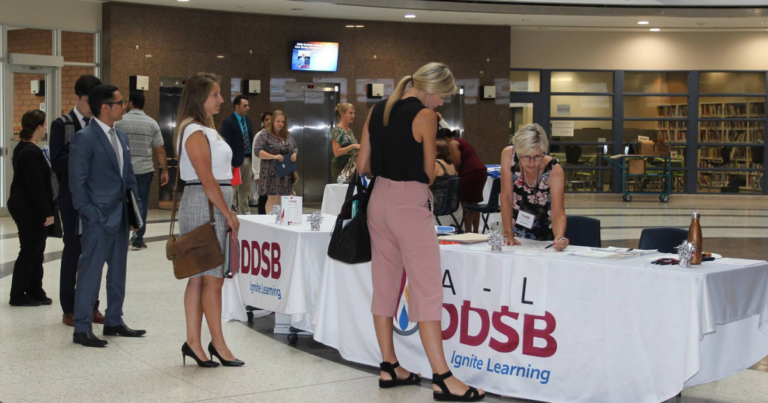
Following an outpouring of emails from concerned parents, the Durham District School Board rejected a motion to remove public questions during meetings and instead passed a motion for a report defining the public’s right to participate.

A September Governance and Policy Committee meeting caught the attention of a local parental rights activist group after it caught wind of a recommendation to amend bylaws and remove the question period from the school board meeting agendas.

The DDSB Concerned Parents Facebook group urged its community members to attend the next meeting on Monday when the proposal was up for a vote. The group told its members to send letters to the trustees to vote against removing sections 5.12.13 to 5.12.16 of the DDSB bylaws, which would eliminate “the taxpayers right to ask questions at school board meetings.”

“While I may not attend every meeting or regularly pose questions, I have exercised my right to do so in the past, and I fully intend to protect this right going forward,” the letter said. “As a taxpayer, I believe this proposal infringes on my rights, including my Charter Rights to freedom of expression, which takes precedence over any such policy changes.”

Ontario laws on school board committee meetings include the right for the public to participate in public meetings. However, the laws do not specify that this must be done during a question-and-answer period during meetings.

None of the trustees voted to second the motion to remove the question period from the bylaws, defeating the motion.

During Monday’s question period, one man, Dylan Reynolds, after asking about potential winter bus cancellations, said he has been attending the public question period since 2020, that it was meaningful to him, and that he opposed the motion to remove it.

After the motion was defeated, Vice Chair Deb Oldfield proposed a new motion to send the recommendation back to the governance and policy committee “for further consideration” and that the director deliver a report to the committee that “addresses the issue of a defined right to public participation.”

“In the emails that we received, many people mentioned a taxpayer’s right or a charter right (to question period), which really aren’t things,” Oldfield said. “So, what that highlighted for me is that when it’s removed from a by-law, then there isn’t (a right.)”

The trustees voted, and Oldfield passed the motion. Most affirmed the importance of question periods or other ways of “meaningful engagement” for the community.

“I think we’ve heard over email and from Dylan today and through various community members that the public question period is something that is meaningful to them, and beyond that, engagement with the school community and the board is meaningful to them as well,” Chairperson Emma Cunningham said. “I quite like the idea of making sure that that is a cemented right for all people to be able to participate with us.” 

Another trustee, Donna Edwards, wanted the report requested by Oldfield’s motion also to include an extensive list of how the community can interact with the school board trustees outside of the question period.

As it’s a motion requesting the governance and policy committee director to submit a report, It’s unclear how that “right” to participate in the question period would interact with people banned from school property for their activism.

The sections that the original defeated motion purported to remove from the DDSB bylaws outline the procedure for a member of the public to ask questions; it mentions the public having to request permission from the board to present their question to the committee.

“The Board reserves the right to deny an individual or party the opportunity to ask a question, or to otherwise limit a question where the question is designed or framed in a manner that would be contrary to the Board’s commitments and statutory duties,” Section 5.12.15 of the DDSB bylaw said.

The DDSB Concerned Parents group noted last year that trustees read their questions out loud, preventing the community group from asking supplementary questions if they felt their questions weren’t answered appropriately.

The school board’s next Governance and Policy Committee meeting is on Oct. 30, 2024

The Daily Brief | Liberals win big in New Brunswick

Susan Holt’s Liberal Party of New Brunswick has won the province’s 2024 election, marking a significant shift in leadership and ending Blaine Higgs’ pursuit of a third consecutive term.

Plus, former B.C. premier Christy Clark is considering a post-Trudeau Liberal leadership bid.

And the Trudeau government will soon ban flavoured vaping products nationally.

Tune into The Daily Brief with Cosmin Dzsurdzsa and Noah Jarvis!

Canada’s OECD tax competitiveness ranking suffers due to capital gains rates, other taxes 

Canada’s high capital gains rates, corporate and digital service taxes could be driving investment away, according to an international report that ranks tax competitiveness among developed nations.

According to the International Tax Foundations’ 2024 International Tax Competitiveness Index, Canada’s tax competitiveness fell two ranks down to 17th out of 38 other Organization for Economic Co-operation and Development countries.

The study examined changes in each country’s tax systems and graded each based on its competitiveness and neutrality.

“A competitive tax code is one that keeps marginal tax rates low,” the report said. “If a country’s tax rate is too high, it will drive investment elsewhere, leading to slower economic growth. In addition, high marginal tax rates can impede domestic investment and lead to tax avoidance.”

The report defines a neutral tax system as one that raises revenue but minimizes economic distortions in the market.

“This means that it doesn’t favour consumption over saving, as happens with investment taxes and wealth taxes,” the report said. “It also means few or no targeted tax breaks for specific activities carried out by businesses or individuals.”

When a tax system influences investors and businesses to make decisions they otherwise wouldn’t make without those taxes, it causes economic distortions.

A nation with low tax rates and minimal economic distortions will rank higher in the international tax competitiveness index.

Canada ranked 31 out of 38 OECD countries for individual taxes, 26 for corporate taxes, and 25 for property taxes.

However, the United States, Canada’s biggest trading partner, ranked 18th in the OECD for tax competitiveness, one rank below Canada, though the US improved by five ranks compared with its performance last year.

As noted in the report, Canada’s consumption taxes were low, ranking it eighth among OECD countries. It does not levy wealth, estate, or inheritance taxes and has “some of the best capital cost recovery provisions for machinery and industrial buildings in the OECD.”

However, Canada’s ranking suffered because of the Trudeau government’s capital gains regime, which was “well above the respective OECD averages.”

According to the report, Canada taxes capital gains at a rate of 35.7% and dividends at 39.3%, while the average in the OECD is 19.7% and 24%, respectively.

Canada’s corporate tax rate is also above the OECD average, at 26.2%, while the rate of the countries it competes against is 23.9%. 

The group also listed Canada’s digital services tax as a weakness in the Canadian tax system, contributing to its worsening tax competitiveness ranking.

“Lower tax rates are better at growing the economy and attracting business and investment,” Franco Terrazzano, the federal director of the Canadian Taxpayers Federation, told True North in an interview. “The less complex a tax system, the less economic distortions it creates, the better.”

The CTF calls on Canadian politicians to “prioritize tax relief” in response to the Tax Foundation’s report and Canada’s worsening competitiveness due to its tax system.

“Canadians know that our economy is not firing on all cylinders, and that’s because politicians are taking too much money from families and businesses,” Terrazzano said. ”If politicians want to grow the economy, they should cut taxes to let families and businesses keep more money. We’ve seen out-of-control spending, higher taxes and corporate welfare from the Trudeau Government, but that’s the wrong way to grow the economy. “

He said a poor tax system with high tax rates will continue to drive away businesses and investments from an economy, which, in Canada’s case, will result in fewer jobs for Canadians.

“We need politicians to encourage success in Canada, but what Trudeau is doing with his capital gains tax hike is punishing doctors, entrepreneurs, and Canadians who are saving for their retirement,” he said. “This report should be a five-alarm siren to stop hiking taxes.”

Canada’s Department of Finance did not respond to True North’s requests to comment before the deadline provided.

Susan Holt’s Liberals form majority government in New Brunswick

Susan Holt’s Liberal Party of New Brunswick has won the province’s 2024 election, marking a significant shift in leadership and ending Blaine Higgs’ pursuit of a third consecutive term.

The victory makes Holt the first female premier in New Brunswick’s history, following a closely contested race. 

The Liberal Party’s triumph signals a change in direction for the province after nearly six years of Progressive Conservative governance.

The Liberals secured the required number of seats to form a majority government in the Legislative Assembly leading in 31 ridings. Meanwhile, Higgs’ Progressive Conservatives only won in 16 ridings and the Greens won 2 seats.

Holt was elected in her riding of Fredericton South-Silverwood while Higgs lost to Liberal candidate Aaron Kennedy in Quispamsis.

The Liberals saw a significant increase from the 17 seats the party held after the 2020 provincial election when they were the official opposition to the Conservatives’ majority government. 

New Brunswick’s Legislative Assembly consists of 49 seats, with 25 needed to form a majority government. In 2020, Higgs’ party won 27 seats.

Holt’s victory comes after a 33-day campaign where the Liberals emphasized improved access to healthcare, increased affordability measures, a new housing strategy, and a reformed education system.

Holt also promised to introduce climate action measures, enhance economic development, and improve leadership in provincial governance.

The Progressive Conservatives’ campaign focused on fiscal management, pledging an HST tax cut, opposing new drug injection sites, and renewing the legal challenge against the federal carbon tax. Blaine Higgs also committed to investment in addiction treatment, support for religious groups facing hate crimes, and protection of landowners’ rights.

New Brunswick reported a 66% turnout in the 2020 provincial election.

Prior to election day, 133,964 votes were cast during advanced voting, special ballot voting at returning offices, and mail-in ballots, according to CTV. The election also saw the return of campus voting stations, which were open in advance.

The New Brunswick election featured eight registered parties, along with various Independent candidates. Since joining Canada in 1867, only the Liberals or Conservatives have governed New Brunswick.

Ratio’d | Racist medical school in Canada? This is INSANE

Toronto Metropolitan University, formerly known as Ryerson University, is launching what may be the world’s first DEI med school where prospective students will be chosen not on merit, but rather on the colour of the skin or ancestry. Of the available 94 seats in the program, 75% of students will be chosen from “equity-seeking” admissions streams which favour black, indigenous and other minorities. The remaining 25% of students will be chosen through the general admissions stream.

Racial discrimination is always wrong and racial quotas are a terrible idea, but when it comes to teaching the next generation of doctors, could there possibly be anything more insane than this?

Watch the latest episode of Ratio’d with Harrison Faulkner.

Former B.C. premier Christy Clark considering post-Trudeau Liberal leadership bid

Former B.C. premier Christy Clark said she is considering running to replace Prime Minister Justin Trudeau as leader of the Liberal Party of Canada should he resign ahead of the next election. 

Trudeau is currently facing mounting pressure from within the Liberal caucus to step down after the party suffered two major byelection losses, dismal poll performance and several key cabinet ministers announcing that they won’t be seeking reelection. 

As Trudeau faces a rebellion from his own Liberal MPs in caucus this week, former B.C. premier Christy Clark is suggesting she would be interested in replacing him, should Trudeau decide to step down.

Clark told Radio-Canada in French that she is considering a return to politics and that she “would like to be part of the discussion about the future direction of the Liberal party and the country.”

Clark said that “Canadians are tired of politicians who think that fear mongering and divisiveness will win an election and gain power,” adding that people “understand that polarized political views are standing in the way of the solutions we need.”

The 58-year-old former leader of the B.C. Liberals was premier of the province from 2011-17.

She said that voters are looking for the kind of leader “who will unite our country with practical solutions to the tough challenges we face,” such as “the cost of living, the housing crisis, the need to strengthen our health-care system and the importance of fighting climate change.”

“Because our country and its future are important to me, I have never closed the door to the possibility of one day returning to political life,” she continued.

Her comments come at a time when Trudeau is dealing with what appears to be somewhat of a mutiny within his party. Internal sources have said Liberal MPs are adding their names to an internal petition being passed around that calls for a leadership change. 

There are also rumours that MPs have quietly organized plans to call for his resignation at the Liberals’ next caucus meeting on Wednesday. 

While Liberal backbencher Sean Casey was the first MP to publicly call for Trudeau to resign, Clark did so even earlier.

“I think the leader needs to be replaced,” said Clark in June after the loss of long-time Liberal stronghold Toronto–St. Paul’s to the Conservatives. 

“I think it’s time for him to move on to other, fairer pastures,” she told the Globe and Mail at the time.

However, that wasn’t the first time that she had spoken out against Trudeau. 

In an interview in 2022 on the podcast  Curse of Politics, Clark said that “Justin Trudeau is tired and complacent.”

“I don’t think Trudeau is an asset to the Liberals, I think he’s a gift to Poilievre,” she said, referring to Conservative Leader Pierre Poilievre. 

Clark went on to say that the prime minister has only added to tensions between Quebec and Western Canada “for political reasons,” while Canada “needs politicians who will bridge this gap.”

OP-ED: Why is the elimination of Yahya Sinwar, the Head of Hamas, so significant?

Yahya Sinwar has been the leader of Hamas since 2017. His biography reflects the life of an arch-terrorist responsible not only for the deaths of many Israeli civilians but also for the deaths of numerous Palestinians. Sinwar personally oversaw the execution of Palestinians suspected of cooperating with Israel or opposing Hamas. Additionally, he systematically used civilians as human shields, indirectly causing thousands of Palestinian casualties. His removal carries profound consequences for both Hamas and the broader conflict.

Hamas is a highly structured, hierarchical organization where decisions rest almost entirely in the hands of one person. Sinwar’s authority was absolute; he controlled operations and led crucial matters such as ceasefire negotiations and hostage releases. Every summit involving Egypt, Qatar, Israel, and the U.S. ultimately hinged on his word. With his death, the group faces a leadership vacuum that could lead to disarray, disrupt coordination, and spark internal power struggles. This sudden absence of centralized leadership may leave Hamas vulnerable and directionless in a critical moment.

Sinwar’s elimination also deals a severe psychological blow to Hamas and its allies. Leaders in such ideologically driven organizations are not just decision-makers but powerful symbols who inspire loyalty and morale. Losing a leader of his stature can diminish the fighting spirit of those within the group. This mirrors the psychological effect of Israel’s efforts against Hezbollah, including its campaign targeting key figures such as Hassan Nasrallah. When the figureheads of movements are taken down, it can erode the morale of followers and create a significant crisis for the organization.

For Israel, the elimination of Sinwar represents both a strategic and symbolic victory. From the beginning of the war, Prime Minister Benjamin Netanyahu emphasized dismantling Hamas’s leadership and operational capabilities as key objectives. Sinwar’s death demonstrates that these goals are within reach, reinforcing the government’s resolve and boosting public confidence in the war effort. The operation also restores a sense of purpose after the devastating events of October 7th, when Hamas inflicted massive casualties on Israeli civilians.

Beyond the immediate military impact, Sinwar’s death serves as a deterrent to other militant leaders. He prioritized his own survival from the onset of the war, hiding most of the time in tunnels and minimizing communication with his commanders. His elimination sends a clear message: those who orchestrate attacks on Israel will not escape retribution.

For Canadians, Sinwar’s removal also holds particular relevance. Canada’s designation of Hamas as a terrorist organization aligns with its commitment to combating global terrorism. It may also help ensure the millions in humanitarian aid Canada provides to Gaza through UN channels (Since the outbreak of the war on October 7, 2023, Canada has committed $60 million in humanitarian aid to Gaza). As former Foreign Affairs Minister John Baird (2011-2015) stated, “Terrorist groups like Hamas do not represent the Palestinian people, and we must ensure that aid serves those in need, not the agendas of extremists.”

Finally, the death of Sinwar may open the door to a different future for Gaza. His absence could allow for new leadership to emerge with different policies and approaches. This shift might create an opportunity for a ceasefire, the release of hostages, and the end of Hamas’s rule over Gaza. While the path to peace remains uncertain, the hope is that these changes could pave the way for greater cooperation between Israelis and Palestinians, and perhaps even lead to lasting peace.

Sinwar’s removal is, therefore, more than just a tactical achievement; it is a moment of significant military, psychological, and political importance. The consequences of his death could reshape the dynamics of the conflict, offering both challenges and opportunities for all parties involved.

Comments: [email protected]

Dotan Rousso. Holds a Ph.D. in Law—a former criminal prosecutor in Israel. He currently lives in Alberta and teaches Philosophy at the Southern Alberta Institute of Technology (SAIT).

CUPE’s Fred Hahn spoke at anti-Israel rally where terrorist-glorifying signs were present

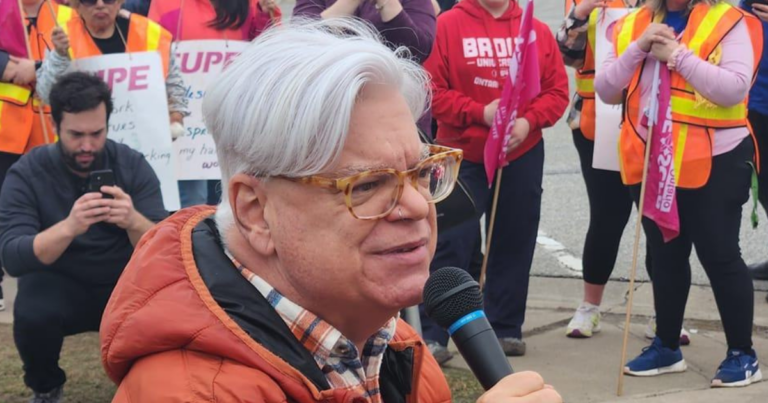
The president of Ontario’s public workers union, Fred Hahn, was a guest speaker at an anti-Israel rally where Taliban flags, images glorifying Hamas’ recently eliminated leadership, and other symbols associated with terrorism were present. 

At the rally on Sunday at the US Consulate building in Toronto, Hahn gave an impassioned speech on behalf of CUPE Ontario. He affirmed his union’s commitment to the Boycott Divest Sanction movement against Israel, called for the arrest of Israel’s president Benjamin Netanyahu and said he was answering the calls of “Palestinian trade unionists” for solidarity.

In his speech, Hahn stated that the public workers union has been “on the side of Palestinian liberation” since 2006 when his union became the first in Canada to join the BDS movement and that his group has devoted resources and time to “educating” its members on the history of the “Israel occupation and colonization of Palestine.”

He said he represents thousands of public employees who he claims all “proudly and unequivocally” demand a cease-fire, an arms embargo against Israel and “decolonization” of the region. During his speech, Hahn did not call for a return of the nearly 100 hostages still held by Hamas or condemn actions done by terrorist entities against Israel.

In August, Hahn was asked to resign by CUPE’s national executive committee, which stated they had lost confidence in Hahn’s ability to represent the union’s members following a slew of anti-Israel social media posts.

Hahn is also embroiled in a human rights complaint by twenty-five Jewish members of CUPE Ontario for similar rhetoric. 

“As the largest union in Canada, our members have decided to do this, but we did it in part because of a call from Palestinian trade unionists for solidarity as workers,” Hahn said at the rally, “When workers in any part of the world call on our solidarity, we must be there with them!”

There are six documented unions in Gaza and the West Bank, each representing public workers. The public sector of Gaza is controlled by Hamas, the listed terrorist entity recognized by Canada responsible for the Oct. 7 terrorist attack on Israel.

When asked which Palestinian unions CUPE Ontario was answering to, a representative from the Ontario union did not respond to True North’s requests for information.

As documented by independent journalist and lawyer Caryma S’ad, and X user “Leviathan,” several images glorifying terrorist entities such as Hamas and its leadership were brandished by demonstrators at the protest.

“Yahya Sinwar – 100% Legend,” one sign with the eliminated Hamas leader’s face said.

“Jadala under siege,”  Another sign with an image of the terrorist leader’s corpse next to an image of him alive said. “He lived as a leader. He died as a soldier.”

Another protester held a sign featuring an inverted red triangle, a symbol used in Hamas propaganda videos depicting the killing of Israeli soldiers, comparing Sinwar to black civil rights figure Malcolm X.

“From Malcolm X to Yahya Sinwar, heroes become legends and legends become Immortal,” the sign said.

Sa’d shared an image from the protest as well of a woman in a keffiyeh, a headscarf which has been used as a symbol of solidarity with anti-Israel combatants, wielding a Taliban flag.

The Taliban is a listed terrorist entity in Canada. According to the Canadian Encyclopedia, 165 Canadians died during the war against the Taliban in Afghanistan. 158 Canadian Armed Forces members and seven Canadian civilians died during the war. More than 2000 members of the CAF were wounded or injured during the war against the terrorist group.

The Islamic Emirate of Afghanistan changed its flag to the Taliban flag after the terrorist group took control of the country following the end of the 2001-2021 war in Afghanistan.

During a brief interview by Sa’d’s videographer with the woman, she explains that the words inscribed on the flag are the “Shahada”, an Islamic declaration of faith which says: “There is no god but Allah and Muhammad is his messenger.”

redHahn and CUPE Ontario did not respond to True North’s requests to comment or denounce the use of symbols and flags associated with terrorist entities in Canada before the deadline provided.

Ottawa to ban flavoured vaping products nationally

The federal government will soon ban flavoured vape products across Canada, according to Minister of Mental Health and Addictions Ya’ara Saks. 

The announcement comes over three years after the Trudeau government first pledged to usher in new restrictions in 2021. 

The minister’s promise was in response to a press conference held in Ottawa earlier this month by an anti-tobacco coalition that demanded Saks either resign or immediately implement the ban. 

“We have made a commitment from the start to restrict flavours. We haven’t wavered from that,” Ya’ara Saks told CBC News last week. “We will have this in place soon. I don’t anticipate this is going to take much longer.” 

However, Saks provided no specific timeline. 

The anti-tobacco groups blamed the minister’s failure to finalize regulations planned for earlier this year as the result of Saks succumbing to pressure from the vaping industry.

Health Canada initially pledged to reduce vaping flavours to just mint, menthol and tobacco in June 2021, citing a “rapid increase in youth vaping in Canada,” however, nothing materialized after that. 

“The availability of a variety of desirable flavours is believed to have contributed to the rise in youth vaping,” said Health Canada in 2021. 

The agency noted more than three years ago that research found young people are more likely to begin vaping with fruity and sweet flavours.

Today, Canada has one of the highest teen vaping rates globally, with almost half of all young adults having experimented with vaping, according to Statistics Canada. 

Additionally, the majority of new vape users, 86%, had never smoked cigarettes before they began vaping, according to the latest Canadian Tobacco and Nicotine Survey. 

“We know that young people are being exposed to vaping first now,” said Saks.

Six provinces and territories have introduced regional flavour bans as the Trudeau government finished its consultation process on regulations, including British Columbia, New Brunswick, Nova Scotia, P.E.I., Northwest Territories, Nunavut and Quebec.

According to Saks, the delay in Ottawa is in response to Health Canada wanting to see how things play out in Quebec, which was the first province to implement a ban last year. 

“We’ve … seen in jurisdictions like Quebec, where banning of flavours has led to an illicit market that is accessible,” she said. “So as we move forward with this, we want to make sure that we get it right.”

Skas said that Ottawa wants to ensure that the new regulations will be enforceable in a way that does not easily foster an underground market. 

“Just to be clear, there is no slow-walking of this,” she said. “It’s a matter of what are the lessons that we can learn right now?”

However, the Quebec Coalition for Tobacco Control’s co-director Flory Doucas argued that the lack of a national ban is the very reason why the province has seen a burgeoning illicit market. 

According to Doucas, Quebeckers can easily order flavoured vaping products from a retailer outside of the province, as they have already been approved by Health Canada. 

“The argument … of delaying the regulation because there are issues in provinces is pretty rich, because the federal framework has made it very easy for industry to skirt these provincial regulations,” said Doucas.

“We’ve been dealing with an industry that has been successful in delaying and delaying these regulations.”