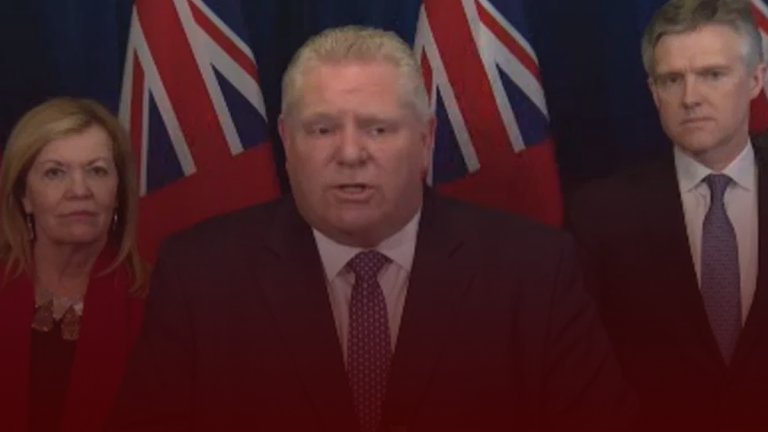
Ontario deficit expected to spike to $20.5 billion in 2020-2021 because of coronavirus

0

The coronavirus pandemic is expected to more than double Ontario’s deficit by next year.

According to Ontario Finance Minister Rod Phillips, the province’s deficit is projected to balloon to $20.5 billion over the period of 2020-2021 from its current standing at $9 billion. 

Phillips tabled Ontario’s one-year fiscal outlook at the legislature on Wednesday and announced a $17 billion dollar plan to combat the virus. 

“The government’s action plan is a first step in its response to COVID-19 and includes $7 billion in additional resources for the healthcare system and direct support for people and jobs,” said a Ministry of Finance press release.

“It also will make available $10 billion in support for people and businesses through tax and other deferrals to improve their cash flow, protecting jobs and household budgets.”

The new measures include $3.3 billion in healthcare resources, including acute care facilities and hospital beds. Of that sum, $160 million will be going towards monitoring the spread of the virus and introducing at-home testing. 

New healthcare spending also includes $75 million to be put towards personal protective equipment and medical supplies. 

“COVID-19 is an extraordinary threat to the health and economy of Ontario — the greatest we’ve faced in my lifetime — and it demands an extraordinary response from all levels of government and civil society because we’re all in this together,” said Phillips. 

Measures intending on helping employers and people who are out of work were also proposed by Phillips. 

Families will be able to receive a one-time payment of $200-$250 per child under 12 to help with costs incurred by the closures of schools and daycare centres. 

Ontario will also be spending $5.6 billion to reduce the cost of hydro bills for Canadians in the province. Phillips also announced a $355 million tax cut expected to help about 57,000 employers as part of the Employer Health Tax exemption. 

For a full list of the province’s economic measures to combat the effects of the coronavirus, visit Ontario’s Action Plan here.  

Government to give media $30 million for coronavirus awareness campaign

0

The Liberal government announced it will be giving media companies $30 million taxpayer dollars as part of its national coronavirus awareness campaign. 

Minister of Canadian Heritage Steven Guilbeault made the announcement during a federal COVID-19 update on Wednesday. 

“It’s crucial that Canadians can obtain authoritative, well-sourced and factual information related to COVID-19. This is why the government of Canada is taking immediate action so Canadians can continue to access diverse and reliable sources of news,” said Guilbeault. 

“Moreover, based on the $30 million invested on our government in a national awareness campaign about COVID-19, this will be invested in Canadian media, whether it’s on TV, in newspapers and magazines or online so that the revenues generated by this campaign breathe new life into our media.”

The federal government will be purchasing advertisements on traditional and digital media platforms to inform the public about the pandemic. 

“Right now, it is more important than ever that Canadians have access to the latest news and information,” said Trudeau about the funding during a press conference. 

“To ensure that journalists can continue to do this vital work, our government is announcing new measures to support them.”

The announcement also includes an expedited application process for the Canadian Periodical Fund and the Canadian Book Fund. 

According to Guilbeault, media tax credits included in last year’s budget will now be implemented formally by the independent panel overseeing the $600 million government bailout. 

In 2019, the federal government revealed that it would be giving failing news companies labour tax credits. Only companies that are found to be “qualified Canadian journalism organizations” will be able to receive the benefit. 

The measure also includes allowing not-for-profit media organizations to receive charity status, meaning they can issue tax receipts for any donations received. 

Guilbeault recently came under fire after suggesting on television that the federal government could also require media companies to get a license in order to operate. 

“We would ask that they have a licence, yes…If you’re a distributor of content in Canada and obviously if you’re a very small media organization the requirement probably wouldn’t be the same if you’re Facebook, or Google. There would have to be some proportionality embedded into this,” Guilbeault told CTV.

The heritage minister eventually retracted his comments after receiving a public backlash, claiming that he was misunderstood. 

True North Update: It’s no longer a request, but it’s the law

Travellers will be subject to a legally mandatory 14-day quarantine upon entering Canada, and those who skirt the isolation period could face criminal sanctions or fines. How will the government enforce this?

Plus, the Trudeau government announces $30 million to support “diverse and reliable reporting.” Is this another media bailout?

True North’s Candice Malcolm and Andrew Lawton break down the latest news on the coronavirus. Watch now!

Trudeau government imposing mandatory quarantines with criminal sanctions for violators

0

It’s no longer a request, but an order. 

Most people will be subject to a legally mandatory 14-day quarantine upon entering Canada, and those who skirt the isolation period could face criminal sanctions or fines under the Quarantine Act, the government announced Wednesday.

“The health minister will be using powers that she has under the Quarantine Act beginning at midnight tonight to impose a mandatory 14-day period of isolation on all people coming into Canada from outside,” said Deputy Prime Minister Chrystia Freeland during a press conference

The quarantine goes into effect at 11:59pm Wednesday night.

Freeland declined to elaborate on how the government will monitor and enforce the quarantine, but promised more information would be released later Wednesday.

People whose jobs have been deemed essential, such as healthcare workers and supply chain truck drivers, will be exempt from the mandatory quarantine, Freeland said.

Under the new measures, anyone showing symptoms will be barred from taking public transit and those who have to self-isolate must do so away from people who are vulnerable to the disease.

Provincial and federal authorities have been clamping down on people who have been willfully ignoring the advice of public health officials. 

Police arrested a 53-year old woman from Corner Brook. Nfld. for ignoring orders to self-isolate. She’s now being held in custody after arriving from outside the province.

“Medical officials have been loud and clear this virus could devastate our community. If you put people at risk we will take every measure available to us,” said police media relations officer James Cadigan. 

Last weekend, police similarly arrested a woman in Quebec City for breaching her isolation. 

According to the city’s health services centre CIUSSS de la Capitale-Nationale, police will surveil Canadians who have been issued an isolation order and make an arrest if they are found to have disobeyed it. 

“The Public Health Act accords our director of public health the power to put into action all appropriate measures where the non-respect of instructions can jeopardize the health and security of the public,” claimed the CIUSS in a press release. 

CBC runs story blaming Trump for death of man who ingested fish tank cleaner

0

The CBC has published a story blaming U.S. President Donald Trump for the death of a man who drank aquarium cleaner believing it would prevent COVID-19.

On Monday, a man from Arizona died after he and his wife consumed aquarium cleaner that contained chloroquine, a drug that Trump has been promoting as a possible treatment for COVID-19.

However, the couple was not drinking the medicinal form of chloroquine, but rather fish tank cleaner containing chloroquine phosphate – leading to immediate poisoning.

The man’s wife was able to vomit much of the cleaning agent and survived the incident.

Despite the unnamed woman giving a lengthy interview to NBC, the CBC only shared one quote from her, where she bashes the president.

“Trump kept saying it was basically pretty much a cure,” the woman said.

“Don’t take anything. Don’t believe anything. Don’t believe anything that the president says… call your doctor.”

While the man’s death is a horrible mishap, it is wrong to suggest Trump was to blame for the incident.

Over the past couple of weeks, Trump has been touting chloroquine, an anti-malaria medication, along with two other drugs as possible “game-changers” in the fight against COVID-19.

Chloroquine is currently being tested in the United States as a potential treatment for COVID-19.

Studies have shown that chloroquine has been successful at treating COVID-19 in patients in China, though its overall effectiveness is still being researched. South Korea and France are also experimenting with chloroquine.

Currently, there is no cure for COVID-19, and medical professionals are making it clear that people should not attempt to self-medicate.

“Given the uncertainty around COVID-19, we understand that people are trying to find new ways to prevent or treat this virus, but self-medicating is not the way to do so,” said Dr. Daniel Brooks of Arizona’s Banner Poison and Drug Information Center.

“The last thing that we want right now is to inundate our emergency departments with patients who believe they found a vague and risky solution that could potentially jeopardize their health.”

Trudeau government to move forward with carbon tax hikes despite pandemic

0

As the COVID-19 pandemic threatens to halt the Canadians economy, the Trudeau government says it does not plan to postpone a 50% increase to the carbon tax.

On April 1, the carbon tax on gasoline is planned to rise by 50%, raising the price of gas by between 4.4¢ to 6.6¢ a litre depending on location.

Despite economic disruptions caused by the COVID-19 pandemic, on Tuesday Deputy Prime Minister Chrystia Freeland indicated that the carbon tax hike will move forward.

“I think our government has been very clear that this is a time where our first priority is protecting the health and safety of Canadians, and that’s what everyone here has been very focused on,” she said.

“We are thinking very carefully about our whole approach to what we are doing economically, both in terms of how we are supporting workers and businesses, and also what we are doing on the tax side.”

As highlighted by Blacklock’s Reporter, on April 1 the Liberal government has scheduled a rise on the carbon tax rate of various fuels. Along with gasoline, propane will see a 48% increase, aviation fuel 45% and natural gas 44%.

Last week the government announced $82 billion in assistance for individuals and business as the COVID-19 pandemic forces much of the Canadian economy to a halt.

Critics have suggested that postponing increases to the carbon tax would be an easy way to save Canadians money during this uncertain time.

“If deferring taxes is one way we can credibly help small businesses and individual moms and dads and seniors, they should be looking at pushing back implementing new tax measures at this time,” said Conservative MP Dan Albas.

Nearly one million people applied for Employment Insurance as businesses across Canada close their doors.

On Tuesday the Liberals walked back from a bill which would have given the government unbridled powers to tax and spend without parliamentary approval until December 2021.

After pushback from opposition parties, the Liberals said they would amend the proposed legislation.

Almost one million Canadians made EI claims last week

0

Nearly 5% of Canada’s workforce made jobless claims last week amid the COVID-19 pandemic.

According to the Financial Post, 929,000 people submitted EI applications during the week of Monday March 16 to Sunday March 22. In comparison, for the month of March 2019 Canadians made a total of 244,000 employment insurance claims.

The number is much higher than the 500,000 figure reported by Prime Minister Justin Trudeau last Friday, as it included claims made over the weekend.

“The rise in EI applications gives us a sneak peak into just how sharp the drop off in economic activity has been over the past few weeks. While we really don’t know how long this will last, we do know the hit to GDP will be severe,” Canadian Imperial Bank of Commerce economist Royce Mendes told the Financial Post.

By March 18th, a stunning $1 trillion was wiped out as Canadians stocks plummeted due to coronavirus fears.

Today the House of Commons reconvened to pass additional legislation to aid the economy. Part of the plan is a $27 billion aid package to help Canadians who are out of work because of the pandemic. 

The Candice Malcolm Show: The economic toll of COVID-19

SUBSCRIBE TO THE CANDICE MALCOLM SHOW!

Canada wildly under-estimates the economic toll of social distancing measures.

Journalists and politicians continue to mislead up about the Wuhan coronavirus.

Plus good news, True North’s Candice Malcolm tested negative for COVID-19!

Tune into The Candice Malcolm Show!

True North Update: Playing politics during a pandemic

SUBSCRIBE TO THE CANDICE MALCOLM SHOW!

MPs are back in Ottawa. Instead of voting on the $82 billion COVID-19 aid package, they’re haggling behind closed doors because the Trudeau government sprung a last-minute bill that tried to give his government unfettered taxing and spending powers without parliamentary approval.

True North’s Candice Malcolm and Andrew Lawton reports on the latest news on the COVID-19 pandemic.

Liberals walk back bill that would have reportedly given Justin Trudeau a “blank cheque”

0

The federal Liberals have vowed to amend a bill they were planning to table at an emergency session of Parliament Tuesday after pushback from opposition parties.

“We consulted with the opposition and will bring changes to the draft legislation,” tweeted Liberal House Leader Pablo Rodriguez Monday evening. “We will always work collaboratively and respect the fundamental role of Parliament.”

The bill, as reviewed by opposition parties and reported by numerous media outlets, would have given Justin Trudeau’s government unfettered taxing and spending authority without parliamentary approval, until December 2021.

The law would have effectively allowed the minority government to skirt debates and voting by elected MPs in the House of Commons, irrespective of opposition concerns.

If passed, it would also have granted the Liberals the benefit of avoiding confidence votes on spending bills.

Interim Conservative Leader Andrew Scheer indicated his party wouldn’t support the government’s proposal. 

“We will not give the government unlimited power to raise taxes without a parliamentary vote. We will authorize whatever spending measures are justified to respond to the situation, but we will not sign a blank cheque,” Scheer said in a statement. 

On Monday, Prime Minister Justin Trudeau met with provincial leaders to discuss the possibility of invoking the federal Emergencies Act. 

If declared, it would give the Trudeau government the power to restrict travel within Canada, seize and control goods, or build emergency hospitals, among other things. 

Tuesday’s emergency House of Commons meeting will see a small number of MPs return to debate and vote additional federal coronavirus aid. It will be the first time the Parliament has convened since it was suspended on March 13.