A woman who the Canadian government repatriated from a Syrian camp designated for ISIS terrorists found herself in custody shortly after arriving in Edmonton.
The woman, whose name has been withheld due to a publication ban, was arrested under a terrorism peace bond application, according to CTV News.
She is among a group of women and children who returned to the country after being in the Al-Roj detention camp for former ISIS militants.
Their return follows a deal brokered by Global Affairs Canada in January, which came after legal battles and advocacy efforts by families and advocates.
The Edmonton woman’s bail hearing took place promptly on Thursday night, where she was released under specific conditions.
According to Lawrence Greenspon, a lawyer representing the women, these conditions often include adherence to curfews and good behaviour. However, in cases involving terrorism-related concerns, additional measures are typically enforced.
“What essentially the Crown is asking for here is that the person involved be subject to an agreement with the court and that that agreement involve a number of conditions under which they agree to live for up to a period of a year,” Greenspon told CTV News.
“With respect to a terrorist peace bond, you can expect that there will be some additional conditions over and above that.”
While neither the Edmonton woman nor the other individuals repatriated alongside her have also received charges, they now find themselves navigating the complex legal terrain of Terrorism Peace Bond applications.
Greenspon emphasized that these legal mechanisms, along with the broader justice system, are equipped to address any potential risks associated with their return.
Yet, the circumstances surrounding the absence of two women and three children from the repatriation flight that landed in Montreal on Thursday remain unclear, raising questions about the intricacies and challenges involved in such repatriation efforts.
Canada is outpacing other Organization for Economic Co-operation and Development nations in terms of how much money it’s dedicating to foreign aid.
In a recent analysis by the OECD, Canada has ranked seventh globally in terms of foreign aid expenditure.
The final bill of the 2023 fiscal year was a whopping USD $8 billion in taxpayer funding spent on foreign aid programs.
But not all of this money leaves Canada’s border. A significant portion of the bill was directed towards the support of refugees, asylum seekers, and displaced Ukrainians.
This figure represents 19% of the nation’s total foreign aid budget, surpassing the OECD average of 13.8%.
“Most Canadians would not think that counts, because when we think of foreign aid we think of something happening in other countries, not costs that we have here,” anti-poverty advocate and Canadian director of One Campaign Elise Legault told CTV News.
According to Legault, the Canadian government has yet to budge on its generous foreign aid spending, despite the growing costs of taking in refugees.
“Other countries like the U.K. and Sweden have been raiding their foreign-aid budgets to cover the cost of refugees arriving in the country, and thankfully Canada has avoided that path,” explained Legault.
The detailed breakdown reveals that Canada’s aid efforts are not just confined within its borders.
Internationally, the Liberal government has dumped money into the conflict in Sudan, on the crisis in Haiti, and provided financial assistance to Ukraine.
Loans to other countries accounted for a substantial 21.4% of all of the aid sent abroad.
However, there have been concerns from aid groups about a 15% reduction in the international aid budget.
Yet the Liberals insist that they will incrementally raise aid funding.
The ambiguity surrounding the exact figures for future aid spending has persisted, with no consolidated numbers presented in the latest budget and no clarification from Development Minister Ahmed Hussen’s office.
Despite the federal government handing out billions in subsidies to aid the transition of making electric vehicles the dominant mode of transportation, sales continue to drop.
The Trudeau government has a mandate to require all new passenger vehicles and light trucks sold in Canada to be zero-emission by 2035, however, consumer interest has been steadily in decline this year.
While EVs sold relatively well last year, so far in 2024, they’re now selling at half the rate of 2023, lagging behind gas-powered vehicles
According to Fraser Institute’s director of natural resource studies Elmira Aliakbari and policy analyst Julio Mejia, this should be cause for concern.
“The sluggish demand for EVs and the response from automakers should raise red flags for both the Trudeau government and Biden administration, given the massive subsidies (a.k.a. corporate welfare) injected into the EV and battery production industry,” wrote Aliakbari and Mejia in a recent op-ed.
“The EV transition faces major obstacles, and the recent scaling back or delays in EV production by automakers should serve as a warning to governments about the feasibility of their forced transition policies, which clearly put Canadian taxpayers at risk.”
The same trend is happening south of the border, despite the Biden administration sharing similar EV targets with Canada and heavily subsidizing the industry as well.
Tesla had to lay off 10% of its global workforce last month due to declining sales and Ford has pushed back its EV production at its EV plant in Oakville, Ont. for the next two years.
General Motors had initially set a target to build 400,000 EVs by the middle of this year, however, they have since abandoned the project, due to lower-than-expected sales.
Car rental companies are making similar decisions, with Hertz announcing it would be selling off one-third of its EV fleet in the U.S. and begin reinvesting in gas-powered vehicles.
The Trudeau government and the Ontario government have now given $28.2 billion to the Stellantis EV battery plant in Windsor and the Volkswagen plant in St. Thomas in corporate welfare.
According to Parliamentary Budget Officer Yves Giroux, it will take the government 20 years to break even on the invested subsidies. That’s not including an additional $5 billion in taxpayer subsidies that was given to construct a new Honda EV manufacturing plant.
Quebec has also pledged $2.7 billion in subsidies along with help from the federal government to build a new EV manufacturing plant with another $644 million going to Ford to build a plant that will produce EV battery materials.
However, a recent study conducted by the Fraser Institute revealed that Canada currently does not have an adequate power grid infrastructure in place to meet the demands of how many EVs it would need to be on the road to meet the 2035 target.
Meeting the EV mandate would mean a 15.3% increase in demand for electricity across Canada, which would require significant investments in new electricity generation and transmission capacity.
“Canadians need to know just how much additional electricity is going to be required in order to meet Ottawa’s electric vehicle mandate, because its impact on the provinces — and taxpayers and ratepayers — will be significant,” said G. Cornelis van Kooten, the study’s author and a Fraser Institute senior fellow.
The shift to “green” power would also mean the installation of 5,000 new wind turbines, however, each turbine would still be required to be backed up by natural gas for days when the wind is not blowing.
“Requiring all new vehicle sales in Canada to be electric in just 11 years means the provinces need to substantially increase their power generation capabilities, and adding the equivalent of 10 new mega-dams or 13 new gas plants in such a short timeline isn’t realistic or feasible,” said van Kooten.
There is also the issue of the mineral supply shortage required for EV batteries.
A study from last year called Can Metal Mining Match the Speed of the Planned Electric Vehicle Transition? found that acquiring and maintaining the resources to meet the EV target by 2030 is highly unlikely.
For those targets, the world would need “50 new lithium mines, 60 new nickel mines, 17 new cobalt mines, 50 new mines for cathode production, 40 new mines for anode materials, 90 new mines for battery cells, and 81 new mines for EV bodies and motors,” reads the study.
That would make for a total of 388 new mines worldwide, for comparison, there are only 340 mines total in operation between Canada and the U.S. and mine development is a slow process.
Lithium mines take anywhere from six to nine years to get up and running and that timeline increases from 13 to 18 years for nickel.
Two elements which are critical in producing EV batteries, meaning even if the government-subsidized EV production plants remain on schedule, they will likely still face material shortages.
A convicted murderer sentenced to a minimum-security prison has escaped and remains on the run in Quebec.
Authorities are on high alert after they discovered that Yacine Zouaoui, 32, escaped from the Federal Training Centre in Laval on Thursday night. The Federal Training Centre has both minimum and medium security sections.
Zouaoui is currently serving an indeterminate sentence for Assault Causing Bodily Injury and Second Degree Murder. He was sentenced after turning himself in to police for killing a man by stabbing him in the back with a sword in 2011.
As for why Zouaoui was in a minimum security prison for second-degree murder, the Correctional Service of Canada told True North that requirements for reclassification have improved.
“CSC is required to ensure all inmates are placed in institutions that match their security level. CSC’s approach to both initial security classification and subsequent security reclassification includes the use of evidence-based assessment instruments along with the professional judgment of specialized staff and psychological assessments, if applicable,” said the agency.
“In recent years, the Correctional Services of Canada has strengthened requirements when an offender is being considered for a reclassification to minimum security. This includes requiring that a psychological risk assessment is undertaken for those who meet specific criteria.”
“Mr. Zouaoui fled the scene, abandoned the weapon at a shopping mall, and sought advice from his uncle. He then called the police, turned himself in, and cooperated in the investigation,” revealed court documents from Zouaoui appealing his sentence of second-degree murder, where he argued that he should have been charged with manslaughter. His appeal was dismissed in 2014.
Zouaoui was drunk and high when he decided to bring his sword with him for protection on the way to the car wash. He alleged the man he killed, Zsolt Csikos, had previously yelled, made vulgar gestures, and directed racial slurs at him. The route to the car wash passed the murdered individual’s house, so Zouaoui said he feared another hostile encounter.
He stopped for a cigarette at a corner store next to Csikos’ building when Csikos allegedly drove up, got out of his car, and said to Zouaoui, “There’s that fucking Arab,” while making a vulgar gesture. Zouaoui said he took this as a slur against his deceased father, who died in 2009.
Csikos ignored Zouaoui when he confronted him and instead continued up the stairs to his building. Csikos had his back to Zouaoui when he reached for something in his pocket. Zouaoui thought it was a weapon, so he stabbed him from behind and fled. It was his keys.
His escape has prompted immediate action from both the CSC and law enforcement agencies.
The Quebec region of the Correctional Service of Canada told True North in an email that escapees across the country represent 0.1% of the total inmate population.
“The Correctional Service of Canada immediately contacted both the Laval Police and the Sûreté du Québec, and a warrant for the inmate’s arrest was issued,” said the agency in a press release.
Quebec’s provincial police force, the Sûreté du Québec, described Zouaoui as 6 feet 1 inch tall, weighing 186 pounds, with a dark complexion, brown eyes, brown hair, and distinctive tattoos, including a teardrop under his left eye and three dots on the web of his left hand, in a news release.
The police force said Zouaoui was last seen wearing a light-coloured top, jeans, and black sneakers.
“He was travelling on foot, but may attempt to solicit transportation,” said the Sûreté du Québec in French.
The police warned that anyone who sees Zouaoui should not approach him, and instead call 911. They also urged the public to send any information that could help anonymously to the police force.
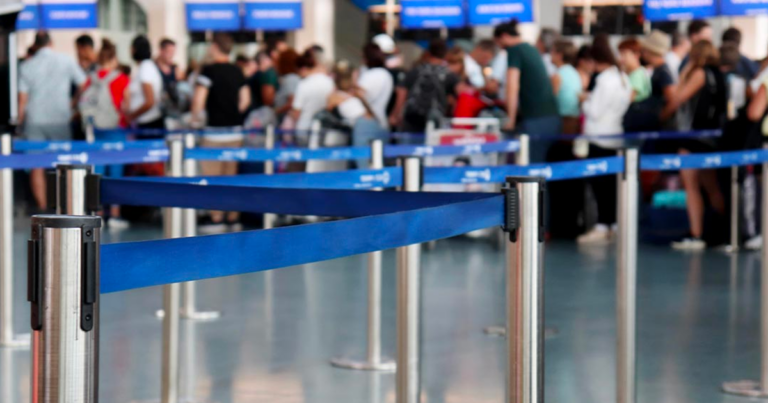
Canadians could soon find themselves having trouble crossing the border or boarding a flight as border workers prepare for a national strike.
Canada’s border workers have voted overwhelmingly in favour of a strike mandate if the demands of their union are not met by the federal government.
According to the Public Service Alliance of Canada, the union which represents the border workers said that its members have been without an updated collective agreement for two years.
PSAC members include intelligence and trade officers as well as inland enforcement and investigators at all land and marine borders.
Officers at airports and other commercial points of entry are represented by PSAC as well, which says that negotiations are at an impasse.
Intelligence and trade officers as well as inland enforcement and investigators are also represented by the PSAC.
Border workers voted 96% in favour of a strike mandate which their union said may present “significant disruptions” to the distribution of goods and services as well as people trying to get through Canadian ports of entry.
Mediation sessions between the two parties are slated to begin on June 3, meaning a strike action could come as early as next month, just as the tourist season between Canada and the U.S. begins to pick up momentum.
However, basic services are still obligated to remain ongoing as many border employees are considered essential workers.
A brief border strike in 2021 led to long lines of transport trucks and passenger vehicles stuck along the Canada-U.S. border, as well as at airports.
The Canada Border Services Agency ultimately reached a deal with the Trudeau government after a 36-hour negotiation.
Now, the PSAC is saying it wants “fair” wages that are akin to what other law enforcement employees are given, as well as an “equitable retirement regime.”
“When you look at the RCMP, after 25 years, they have the option to retire,” spokesperson for the Customs and Immigration Union, a subsidiary of PSAC Pierre St-Jacques, told CTV News.
“CBSA does not have that,” he added. “These are difficult jobs. People need to maintain their training. As people get older, sometimes this gets more difficult.”
Additionally, the union is demanding some remote work options.
“Taking job action is always a last resort, but this strong strike mandate underscores that our members are prepared to do what it takes to secure a fair contract,” said Chris Aylward, PSAC National President in a press release.
“Unless they want a repeat of 2021, Treasury Board and CBSA must be prepared to come to the table with a fair offer that addresses our key issues.”
The Trudeau government responded to news of the strike mandate by saying it was ready to return to the bargaining table “at any time” vowing to do “everything possible to reach a responsible and competitive agreement.”
According to the government, 80% of all public service agreements have been renewed and when it comes to the PSAC, “if the union is ready to negotiate in good faith, we can do the same.”
Amidst radical anti-Israel protests taking over Canadian streets and campuses, a prominent Jewish advocate says that hating on Israel will not bring justice to Palestinians
Ysabella Hazan, a 24-year-old University of Ottawa law graduate and founder of Decolonized Judean, an organization dedicated to “empowerment, movement, promoting justice & decolonizing Jewish identity,” recently gave an interview to True North.
“Hating Israel does not mean you love Palestinians, hating on Israel will not bring justice to Palestinians,” she said. “You can’t blame the consequences of war on one side. It just ignores the history and the context.”
She added that to truly fight for justice for Palestinians, one must first acknowledge “that Israel is not going anywhere.”
Hazan, who has visited the encampment occupying the McGill University campus, believes that some people are participating in encampment protests “who genuinely care about the Palestinian struggle and Palestinian rights and Palestinian suffering.”
She, however, added that many are just using the current issue to push their hatred of Jews, and hence there is “an inherent issue” within the Palestinian movement.
As previously reported by True North, the encampments have seen disturbingamounts of antisemitism, hate and far-left extremism. At McGill, an encampment organizer of the McGill protest refused to condemn Hamas, its Oct. 7 attack or call for a return of the hostages. An Iraqi Jew was also harassed and told to “go back to Europe.” There have also been calls for Intifada (violent uprisings) at the McGill encampment.
"Go back to Europe" sings a pro-Hamas mob in Montreal at Jewish Canadians.
When a Jewish person says their family is from Iraq, they're told to go there.
Iraq has no Jews. They fled mobs there too, in Iraq & across the MidEast. Most sought safe-haven in Israel. pic.twitter.com/rLXeZufezG
Hazan also touched on common claims made by protesters, including in regards to Zionism and the situation in Gaza.
Many pro-Palestinian protesters claim that Zionism and Judaism are very different things and that it is okay to be radically anti-Zionist, and stigmatize Zionists, as it is not the same thing as being antisemitic.
However, Hazan noted that nearly all Jews are Zionists.
“All Jews are Zionists, and the exception is not the rule,” she said.
She elaborated by noting that Zionism, the belief that Jews have the right to self-determination in their ancestral and indigenous homeland of Israel is inherent to Jewish culture.
“We pray towards Jerusalem,” she said. “Our holidays are based on the seasons of the land.”
Amidst this, Hazan says “anti-colonial tactics” seen in struggles for decolonization around the world have not and will not work on Israel because Israelis are not settlers but Indigenous peoples.
“Anti-colonial tactics do not work on Indigenous people,” she said.
“They’re appropriating the South African apartheid struggle, it won’t work on Israel because we won’t respond that way,” she said. “We just saw in the aftermath of October 7th. Jews will respond like the ancient custodians of the land that we are. We’re not going to let ourselves be butchered in our home.”
Something else that pro-Palestinian activists have been doing is comparing Israel’s war against Hamas to the Holocaust while pushing the false claim that Israel is committing genocide in Gaza.
What do you think should be universally accepted as grounds for charges of a hate crime?
Hazan noted that the appropriation of Jewish suffering and the use of terms like “never again” to describe the situation in Gaza is “a very, very offensive thing to do. Especially when there are Holocaust survivors who are still alive.”
She pointed out that Israel sends leaflets and calls to areas it is about to attack to warn civilians to get out and create passages for humanitarian aid in Gaza, things that the Nazis didn’t do.
“We didn’t have humanitarian aid in Auschwitz,” she said. “So to use the language of our suffering, to appropriate it, to turn it against us, is very, very, very disturbing.”
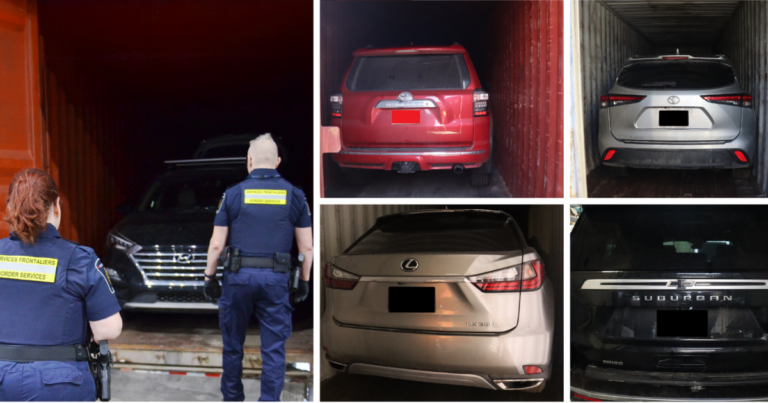
Over 200 Canadian cars a week have been found scattered across the world, reported as stolen and usually located at national ports of entry, according to Interpol, the International Criminal Police Organization.
The RCMP integrated the Canadian Police Information Centre’s stolen vehicle data with Interpol’s stolen motor vehicle database in February.
Since then, more than 1,500 Canadian vehicles have been detected worldwide.
Interpol confirmed in a news release that Canada ranks among the top 10 countries in hits received through the stolen motor vehicle database this year, out of the 137 countries connected worldwide.
Interpol’s stolen motor vehicle database connects 137 countries and holds data on 12 million vehicles worldwide. The database allows police from member countries to check whether a suspicious vehicle has been reported as stolen. In 2023, approximately 226,000 cars were identified as stolen worldwide through Interpol’s database.
Interpol manages a range of databases containing information related to criminals and crimes, with over 125 million police records and 5.9 billion database searches.
The RCMP’s Canadian Police Information Centre’s database contains information on around 150,000 stolen vehicles in Canada.
Canada’s abundant supply of high-value models like SUVs and crossovers makes it an attractive target for thieves.
“Stolen vehicles are international criminal currency. Not only are they used to traffic drugs, but also as payment to other criminal networks as well as fuelling activities from human trafficking to terrorism,” said Interpol Secretary General Jürgen Stock.
Many Canadian vehicles found to be stolen are shipped to the Middle East and West Africa, where they are traded or re-sold, according to Interpol.
“Sometimes overlooked, a stolen car is not just car theft. It is part of a major revenue stream for transnational organized crime. Through increased data sharing at the global level, we can better screen vehicles at border points, identify trafficking routes, and arrest the perpetrators,” said Stock.
Due to insurance claims reaching an unprecedented level in Canada thanks in part to the auto theft crisis, insurance premiums in the country have increased between 25% and 50% on commonly stolen car models, with owners of “high-risk vehicles” being subject to a $500 surcharge. Claims increased 254% nationally between 2018 and 2023, reaching $1.5 billion in 2023.
Bryan Gast, vice president of investigative services for Équité Association, said the problem has reached “crisis levels.”
Conservative Leader Pierre Poilievre said he would fix Canada’s car theft crisis if elected prime minister.
“Common sense Conservatives will reverse Trudeau’s reckless policies that have turned our federal ports into parking lots for stolen cars. By making it much harder to ship cars overseas where they can be sold, this violent get-rich-quick scheme that gangs around the country have been taking advantage of will no longer be possible,” said Poilievre.
The federal Port of Montreal is severely understaffed, with only five agents tasked with inspecting all containers passing through annually. This port, a primary exit point for stolen cars, has just one often malfunctioning X-ray scanner, leading to Canadian Border Service agents inspecting less than 1% of all containers.
Despite widespread acknowledgement of the Canadian healthcare system’s shortcomings, including long wait times and overcrowded facilities, political action in Ottawa remains stagnant, even as calls for major reforms grow. SecondStreet.org president Colin Craig joined True North’s Andrew Lawton to explain why our federal leaders are partially to blame for the persistent issues plaguing our healthcare system.
Earlier this month, the Saskatchewan Court of Appeal dismissed the appeal of the Charter challenge to the provincial government’s 10-person outdoor gathering restrictions, which had been introduced during the COVID-19 pandemic in 2021. Charter Advocates Canada litigation director Marty Moore joined True North’s Andrew Lawton to break down the ruling.
Today on the Alberta Roundup with Rachel Emmanuel, Rachel explains how most of the fires started in Alberta over the long weekend were human caused. Also on the show, Rachel has an update from Alberta Premier Danielle Smith about the changes her government is making in healthcare and how it will improve things.
Later on the show, Rachel has a bizarre story about a Calgary court ruling to allow depraved sex parties in one northwest neighbourhood.