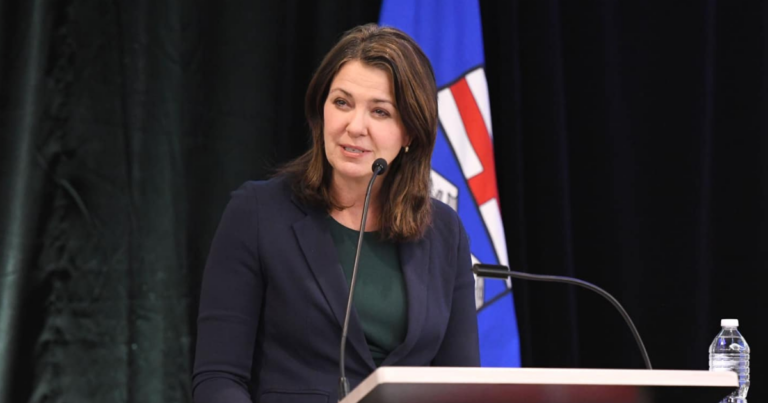
Today on the Alberta Roundup with Rachel Emmanuel, Rachel interviews United Conservative Party board president Rob Smith about why the board is urging Alberta Premier Danielle Smith to change the province’s Covid-19 vaccine policy. Smith says doctors must be forthcoming with parents about all the possible impacts of the Covid-19 vaccine, and that the board has already raised their concerns with the premier.
The interview comes ahead of an event warning of the dangers of the Covid-19 vaccine hosted by the Calgary-Lougheed UCP constituency association.
Anti-Israel protesters are claiming victory after one Ontario university caved to their demands.
Ontario Tech University has given protesters encamped on the Oshawa, Ont. campus what they wanted.
Much like other anti-Israel protests on campuses in Canada, the demands centred around the school disclosing and divesting any investments that assist Israel in its war against Hamas.
According to a copy of an agreement between protesters and the school, Ontario Tech University agreed to disclose an annual report of its investments on its website beginning this fall. The school said it is not aware of any assets that benefit from the Israel-Hamas war.
“The university affirms that it is engaged in responsible investment practices. It is not aware of investments in any companies that are benefitting from the current Palestinian humanitarian crisis.”
As part of the deal, protest organizers agreed to not reestablish an encampment at Ontario Tech University before May 2025.
In an Instagram video posted by Canadians For Palestine, protesters celebrated their victory on campus with an array of anti-Israel chants.
“We will go onto the streets to let the rest of Canada know. Yes (Ontario Tech University) has divested, but Canada still needs to divest and sanction. We will let Oshawa know, as we will each and every city, each and every day, each and every week until Palestine is free,” a protester said.
The university has agreed to protect any students, staff, or faculty participating in the encampment from potential academic or employment-based retaliation at the university.
It also agreed to create a memorandum of understanding for all future partnerships affirming its commitment to diversity, equity, and inclusion.
It will create a “responsible working group” to make recommendations to the school’s audit and finance committee, with “particular attention” to companies involved in arms manufacturing and delivery or any investment benefiting from military action in the region.
“We were able to reach an agreement with our students by establishing a Presidential Advisory Committee, primarily composed of diverse students, to explore the development of Responsible Investment Practices,” the university said in an update.
The committee will advise the university’s president and vice-chancellor and guide the school’s administrators in ensuring that any investment is made within an environmental, social, and governance (ESG) lens.
The university has declared a long-standing commitment to ESG for over a decade and has its own DEI department.
The president and vice-chancellor will choose the advisory committee, which will consist primarily of students, with two members being alumni, who will “preferably have a financial background.”
Starting this fall, through the Ontario Tech International Emergency Bursary, the university has promised to fund three undergraduate student scholarships for refugees from “Palestinian or similarly affected areas.”
However, bringing in refugees from Gaza might not be as easy as paying for their scholarships.
Despite the Liberal government’s plan to raise the cap on refugees from Gaza, it has taken no immigrants from the region.
The Conservatives hope to rally the NDP to remove House Speaker Greg Fergus and trigger a non-confidence vote in the House of Commons.
Fergus was under fire for the language he used in an advertisement promoting an upcoming event, which critics called an inflammatory display of political bias.
“House of Commons Speaker Greg Fergus has once again shown his disregard for the neutrality required in his role,” said Chris Warkentin, Deputy Whip of the Official Opposition in a statement released on Tuesday.
In the invitation for his event called ‘A Summer Evening with the Honourable Greg Fergus,’ he wrote, “Pierre Poilievre and the Conservatives propose reckless policies that would risk our health, safety and pocketbooks.”
This is not the first time that the Conservatives have accused Fergus of Liberal bias since becoming Speaker of the House, a role which requires him to moderate debate in the House of Commons in a non-partisan manner.
Fergus removed Conservative leader Pierre Poilievre from the House of Commons last month after he refused to withdraw a claim that Prime Minister Justin Trudeau was a “wacko.”
Poilievre’s comments followed Trudeau accusing the opposition leader of associating with far-right extremists and pandering to white nationalists to acquire votes.
Trudeau also went on to say that Poilievre was not fit to be prime minister without reprimand from Fergus.
“The promotional material uses inflammatory partisan attacks about the Leader of the Official Opposition and the Conservative Party. This is the same Speaker who, just a few weeks ago, used the authority of his position to kick out the Leader of the Opposition while giving a free pass to the Prime Minister for using similar language,” wrote Warkentin.
“This Speaker has shown that he has no intention of remaining non-partisan. In addition to the two instances mentioned above, the Speaker has spoken at a cocktail fundraising dinner for a neighbouring Liberal, addressed the Ontario Liberal Party leadership convention in full Speaker garb, and jetted off to Washington to make a speech about his days as a member of the Young Liberals.”
Fergus was elected as a Liberal MP, represening the riding of Hull-Aylmer in Quebec and became House Speaker last October.
Warkentin acknowledged that while any sitting Speaker who intends to run for re-election as an MP must partake in fundraising events, he believed Fergus’ language around the event, which doesn’t appear to be a fundraiser, crossed the line.
“I note that your advertised event does not appear to be a fundraiser, as there is no ticketed price. With such a highly partisan description, your event appears more akin to a partisan political rally than anything else,” said Wekentin.
Conservatives argue that Fergus has made enough impartial decisions and actions that would deem him unfit for the role of House Speaker.
“Conservatives have known for months that the Speaker has no intention of doing his job well or fairly. Unfortunately, Trudeau’s NDP coalition partners have stood behind Fergus, preferring a Speaker who will protect Trudeau to one who shows a modicum of fairness in the chair,” continued Warkentin’s statement.
“After Fergus’ last malfeasance, however, the NDP promised that they would call for Greg Fergus to step down if something like what happened at the Ontario Liberal Party convention ever happened again.”
The Conservatives are now seeking support from the NDP, who have a supply-and-confidence agreement with the Liberals to join them in a vote of non-confidence to remove Fergus as House Speaker.
“It has happened again. If Fergus refuses to see the obvious error of his conduct, the NDP must finally join the Conservatives and the Bloc to express non-confidence in the Speaker.”
Opioids have killed or harmed more Albertans than ever before.
According to data released by the government, drug poisoning deaths reached an all-time high in the province last year.
A total of 2,051 Albertans were killed by drug overdoses in 2023, with opioids being the primary culprit, accounting for 1,867 of those deaths.
Hunter Baril, press secretary to Alberta’s Minister of Mental Health and Addiction, Dan Williams, said that the number of people losing their lives to addiction was concerning.
“The loss of any life is an absolute tragedy. We offer condolences to the families, loved ones, and communities of those who have been impacted by the addiction crisis,” said Baril.
While 2023 saw Alberta hit a record number of deaths, an intensified drug recovery approach could be showing promising signs early this year.
“We are cautiously optimistic about the downward trend in the first two months of 2024. February of this year shows a 33% decrease in fatalities compared to February of last year and is the lowest number of all substance fatalities in nearly four years,” said Baril.
In January and February 2024, 254 Albertans died from drug poisonings, down from 309 in the same period in 2023. This is a further decrease from the 365 Albertans who died from drug poisonings in the first two months of 2022, which was an increase from 271 in 2021 and 125 in 2020.
The decrease could be due to Alberta’s recovery-based approach, which Baril said is focused on a system of care to support everyone in their pursuit of recovery. The United Conservative Party has emphasized a recovery-oriented system of care over so-called safe supply.
Alberta has opened two treatment centres in Red Deer and Lethbridge over the last year. The provincial government is building nine more of these facilities, five in partnership with Indigenous communities provincewide.
“We provide immediate, same-day access to life-saving treatment medication through the Virtual Opioid Dependency Program. Nowhere else in the world is there this level of access to evidence-based opioid agonist therapy,” said Baril.
Despite the early signs of progress in 2024, the opioid crisis remains severe and continues to worsen.
Of the 254 Albertans who died from drug poisoning in the first two months of 2024, 237, or 93.3%, were opioid deaths.
An equal 93% of all drug poisoning deaths involved fentanyl. Multiple drugs can be involved in one death; therefore, drugs present during death are not mutually exclusive. Methamphetamine was present in two-thirds of all drug poisoning deaths.
While the number of deaths is down for the first two months of 2024, the percentage of total drug poisoning deaths that resulted from opioids has reached a record. The number of opioid deaths as a percentage of total drug deaths is the highest for the first two months of the year since the data began being tracked in 2016.
This followed the Liberals denying Alberta’s request to track safe-supply drugs being sold on the streets with a “unique chemical identifier.” The Alberta Recovery Model seeks to focus on long-term recovery for the province’s addiction and mental health system.
Andrew is away this week, so Canadian Taxpayers’ Federation Alberta Director, Kris Sims, will be hosting the show!
On this special edition of The Andrew Lawton Show, Kris takes a deep dive into Canada’s cost of living crisis, examining how despite a slight slowdown in inflation, rising gas prices continue to worsen. At the same time, Canada is set to refinance one-third of its $1.4 trillion debt this year at higher interest rates, significantly increasing costs for taxpayers. Will there be any relief for Canadians?
Also, newly released documents show Canada spent almost $3 million to send a delegation to COP28 in Dubai, nearly double what was initially reported. Franco Terrazzano of the Canadian Taxpayers Federation joins to discuss.
Plus, the Trudeau government’s proposed ban on new gas and diesel vehicles by 2035 may overwhelm Canada’s power grid. So why are they still pushing this agenda?
Tune into The Andrew Lawton Show, guest hosted by Kris Sims!
After nine years in power, the Liberal government says it’s getting serious about car thefts.
At a Brampton, Ont. press conference on Monday, the government unveiled its “national action plan” on auto thefts.
“We want to build on the joint enforcement actions that have taken place since the national summit on combating auto theft,” said Public Safety Minister LeBlanc. The government, through its latest budget, plans to toughen penalties for car thefts, enhance information sharing between various law enforcement agencies and the government, and further cooperate with the port and rail industry.
Minister of Justice Arif Virani announced several new offences that will be added to the Criminal Code aimed at targeting auto thieves.
Deputy Prime Minister Chrystia Freeland blamed the Conservatives when questioned who in the government should be held responsible for rising crime in Canadian cities. pic.twitter.com/vgMhfsq5cl
In specific, Virani announced new offences for auto thefts linked to violence, an offence targeting leaders of organised auto theft rings, and offences for the possession and distribution of devices used to commit auto theft, such as key programming machines.
New offences would also be created to target those who launder the proceeds of stolen vehicle sales and other crimes at the behest of a criminal organization.
An aggravating factor would also be created for adults who bring a minor to accompany them in their crime to dissuade adults creating youth offenders.
A Conservative spokesperson slammed the announcement as a “Liberal photo-op,” pointing to the government’s record overseeing a widespread surge in auto thefts.
“Justin Trudeau’s Liberal ministers will hold another one of their photo ops to talk about the out of control auto theft crisis they’ve caused,” said Pierre Poilievre’s spokesperson.
“It truly comes as a shock that their endless meetings and photo ops on this subject have yielded absolutely no results, other than to make the situation much worse.”
The spokesperson pointed to the soaring rates of auto theft and record-high insurance claims for auto thefts during Justin Trudeau’s time in office..
“Here is the sobering truth about the situation after nine years of Justin Trudeau – a car is stolen every six minutes in this country and car theft is up 34%,” the Conservatives said.
In February, Poilievre announced his party’s plan to crack down on auto thefts if elected, promising to lock up repeat offenders, lengthen sentences while removing the possibility of house arrest, and give additional funding to the Canadian Border Services Agency to hire more agents and buy x-ray equipment.
Over the past several years, a wave of auto theft has swept over Canada’s major cities far beyond normal levels.
In Toronto, instances of motor vehicle theft have increased by over 350% from 2015-2023 while the Region of Peel has been reeling from an over 200% increase from 2020-2024.
Last week the Insurance Bureau of Canada announced that the cost to replace stolen vehicles has reached a record-breaking $1.5 billion in 2023, a three-fold increase from the 2018-2021 average.
Canada’s annual inflation rate eased to 2.7% last month and measures of core inflation also slowed, according to Statistics Canada.
These latest figures will help to increase the likelihood that the Bank of Canada will begin cutting interest rates in June.
According to Statistics Canada’s latest Consumer Price Index, the deceleration was mostly due to a slower growth in the prices of services, durable goods and food.
However, the slowdown was impeded by rising gas prices, up 6.1% last month, compared to a 4.5% increase in March.
The CPI increased 2.5% last month, excluding gasoline.
“Today’s data should have provided the all clear on the inflation front that the Bank of Canada needed to start cutting interest rates in June,” CIBC economist Andrew Grantham wrote in a research note on Tuesday.
The Bank of Canada uses the data from the CPI to help inform its decisions on interest rates.
The central bank’s next rate announcement will be on June 5.
Bank of Canada governor Tiff Macklem said last month that the bank must see sustained evidence that progress is being made, particularly on the core inflation front.
“Since then we have received two more months of data pointing to tame underlying inflation, for a total of four in a row, and because of that we continue to forecast a first rate cut at the next meeting in June,” said Grantham.
While the CPI increased 2.9% in March, core inflation slowed and continued that trend last month, with the CPI-median dropping from 2.9% in March to 2.6% in April.
“Canadians look likely to get a small dose of rate relief in the coming week,” wrote Royce Mendes, managing director and head of macro strategy for Desjardins.
“With headline inflation decelerating to 2.7 per cent in April from 2.9 per cent in March and core measures also moving in the right direction, Canadian central bankers should have the evidence they need to begin easing monetary policy,” he added.
“While the market still seems somewhat hesitant to fully commit to a rate cut in June, we see the latest inflation data as enough for the Bank of Canada to begin a gradual easing cycle at its next policy announcement.”The Bank of Canada has held its benchmark interest rate at 5% for the past year.
An Oshawa dog rescue organization was forced to cancel its fundraising barbecue after vegan activists chastised them over plans to serve burgers and hot dogs.
Team Chelsea, a Durham Region-based organization has been rescuing lost pets in the area for over a dozen years and had scheduled the event for this Sunday from 11 a.m. to 3 p.m.
The group planned to host the fundraising event for lost dogs and cats in the Rona parking lot on Laval Drive in the Stevenson Road and Hwy 401 area.
However, they were forced to cancel after an “unexpected turn of events” occurred on social media while promoting the fundraiser.
Source: Facebook
“Sadly, the post on Rona+ Oshawa social media page attracted a lot of attention in respect to the concern for serving meat at this particular BBQ Fundraiser,” wrote Team Chelsea in a Facebook post. “We at Team Chelsea believe in freedom of choice and we believe that everyone has the right to choose what’s best for them.”
According to the group, their event post was met with “harsh and offensive” comments directed at both them and Rona for agreeing to host the event, “imploring and bullying us into turning the event into a vegan-only option.”
Team Chelsea saw the fundraiser as an opportunity to boost resources in its objective to rescue lost pets.
A goal that the group has certainly already had a great deal of success with, rescuing almost 25,000 dogs and cats since 2011.
The group was launched after community members got together in search of a lost Bernese mountain dog named Chelsea 14 years ago.
“We appreciate the community partnerships and support that many local businesses offer to Team Chelsea and are very saddened and disappointed with the effect that social media has taken on this particular situation,” reads the post. “It is very challenging to try and appease a huge population of people: we felt by offering choices at the BBQ that we would be respecting all our supporters and their values. I regret to say this was not the case.”
Despite its disappointment, Team Chelsea still expressed its gratitude for both Rona and the city of Oshawa for offering to host the event, as well as the group’s many volunteers.
“We rely solely on donations as we are not funded, so missed opportunities directly impact the number of animals we are able to help. It’s unfortunate that a small group of people were able to make such an impact, as we believe that everyone has the right to choose,” added the post.
Comments on the post have since been disabled, however, one community member expressed their support before their removal.
“This was an opportunity for a variety of people to come together as one to raise money for so many animals in need. Having a difference of opinion or lifestyle does not give a person the right to bully others into thinking or living the way they do,” they wrote.
“This is such a sad situation and honestly, I don’t know how these people can sleep at night knowing they took medical care, food, housing and other needs away from animals in Team Chelsea’s care, all because others live their own lives, by their own choices. What a damn waste!”
Compared to Canada’s national average, the country’s homeless population stays in hospitals for almost twice as long and costs the taxpayer more than double, according to data released by the Canadian Institute for Health Information.
At least 25,000 Canadians experience homelessness on a given night, and an average of 235,000 Canadians experience a type of homelessness in a given year.
In 2018, Canadian hospitals became required to document when a patient was homeless. According to the Canadian Institute for Health Information, 29,321 homeless Canadians were hospitalized in 2022-2023.
The top three reasons for hospital stays for homeless Canadians were substance use disorders (18%), schizophrenia and other psychotic disorders (11%), and the skin infection known as cellulitis (7%).
“Most types of mental health and substance use hospitalizations are associated with longer-than-average hospital stays and repeat admissions,” read the study.
Patients in Canadian hospitals experiencing homelessness had an average length of stay of 15.4 days, compared to the national average of eight days. The estimated average cost of homeless Canadians’ stays in the hospital was $16,800, compared to the national average of $7,800.
“In addition to longer lengths of stay, hospitalization for (people experiencing homelessness) were more likely to include alternate level of care days, compared with the Canadian average (11.9% versus 6.2%),” read the study, noting that both percentages excluded Quebec.
Almost all patients experiencing homelessness, 93%, were admitted to the hospital through the emergency department.
“Many (patients experiencing homelessness) face barriers to accessing other types of healthcare services, including primary care. Getting appropriate care in the community may prevent emergency departments visits and hospital stays,” read the study.
The study revealed that homeless Canadians have “complex health needs” and are more likely to rely on hospitals for healthcare because homeless Canadians often struggle with accessing other types of healthcare, such as primary care.
Non-hospital data sources show that the average age of a Canadian experiencing homelessness is 40.3 years old. However, the average age of a hospitalized homeless Canadian was 44.4 years old in 2022-23.
While 70.3% of homeless Canadians were male from non-hospital data sources, an almost equal 70.8% of hospitalized homeless Canadians were male in 2022-23.
The most commonly hospitalized homeless Canadian was aged 25-49 years old, which accounted for 56.4% of hospitalizations, followed by those aged 50-64 years old at 26.1%, 65 years and older at 10.4%, and 0-24 years old at 7.1%.
While nearly 30,000 hospitalizations included hospitals documenting a homeless patient in 2022-23, the study confirmed that this number was likely under-representative of the actual number of patients experiencing homelessness.
Factors that could have influenced under-representation were “Patients not identifying themselves as experiencing homelessness due to a concern about stigma or for other reasons; (and) variation in the processes hospitals use to ensure that healthcare providers ask patients about their housing status,” according to the study.
The data did not include residency status.
True North previously reported that almost half of the occupants in Ottawa’s homeless shelters are new immigrants and refugee claimants.