Canada delays controversial assisted dying rollout

After public outcry and international scrutiny over the federal Liberal government’s decision to expand doctor assisted suicide to the mentally ill, on Thursday Ottawa announced it will introduce a bill to delay the new rules until March 17, 2024. 

Originally the program was set to take effect in spring 2023. 

Justice Minister David Lametti said during a press conference that recent developments with assisted suicide in Canada has created the need for more deliberation on the expansion. 

“It is clear that more time is needed to get this right, which brings us to today’s bill, C-39 – the proposed one year expansion is necessary to ensure that we move forward on this sensitive and complex issue in a prudent and measured way,” said Lametti. 

Lametti cited the need for more studies on the risks associated with providing assisted suicide to the mentally ill. 

On whether the one year extension was enough time to sort out these complex issues, Lametti said he was “extremely confident” that the program will be in place by the new deadline. 

“We’re giving time, for whatever reason… Covid or other factors… For those other provinces, faculties of medicine to internalize the very positive guidelines that are given by the expert committee.” 


In a Feb. 2 statement the non-partisan think tank Cardus said that while the delay is a step in the right direction it falls short. 

Ray Pennings, Executive vice-president of Cardus, called on the government to not follow through with the expansion and instead make palliative care universally available to all Canadians. 

“(The government should be) committing to helping people live with dignity, so that no one seeks medically assisted suicide because of a lack of housing, insufficient income, or inadequate support for physical disabilities or mental illness,” wrote Pennings. 

“(Also by) reducing social isolation and loneliness by working with charities, faith communities, and other parts of civil society who can help desperate and vulnerable people in ways bureaucracies cannot.” 

In Aug. 2022 it was revealed that a Canadian veteran seeking treatment for mental health issues was told by a Veterans Affairs Canada (VAC) official to consider seeking doctor assisted suicide. 

VAC eventually apologized over the incident after it was reported to the media. 

“VAC deeply regrets what transpired,” said the agency claiming that “appropriate administrative action will be taken.”

“Providing advice pertaining to medical assistance in dying is not a VAC service.”

The Daily Brief | Feds consider copying riot-causing Netherlands fertilizer plans

The Canadian federal government was inspired by fertilizer emissions reductions plans first undertaken by the European Union – which asked member states to introduce policies to reduce fertilizer use altogether. The controversial policy, when applied in countries like the Netherlands, led to widespread protests, tractor convoys and clashes with authorities.

After being canned by Alberta Premier Danielle Smith, former Alberta Chief Medical Health Officer Deena Hinshaw has been hired on a six-month contract as British Columbia’s deputy provincial health officer.

Plus, Conservative leader Pierre Poilievre says British Columbia’s permissive policies on illicit drug use have been a failure.

Tune into The Daily Brief with Anthony Furey and Rachel Emmanuel!

SUBSCRIBE TO THE DAILY BRIEF

Canadian novelists warn against Bill C-11

Famed Canadian authors Margaret Atwood and David Adams Richards are among novelists warning against the Trudeau government’s online censorship Bill C-11 to amend the Broadcasting Act.

“That what George Orwell says we must resist is a prison of self-censorship,” Richards said during a speech in Canada’s Senate, where he sits as a Senator. “This bill goes a long way to construct such a prison.”

As Bill C-11 moves closer to passing third reading in the Senate, writers are voicing their concerns over the bill’s regulation of Canadian media. 

“The idea of any hierarchical politico deciding what a man or woman is allowed to write to fit a proscribed national agenda is a horrid thing,” Richards continued. “I am wondering if anyone on the staff of our Minister of Canadian Heritage understands this.”

“No decree by the CRTC could, in any way, tell us what Canadian content should or should not be,” said Richards, who was appointed to the Senate by Prime Minister Justin Trudeau in 2017.

Famed author Margaret Atwood shared the video in support of Richards’ speech, saying that it “needs a listen.”

Richards also told the Senate of one night in Toronto where he was approached by Irish writer Roddy Doyle and First Nations writer Richard Wagamese, who were both inspired by his work.

“Both were very kind, lived thousands of miles apart, one Irish and one First Nations. The writing had little to do with identity politics, but it did have much to do with identifying,” said Richards. “I do not know who would be able to tell me what Canadian content is and what it is not, but I know it won’t be in the Minister of Heritage’s power to ever tell me.”

“This is not opening the gate to greatness but only to compliance,” said Richards. “We will have government officials holding a book of rules telling us if we are Canadian enough or, worse, who can write what about whom.

“We have filled the world with our talent, but not because of the Minister of Heritage,” finished Richards. ”This law will be one of scapegoating all those who do not fit into what our bureaucrats think Canada should be. Stalin, again, will be looking over our shoulders when we write.”

David Adams Richards has won the Governor General’s Award for fiction and non-fiction and the Giller Prize.

The bill is expected to return to the House of Commons after the third reading in the Senate where amendments will be debated before it is voted on to become law. 

LEVY: Ontario school board bans spirit days, wacky hair days for woke reasons

Determined to remain an international laughingstock, the school board that brought you Boob-gate has now decided that it is no longer acceptable for schools to get into the spirit of something fun.

The Halton District School Board – led by education director Curtis Ennis – has put out a laughable memo claiming school spirit days must be reimagined because many are racist, ableist, exclusionary and most of all, push colonialism.

The initial edict came out in November 2021 when no students were attending in-person school anyways. It was just updated and revised last month.

According to the board, “red and white” days during which students wear red and white may be perceived as a reminder of the impacts of “colonialism,” including erasure and the violation of Treaties. This, board officials say, may trigger Indigenous students. 

“The well-being of Indigenous students must be supported through anti-colonial strategies,” the staff memo says. “The planning of spirit days should examine both the implicit and explicit messages sent about/to Indigenous peoples… perpetuating stereotypes must be avoided and the impacts of student safety and well-being must be considered.”

The board’s brass also say that any days that commence with the word “crazy” are out because this is “ableist” language.

Hair Days are also a no-no because they can create “exclusion” and opportunities for “cultural appropriation and/or stereotyping.”

I guess that means no more Crazy Hair days in the Halton Board.

Twins Day, according to the board, is also off-limits because they can create “exclusion” and “hyper-awareness” of differences.

Board officials claim that besides being discriminatory, racist and exclusionary for some students, some will feel “anxious” about such days while others who don’t want to participate may “feel stigmatized” for opting out.

For heaven’s sake you can’t make this stuff up. This edict is so crazy, one doesn’t know whether to laugh or cry.

It seems some woke boards won’t stop until they take all of the fun and spirit out of their schools for fear of offending someone.

In doing so, I fear they will turn this generation of students – or at least some – into humourless and cowardly crybabies, unable to deal with anything that might challenge their creativity or sense of fun.

But I am particularly incensed with this edict considering this is the same board that has allowed Kayla Lemieux, the shop teacher who sports mammoth prosthetic breasts, protruding nipples and a cheap blond wig, to continue to come to school dressed like a character out of a drag show.

In November the board ruled that despite the protests, the outrage and international media attention, Lemieux’s rights to gender expression far outweigh those of the students.

It took long overdue comments from education minister Stephen Lecce for trustees to decide last month to pursue a professionalism policy for teachers which will include appropriate standards of dress in the classroom.

The report from Ennis is due March 1. I’m willing to bet that policy won’t come into play until the next school year.

In the meantime, huge prosthetic breasts with protruding nipples proudly displayed by a trans teacher doesn’t violate student safety or well-being.

But it seems a red and white shirt or crazy hair might.

That’s what a school board like the HDSB calls “inclusiveness” in 2023.

Loblaws Twitter account engages in damage control over price gouging claims

0

Grocery giant Loblaws’ corporate Twitter account has been tweeting up a storm over the past few days in response to allegations that it’s unfairly hiking prices on Canadian consumers. 

A price freeze on No Name products came to an end on Tuesday and the Loblaw Companies Twitter account has taken to social media to cite food inflation as the reason behind hiking prices. 

In one tweet responding to University of Ottawa associate professor Yoni Freedhoff, the official Loblaws account blamed manufacturers for charging higher prices on products. 

“Loblaws’ no name price freeze ends today and despite soaring profits have the gall to state they can’t help but raise prices cuz inflation. Listen, you’re a for profit company so do what you want but spare us the bullsh**tery,” tweeted Freedhoff. 

“While we may be the face of food inflation but we are certainly not the cause. Food prices are higher in our stores simply because the manufacturers who make the products are charging more for them,” responded Loblaws. 

That same message was echoed in another tweet which blamed “big cost increases from vendors.” 

“We froze prices to help customers at a time they needed it most. Food inflation continues and we’re seeing a lot of big cost increases from vendors, but hundreds of no name products will not go up,” wrote the company account. 

In another tweet about high produce prices at Loblaws stores, the company claimed that their prices were competitive compared to other grocery stores. 

“We would say our prices are competitive when compared to other major grocers. We try to offer a wide range of products and locations to meet a variety of needs, but we also encourage you to shop where you feel most comfortable,” said Loblaws. 

The company also claimed that it makes less than $4 on a $100 grocery bill. 

“We get it. It’s easy to blame grocers for higher grocery prices. But on a $100 grocery bill, our profit is less than $4,” wrote Loblaws. 

Loblaws is going on the offensive as politicians in Ottawa question the company’s business practices during high inflation and as Canadians face rising costs of living. In November, it was revealed that top grocers, including Loblaws posted record profits in 2022 as inflation was ramping up throughout Canada. 

In the first half of 2022 Loblaws beat records by $180 million, according to research by Dalhousie University. 

In 2018, Loblaws admitted to a bread price-fixing scheme after it was found that chains had “regularly increased prices on a coordinated basis.” Additionally, the company was also ordered to pay back $368 million in unpaid taxes that same year. 

Majority of Canadians not happy with country’s direction, new poll reports

The majority of Canadians say the country is headed in the wrong direction, according to a new poll.

The Abacus Data survey released Wednesday said 55% of Canadian respondents think the country is on the “wrong track,” with government approval ratings down since January 2022.

“For the Liberals, these numbers should be a warning that they are losing the empathy game,” said Abacus CEO David Coletto.

Coletto pointed to the “pocketbook” issues of the survey, showing that seven-in-ten Canadians think the Liberals are neglecting the rising costs of living and housing.

It may be turning the tide against the Liberals.

In the survey conducted last week, 50% of Canadians said they definitely want a change of government, while 14% said they definitely want the Liberals re-elected. 

The poll showed that 37% would vote for the Conservative party tomorrow, 29% would vote for the Liberals, and 18% would vote for the NDP.  

The differential between the Conservatives and the Liberals has swayed by roughly 10% since last January, when the Liberals led by 2%.

“This Conservative lead is more about dissatisfaction with the Liberals than enthusiasm for the Conservatives,” said Coletto. “Pierre Poilievre’s personal image has neither improved nor deteriorated – perhaps a win given the environment.”

In the survey, one-third of Canadians said they had a negative impression of Conservative leader Pierre Poilievre, half said they had a negative impression of Prime Minister Justin Trudeau, and one-third said they had a negative impression of NDP leader Jagmeet Singh.

The Rupa Subramanya Show | The media got it wrong on Covid (Ft. Dr. Matt Strauss) Pt. 1

0

As the medical officer for Haldimand-Norfolk, Dr. Matt Strauss took a rational approach to Covid. He spoke out about the effectiveness of masks, opposed lockdowns and  questioned the need to vaccinate kids. In the region that he oversaw, the mortality for Covid was 30% lower than the provincial average.

However, that didn’t stop legacy media outlets like the Toronto Star from attempting to cancel Dr. Strauss.

On this episode of The Rupa Subramanya Show, Rupa and Dr. Strauss discuss how the media got it wrong on Covid, Strauss’ ongoing battles with activist journalists and much more. Tune into part 1 of Rupa’s interview with Dr. Strauss!

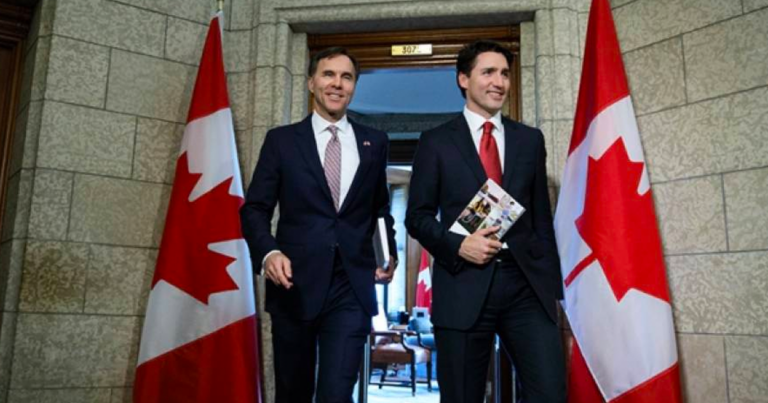
Trudeau calls Morneau and Carney “random Liberals” during question period

Prime Minister Justin Trudeau referred to his former finance minister Bill Morneau and the former governor of the Bank of Canada Mark Carney as “random Liberals” during Wednesday’s question period. 

Trudeau made the statement in response to a question posed to him by Conservative leader Pierre Poilievre regarding how much funding the consulting group McKinsey and Company received from the Liberal government.  

“It isn’t me that said the prime minister overspent, it’s Bill Morneau. Remember him? He’s the one that said the prime minister spent too much and the future Liberal leader Mark Carney is the one, who, along with the current governor of the Bank of Canada says that this overspending is contributing to inflation,” said Poilievre. 

In response, Trudeau accused Poilievre of “stumbling over himself” by quoting “random Liberals.” 

“You know the Conservative leader is stumbling over himself when he starts quoting random Liberals,” responded Trudeau. 

In a recent book, Morneau blasted his former boss saying that he had turned the finance ministry into a “rubber stamp” for Liberal government policies before he was ousted. 

“My job of providing counsel and direction where fiscal matters were concerned had deteriorated into serving as something between a figurehead and a rubber stamp,” wrote Morneau in Where To from Here: A Path to Canadian Prosperity.

“We lost the agenda. During the period when the largest government expenditures as a portion of GDP were made in the shortest time since the advent of World War II, calculations and recommendations from the Ministry of Finance were basically disregarded in favour of winning a popularity contest.” 

During testimony before the Senate banking committee Carney said that much of the pandemic spending introduced by the Trudeau Liberals was unjustified and went on for too long a period of time. 

“There was a period of time where fiscal policy was reinforcing some of the challenges that the Bank of Canada began to see,” explained Carney. 

EXCLUSIVE: Ottawa considered following Europe’s riot-causing fertilizer rules

This is the final part of the Fertilizer Files, a 3-part series on what internal government documents show about the Trudeau Liberals’ push to reduce fertilizer emissions. Read part 1 here and part 2 here.

While modeling its agriculture emissions reduction plan, Ottawa considered following in the footsteps of the European Union – which has asked member states to introduce policies to reduce fertilizer use altogether. The controversial policy, when applied in countries like the Netherlands, has led to widespread protests, tractor convoys and clashes with authorities.

Documents obtained by True North as part of its ongoing investigative series into the fertilizer emission reduction scheme show that along the way the government was closely aligning its approach with the European strategy.

About a year after the voluntary federal target was first announced, the industry group Fertilizer Canada raised their concerns that Ottawa would follow in the footsteps of the EU’s “Farm to Fork Strategy” (F2F), which mandates a 20% wholesale reduction in use of fertilizer among 27 other climate-oriented actions that include a 10% reduction in farmland. 

In an email to the Ministry of Agriculture dated to June 21, 2021, the organization’s representative went on to urge that “the approach taken in Europe is not duplicated” in Canada. 

“I think the additional communications that will be released with the report highlight, explicitly, that we want to work with all governments to ensure that the approach taken in Europe is not duplicated in Canada,” said senior manager of government relations Daniel Kelter. 

Fertilizer Canada also cited “closed-door meetings” with the government where the possibility of taking the EU approach was considered.

“From the beginning other officials in the department have made comments in meetings with Fertilizer Canada about the European Union as a potential model on this issue.” 

A copy of a speech delivered by Agriculture Minister Marie Claude-Bibeau that same year as part of a sustainable agriculture webinar with European counterparts went even further, describing Canada’s measures as “very closely aligned” with “the fertilizer reduction target in the EU’s Farm to Fork strategy.” 

According to internal memos, Fertilizer Canada’s concerns were well-founded. One June 2021 briefing described the European Union’s policy framework as “an opportunity (for Canada) to align itself with the EU on a shared commitment to sustainable agriculture.” 

A copy of a speech delivered by Agriculture Minister Marie Claude-Bibeau that same year as part of a sustainable agriculture webinar with European counterparts went even further, describing Canada’s measures as “very closely aligned” with “the fertilizer reduction target in the EU’s Farm to Fork strategy.” 

Prompted by the overarching F2F approach, the Dutch government unveiled its ambitious plan to cut nitrogen emissions by a whopping 50% via a €7.5 billion farm buyout scheme. The move immediately led to nationwide protests from farmers and even the resignation of Netherland’s agricultural minister at the time. 

In the same email, Kelter went on to explain how the fertilizer industry “was not consulted” on the 30% emission goal “even though we have been actively working in this field for the last ten years and had asked (Agriculture Canada) for co-operation on this exact issue a number of times.” 

Throughout the consultation process Fertilizer Canada has called on the government to adopt an “emission intensity” reduction target instead of an “absolute emission” cut – which has been Ottawa’s preferred measure. Farmers groups have argued that cutting greenhouse gasses emitted relative to the production of a bushel is a much less risky target than an absolute reduction.

To achieve these goals the group has advocated for its 4R Nutrient Stewardship program which calls on farmers to apply fertilizer at the “right source, right rate, right time and right place” – an effort which the federal government has expressed endorsement of.

The Fertilizer Canada representative also raised concerns about how deputy minister of agriculture Chris Forbes allegedly claimed during a Canadian Agri-Food Policy Institute “Big Forum Webinar Series” that the imperative was to “reduce fertilizer use” while maintaining competitiveness – despite vehement denials elsewhere by the department that a wholesale fertilizer reduction was not the plan. 

“(The deputy minister said) the imperative is to find a way to do both – reduce fertilizer use without impairing the competitiveness of the sector,” quoted Kelter. 

Soon after the exchange Fertilizer Canada went public with a shocking report showing that should the Canadian government follow in the EU’s footsteps and require a reduction in fertilizer use as had been floated it could lead to a projected production loss of billions each year for farmers. 

“The estimated lost production has significant effects on Canada’s ability to fill domestic processing capacity (e.g., canola crushing facilities) as well as export capacity. Assuming that domestic capacity will be filled first, it is estimated that by 2030 most Canadian exports of canola will not exist,” the report Implications of a Total Emissions Reduction Target on Fertilizer explains. 

As True North reported in the first part of this series, the government has considered more forceful regulatory measures as future “policy options.” 

After catching wind of the report’s release in the fall of 2021, senior Agriculture Canada officials were already rallying their troops to run a tight media operation and “develop responsive media lines once we become aware of the content” a Sept. 23, 2021 email from Agriculture Canada director general Donald Boucher shows. 

Instead of addressing the concerns expressed by Fertilizer Canada and others, the controlled media line continued for months as a Nov. 4 2021 email from senior communications advisor Kilee Mackay stated: “We’ll need to make sure there are 2-3 tough Qs on environment in the Q&A (i.e. environmental targets and impacts it may have on sector, methane, fertilize issue, etc.) Answer should be focusing on (the minister’s) language.” 

True North reached out to Agriculture Canada to inquire about the current status of the fertilizer reduction program but did not receive a response. 

‘It’s hell on Earth’: Poilievre says B.C. drug policies worsen addiction crisis

Conservative leader Pierre Poilievre says British Columbia’s permissive policies on illicit drug use have been a failure.

Poilievre said during a Wednesday media scrum that there’s no question how the province officially decriminalizing hard drugs will play out.

“The debate is over,” he said. “It has been a disaster.”

Poilievre said the B.C. government has seen overdose deaths rise by 300% under Liberal and NDP drug policies. He said the results are on display in affected areas of Vancouver.

“It is hell on Earth,” he said.

British Columbia’s new decriminalization regime came into effect on Tuesday. The three-year program will allow adults to carry up to 2.5 grams of illicit substances, such as cocaine and crack.

The province said Tuesday’s move will remove barriers for addicts, enabling their recovery.

“Decriminalizing people who use drugs breaks down the fear and shame associated with substance use and ensures they feel safer reaching out for life-saving supports,” said B.C. Minister of Mental Health and Addictions, Jennifer Whiteside.

Poilievre said he would tackle the problem differently, pointing to Alberta’s recent investments into treatment beds at recovery facilities.