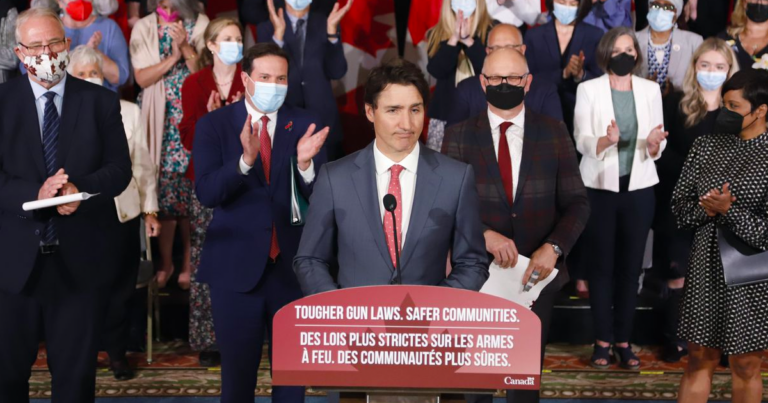
Liberals withdraw amendment banning hunting rifles and shotguns

The Liberals have withdrawn a controversial amendment to Bill C-21, which would ban numerous models of rifles and shotguns used by hunters and farmers in Canada.

Bill C-21, which cements the Liberals’ ban on handguns, is before the House of Commons public safety committee. Last year, a Liberal MP introduced an amendment banning in criminal law, rather than regulations, any rifle or shotgun that could accept a magazine with more than five rounds, regardless of whether it has such a magazine.

In practice, this would prohibit hundreds of types of guns used by hunters and farmers, as well as short-shooters.

The amendment was widely condemned by gun owners, including many from Indigenous nations.

The Liberals said the withdrawal was because they “heard” Canadians.

“In order to get this bill right, Canadians need to know that we heard them, and it’s important for us to hear those voices that have not been heard and hear some of those voices that have been heard in the past,” said Liberal MP Taleeb Noormohamed. “We have to get this over the finish line in a way that respects victims but also respects hunters, farmers, and Indigenous communities.”

In November, Public Safety Minister Marco Mendicino said that the Conservatives and other critics of the C-21 amendment were “whipping up fear.” In a statement Friday morning, he acknowledged there have been “legitimate concerns raised.”

Conservative leader Pierre Poilievre trumpeted the amendment’s withdrawal as a victory, but cautioned that the Liberals were still keen on banning hunting firearms.

“We know his agenda,” Poilievre said. “He’ll reintroduce this either in this parliament or he’ll dream that, God forbid if he ever got a majority, he would ram it through. That’s why the only way that law abiding hunters and farmers will be able to protect their way of life is to elect a Conservative majority government led by Pierre Poilievre.”

The Liberals are still proceeding with Bill C-21, which, if passed, will ban handgun sales and introduce “red flag” and “yellow flag” laws to expand the ways authorities can seize firearms of individuals believed to be a danger to themselves or others, or those suspected of owning firearms without a license.
Northern BC community calls for more rural policing

At a town hall in Taylor, British Columbia, residents expressed a demand for more policing resources in rural communities that often feel overlooked compared to their urban counterparts. 

When it comes to jurisdiction, Taylor is covered by Fort St. John RCMP but the provincial police force serves a wide swathe of territory well over 100 km long including the communities of Wonowon, Pink Mountain and several First Nations reserves. 

As reported by Alaska Highway News, Taylor’s policing is also supplemented by police officers from the nearby Fort St. John, but the community has been in discussion to request additional policing resources. 

According to Mayor Brent Taillefer, Taylor will be lobbying the BC government and potentially raising taxes to pay for the costs. 

“Two members at the most to cover this huge area we feel, in Taylor, is not enough,” Taillefer said during the town hall. 

“So if we need to increase provincial policing and that means they need to collect money through taxation to do so for the rural areas, I believe that people are OK with spending a little more money to see more police.”

Instead of getting a designated police officer for the area, the community has opted to call for a general increase in rural policing.

“That is the route, rather than trying to hire a police officer for Taylor is to get more rural policing for the whole region,” said Taillefer. 

BC Liberal MLA Dan Davies was also in attendance at the town hall and said that the “entire system” of policing needs to be reviewed to deal with current realities. 

“The entire system needs to be reviewed on how the funding of our police forces, especially in rural areas, is done,” said Davies. 

Some of the crime spilling into Taylor and the surrounding region is coming in across the Alberta provincial border. 

LEVY: Toronto school board ditches Shakespeare for virtue-signalling Indigenous course

0

Friends, Romans Countrymen Lend me Your Ears.

This was the most Unkindest Cut of all, says Antony in the famous Shakespearean classic, Julius Caesar.

In our case, the “unkindest cut” is the Toronto District School Board’s decision Wednesday evening to cut what many are calling “Eurocentric, colonial” classics from Grade 11 English and mandate a course called Understanding Contemporary First Nations, Metis and Inuit Voices.

Notice I said it will be “mandatory,” not an elective one can choose, meaning all Grade 11 students will have a school year of virtue signaling rammed down their throats.

The course is based on curriculum materials developed no doubt by former Premier Kathleen Wynne’s leftovers at the education ministry, who Premier Doug Ford and education minister Stephen Lecce didn’t get rid of as they should have at the outset of their first term.

According to TDSB spokesman Ryan Bird, there are four strands, the first of which involves explaining texts related to Indigenous cultures to better understand First Nations, Metis and Inuit individuals, communities and cultures.

Two of the Indigenous authors proposed are Leanne Betasamosake Simpson and Toronto Star journalist Tanya Talaga.

Simpson’s books include As We Have Always Done: Indigenous Freedom through Radical Resistence  and Noopiming (written during the pandemic) described as a “poetic world-building journey in to the power of Anishinaabe life and traditions and colonialism.”

In 2020 Talaga published All our Relations: Indigenous Trauma in the Shadow of Colonialism.

Students who take the course will also develop oral communications skills based on these traditional stories – unless, as the curriculum states, the knowledge is “sacred” and can only be shared with permission from the knowledge holder.

Grade 11 students will also be expected to read and write interesting and original essays and improve their media skills based on subject matter related to First Nations, Metis and Inuit cultures.

Colleen Russell-Rawlins, director of education at the TDSB, called this course an “exciting opportunity” to ensure students graduate with a “greater understanding of Indigenous cultures and history than their parents/caregivers.”

She said this course will ensure students learn the “truth about Indigenous brilliance, contributions, history…”

The nerve of her. How does she know what understanding parents and caregivers may have of the situation and who is she to determine what version of the  “truth” TDSB students need to learn?

Board chairman Rachel Chernos Lin said it is important to take “meaningful steps” such as this mandatory course to implement the Truth and Reconciliation Commission of Canada.

What a pile of bunk.

The students would be far better off taking a field trip up to a reserve with no running water and in despicable conditions to learn the truth of how successive governments have let them down. But far be it from these educational activists to present anything but victimhood at the hands of whites and a romantic version of Indigenous life.

Still I’m certainly not against teaching students the history of the Indigenous in Canada. But to stretch what should be one or two units into an entire course sounds like indoctrination.

Yet again, this is the 2023 version of climate change – meaning every single student will be expected to feel guilty about what the white colonialists did to Canadian natives.

In my view, to abandon the classics — around which festivals are dedicated through North America (starting with Stratford) — for an entire year is akin to knocking down statues of our founding fathers to erase an important part of history.

I can’t imagine this will do much to improve student writing and critical thinking skills, or their literacy.

And at what cost for this virtue signaling exercise besides the blatant attempts to indoctrinate?

Bird says he doesn’t know how much it will cost to implement the new course across all Grade 11 classes along with the cost of professional development. That will come back in a June report, he said.

Meanwhile, a quote from Shakespeare’s Much Ado about Nothing fits rather perfectly here:

“Let me be who I am and seek not to alter me.”

The TDSB would be far better off letting Grade 11 students choose whether they want to pursue such a course instead of trying to foist their collective guilt on all of them.

The Daily Brief | Feds delay expansion of doctor-assisted suicide

After public outcry and international scrutiny over the federal Liberal government’s decision to expand doctor assisted suicide to the mentally ill, Ottawa announced it will introduce a bill to delay the new rules until March 17, 2024.

Plus, the majority of Canadians say the country is headed in the wrong direction, according to a new poll.

And more prominent Canadians are speaking out about the Trudeau government’s online censorship bill, C-11.

Tune into The Daily Brief with Anthony Furey and Andrew Lawton!

SUBSCRIBE TO THE DAILY BRIEF

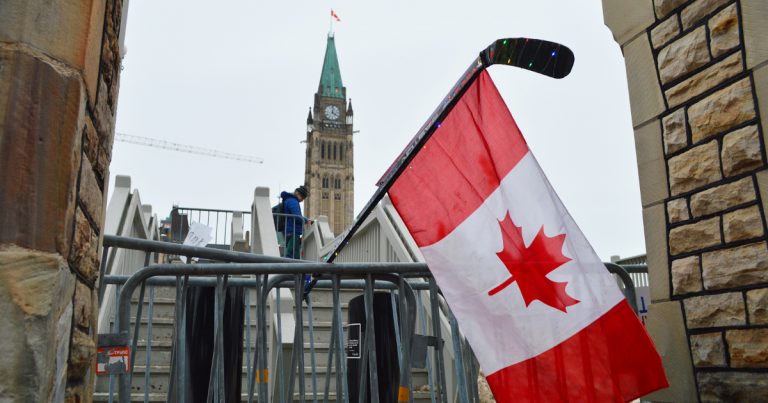
Half of Canadians say Freedom Convoy was threat to national security: poll

One-in-two Canadians think the protests surrounding the Freedom Convoy were a threat to national security, according to a new poll.

The Angus Reid poll released on Thursday shows 51% of Canadian respondents said Convoy protests posed a threat of espionage, sabotage, foreign influence, serious violence, or an overthrow of the Canadian government.

Respondents were given these terms so as to match the terms needed by government officials to invoke the Emergencies Act. 

Angus Reid noted that last year’s Public Order Emergency Commission heard testimonies that, both, this definition was not officially met, and this definition was not needed.

Eight-in-ten who voted Liberal in the last federal election said the criteria was met, while only two-in-ten who voted Conservative shared that opinion. 

Half of all Canadians said the Act was needed to clear protesters. 

One-in-four said invoking the Emergencies Act was unnecessary, and one-in-six said the government did not need to take any action to clear protesters.

The survey, released Thursday, was conducted in the first week of December 2022.

National Police Federation calls Alberta police proposal ‘unpopular and costly’

The National Police Federation is calling the Alberta government’s provincial police service proposal “unpopular and costly,” saying funds should be spent to bolster existing policing, not to transition to a new model.

A 2021 PricewaterhouseCoopers report, commissioned by the province, said the RCMP costs Alberta about $500-million a year. Those costs would rise to $735-million annually for a provincial service, on top of $366-million in startup costs, the report found.

A provincial police service has long been debated as a means to give Alberta more autonomy. It was recommended in the provincial government’s Fair Deal Panel Report released in June 2020. 

The National Police Federation said the province would be better off making investments in the current policing system over three years, instead of “redirecting taxes to an unpopular and costly proposed provincial police transition.”

“Modern policing requires pragmatic approaches to supporting and delivering effective public safety for communities and their residents – in particular, rural and remote areas that are served by the RCMP,” said president Brian Sauvé.

“Against the backdrop of a growing population and evolving criminal environment, we believe it’s time to invest in both policing and public safety for the benefit of our communities and all its residents.”

The NPF suggested the funds could be spread through $164 million to increase regular member strength by 633 additional positions and 250 administrative support staff, $45 million to support modernized and sustainable equipment resources, and $20 million for holistic responses to mental health calls, among other things. 

Dylan Topal, spokesperson for Public Safety and Emergency Services Minister Mile Ellis, said no decision has been made to establish an Alberta Police Service. Rather, the province has begun work to ensure Alberta can transition “on its own terms”  if the federal government ends RCMP contract policing or reduces subsidies when current policing agreements expire in 2032, he said. 

Topal said there are indicators the federal government is looking to re-evaluate current policing agreements “and it would be negligent and bad governance to not explore all options available to keep Albertans safe.”

“The provincial government has a responsibility to approach policing and public security issues from the perspective of making Alberta a safer place for everyone,” he told True North. 

“Exploring whether a new policing model could reduce response times, better address the root causes of crime and provide consistent and reliable service to everyone in Alberta is part of the government’s commitment to safer communities for all.”

Ottawa contributes $170-million to the Alberta RCMP under the current agreement. Saskatchewan, New Brunswick and Nova Scotia are also studying the feasibility of a provincial service. 

Topal said the National Police Federation failed to address the significant structural issues around the RCMP’s contract policing model and legitimate questions about whether it will remain sustainable in the future. 

In his new mandate letter, Public Safety Marco Mendicino has been directed by Prime Minister Justin Trudeau to conduct an assessment of RCMP contract policing in consultation with provinces, territories, municipalities and Indigenous communities. 

And in June 2021, the House of Commons Standing Committee on Public Safety and National Security  released a report in June 2021 recommending that the federal government explore the possibility of ending contract policing and work with the provinces and municipalities to help those interested establish their own police services.

In August, Justice Minister Tyler Shandro said it’s incumbent on the provincial government to look at innovative ways to improve policing in its communities.

“This is a conversation that is happening everywhere in the country,” he told True North. “And we think that Alberta is on the precipice of being a leading voice and modernizing policing in the country.”

Alberta Premier Danielle Smith voiced support for a provincial police service during the party’s leadership race last summer. 

Taxpayers billed nearly $70 billion on federal & provincial debt interest

0

Canadian taxpayers spent an unprecedented $68.6 billion on interest payments for federal and provincial government debt in 2022-2023. 

A new report by the Fraser Institute delves into the details of how government spending and deficits are driving up the country’s interest payments. 

“Interest must be paid on government debt, and the more money governments spend on interest payments the less money is available for the programs and services that matter to Canadians,” said Fraser Institute associate director of fiscal studies Jake Fuss. 

According to Fuss, government debt was already high prior to the Covid-19 pandemic and it’s impacting access to services.

“Even before the COVID-19 pandemic and recession, governments across Canada and in Ottawa were racking up large debts, and this debt imposes real costs on Canadian taxpayers in the form of interest payments,” said Fuss in a press release.

“Interest payments across the country are substantial, and that takes money away from other important priorities.”

When broken down to a per-person rate, Newfoundland and Labrador taxpayers were the hardest hit with $2,727 being spent on interest payments per person. Quebec followed with $2,110 per person. 

Federal debt made up about half of the total sum spent on interest, coming it at $34.7 billion – substantially more than the $29.4 billion allotted for child care benefits. 

Meanwhile in Alberta, a total of $6.7 billion was spent on interest payments alone which is more than what it spends on physicians. 

Projections show that Canada’s debt is expected to reach a record high of $2.1 trillion by this year. 

“It is expected that this trend will continue for the foreseeable future, as some governments project they will continue running deficits,” read Federal and Provincial Debt-Interest Costs for Canadians, 2023 edition.

“It is also important to mention that these interest payments come at a time when interest rates have been rising. Should interest rates rise more in the future, the cost of borrowing would increase over time.”

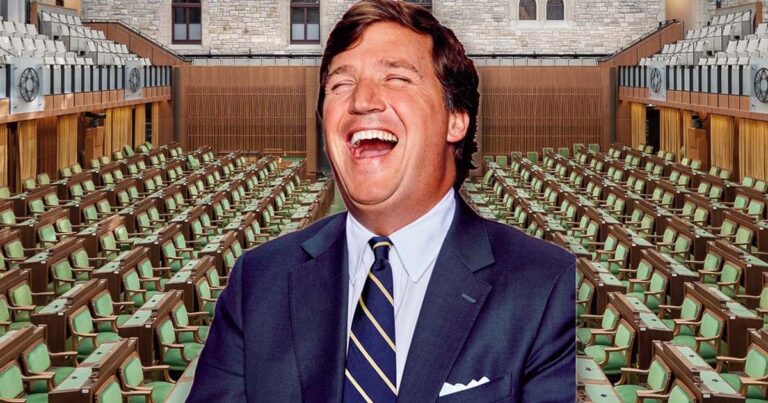
Ratio’d | Tucker Carlson triggers Ottawa AGAIN

Tucker Carlson has once again triggered the Ottawa establishment with jokes about “liberating Canada.” Over the weekend, Tucker asked a Canadian guest if the United States should liberate Canada from Prime Minister Trudeau to prevent the US’ biggest trading partner become the next Cuba.

Despite laughing and the obvious humour with which Carlson asked the question, Canada’s NDP jumped at the opportunity and attempted to pass a motion condemning Carlson in the House of Commons for his remarks.

Unsurprisingly, they failed.

Tune into the latest episode of Ratio’d with Harrison Faulkner.

BONOKOSKI: Yet another university says no to free speech and debate

Yet another Canadian university had blackballed yet another Canadian professor — this one fired for her controversial comments on residential schools — from giving a speech on its campus.

The University of Lethbridge said a speech by a former Mount Royal University professor, Frances Widdowson, who was fired in 2021 amid an uproar over her residential-school comments, wouldn’t be allowed space on campus.

But the academic said she still intended to show up and give her talk entitled, “How ‘Woke-ism Threatens Academic Freedom.'”

“They will have to call security and forcibly haul me away to stop me,” Widdowson told the CBC in an email on Monday.

And show up she did on Wednesday evening, only to be drowned out by protesters.

It used to be that university and college campuses were the crucibles for conflicting thoughts and freedom of expression.

But not anymore.

Today, more and more university brain trusts have sold out to the loudest voices, submitted their principles to the protesters and have buckled under the simplest of criticisms.

Gone is freedom of expression, which is a huge disservice to the student body whether it disagrees or not.

Conflicting views are the backbone of debate. Censorship serves no one but the spineless.

Mike Mahon, president and vice-chancellor of the university, wrote in a statement Monday that the U of L had sought guidance over the past few days upon learning of the planned lecture involving Widdowson. 

That was a turnaround from a last Thursday statement from the U of L. In that statement, Mahon wrote that Widdowson’s views were in conflict with those held by the university, including its stated commitment to the Calls to Action of the Truth and Reconciliation Commission of Canada.

Widdowson, a tenured professor at Mount Royal, was fired from MRU in 2020 when she was criticizing the Black Lives Matter movement and espousing the educational benefits of residential schools.

However, the U of L statement also added the lecture would be allowed to proceed, citing its policies on free expression.

On Monday, however, Mahon had changed his tune, saying that the U of L had received “considerable input” from both internal and external communities.

“This input confirmed that assertions that seek to minimize the significant and detrimental impact of Canada’s residential school system are harmful,” Mahon wrote.

And so Widdowson’s speech was nixed.

One of two petitions calling for Widdowson to be denied access to the university read as follows:

“Frances Widdowson is a residential school denialist, Anti BLM, and trans rights critic who was fired by Mount Royal University for her controversial ideology. Her presence on campus not only denigrates the status of the University by giving space to a speaker who promotes historical falsities and racial bigotry, but endangers student’s well-being and safety.

“Although this was not organized by the University itself, the University should be focussed on Truth and Reconciliation. The reality is, that racist and harmful ideologies are coming on campus; silence is complicity. This is an act of violence upon its BIPOC, LGBTQIA2S+, and especially Indigenous students by allowing space for these ideologies to traumatize students in a space that is supposed to be safe and educating. 

“Freedom of speech is vital to the functioning of higher education, but Frances Widdowson’s ideology of “anti-wokeism” is not only based on historical falsities and racist bigotry, but student-well being and safety is more important than any guest speaker’s message. 

“Anti-wokeism is a fallacious ideology because things like critical race theory and Indigenous teachings are just as much a part of academic freedom and freedom of speech, but is labelled as “wokeism” by scholars such as Widdowson.”

Now there is one side of the story, and a fine set-up for a good debate.

All that was needed was Frances Widdowson.

Not forgiven: despite apology, Bloc Quebecois still calls for anti-Islamophobia rep to resign

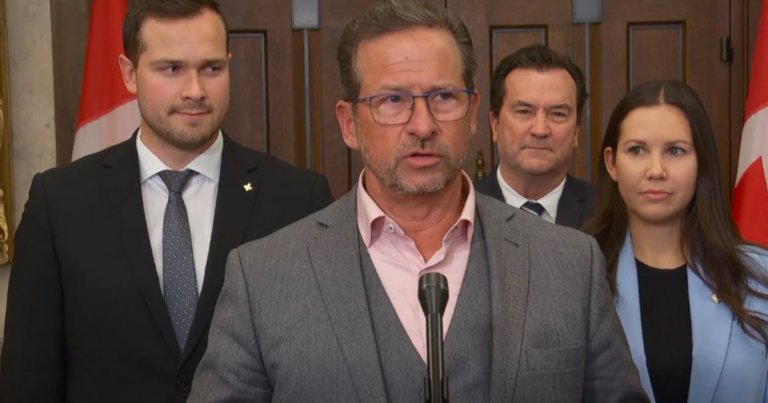
The leader of the Bloc Quebecois has called on anti-Islamophobia representative Amira Elgawhaby to resign from her post in the Liberal government. This comes despite the fact she met with the federal party the day before and apologized for her previous remarks deemed offensive.

Bloc leader Yves-François Blanchet said on Thursday that Quebecers could not forgive the initial decision to appoint Elghawaby, who previously said Quebecers are swayed by anti-Muslim sentiment rather than rule of law.

“[It] made the very function impossible to restore,” said Blanchet, acknowledging that Elghawaby attempted to repair the relationship.

Elghawaby met with Blanchet on Wednesday to apologize for her comments, one day after the Quebec legislature passed a motion calling for her dismissal.

“I am extremely sorry for the way that my words have carried, how they have hurt the people of Quebec,” she said at the time.

In a media scrum outside that meeting, Elghawaby said her past comments about Quebecers were not intended to hurt, but rather to shine light on discrimination.

“My intention has always been […] to bring people together,” she said.

Prime Minister Justin Trudeau appointed Elghawaby last week as Canada’s first Special Representative on Combatting Islamophobia.

Apart from the outcry at the Quebec legislature, her appointment has also drawn significant attention from the media.

On Monday, the vice-president of the Canadian Council of Muslim Women said the controversy surrounding Elghawaby is undemocratic.

“There is no freedom of speech if these things can happen,” Shaheen Ashraf said in a CBC article. “[If] you’re asked to resign just because of some comments you made against the Quebec government many years ago.”

On Wednesday, The Globe and Mail columnist Konrad Yakabuski criticized Elghawaby’s job, saying her anti-Islamophobia role is nothing more than political theatre.

“Elghawaby’s appointment has little to do with any attempt by Mr. Trudeau to foster meaningful dialogue,” he said. “Her nomination is meant to delight outspoken interest groups whose support is critical to Liberal political fortunes.”

Elghawaby has not officially responded to Yves-Francois Blanchet’s request that she resign.