Further action needed to combat unpopular Liberal gun laws, says Alberta minister

Alberta Justice Minister Tyler Shandro says the Liberal government is still intent on banning shotguns and rifles. 

Early Friday morning, Liberals on the House of Commons Public Safety committee withdrew a controversial amendment to Bill C-21, which would ban numerous models of rifles and shotguns, including those primarily used by hunters, farmers, and sport shooters. 

Shandro said firearms owners across Canada “breathed a sigh of relief” when the announcement became public — until a statement from Public Safety Minister Marco Mendicino “made it clear” that the decision to remove the amendments “was merely a pause in their campaign.”

“It is becoming increasingly clear that further action will need to be taken to respond to the federal government’s hostility towards hunters, farmers, sport shooters and Indigenous Peoples,” Shandro said in a statement. 

Bill C-21, which cements the Liberals’ ban on handguns, is before the House of Commons public safety committee. Last year, a Liberal MP introduced an amendment banning in criminal law, rather than regulations, any rifle or shotgun that could accept a magazine with more than five rounds, regardless of whether it has such a magazine.

Critics, including the federal Conservatives and the Alberta government, have said the Trudeau Liberals are unfairly targeting law-abiding firearms owners. 

In November, Mendicino said that the Conservatives and other critics of the C-21 amendment were “whipping up fear.” In a statement Friday morning, he acknowledged there have been “legitimate concerns raised.”

“We are now getting to work with our parliamentary colleagues to craft a clear solution that will keep assault-style weapons off the streets,” he wrote.

Shandro said law-abiding firearms owners know this is “thinly worded code” signalling Mendicino’s intent to continue to pursue avenues to ban widely owned shotguns and rifles.

Conservative leader Pierre Poilievre trumpeted the amendment’s withdrawal as a victory, but also warned that the Liberals are still intent on banning hunting firearms.

“We know his agenda,” Poilievre said. “He’ll reintroduce this either in this parliament or he’ll dream that, God forbid if he ever got a majority, he would ram it through. That’s why the only way that law-abiding hunters and farmers will be able to protect their way of life is to elect a Conservative majority government led by Pierre Poilievre.”

The Liberals are still proceeding with Bill C-21, which, if passed, will ban handgun sales and introduce “red flag” and “yellow flag” laws to expand the ways authorities can seize firearms of individuals believed to be a danger to themselves or others, or those suspected of owning firearms without a licence.

The Alberta Roundup | Hinshaw hired in British Columbia

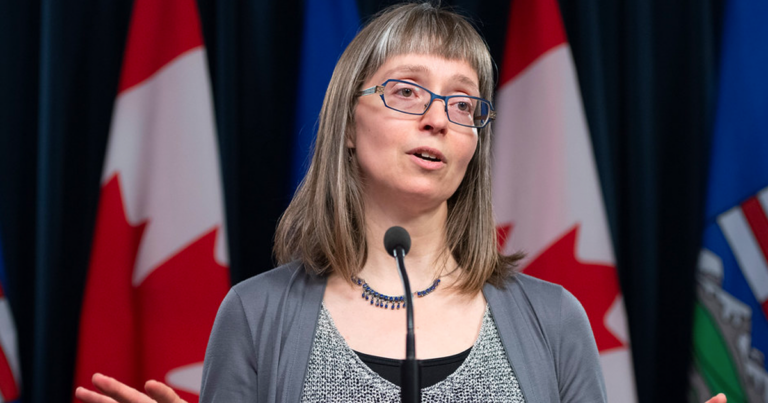
This week on The Alberta Roundup with Rachel Emmanuel, Rachel discusses former Alberta Chief Medical Health Office Deena Hinshaw, who’s been given a six month contract in BC.

Also on the show, the Alberta government is taking new measures to improve public safety in Edmonton.

And finally, Rachel has the details on the new Red Deer Recovery Community — the first of six new massive recovery facilities the Alberta government is launching in response to the addictions and homelessness crisis.

Tune into The Alberta Roundup now!

SUBSCRIBE TO THE ALBERTA ROUNDUP

Alberta addictions recovery centre set to open this month

The United Conservative Party government’s first major effort to allow addicts to be “unencumbered in their pursuit of a better life for themselves” will open later this month. 

The Red Deer Recovery Community, the only one of its kind in Alberta, is the first of six massive recovery communities currently being built by the province. 

Marshall Smith, chief of staff to Alberta’s premier and recovered addict of 17 years, has been guiding the UCP government’s approach to homelessness and addiction. 

He said the facilities recreate community in a healthy way, unlike other approaches which isolate homeless addicts in hotel rooms.

“It’s about getting people who are in a fight against addiction together as a community and allowing them to heal together and support each other in doing that,” he told True North in an earlier interview.

Smith said previous governments of all political spectrums haven’t had the political will to appropriately plan, fund and build a proper system of care.

But that’s about to change in Alberta as the province trades “decades of neglect” for what Smith calls a “breathtaking system of care.” 

The new facility in north Red Deer is nearly the size of a football field. It has 75 beds and the ability to treat up to 300 people per year. It was announced on July 18, 2020 and construction began in November 2021.

There are also recovery communities underway in Lethbridge, Gunn, Calgary, Edmonton and on the Blood Tribe. Smith told True North the province hopes to build 11 in total. Details on other facilities are not yet public. 

The facilities cost around $20 million each. Programs vary from one month to one year, depending on the client’s needs. 

In the new Red Deer facility, clients will spend their time in therapy and doing jobs around the facility, like working in the kitchen, gardening, or doing administrative work based on their preferences. 

Smith said the addiction spreading from Vancouver down the western seaboard of the United States and across Canada is “causing incredible damage to our culture, to our communities, to the fabric of our social contract to the disorder and safety in our cities.” 

At the same time, he said decriminalization has resulted in “incredible pressure” on healthcare systems. Prisons were once the service of last resort, but now that’s a hospital emergency room – which are “flooded” with homeless addicts and those with mental health issues who are no longer being serviced in correctional centres or voluntary treatment facilities, he said. 

“That’s causing an unbelievable spike in ambulance calls, hospital admissions, wait times, etc,” he said. 

“And that’s happening across the country and it’s happening because successive governments have failed to prepare or plan to make investments into treatment opportunities for people with addiction.”

Beginning Tuesday, adults in B.C. with up to two-and-a-half grams of drugs for personal use, including opioids, cocaine and MDMA, will not be arrested or charged.

Smith said it’s a “simple, but not easy process” to address the homelessness and addictions crisis. It takes political will and investment, and the understanding that addiction is a treatable illness which demands available treatment. Without available spaces, people forced to wait for treatment wind up in tents on the street. 

“It’s really not a tough concept to understand.” 

Smith said a recovery-oriented system of care means keeping the system flowing. Enough treatment beds means freeing up space in detox, resulting in dropping the count in shelters and less people living on the streets. 

He also says Alberta’s efforts over the last four years have put them far ahead of other provinces. 

“There’s still lots of work to do,” he said. “This isn’t a problem that’s going to be fixed overnight.”

BONOKOSKI: Quarantine hotels are exposed as a major waste of tax dollars

While I am typically a Super 8 kind of traveller—give me a clean room, heat and air conditioning, a decent bed and no surprises—it would appear our federal government’s taste in lodging is more high-end champagne than discount beer.

The Trudeau Liberals, their leader born with a silver spoon in his mouth, spent close to $400 million on contracts for quarantine hotels during the COVID-19 pandemic, including nearly $80 million in 2022, according to latest numbers provided by Health Canada.

There was not a Super 8 among them, and certainly no Motel 6.

Instead, there were hotels such as the Westin near the airport in Calgary and the Crowne Royal in Montreal.

Posh places by comparison. Hence the posh room bill.

At the Westin in Calgary, for example, the feds paid over $6 million in 2022 to host the quarantine of 15 individuals. That’s $400,000 per “guest.”

Or, $33,000 a night.

This pales by comparison the $6,000 a night hotel room that a still-unnamed someone in Prime Minister Justin Trudeau’s entourage billed Canadian taxpayers during the funeral of Queen Elizabeth II.

Normally, a night at the Westin Calgary Airport hotel will cost $143 plus tax, for a nice room with a king-sized bed. 

“There’s no justification for this expense. It’s complete waste, it’s complete mismanagement,” Conservative MP Michelle Rempel-Garner said in a video.

“It’s translating this money into what it means for an average person. Again, 4,100 Calgarians could have had their rent paid for a month based on what they wasted on here.”

The costs associated with this project — 38 hotels in 14 cities — which have since been phased out included lodging, meals, security, and traveller support.

The latest financial figures come after a response to an order paper submitted by Rempel Garner who said Wednesday that the latest cross-Canada numbers were a “waste” of money and rampant.

“It was across the country and if someone hasn’t already been fired over this, that has to happen,” said Rempel Garner. “I think there’s a lot more questions … Why was this needed after quarantine restrictions were lifted? Did somebody just forget to cancel the contract?”

International travel into Canada was restricted to various levels throughout the pandemic, including a period of time in 2021 when most Canadians returning from non-essential travel abroad were required to take a test and await results at a designated quarantine hotel until a negative result was returned.

The government’s hotel stay requirement ended for all travellers on Aug. 9, 2021. However, unvaccinated Canadians were still required to isolate for 14 days when entering the country.

Between March of 2020 and September 2022, the government had agreements for 38 quarantine hotel sites in 14 cities across the country. Ottawa spent a total of $388.7 million during those operation dates, according to a statement from the Public Health Agency of Canada (PHAC). That breaks down to $158.5 million in fiscal year 2020-21, $153 million in 2021-22, and $77.2 million in 2022-23. 

“The Government of Canada has always worked to protect Canadians, adapting our COVID-19 response based on the latest science and evidence,” PHAC spokesperson Tammy Jarbeau said in an email to the CBC and Postmedia. “These facilities were there as an important measure to stop the spread and save lives.”

The other side of the story comes from Duane Bratt, a political scientist at Calgary’s Mount Royal University. 

“This isn’t just a regular government waste story. It’s also a COVID story,” he said. “It fits in with that narrative about while public health restrictions were necessary, they caused undue harm and now they’re costing millions of dollars in wasteful spending.”

Majority of Canadians believe prisoners should still be segregated based on biological sex, says poll

Nearly 80% of Canadians say it is important to segregate biological men from women in Canada’s prisons, according to a new poll.

The poll released by the Macdonald-Laurier Institute on Thursday shows that 4-in-5 Canadians say it’s either “somewhat important” or “very important” to segregate prisoners based on the two biological sexes of male and female.

This comes right after new numbers from the Correctional Service of Canada revealed that almost half – 44% – of male-to-female transgender inmates have been incarcerated for sexual offences.

Canadians aged 55+ valued segregation the most, while the youngest group of Canadians, aged 18 to 34, valued segregation the least.

Opinions were split about how to house transgender prisoners who had switched from male to female.

Half of respondents said the prisoners should be housed in separate facilities, and the other half were split between the idea of housing the transgender prisoners in male or female facilities.

Women were 16% more likely to say previously-male transgender prisoners should be housed with women.

For any and all sex-segregation, male respondents showed strong opinions at conflicting sides of the questionnaire.

While male respondents said sex-segregation was “very important” (42%) at a higher rate than female respondents (35%), the group was also nearly twice-as-likely than women to say that sex-segreation was “not important at all” (11%).

Young adults in Canada had the least support for segregating prisoners by sex.

A quarter of those between the ages of 18 and 34 said sex-segregating was “somewhat unimportant” or “not important at all.”

Given four answers to choose from, 68% of young adults selected something other than “it’s very important” to separate male and female prisoners into separate facilities.

Gender has become a recent concern in Canada’s prison systems as reports surface of violence and sexual coercion involving “gender diverse” inmates.

True North reported last year that federal policymakers introduced a transfer process for inmates seeking gendered prisons that match their new identity.

‘Fiscal restraint:’ Freeland says government needs to control spending

Deputy Prime Minister Chrystia Freeland declared it is time for fiscal responsibility from the Liberal government.

Freeland made the comments at a press conference on Friday, after meeting with finance ministers to discuss Canada’s future.

“Any new spending has to be targeted,” she said. “We know that one of the most important things the federal government can do to help Canadians today is […] not to pour fuel on the fire of inflation.”

Freeland said the government is faced with high interest rates and a slowing global economy, which put constraints on the government’s ability to spend.

Despite these constraints, she said, two big areas need investment:  healthcare, and a “clean economy.”

Freeland’s comments come two days after a public opinion poll showed Canadians are concerned about the Liberal government’s priorities.

In the Abacus Data poll, seven-in-ten Canadians said the Liberal government is neglecting the rising costs of living and housing.

Alberta government mandates free speech reporting for universities

The Alberta government will require post-secondary institutions to provide annual free speech reporting to Advanced Education Minister Demetrios Nicolaides after the University of Lethbridge cancelled a controversial speaker earlier this week. 

On Monday, the University Lethbridge caved to public pressure and cancelled a speaker who questioned whether abuses against Indigenous children amounted to cultural genocide.

Nicolaides said it is “abundantly clear” that more needs to be done to ensure post-secondary institutions are adequately protecting free speech

“Alberta’s post-secondary institutions should be bastions of free speech and academic freedom that promote critical thinking,” he said in a statement on Friday. “I will continue to explore greater steps we can take to strengthen free speech on campus.”

Frances Widdowson, a former tenured professor at Calgary’s Mount Royal University, was supposed to speak at Lethbridge about mob mentality and “woke policies” she says threaten academic freedom.

Widdowson was fired from Mount Royal in 2021 after noting what she described as the educational benefits of Canada’s residential school system and for questioning whether abuses against Indigenous children amounted to cultural genocide.

Widdowson was invited by a professor to speak on Wednesday. The University of Lethbridge granted space for the event until about 2,500 students signed a petition against that decision.

University president Mike Mahon initially defended the decision to host Widdowson, citing free speech. But days later, he revoked the space saying her views would not advance the residential schools discussion and would “cause harm” by minimizing the pain and suffering inflicted on First Nations children and families.

“It is clear that the harm associated with this talk is an impediment to meaningful reconciliation,” he said in a statement.

In response, Nicolaides said changes are coming to further protect free speech on campuses. 

“I understand past comments made by this speaker are controversial,” Nicolaides told the Canadian Press on Tuesday. “But I believe it is important for our universities and colleges to foster a strong culture of free speech and diverse viewpoints, even when those viewpoints are deemed controversial, or even offensive, barring speech intended to incite hatred or violence of course.”

Opposition NDP Leader Rachel Notley said she was troubled by Nicolaides’ position.

“As far as I’m concerned, the idea of having someone come and speak at the university, particularly in Lethbridge, to a student body that consists of many Indigenous students about how they somehow benefited from residential schools, is deeply troubling to me,” Notley told reporters Tuesday.”That is deeply hurtful communication.”

In its announcement, the Alberta government also cited a 2022 MacDonald Laurier Institute study of university professors in Canada. The report found that, regardless of political leaning, 34% of professors self-censor because they are concerned about negative consequences if their true opinions on certain topics become known.

In his mandate letter, published in November, Alberta Premier Danielle Smith charged Nicolaides with ensuring the province’s institutions are “adequately protecting the academic freedom and free speech of students and faculty.”

In 2019, the United Conservative Party government required all 26 publicly funded post-secondary institutions in Alberta to either endorse the Chicago Principles on free expression or develop a policy that is consistent with the principles. All institutions complied and implemented their policies by the December 2019 deadline, with an exception made for Burman University and the institution’s religious values.

Fake News Friday | An outrageous week for the CBC

The CBC wins the bronze, silver and gold medals for the most outrageous news this week on Fake News Friday. First, the CBC warns that newspapers are under threat by “monopoly capitalism.” What’s their solution? Bring on the government regulators, of course! Instead of changing up a failing business model, the CBC wants more taxpayer subsidies.

Next the story Canadians have all been waiting for…the habits of New York vegans. The CBC interviews a man from Manhattan who says recycling and composting is not going far enough so he’s decided to unplug his fridge to save the planet. That $1.2 billion the state broadcaster receives annually is really paying off for Canadians.

To bring it home, Conservative Leader Pierre Poilievre had a humorous exchange with a CBC reporter about the Trudeau government’s failed plan to ban hunting rifles.

Tune into Fake News Friday with Andrew Lawton and Harrison Faulkner on True North!

National Arts Centre hosting drag queen storytime for kids

A free all-ages drag queen storytime featuring performers who do x-rated content will be held at the National Arts Centre (NAC). This comes after the federal theatre had to back out of a plan to provide a performance to an exclusively black audience over accusations of segregation. 

On February 8, drag performers Cyril Cinder and China Doll will be reading to children while in drag. 

“Join in on the family pride fun with Drag Storytime at The National Arts Centre! Hosted with stories by China Doll and Cyril Cinder with Children’s tunes by Monkey Rock Music, this will be a fun event for all!” the Capital Pride page explains. 

Local performer Cyril Cinder’s Instagram page features a variety of explicit and “x-rated” content, including images of male prosthetic genitalia. 

The Liberal government is also promoting a “fun-filled” drag queen story time for kids in Ottawa next Saturday as part of the capital region’s “Winterlude” festivities. 

A Heritage Canada webpage advertises the February 11 outdoor performance by local drag queens Genesis and Ruby Foxglove.

“Gather around with local drag queens Genesis and Ruby Foxglove for a fun-filled morning of stories for families. Plus be entertained by Goopee the Clown and his mesmerizing magic tricks,” writes Heritage Canada. 

One of the performers, Genesis, participated in similar drag queen storytimes last year at the Capital Pride’s summer festival. Genesis’ public social media accounts also show the performer in racy photographs, one alluding to Queen Elizabeth II’s death. 

“Did you hear? The Queen is dead! Which means the crown (and sceptre) is open for the taking,” writes Genesis on Instagram. 

The event is part of Capital Prides’ programming from Feb. 5 to Feb. 19 which will see a variety of drag-themed events including “Drag on Ice” performances.

Last week, the NAC backed out of its controversial plan to have an evening of theatre reserved exclusively for an “all-black” audience. The event prompted public and international backlash over accusations of discrimination based on race.

Controversial Bill C-11 passes through Senate

The Liberal government’s controversial “Online Streaming Bill” has passed through the Senate.

On Thursday, the Senate approved Bill C-11, otherwise known as the “Online Streaming Bill,” which has drawn a variety of criticisms, including from leading Canadian novelists and tech giant YouTube.

Bill C-11 will now head back to the House of Commons, where members vote over passing it into law. 

Heritage Minister Pablo Rodriguez said that decision may come soon. “If all goes well, next week,” he said. Rodriguez hinted that some but not all of the Senate’s recommendations would be incorporated.

Canadian author Margaret Atwood weighed-in on the controversy earlier this week, sharing a video of novelist and Senator David Adams Richards criticizing the bill. She encouraged others to take notice.

Independent citizens are not the only forces resisting the bill.

On Thursday, YouTube Chief Product Officer Neal Mohan appeared on CTV News, saying C-11 will harm the very people it intends to help.

YouTube also began an ad-campaign last year called “Keep YouTube Yours,” saying that Bill C-11 threatens to bring a regulatory agency – the Canadian Radio-television and Telecommunications Commission – between Canadians and the content they wish to see.