Poll finds half of Canadians believe Trudeau “not up for the job”

0

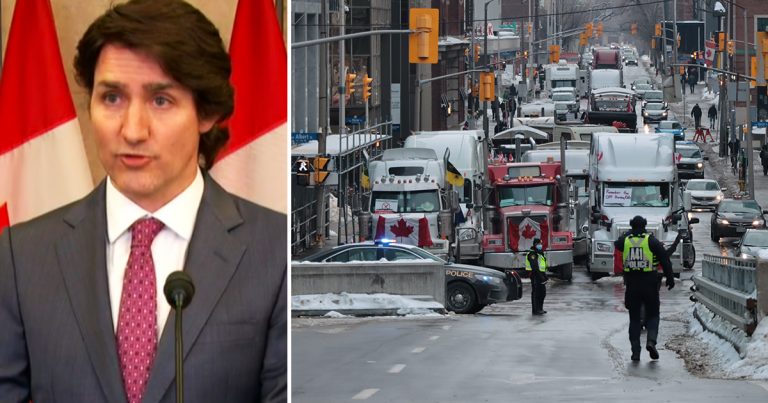
As the Freedom Convoy enters its third week, Canadians are saying they’re not happy with Prime Minister Justin Trudeau’s performance.

A new poll from Maru Public Opinion finds that in response to the Freedom Convoy, “a majority (53%) of Canadians think the Prime Minister has looked weak in the face of threats to the country.” 

Even worse for Trudeau, only 16% of Canadians say they would vote for the prime minister based on how he has dealt with the situation, as opposed to the 63% who say they wouldn’t. 

“The last time I’ve seen numbers even close to this were in the final days of Brian Mulroney,” said Maru executive vice-president John Wright. “I think this could cost him (Trudeau) his job.”

During the Sep. 2021 election, Trudeau’s Liberals won 32% of the votes. According to polls, however, their performance since then is casting doubt on whether or not they are fit to govern, and even if Trudeau is fit to be the leader of his own party. 

The poll found that only 3 in 10 Canadians believe that Justin Trudeau acted as a Prime Minister should act in face of a protest, while a plurality of Canadians believe that he should not be leader of the Liberal Party of Canada. 

Despite overwhelmingly unfavourable coverage of the Freedom Convoy by the legacy media, Trudeau seems to have been unable to capitalize on any public disapproval of the protesters to enhance his own image.

As the convoy was approaching Ottawa and calling for an end to COVID restrictions, Trudeau called the protesters a “fringe minority” that holds “unacceptable views.” 

While another poll recently suggested that 54% Canadians support ending all COVID restrictions, the findings of the Maru poll suggest that 44% of Canadians believe Trudeau has actually inflamed the situation with the truckers. Another 31% believe he is responsible for the incitement of the protests, while only 7% blame the leadership of the Conservative Party of Canada.

With increasing demands to dump federal public health measures and with five provinces having announced their own plans, Trudeau has yet to take any action to repeal federal COVID mandates.

Instead, Trudeau announced on Monday that he was invoking the Emergencies Act to deal with the ongoing protests, the same day that Ontario premier Doug Ford said his province would be dropping vaccine passports on March 1.
Canadian Constitution Foundation condemns Trudeau for invoking Emergencies Act 

The Canadian Constitution Foundation (CCF) has reacted to Prime Minister Justin Trudeau’s invoking of the Emergencies Act to deal with trucker protests across Canada, saying it sets “a dangerous precedent.”

“The CCF is concerned by the federal government’s historic invocation of the Emergencies Act,” said the organization in a statement on Monday. “The government has set a dangerous precedent for the right to freedom of assembly and protest, declaring the protests occurring in Ottawa and elsewhere across the country to be unlawful.” 

The Emergencies Act defines a national emergency as “an urgent and critical situation of a temporary nature that seriously endangers the lives, health or safety of Canadians and is of such proportions or nature as to exceed the capacity or authority of a province to deal with it.” 

According to the CCF, provincial police forces already have power to enforce the law, which was shown when the Ontario Provincial Police cleared truck drivers and other protesters from the Ambassador Bridge. 

The CCF went on to say they are concerned about the policies announced by the government concerning the freezing and seizure of financial assets from crowdfunding platforms and banks. It remains unclear how these policies will work, the CCF says, but the new powers appear to allow banks to freeze and suspend accounts without a court order.

“These measures present the clear opportunity for undermining rights to property and privacy,” they said. 

Trudeau invoked the Emergencies Act for the first time in Canadian history to give the federal government more powers to handle the trucker protests. 

“It is now clear that there are serious challenges to law enforcement’s ability to effectively enforce the law,” Trudeau said. 

He declared that the Emergencies Act would give police more power to restore order where public gatherings become illegal and dangerous, including blockades and occupations. 

The RCMP, he said, would be able to enforce municipal bylaws and provincial offences where needed. 

Finance Minister Chrystia Freeland said that under the Emergencies Act, crowdfunding platforms would have to register with the Financial Transactions and Reports Analysis Centre of Canada (FINTRAC). She added that they must report large and suspicious transactions to FINTRAC.

“We are making these changes because we know these platforms are being used to support illegal blockades and illegal activity, which is damaging the Canadian economy,” said Freeland. 

The premiers of Alberta, Saskatchewan, Manitoba and Quebec have openly opposed Trudeau’s invocation of the Emergencies Act, although Trudeau does not require their approval.

Ontario premier Doug Ford, however, said that he supported Trudeau. 

“Those participating in illegal blockades in Ontario and across Canada need to know there are serious consequences for their actions,” said Ford. 

Ford said that he told Trudeau these measures should “be targeted and time-limited, but that we need to do what it takes to restore law and order in our country.” 

Recap of Day 23 of the Truckers for Freedom Convoy

On Day 23 of the Truckers for Freedom Convoy, Prime Minister Justin invoked the Emergencies Act for the first time in history and Doug Ford announced that Ontario would be dropping its vaccine passport.

Today Trudeau made good on his threat Sunday night to invoke a never-before-used piece of federal legislation to declare a national emergency due to the trucker protests.

The Emergencies Act gives the federal government sweeping powers, including freezing the financial assets of any protester with a truck, criminalizing all monetary donations made to the convoy – including those in cryptocurrency  – and expanding the ability of police to imprison protesters.

Trudeau announced the new powers at a press conference. 

“The invoking of the Emergencies Act is never the first thing a government should do, or even the second,” he said. “The act is to be used sparingly and as a last resort.”

“Right now, the situation requires additional tools that are not held by any other federal, provincial or territorial law.”

“Today, in these circumstances, it is now clear that responsible leadership requires us to do this,” Trudeau said.

“These measures must be and will be compliant with the Charter of Rights and Freedoms. Indeed, the Emergencies Act was created in the late 80’s to flow from and uphold the Charter.”

Deputy Prime Minister Crystia Freeland also announced a series of sweeping financial laws that allow the government to cancel and freeze or suspend the assets of demonstrators involved in the protest without a court order. 

Freeland also said that the government would be “broadening the scope” of the Terrorist Financing Act by regulating all crowdfunding platforms and cryptocurrency transactions.

The Canadian Constitution Foundation condemned Trudeau’s decision, saying that “(t)he government has set a dangerous precedent for the right to free assembly and protest, declaring the protests occurring in Ottawa and elsewhere across the country to be unlawful without any further explanation.”

Conservative MP and leadership candidate Pierre Poilievre spoke to the press before Trudeau’s announcement and shredded the prime minister’s handling of the pandemic. 

“Now he’s dropping in the polls, (he’s) desperately trying to save his political career, and save face for himself,” Poilievre began. 

“The solution is staring him in the face. All he has to do is listen to the experts, do what other countries are doing, and that is to eliminate these mandates and restrictions to let these protesters and these truckers go back to their jobs and their lives.”

Earlier in the day, Ontario premier Doug Ford announced that his province would be dropping the vaccine passport on March 1. 

“Over the weekend, I received a recommendation from Dr. Moore on a plan to safely reopen our economy and remove Ontario’s vaccine passport system,” Ford said.

Asked about whether he would support Trudeau’s invoking of the Emergencies Act to clear the protesters from Ottawa and Windsor, Ford said he would support “any proposal the federal government has” to restore law and order. 

Alberta premier Jason Kenney, Saskatchewan premier Scott Moe, Manitoba premier Heather Steffenson and Quebec premier Francois Legault all disapproved of Trudeau’s decision. 

Moe said on Twitter that “Saskatchewan does not support the Trudeau government invoking the Emergencies Act. If the federal government does proceed with this measure, I would hope it would only be invoked in provinces that request it, as the legislation allows.”

Stefenson said, “(t)he proposal from the federal government to use the Emergencies Act is not helpful to the situation at the Emerson Border.”

Kenney wrote on Twitter, “(t)his morning I told Prime Minister Trudeau that Alberta’s Government is opposed to the invocation of the federal Emergencies Act. We have all of the legal tools and operational resources required to maintain order. The Act would add no relevant additional powers or resources.”

NDP leader Jagmeet Singh endorsed Trudeau invocation of the Emergencies Act. 

True North will have reporters on the ground in Ottawa for the next dew days.

The GiveSendGo fundraiser for the Freedom Convoy remains offline after being hacked Sunday evening. 

Liberal MP Joel Lightbound supported Conservative motion to end restrictions

Liberal MP Joel Lightbound voted in support of a Conservative motion on Monday calling on the Trudeau government to table a plan to end COVID-19 restrictions and mandates. 

The motion was defeated 185-151 after the ruling Liberals teamed up with the NDP to quash it. 

Lightbound was the only Liberal to support the motion.

The text of the motion read, “(t)hat, given that provinces are lifting COVID-19 restrictions and that Dr. Theresa Tam has said that all existing public health measures need to be ‘re-evaluated’ so that we can ‘get back to some normalcy,’ the House calls on the government to table a plan for the lifting of all federal mandates and restrictions, and to table that plan by February 28, 2022.” 

Lightbound’s decision to vote for the Conservative motion reaffirms his call for a roadmap to lifting restrictions.

The Quebec MP broke ranks with his caucus earlier this month and publicly came out against the “division” promoted by Prime Minister Justin Trudeau. 

“I can’t help but notice with regret that both the tone and policies of my government changed drastically on the eve and during the last election campaign,” he said.

“Some seem to forget that isolation is felt differently. Not everyone can still earn money using their MacBook while at the cottage. Some are suffering in silence and feel like they’re not heard.”

Lightbound was echoed by Liberal MP Yves Robillard the following day, who said he agreed with his fellow MP’s position. However, Robillard did not join Lightbound in voting for the motion. 

Prior to the vote, Conservative interim leader Candice Bergen released a statement.

“For two years, Canadians have been living with COVID-19 restrictions. Two years of lockdowns. Of not being able to visit loved ones. Of not being able to travel. Two years of isolation that has inflamed Canada’s mental health crisis, and hurt Canada’s vulnerable populations.” 

“Canadians just want their lives back. Conservatives are calling on the Trudeau government to follow the evidence; follow the science, and table a plan to quickly end all federal mandates and restrictions. Canadians deserve a plan — it’s time the Prime Minister gave them one.”

In response to a nation-wide wave of protests and border blockades opposing ongoing COVID-19 measures, Trudeau announced over the weekend that he would invoke the Emergencies Act to quash the demonstrations.

Trudeau made good on that announcement Monday morning. 

Quebec’s health institute admits “no documents” justifying curfews and vax pass

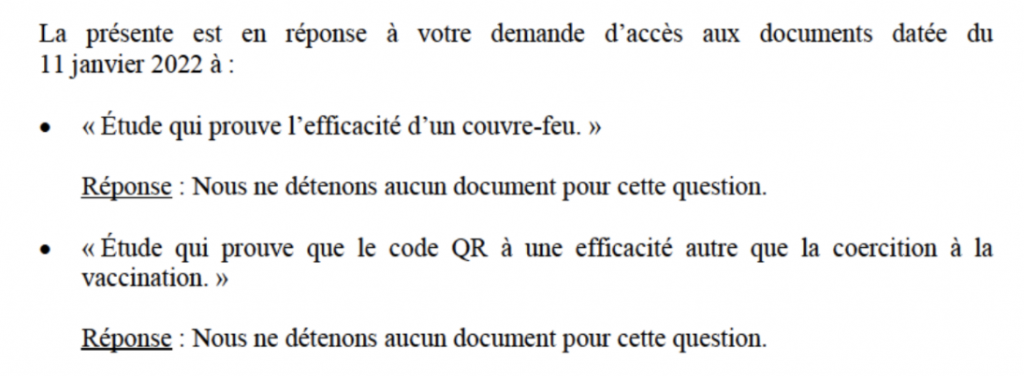
Despite Quebec’s use of repeated curfews and vaccine passports, the province’s national institute of public health (INSPQ) has admitted that it does not have any documents related to studies showing the effectiveness of these two measures.

These and other revelations came in response to an access to information request filed on Jan 11 asking a number of questions related to the COVID-19 pandemic. 

The request inquired whether the INSPQ had any studies proving the effectiveness of curfews, to which it stated that it holds “no documents for this question.”

The same answer was given to a question about whether the INSPQ had studies proving the effectiveness of vaccine passports (apart from increasing vaccination rates through coercion).

Source: INSPQ 

The INSPQ was also asked to provide any documents it had suggesting that natural immunity resulted in better protection from COVID-19 than vaccination. 

It once again responded by stating it had no documents relating to the question.

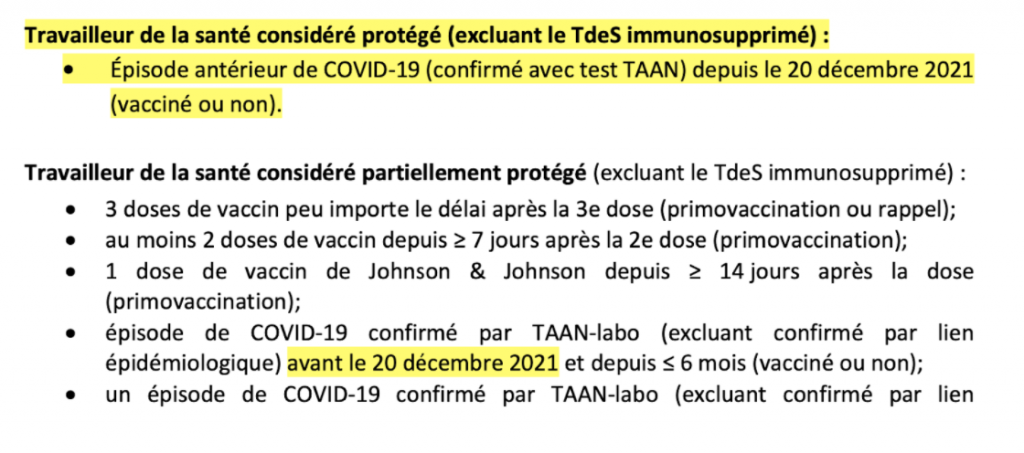
Despite this lack of documentation, a directive from Quebec’s Ministry of Health reveals the INSPQ had advised that workers who are double or even triple-vaccinated are to be considered only partially protected.

However, the ministerial directive also stated that non-immunocompromised healthcare workers who had been infected with COVID-19 since Dec. 20 2021 are considered “protected” regardless of their vaccination status. 

Source: Quebec Ministry of Health and Social Services 

Even though Quebec’s health ministry considers recently infected unvaccinated workers to have stronger protection from COVID-19 than some people with three vaccine doses, unvaccinated Quebecers remain subject to harsh restrictions due to the province’s vaccine passport program. 

Quebec has some of the harshest vaccine mandates in North America, which were recently expanded to include places of worship and government run liquor and cannabis stores.

The government also banned the unvaccinated from buying groceries at big box stores including Walmart and Costco. Quebec even considered charging unvaccinated people a “significant” health tax, but later abandoned the idea amid backlash.

True North reached out to the Quebec Ministry of Health for comment on the findings of the INSPQ’s access information request. 

“The curfew, when applied, certainly had a deterrent effect on the population from going out after a certain time,” said a spokesperson for the ministry.

The ministry added that  “(o)bservational studies show that it prevented gatherings. The curfew was therefore useful at a time when the number of cases in the general population remained high.”

However, only one of the studies provided to True North mentioned Quebec’s curfew, and it focused on overnight mobility. The other studies analyzed curfews in other nations.

While the mobility of Quebecers was certainly impacted by the curfew, a group of 13 experts wrote in December that curfews were insignificant when it came to reducing the spread of COVID-19.

The group used data from the INSPQ to back their claim, concluding that the curfew imposed by the government of Quebec was not only ineffective when it came to preventing the spread of COVID, but harmful to society at large.

Source: Quebec Ministry of Health and Social Services 

True North also previously reported that Montreal’s public health director Dr. Mylène Drouin was against reimposing the curfew in response to the Omicron wave. 

The Quebec government chose to ignore Droin’s advice.
Despite Quebec being the only province to impose a curfew, it has the highest COVID death rate in Canada, as well as the country’s third-highest rate of infection.

Trudeau invokes Emergencies Act to quash Canada-wide trucker protests

Prime Minister Justin Trudeau and the Liberal cabinet invoked the Emergencies Act on Monday afternoon to crackdown on peaceful protests against COVID-19 measures across Canada.

This was the first time in Canadian history that the law has been implemented since it replaced the War Measures Act in 1988. 

According to Trudeau, using the Act is necessary to give the federal government and law enforcement more powers to break up the protests including by securing airports and border crossings. 

It will also allow the government to seize essential services like towing trucks to remove trucks in Ottawa and elsewhere. 

“There’s a high level of frustration that this situation has gone on as long as it has,” said Trudeau.

“Those people have gone from protesting and disagreeing with those (COVID-19) measures, to limiting and blocking the freedoms of their fellow citizens.”

Although the prime minister said that the powers would be limited geographically, he did not specify which areas would be subject to the regime but did say that provinces would not be able to opt-out. 

Several premiers have spoken out against using the Emergencies Act including Quebec Premier Francois Legault and Alberta Premier Jason Kenney. 

According to deputy prime minister and finance minister Chrystia Freeland, the Act will also allow financial institutions to freeze bank accounts of truckers involved in the protest and for their insurance to be canceled. 

We are broadening the scope of Canada’s anti-money laundering and terrorist financing rules so that they cover crowdfunding platforms and the payment service providers they use. These changes cover all forms of transactions including digital assets such as cryptocurrencies,” said Freeland. 

Into their third week, peaceful protestors have assembled in various cities and locations including Ottawa, Vancouver, Calgary and Windsor. 

As per the law, the federal government now has seven days to table a plan to Parliament which will require approval from both the House of Commons and the Senate.

Justin Trudeau has invoked the Emergencies Act

In response to the ongoing freedom convoy protests taking place across Canada, Prime Minister Justin Trudeau has invoked the Emergencies Act.

What does all of this mean? How does the Emergencies Act work?  Will Trudeau’s decision escalate tensions even further?

True North’s Candice Malcolm, Andrew Lawton and Harley Sims are live to discuss Trudeau’s latest attempt to stop the protests and discuss the latest on the freedom convoy.

Multiple provinces oppose Trudeau’s plan to invoke Emergencies Act

Several premiers have spoken out against Prime Minister Justin Trudeau’s plan to invoke the Emergencies Act to deal with nationwide convoy protests calling for an end to COVID-19 restrictions. 

Alberta premier Jason Kenney was the first to speak out against the proposal after a First Ministers meeting Monday. Kenney said that federal emergency powers would not be required for Alberta to deal with the situation. 

“This is not necessary, at least for Alberta. We have all the necessary statutory powers and operational capacity for enforcement,” Kenney said.

Kenney added that invoking the Act could further inflame protesters. He said that if Trudeau moves forward with the decision to invoke the Emergencies Act, he would request that it not apply to Alberta. 

Some truckers have set up a blockade at the Coutts-Montana border where they have been encamped for several weeks now. After reports of 11 arrests and the discovery of a cache of guns and ammunition at the site, Kenney said the RCMP would move to clear the border protest on Monday. 

Meanwhile, Saskatchewan premier Scott Moe took to Twitter shortly after Monday morning’s premiers meeting to announce his own opposition to federal emergency powers. 

“The illegal blockades must end, but police already have sufficient tools to enforce the law and clear the blockades, as they did over the weekend in Windsor,” Moe tweeted.

“Therefore, Saskatchewan does not support the Trudeau government invoking the Emergencies Act. If the federal government does proceed with this measure, I would hope it would only be invoked in provinces that request it, as the legislation allows.”

Quebec premier Francois Legault and Manitoba premier Heather Stefanson also voiced opposition to the plan. 

“We do not wish to have a state of emergency in Quebec. It’s not necessary, and it’s time to bring together, not divide,” Legault said on Monday.

Stefanson declared Manitoba’s opposition in a news release, saying “I am not currently satisfied the Emergencies Act should be applied in Manitoba. Winnipeg’s situation is dramatically different from the one in Ottawa. The Emerson border situation is very different than the one faced in Windsor.” 

The Emergencies Act – which was legislated in 1988 as a replacement to the War Measures Act – allows the federal government to declare an emergency with the approval of Parliament. 

Under the Act, the government would be able to coordinate provincial responses and gain powers to ban public gatherings, requisition public services and issue fines and jail time for those who breach public orders.

Ontario premier Doug Ford has said he supports Trudeau invoking the Act

“I will support the federal government in any proposals they have to bring law and order back to our province,” said Ford on Monday. 

According to legislation, Trudeau does not require the premiers’ approval to invoke the Act.

Ontario NDP accuses Ford of supporting anti-vaxxers by ending vaccine passports 

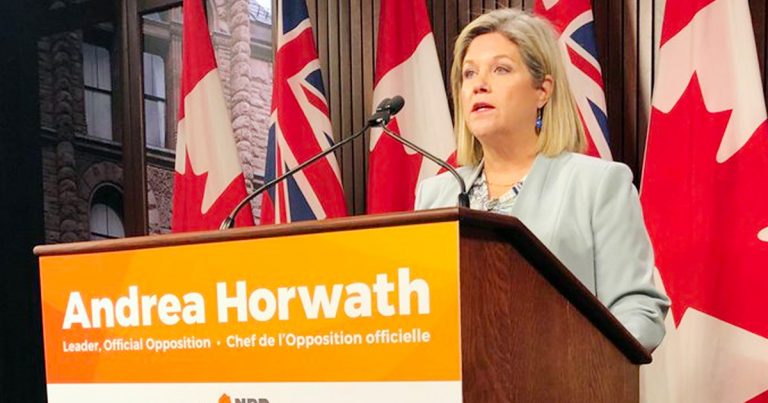
Ontario NDP Leader Andrea Horwath has said that Premier Doug Ford is caving to anti-vaxxers by announcing he is dropping vaccine passports. 

Horwath claimed that vaccine passports are helping to keep Ontario open and are protecting people. 

“Ending vaccine certificates is risky, and scary — for seniors, parents whose little ones are too young to get the shot and everyday folks who want to know that the person on the treadmill next to them at the gym or eating across from them at the diner are vaccinated,” said Horwath in a press release on Monday. 

She said that ending vaccine passports is “taking away an important incentive that encourages people to get vaccinated.” Vaccine passports, she said, are “not a restriction — unless you’re not vaccinated.”

“The request to scrap vaccine certificates isn’t coming from small businesses, health care experts or working people,” she said. “This is Doug Ford caving to anti-vax politics.” 

The Ontario government announced on Monday that they would be easing public health measures sooner than expected. 

“This is great news and a sign of just how far we’ve come together in our fight against the virus,” said Ford. “While we aren’t out of the woods just yet, we are moving in the right direction.”

The press release said that effective Thursday, social gathering limits would increase to 50 people indoors and 100 people outdoors while capacity limits would be dropped in places such as restaurants, bars, and gyms. Sports and concert venues would be permitted to operate at 50%. 

Ontario will be removing vaccine passports on March 1, according to the press release. It said that businesses can choose to keep vaccine passports if they wish.

The government also announced, however, that mandatory mask policies would remain in place for now, with a date for them to be lifted to be communicated down the road. 

The percentage of Canadians who believe COVID-19 restrictions should come to an end has leapt from 40% to 54% in less than one month, according to polls 

The latest poll, which was conducted by Angus Reid in January, suggested that more than half (54%) of Canadians strongly agree or agree it is time to end restrictions and “let people self-isolate if they are at risk.” 

“The public sentiment appears to be moving in the direction of opening up communities,” said Angus Reid. “Indeed, in the past two weeks the number of Canadians saying they would like to see restrictions ended has risen by 15 percentage points, to a majority (54%).” 

Trudeau wants to invoke the Emergencies Act – here’s how it works

Prime Minister Justin Trudeau is likely to become the first Canadian leader to invoke the Emergencies Act.

Recent reports have indicated that the federal government is planning to invoke the Act in order to deal with the ongoing trucker convoy protests sweeping Canada. 

Trudeau met with caucus on Monday morning and will inform Canada’s premiers of his plan later in the day. He does not need their approval, only to consult with them.

The Emergencies Act was passed in 1988 after former prime minister Brian Mulroney repealed its precursor, the War Measures Act.

Mulroney had officially apologized to Japanese Canadians for abuse suffered at the hands of the federal government during the Second World War. The government at the time had used the War Measures Act to force them into internment camps. 

The Emergencies Act introduced by Mulroney differed on several grounds from the War Measures Act. It outlined more limited and specific powers to handle emergencies. 

For one, all cabinet orders are subject to review by Parliament – meaning that the federal government can’t act on its own without oversight. 

Decisions adopted under the Act are required to abide by the Canadian Charter of Rights and Freedoms and the Canadian Bill of Rights. The Act forbids the government from imprisoning anybody based on protected categories such as race, nationality or religion.

The Emergencies Act also requires the federal government to compensate individuals or groups whose rights are violated by its actions.

There are several types of emergencies that can be declared.

 A “national emergency” is “an urgent and critical situation” that “seriously endangers the lives, health or safety of Canadians” and is unable to be handled by the provinces. It is also a situation which “seriously threatens the ability of the Government of Canada to preserve the sovereignty, security and territorial integrity of Canada.”

A “public welfare emergency” applies to natural disasters, disease or accidents. In addition, “a public order emergency arises from threats to the security of Canada and that is so serious as to be a national emergency.” 

Other types of emergencies under the Act include international emergencies and war emergencies. 

Under the Act, the government would have the power to do such things as ban public gatherings in certain places, requisition public services and issue fines and jail time for those who breach public orders.

The Emergencies Act is not necessary for the government to deploy the military. For example, the military was deployed during the 1990 Oka Crisis even though the Emergencies Act was not invoked. 

Once an emergency is declared, the federal government has seven days to present Parliament with a “motion for confirmation of a declaration of emergency,” with an explanation explaining why the declaration took place. These reasons must be documented, and they must be presented before the House of Commons and the Senate. 

Debate over the declaration would then ensue. If Parliament approves the measures, they would go into effect for 30 days unless further extended. 

To ensure that proper laws are followed, a Parliamentary Review Committee would also be formed, which includes one member from each party. 

Following the end of the emergency, the government would have 60 days to hold an inquiry into the measures they took.

Trudeau first considered invoking the Emergencies Act at the beginning of the COVID-19 pandemic but reportedly backed off after vehement opposition from some premiers.

Trudeau is set to deliver remarks and hold a media availability today at 4:30pm ET. 

True North is following this developing story.