Service Canada suspends hundreds employees under vaccine mandate despite passport delays

Despite processing delays at passport offices, which have forced Canadians to wait hours for their passports, Service Canada suspended hundreds of employees due to their vaccine status.

According to Blacklock’s Reporter, Service Canada suspended 249 employees to comply with the Trudeau government’s vaccine mandate program for federal employees.

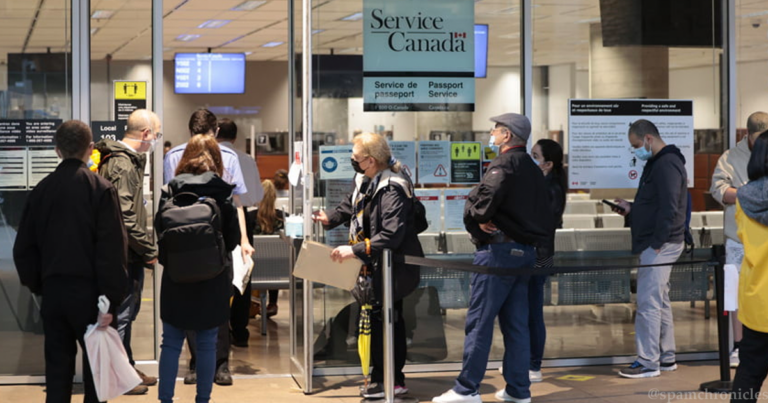
Passport offices have been seeing unacceptably long wait times across the country – nearly seven hours at a Vancouver office and nearly five hours at an Ottawa office.

Prior to the pandemic, Service Canada typically processed between two million and five million passports annually. However, passport offices have only been able to process 1.5 million passports during the two pandemic years. 

The debacle at passport offices has led to some Canadians who are looking to renew their passports camp outside passport offices at 2 a.m., hoping to be first in line the next day. 

In some instances, an hour before offices open, the line-up outside wraps around the building.

The minister in charge of Service Canada Karina Gould could not provide a timeline of when the ministry will resolve the delays. 

“Believe me, I wish it was sooner rather than later. I completely understand the frustration that Canadians are facing right now,” she said. “I can’t, unfortunately, give you that date. What I can give you is assurance that this is my number one priority.”

Minister Karina Gould told the House of Commons in May, “(I)f someone has urgent travel in that regard, I would recommend you contact your Member of Parliament.”

Conservative MP Marc Dalton grilled the government for the long wait times. Dalton claims his assistant was put on hold for five hours when they attempted to call the passport offices.

“The hotline is cold,” said Dalton. “My assistant waited five hours on Wednesday to get through.”

On the issue of passport wait times, Conservative MP Gérard Deltell told the House of Commons, “(W)hen I see this I feel bad for my country. Canada is a G7 country, not a Third World Country.”

Last week, the Trudeau government repealed its vaccine mandate for federal government employees – a move that comes well after all of the provinces scrapped their vaccine mandates. 

The government has not made it clear if it will reinstate any of the 249 employees laid off due to the vaccine mandate, nor have they made clear whether or not repealing the vaccine mandate is part of the effort to alleviate passport processing pressure. 
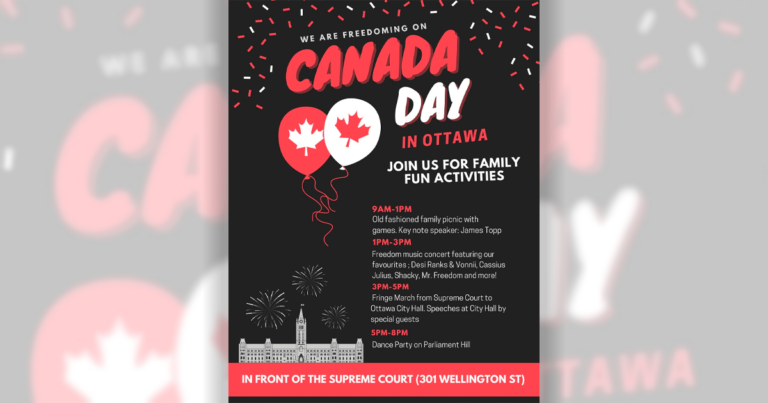
Freedom rallies planned in Ottawa for the arrival of James Topp and Canada Day

Freedom rallies are returning to Ottawa this summer for the arrival of Canada Armed Forces veteran James Topp and for Canada Day.

Topp began marching towards Ottawa from Vancouver in February in protest of heavy-handed government restrictions during the pandemic. He will arrive at the National War Memorial in downtown Ottawa on Jun. 30 at 6pm ET, ending his 4000 km walk across Canada.

In addition to Topp’s anticipated arrival, freedom movement organizers are also planning Canada Day celebrations in the nation’s capital.

A family picnic will be held in front of the Supreme Court on Jul. 1 from 9am to 1pm ET, where Topp will give a keynote speech. The picnic will be followed by a music concert featuring artists who have ties to the freedom movement.

There will also be a “fringe march” from the Supreme Court to Ottawa City Hall at 3pm ET, followed by a dance party on Parliament Hill from 5pm to 8pm ET.

The freedom events will last beyond Canada Day, with organizers saying they have events planned in Ottawa for the entire summer.

Advocacy group Veterans 4 Freedom (V4F) will be setting up a base called “Camp Eagle” on private property outside Ottawa. V4F member Andrew MacGillivray says their protest will aim to have the “least impact on citizens of Ottawa with their everyday life.” The group says they plan to leave the city around Labour Day weekend. 

“Basically, we’re going to stay there the entire summer. We’re going to implement our strategy and our plan to lean on the government through education, information, et cetera.” said MacGillivray.

In response to the planned events, the Ottawa Police Service (OPS) issued a statement stating it will not allow for a second Freedom Convoy situation.

“We will not allow for conditions that led to the unlawful protests in February to reoccur. We are applying lessons learned from the unlawful protest as well as the Rolling Thunder and associated protests to build our plan.” 

OPS also said it “will continue an approach that prohibits vehicle-based protests in areas in and around places of national significance” at the request of the city.

The planned events will mark the third major freedom demonstrations to take place in Ottawa since the peaceful Freedom Convoy was forcefully removed by law enforcement after Prime Minister Justin Trudeau invoked the Emergencies Act.

Former cabinet minister Rebecca Schulz seeks UCP leadership

The United Conservative Party’s leadership race is in full force, with candidates vying for Jason Kenney’s former job as head of the party and premier of Alberta. Former cabinet minister Rebecca Schulz joined True North’s Andrew Lawton to discuss why she would best be suited to take the helm of the province and lead the party into the next election. Plus, Schulz explains why Alberta’s covid response was a result of the province’s overburdened healthcare system.

SUBSCRIBE TO THE ANDREW LAWTON SHOW

Waterloo schools to permit exposed cleavage and underwear in new dress code

The Waterloo Region District School Board (WRDSB) wants to update the dress code for schools in its jurisdiction so it allows students to expose their cleavage, abdomen and undergarments. 

Draft Board Policy 6010: Student Dress cites the WRDSB’s commitment to “forstering inclusive environments” and anti-discrimination to justify the updated policy. 

“Previously, student dress codes detrimentally impacted students who are female-identifying, Indigenous, Black, racialized, gender diverse, transgender and non-binary, and/or financially insecure, students with disabilities, and/or those experiencing other forms of marginalizations,” wrote the WRDSB. 

The Code of Conduct for Students as of 2018 prohibited revealing clothing and exposed undergarments like bra straps. 

“Skirts and shorts must be an appropriate length as determined by Administration,” the policy reads. “Bare and midriffs or halter tops or off-the-shoulder tops or muscle shirts are not allowed.”

“Undergarments (e.g. bra strap, thong, boxers) must not be visible,” it continued. 

The latest draft policy hopes to overturn all of those restrictions and allow tops that “expose shoulders, abdomen, midriff, neck lines and/or cleavage.” 

“Bottoms may expose legs, thighs and hips,” the draft policy states. “Straps and waistbands may be exposed.” 

If adopted, the policy would specifically require that all clothing be worn “in such a way that all bottom layers cover groin and buttocks and top layers cover nipples, both with opague material.” 

The WRDSB is not the first school to cite equity and discrimination to justify laxing their dress code policies. 

In Oct. 2021, the Hamilton-Wentworth District School Board (HWDSB) also issued guidance to do away with restrictions on revealing clothing in its policy which critics claimed: “targeted female-identified students without considering non-binary views and identities.”

The Toronto District School Board also has a similar policy. 

“It was the culmination of student trustees communicating and really amplifying the voice of students across the board, letting us know that our outdated policy and the way that it has the potential to be enforced at schools is problematic,” claimed HWDSB trustee Marie Felix Miller.

In comparison, schools with the York Region District School Board require cleavage to be “covered and not visible” as well as for the midriff and back to be “covered completely.” Similarly, the Thames Valley District School Board which encompasses London, Ontario also states that clothing with “bare backs, exposed midriffs, or that is too revealing is inappropriate.”

University of Ottawa professor faces international backlash for shaming maskless flight attendant

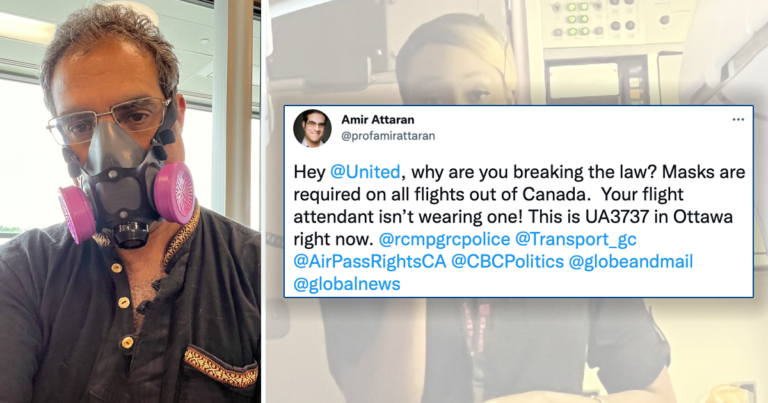
University of Ottawa law and epidemiology professor Amir Attaran is facing international backlash for shaming a maskless United Airlines flight attendant on social media. 

On Saturday, Attaran posted a picture of a flight attendant on a United flight from Ottawa to Chicago and accused the airline of breaking the law because “masks are required on all flights out of Canada.”

Transport Canada says masks are mandatory on all flights to and from Canada, a policy that has created confusion given that masking is not required on planes in America. 

“Canada is not the USA, you f***ers,” said Attaran, who added that United should be banned from operating flights to Canada for not following the Trudeau government’s mask mandates. 

Attaran’s online conduct was quickly criticized by Canadian and international figures from all sides of the political spectrum.

Florida Governor Ron DeSantis spokesperson Christina Pushaw called the University of Ottawa professor’s actions creepy, and suggested he should not fly if he “can’t handle seeing someone’s face.” 

Pushaw also called out United’s response to Attaran and accused the airline of throwing its employees under the bus. United had thanked Attaran for bringing the issue to their attention.

Fox News personality Greg Gutfeld and BlazeTv podcast host Elijah Schaffer also reacted to Attaran’s tweets.

Progressive personalities including Huffington Post contributor Yashar Ali and former The Young Turks correspondent Emma Vigeland also criticized Attaran’s actions.

Meanwhile, former University of Toronto professor Jordan Peterson reacted to Attaran’s tweets by calling him a “pathetic ranfink” and a “horrible piece of work.”

Attaran responded to Peterson’s criticism by claiming he was a baby. He also challenged him to a public debate in Ottawa.

This is not the first time that the University of Ottawa professor has caused controversy for his conduct on social media. 

Attaran, whose Twitter bio states that he “wrecks grifters, anti-vaxxers & scientific illiterates,” has also come under fire for comments he made about unvaccinated people.

Attaran previously called those who do not believe in Covid vaccinations racist, low life trash, losers, stupid, villiage idiots, homophobic and anti-Semetic.

Should the Conservatives embrace woke progressive ideas to beat Trudeau?

The majority of Canadians did not vote for Justin Trudeau in the last election. In fact, the Liberals won with the smallest share of the vote in Canadian history. It’s clear many Canadians do not approve of Trudeau running the country – this means the next Conservative leader has a very good chance of beating Trudeau in the next election.

However, the same was said during the last three elections. Conservatives have come very close in every election since 2015 but have fallen short in dethroning Trudeau.

What’s the path to victory for the Conservatives?

In recent weeks, we’ve started hearing the same failed strategy from the failed backrooms of the party. They argue that the party should become more like the Liberals and NDP – embrace leftist progressive ideologies in order to win. They think the Conservatives should be fiscally prudent and socially woke.

These strategists are wrong. We just need to look at how poorly Erin O’Toole performed in the last election to see that this strategy did not work.

On this episode of The Candice Malcolm Show, Candice is joined by pollster Hamish Marshall to discuss why the Red Tory/Blue Liberal strategy just doesn’t work, why O’Toole failed despite his best attempts to woo leftist voters and what the next Conservative leader needs to do in order to win.

SUBSCRIBE TO THE CANDICE MALCOLM SHOW

City of Ottawa has “no plan” to recover Freedom Convoy costs from organizers

A report submitted to Ottawa City Council says the municipality has no plans to try and recover an estimated $37 million in costs from Freedom Convoy organizers. 

This is according to a formal question to city staff from Ottawa Councillor Riley Brockington. 

“What were the final costs of policing during the convoy occupation and what is/are the legal plan(s) to recoup those funds in particular from convoy organizers and others?” Brockington asked in his inquiry. 

“The costs of the occupation were borne by the Ottawa Police Service. As the federal government has undertaken to make the City of Ottawa and the Ottawa Police Service Board whole in this regard, there is no plan to try and recover those amounts from the convoy organizers, appreciating also that there is no legal authority in the municipality todo so,” city staff wrote in their reply. 

City council is anticipating the Ottawa Police Service’s second quarter financial report in July. This report is expected to detail the full costs the police force incurred from its response to the January and February protest.

According to staff, boths the OPS and the city “will endeavour to recover (their) costs through the National Capital Extraordinary Policing Contract (NCEPCP) with Public Safety Canada.” 

The NCEPCP is a contribution program meant to assist the capital city with its law enforcement costs given Ottawa’s “unique policing environment created by the presence of federal landmarks, institutions and events of national significance.” 

It was first introduced following the Parliament Hill terrorist attack in 2014. 

The staff report says police and bylaw officers issued 3,812 parking tickets and 318 provincial citations for things like traffic violations and excessive noise.

“(Tickets) were issued for offences such as traffic and by-law violations including violations such as use of sound reproduction device on a highway, encumbering a highway by vehicle or other means, causing/permitting unusual noise that disturb inhabitants of the City, an unlicensed mobile refreshment vehicle and failure to comply with Covid public health orders,” wrote staff. 

Many of these tickets are being challenged.

Police removed 110 vehicles from the core when they moved in to disband the protest. Ninety-five percent of them have been claimed by their owners with the remaining still sitting in impound.

Trudeau government spending is worsening inflation crisis says Scotiabank

A Scotiabank investors report decries the Trudeau government’s lack of action in reducing government spending, forcing the Bank of Canada (BoC) to hike interest rates. 

According to Bloomberg News, Scotiabank economists have published a report arguing that the burden of lowering inflation is falling on the private sector as the federal government continues to spend at high levels.

In recent months, the BoC has hiked up interest rates in an effort to minimize the growing inflation crisis in Canada.

“The output losses that the BoC must engineer to rein in inflation are falling disproportionately on the private sector,” said the report. 

At the beginning of June, the BoC increased the benchmark interest rate to 1.5% and is expected to increase the rate by 0.75% the next time the central bank meets. 

The report argues that if the government reduces government spending, it will allow the central bank to keep interest rates lower.

“Less government consumption would lead to a lower path for the policy rate and take some of the burden of adjustment away from the private sector,” the report reads.

In recent weeks, the Trudeau government has not expressed the desire to limit government spending – despite touting “fiscal restraint,” minister of finance Chrystia Freeland announced a $7 billion spending plan in order to ‘combat’ inflation. 

The Trudeau government spent more money than any government in Canadian history, creating a $327.7 billion deficit in the fiscal year 2020/21 and a projected $144.5 billion deficit for the fiscal year 2021/22. 

The inflation crisis has resulted in higher prices for various essentials like gasoline, cars, groceries, lumbar and more. 

A May Angus Reid survey found that half of Canadians are struggling to feed their families, and a Mainstreet Research survey found that 25% of Canadians are eating less amid Canada’s inflationary spiral. 

Worries that the economy will fall into a recession stem from concerns that the interest rate hikes from the BoC will have undue harm on businesses – leading to mass unemployment.

According to a Maru Public Opinion poll, most Canadians believe that if we aren’t already in a recession, we are close to it.

Vast majority of Canadians did not use $20 million Covid Alert app

The vast majority of Canadians did not use the federal government’s now-scrapped Covid Alert application.

According to Blacklock’s Reporter, a report by Canada’s Chief Public Health Officer Dr. Theresa Tam found that the $20 million program went underutilized “to a huge extent.” 

“The app was not being utilized to a huge extent. Not all innovations might work,” wrote Tam. 

“(It was) a good go at trying to utilize another tool in the current era of apps to try and protect the population.”

On Friday, Ottawa officially took the application offline despite Prime Minister Justin Trudeau touting how the program could have a 50% uptake. 

“The more people use it, the better it can trace and therefore slow the spread of the virus. In fact, health experts say if enough people sign up this app can help prevent future outbreaks of Covid-19 in Canada,” said Trudeau in Jul. 2020. 

In total, 6,951,575 Canadians downloaded the application or about 21% of the population. 

The launch of the application was dogged by privacy and effectiveness concerns. A 2021 report on global attitudes found that 64% of consumers refused to share their health data with government contact tracing applications. 

“People are very very concerned about sharing their data, especially their Covid data. They don’t know what people are doing with this information and they’re at a complete loss of where it’s going to go so in terms of contact-tracing they have no interest in that,” Ontario’s former information and privacy commissioner Ann Cavoukian told True North at the time. 

Despite the low uptake, at one point the federal government was considering expanding the program. 

“The Government of Canada has begun to broadly consider how the COVID Alert app could potentially extend beyond a government service to Canadians and the public health systems towards a tool that will also support Canadians and businesses in our economic, social and mental health recovery and restoration,” a federal report claimed. 

YouTube disappointed with C-11 amendments, says government ignoring creators’ concerns

YouTube officials are sharing their disappointment with the Trudeau government’s online censorship bill, C-11, and will be looking to the Senate to ensure user-generated content will not be affected by the controversial bill. 

Last week, MPs on the House of Commons heritage committee rushed over 150 amendments to Bill C-11, but did not address the main concern with the bill – user-generated content such as YouTube videos. 

Green Party MP Mike Morrice had proposed an amendment that seeked to clarify that user generated content would not be regulated under the bill, but it was rejected by the Liberals, NDP and Bloc Quebecois. 

In a statement, YouTube Canada’s head of government affairs and public policy Jeanette Patell said the company is “disappointed that the concerns of thousands of Canadian creators were not recognized through amendments that would have reflected the minister’s intention for Bill C-11′s scope.”

“It is possible to support Canadian artists without compromising the creator ecosystem. We will continue to propose solutions and hope to work closely with the Senate towards this shared goal,” she added.

In May, YouTube warned that Bill C-11 could give the government unprecedented power over everyday content posted online. They said the bill’s wording is so broad that it places home videos within the purview of the Canadian Radio-television and Telecommunications Commission (CRTC). 

Many Canadian content creators have spoken out about the government’s online censorship bill’s potential consequences, including Vancouver based YouTuber J.J. McCullough, who appeared in front of the Heritage Committee earlier this month.

“Anyone proud of the tremendous success of Canadians on Youtube should be deeply concerned about the damage Bill C-11 could do to their livelihoods,” McCullough told the committee.

“I also worry that the dreams of the next generation of Canadian YouTubers will become less achievable, once they’re forced to navigate intimidating new regulatory hurdles my generation did not.”

Trudeau’s heritage minister Pablo Rodriguez has said on several occasions that Bill C-11 would not regulate user-generated content. However, his claims have been contradicted by the CRTC.

“[Section] 4.2 allows the CRTC to prescribe by regulation user uploaded content subject to very explicit criteria. That is also in the Act,” CRTC chair Ian Scott told the heritage committee earlier this month.

Bill C-11 is set to be put to vote for third reading in the House of Commons before heading off to the Senate.