Public health officials in Canada are calling on all Canadians to stay home during Easter, but it doesn’t sound like Canada’s Prime Minister will listen.
The federal government predicts Canada could see 11,000 to 22,000 deaths caused by the coronavirus.
Tune in to the True North Update with Candice Malcolm and Andrew Lawton!
Canada’s Parliamentary Budget Officer (PBO) is predicting that the coronavirus pandemic and low oil prices will lead to record deficits.
In a report published Thursday, the PBO expects the 2020-2021 fiscal year will see a deficit significantly larger than in 2019-2020.
“Our fiscal results include $105.5 billion in federal budgetary measures that have been announced as of April 7 based on Finance Canada and PBO cost estimates,” the report reads.
“Based on our economic scenario and including announced federal measures, the budget deficit would increase to $27.4 billion in 2019-20 and then to $184.2 billion in 2020-21.”
The PBO’s projection predicts the deficit would go from 1.2% of GDP to 8.5% of GDP. The highest budget deficit to GDP ratio since the Second World War was 8.1% in 1984-85.
As public health orders force many businesses to close and the energy sector continues to struggle, the PBO concludes that the number of unemployed people will grow from 1.155 million in the fourth quarter of 2019 to 3.067 million in the third quarter of 2020.
Throughout March, Canada lost over 1 million jobs or about 5.3% of all employed people.
The PBO’s analysis is based on the assumption that current public health orders and social distancing last until August.
The PBO also says that the government may have to take additional fiscal measures over the next few months. Significant borrowing may be required to bring the economy back to normal.
“Consumer and business behaviour does not quickly revert back to normal conditions,” the report reads.
“Further, given credit market access at historically low rates, and looking to historical experience, suggests that the Government could undertake additional significant borrowing if required.”
As many as 22,000 Canadians could die of coronavirus, according to newly released federal projections.
After weeks of declining to release projections, the Public Health Agency of Canada published modelling data with different possible scenarios of how many Canadians could die of the coronavirus in the coming months.
The agency laid out its contingencies for strong control measures, weaker response measures, and one with no measures taken.
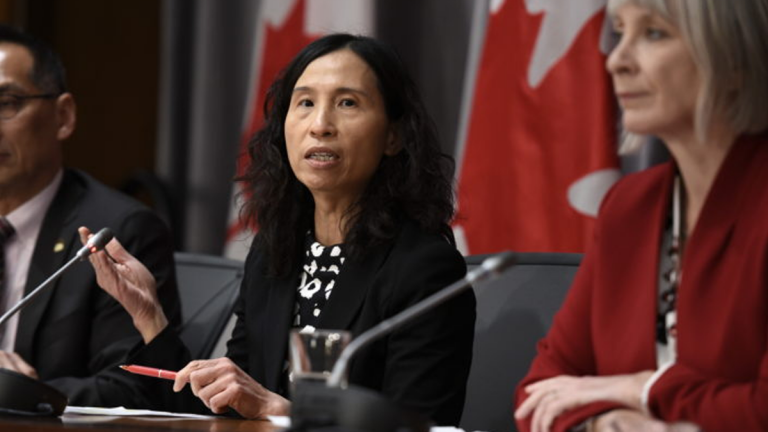
Chief Public Health Officer Dr. Theresa Tam said the objective is to be in the strong control measure camp, which the modelling suggests would result in roughly 11,000 deaths and 22,000 deaths.
In the worst scenario, deaths could spike to more than 100,000.
The agency anticipates 500 to 700 deaths by the end of next week – and indicated that short-term projections are more accurate.
Tam warned that what happens to Canadians in the coming months depends heavily on how strictly people follow social distancing measures.
Tam emphasized that these estimates are based on the best available data so far and can change.
“Data and models can help Canadians see how our collective efforts … can determine the trajectory of Canada’s COVID-19 pandemic,” said Tam. “Models are not a crystal ball.”
The agency did not give an indication of when the pandemic will peak in Canada but said control measures like social distancing and travel restrictions need to remain even after the peak.
“It is too early to know how close we are to the peak from a national perspective,” Tam said. “We can’t give up after the peak.”
As some politicians call for better treatment of convicted criminals and illegal border crossers, Canadians are being disciplined for allegedly violating social distancing measures.
Most Canadians want to do their part during the pandemic and support social distancing but if enforcement officers go too far, public support will start to diminish.
True North’s Anthony Furey stresses the need for better judgement when enforcing social distancing measures.
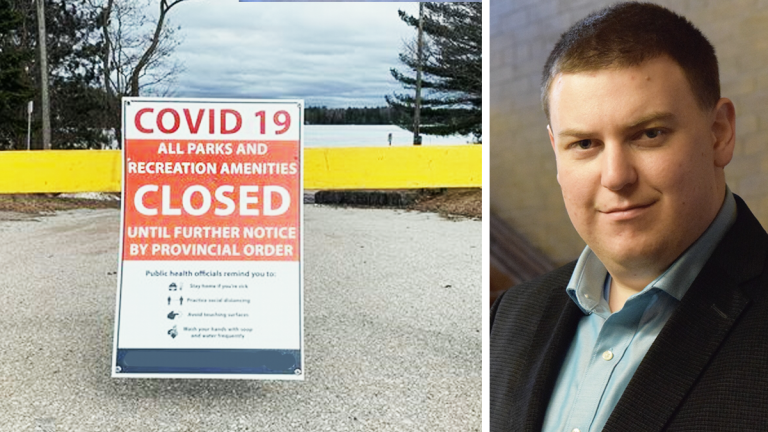
Police are ticketing people for playing in empty parks and even singing ‘Happy Birthday’ from their cars. True North’s Andrew Lawton talks about how state-enforced social distancing is ignoring the spirit of the law.
Also, why the media doesn’t want to talk about hydroxychloroquine.
Watch the latest episode of The Andrew Lawton Show!
Government documents have revealed that health officials decided against issuing mandatory quarantine orders for tens of thousands of travellers returning from China’s Hubei province in early February.
According to Global News, a memo addressed to federal Health Minister Patty Hajdu reveals that health departments from various levels of government decided against the measure because they believed Canada didn’t have the means to enforce it.
“If this approach were to be extended to China, it would be unsustainable given the volume of travellers,” the memo explained.
“A voluntary self-isolation places less pressure on public health resources.”
The memo also estimates that approximately 20,000 travellers were coming from China into Canada each week.
“Canadians may question a voluntary approach since there is no ability to enforce or ensure compliance,” said the memo.
“However, there is anecdotal evidence that individuals who have returned from Hubei are already self-isolating. We could expect that most individuals would be compliant, given concern and anxiety associated with the coronavirus.”
On March 25th, a month after the memo, the federal government decided to impose mandatory quarantine for all travellers entering Canada.
When questioned about whether the federal government could have acted sooner to curb the spread of the coronavirus pandemic, Prime Minister Justin Trudeau said that his government could have done a lot of things differently.
“With hindsight, I’m sure there are lots of things that we could have done differently, but I can tell you that every step of the way we took the advice of our medical professionals and our public health experts seriously and did as best we could,” said Trudeau during a daily coronavirus update on Wednesday.
In March, Trudeau boasted that Canada was ahead of the US in its response to the coronavirus.
“I think I would say we’re not necessarily on the same trajectory. We were quicker to get the screening done, and I think we have had more success in getting people to self-isolate,” Trudeau said in French.
However, as reported on by True North, Canada was behind on several fronts when it came to the government’s response to the coronavirus pandemic.
With the economy shut down, the number of Canadians applying for emergency financial relief has soared. The government says it has received more than 4 million applications for the new Canada Emergency Relief Benefit.
And let’s talk about hydroxychloroquine – something the government and mainstream media are refusing to address.
This is the True North Update with Candice Malcolm and Andrew Lawton.
Quebec public health officials are expecting anywhere between 1,200 and 9,000 deaths due to COVID-19 by the end of April.
The numbers are based on models which project two potential scenarios by April 30. In one scenario, the province could have 29,212 cases of the virus and as few as 1,263 deaths, while in the other it could have 59,845 cases and as many as 8,860 deaths.
Health officials also predict that the virus’ peak will take place on April 18.
Senior public health adviser Richard Massé said the worst-case scenario is unlikely due to the Quebec government’s quick action to implement prevention measures.
“When there is a delay in implementing measures, the situation is painful. We had the vision and capacity to act sooner here,” said Massé.
“I don’t want people to be alarmed by the pessimistic scenario. Obviously, when you see the number of deaths projected, that can appear worrying.”
As of April 8, Quebec was reporting over 10,000 confirmed cases of COVID-19 and 175 deaths.
Premier François Legault was optimistic about Quebec’s future during Wednesday’s coronavirus briefing.
“Let’s not stop – we started very well, let’s keep going the right way,” said Legault.
Alberta Premier Jason Kenney says that as many as 6,600 Albertans may die of coronavirus over the next few months according to the latest predictions by health officials.
In a statement delivered on Tuesday, Kenney said that in the most “probable” scenario between 400 and 3,100 Albertans will die of coronavirus by the end of the summer.
In a more extreme scenario, as many as 6,600 Albertans could pass away.
“Under the more serious but less likely ‘elevated scenario,’ we would see infections peak at the beginning of May, with as many as one million infections, and between 500 and 6,600 deaths,” Kenney declared.
Kenney also said that the number of people who get infected and die largely depends on how closely the following public health orders are followed.
“These models are not a done deal. I want Albertans to see them as a challenge — perhaps the greatest challenge of our generation,” he said.
“I want this to end as soon as you do…But we simply cannot risk letting the virus loose in Alberta. That would create a public health catastrophe, which would force an even more stringent lockdown in the future, leaving our economy even further battered.”
Under new public health orders, public gatherings have been limited to 15 people and many businesses and community services have been ordered to close. Failure to follow the orders can result in hefty fines.
As of Wednesday, there have been 1,373 cases of coronavirus in Alberta with 26 deaths. Canada as a whole has seen over 18,000 confirmed cases and 402 deaths.
Kenney says that Alberta has tested 67,000 people for coronavirus, or 1.5% of Alberta’s population. This number is among the highest rates of testing per capita in the world.
Despite the daunting number of deaths forecasted, Kenney says that overall the coronavirus appears to be spreading less quickly in the province than other places around the world.
Kenney reiterated that the extent of the outbreak in Alberta depends on how serious the public takes public health orders.
“So far, our curve more closely resembles countries that have successfully fought the virus, like South Korea, than the sharp upward rise seen in countries like Italy, Spain and the United States,” he said.
“We are confident that our health system will be able to cope, and that we have the supplies on hand to get the job done,” he said.
Judges have been freeing dangerous offenders into the public due to the coronavirus pandemic.
As reported on by Global News, several criminals who were in custody for violent offences were recently released.
One man, identified only as T.K. in court records, was freed with conditions despite having a long criminal history with 23 convictions to his name. T.K. was being held at the time on drug trafficking charges.
In the decision, the judge cited a report that revealed the inmates were susceptible to the coronavirus due to the cramped and confined prison environment.
19-year-old Kaynadid Abshir, who allegedly participated in a Toronto driveby shooting as a getaway driver, was also released from custody.
Abshir was set to face several charges including attempted murder, aggravated assault, and numerous firearms offences. The judge cited Abshir’s “circumstantial” case, mental health issues, and clean record as the reasons behind his release.
In another decision, alleged “drug supplier” Brandon Cain was released from the Ottawa Carleton Detention Centre despite facing “serious charges from a violent attack.”
Cain and others were alleged to have assaulted victims with a pistol and taser, and also “forcing the complainants to shoplift in order to pay off the drug debt for the stolen drugs,” according to a ruling by the Superior Court.
Cain was released on $11,000 in bonds and house arrest, even though he violated the conditions of his prior bail release which forced police to take him back into custody.
Another man identified as T.L. in court documents was released after requesting to live with his grandparents.
T.L. was alleged to have been involved in a Sept. 30, 2019 shooting that resulted in injuries. According to the court records, T.L. provided the weapon in the shooting and used his own vehicle to help the shooter flee the scene.
“The offence is a very serious one,” wrote the judge.
“The shooter is charged with attempted murder. Mr. L. is charged with having aided that. He is also charged with having provided the weapon.”
In the decision to order T.L’s release the judge referred to the “unique circumstances” regarding the COVID-19 pandemic and that it was difficult to determine when the accused’s trial would begin.