Liberals spent $70,000 on #MeToo poll

0

The Liberal government paid nearly $70,000 in taxpayer dollars to poll Canadians on the #MeToo movement so they could “shift attitudes” that contribute to gendered inequalities. 

In total, $69,562 was spent by the Department of Women and Gender Equality on the poll, according to Blacklock’s Reporter. The results of the poll were published in a report titled “Attitudes Related to Gender-Based Violence And #MeToo In Canada.” 

According to the results, over 60% of Canadians said that the movement did not impact their daily lives. 

“Men often feel more strongly than women that #MeToo has had negative impacts. More specifically, 44 percent of men compared to 31 percent of women think the #MeToo movement had increased the number of false reports of sexual assault to police,” said Earnscliffe Strategy Group. 

The poll also found that a shocking 75% of men were worried about being falsely accused of sexual harassment while at work, and over a quarter of them said that the movement leads to false accusations. 

“The results do not necessarily mean all men are opposed to the movement – in fact over half believe it has had a positive impact – but they do show that men may be more inclined than women to believe it has made the issue of gender-based violence seem like a bigger problem than it actually is, or that it has made it harder to know the difference between flirting and sexual harassment,” claimed the report. 

Other government departments have pushed to implement a “gender-neutral” agenda to appear more progressive.

As exclusively reported on by True North, the Royal Canadian Navy is currently considering replacements for the junior “seaman” ranks.

The review is an attempt by the navy to be more gender-inclusive and encourage membership from a diverse number of genders. 

“The RCN, one of Canada’s top employers in 2019 according to Forbes, prides itself on inculcating an inclusive, diverse, gender-neutral and safe workplace,” said Department of National Defence spokesperson Lt. Jamie Bresolin.

“Therefore, it was recently determined by naval leadership that an organization that has long-since had gender-neutral terms for its personnel – sailor or shipmate – needs reconsider some few rank titles that are rich in history, but perhaps not reflective of the modern, progressive service that is the RCN today.”

Numerous reports suggest China lied about number of coronavirus cases

0

On Thursday, Health Minister Patty Hadju told reporters that asking questions about the accuracy of coronavirus numbers coming out of China is equivalent to perpetuating  “conspiracy theories.” 

“There’s no indication that the data that came out of China in terms of their infection rate and their death rate was falsified any way,” said Hajdu.

“Your question is feeding into conspiracy theories that many people have been perpetuating on the internet and it’s important to remember that there is no way to beat a global pandemic if we’re not willing to work together as a globe.”

On Friday Hadju doubled down, saying that the numbers China was providing to the World Health Organization were credible and Canada trusts them.

This week multiple reports have surfaced suggesting China intentionally hid the true number of cases:

China’s publicized coronavirus data is “intentionally incomplete,” numbers are “fake”

Three anonymous U.S. government officials told Bloomberg that a classified report determined China’s reporting of the coronavirus pandemic was not accurate. 

Two of the officials said China was clearly lying about how many of its citizens fell victim to the virus.

China concealed the numbers when virus first appeared, told doctors to hush

Records indicate that China was aware of the coronavirus two weeks before it informed the World Health Organization, with the communist regime claiming there were only 41 cases on January 11. The real number by was actually in the hundreds.

A doctor working in Wuhan Dr. Li Wenliang had posted on social media in December about a number of cases of pneumonia with links to a local seafood market. He was later arrested by local authorities for spreading rumours. Li lated died after becoming infected by coronavirus.

Wuhan residents doubt official death toll

Reports from inside China suggest that many residents believe more people have died than the 3,300 touted by the communist regime, with some testifying that incinerators have been working around the clock.

One Wuhan-area resident told Radio Free Asia that it is widely believed that around 40,000 people have actually died in China since the coronavirus pandemic began.  

Stacks of urns in Wuhan contradict reported death count

In the past week, thousands of urns have been shipped to funeral homes in the coronavirus epicentre of Wuhan. 

An image of approximately 3,500 urns stacked inside one funeral home circulating on Chinese social media earlier this week, casting doubt on the Chinese government claim that only 3,300 people have died of coronavirus.

FUREY: Here’s the problem when Trudeau refers to the “experts”

There are no “experts” on the coronavirus – this disease is relatively new and we’re still learning more about it every day.

So who exactly is Justin Trudeau referring to when he says he makes his decisions based on “science?”

The fact of the matter is – the experts are still divided and the science is still evolving.

True North’s Anthony Furey discusses in his latest video.

Ford says Ontario will never rely on another country after Trump halts N95 mask shipments

0

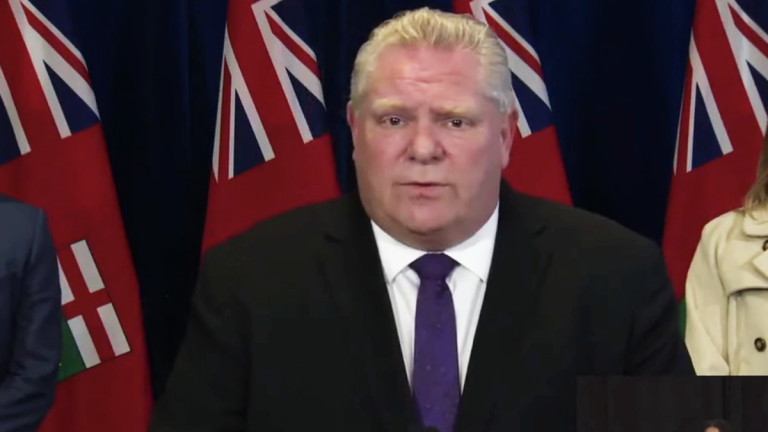
Ontario Premier Doug Ford said on Friday that he will never again rely on any world leader after US President Donald Trump ordered an American company to stop sending N95 masks to Canada. 

Ford told reporters during a daily coronavirus briefing on Friday that once the province is up and running again, he will revamp Ontario’s manufacturing sector.

“I can’t stress how disappointed I am with President Trump for making this decision. I’m not going to rely on President Trump, or any prime minister or president of any other country again,” said Ford.

“Our manufacturing, we’re gearing up and once they start, we’re never going to stop them. As long as I’m premier, I will never, ever let this happen again to the province.”

The Trump administration asked the company 3M to stop sending N95 respirator masks to Canada.

Using the Defence Production Act, Trump ordered the company to speed up production of the masks for the Federal Emergency Management Agency’s (FEMA) use. 

“The administration also requested that 3M cease exporting respirators that we currently manufacture in the United States to the Canadian and Latin American markets,” said a statement by the company. 

“There are, however, significant humanitarian implications of ceasing respirator supplies to health-care workers in Canada and Latin America, where we are a critical supplier of respirators.”

Prime Minister Justin Trudeau said that he is currently in contact with the US and stressed the need to maintain the flow of goods across the border.

“We are discussing very closely with the United States the importance of keeping the flow of essential goods and services across our border to help both countries. I am confident that the close and deep relationship between Canada and the U.S. will hold strong and we will not have to see interruptions in the supply chain in either direction,” said Trudeau on the matter. 

True North Update: Ontario’s sobering coronavirus projections

SUBSCRIBE TO THE CANDICE MALCOLM SHOW

Ontario health officials released their projections for cases and deaths as a result of the coronavirus – and they’re very grim.

Plus, Conservative Leader Andrew Scheer doubles down on his skepticism of Communist China while Chinese state media praises Trudeau’s Health Minister Patty Hajdu, calling her “a role model.”

This is the True North Update with Candice Malcolm and Andrew Lawton!

Chinese state media chief calls Hajdu a “role model” for defending China’s coronavirus data

0

A bureau chief at a Chinese state media publication called Canadian Health Minister Patty Hajdu a “role model” after she defended China’s coronavirus data. 

Columnist and EU Bureau Chief at China Daily Chen Wihua tweeted in support of Hajdu on Friday. 

Chen’s support was in response to Hajdu’s claims that there was no reason to believe that China’s infection or death rate was falsified in any way. 

“There’s no indication that the data that came out of China in terms of their infection rate and their death rate was falsified any way,” said Hajdu during the federal government’s coronavirus update on April 2.

“Your question is feeding into conspiracy theories that many people have been perpetuating on the internet and it’s important to remember that there is no way to beat a global pandemic if we’re not willing to work together as a globe.”

When asked on Friday whether she had any intelligence briefings to confirm China’s data, Hajdu skirted the question saying she trusts the WHO’s evaluation.  

“I am very confident in the WHO’s veracity of reporting of the science and evidence that they are gathering,” said Hajdu earlier today. 

Despite Hajdu’s claims, Foreign Affairs Minister François-Philippe Champagne told reporters during Thursday’s COVID-19 briefing that he was “very concerned” about the accuracy of the data. 

“We are very concerned about this information, I just had a call with NATO allies a few hours ago,” said Champagne.

According to a report by the U.S. intelligence community, there is reason to believe that China purposefully falsified their reporting on the coronavirus and misled the world. 

Advisors to UK Prime Minister Boris Johnson have also said they believe that the real situation could be 15 to 40 times worse than China has led everyone to believe, according to the Daily Mail.

Ontario projects up to 15,000 deaths over course of coronavirus pandemic

0

Ontario health officials project that between 3,000 to 15,000 could die from the coronavirus in the province. The range of the deaths depends on whether all current and additional measures are followed. 

The President and CEO of Public Health Ontario Dr. Peter Donnelly delivered the remarks alongside other health officials on Friday. 

“Our objective today is to share the modelling and projection data that command table has been using to inform our work and has been using to advise the government on their response to COVID-19,” said Dr. Donnelly. 

“It is not possible to be exact about where we will end up but I think it is reasonable to say that if we do everything that we can think of everything that already has been done stays in place all of the other measures that are being considered that I think we can reduce the death toll somewhere between 3,000 and 15,000. There is a range because where we end up depends on us.”

By April 30th, Ontario could expect 80,000 cases and 1,600 deaths with the current measures in place. 

COVID-19 Technical Briefing – Friday April 4 2020 by True North on Scribd

According to the Dean of Dalla Lana School of Public Health and the University of Toronto, Adalsteinn Brown, without any intervention Ontario would have had up to 300,000 cases for the month of April and 6,000 deaths. 

“Had we taken no action, again even within the short 30 day period between here and now you would be looking at up to 6,000 deaths,” said Brown. 

Over the course of the entire pandemic, modelling projects that without any public health measures, Ontario could have had to deal with 100,000 deaths.  

“I think it’s important that we are robustly realistic in the scale of the challenge we are about to face,” said Dr. Donnelly. 

“Had we done nothing, Ontario may have suffered 100,000 deaths. Thankfully, that is not the position we are in.”

Speaking on hospital ICU capacity, President and CEO of Ontario Health Matthew Anderson said that without following social distancing measures strictly, serious cases of the coronavirus would start to overwhelm ICU bed capacity by this weekend. 

Prior to the announcement, Premier Doug Ford told Canadians that he would make the projections available to the general public. 

“They’re going to tell the public exactly what they’re telling me and it’s going to be very clear where we were, where we are now and where we could be if we don’t follow the chief medical officer’s protocol,” said Ford on Thursday. 

As of Friday, Ontario had 3,255 confirmed cases of COVID-19. According to the provincial government, 67 people also died from the virus. 

Critics have been calling on Prime Minister Justin Trudeau to release national projections. On Friday, Conservative Party leader Andrew Scheer urged Trudeau to release all relevant data on the virus that has not been made publically available yet. 

“Mr. Trudeau says his government is being guided by the evidence. So it’s time to release that evidence,” said Scheer. 

During his daily coronavirus update, Trudeau told the media that his government wasn’t ready to release projections but would do so in upcoming “days and weeks.” 

“People can imagine a range of scenarios that shows everything from everyone just suddenly gets better within the next few weeks, to the situation just keeps getting worse,” said Trudeau.

“There is a range out there, and just highlighting that range is not as useful or important and being able to get clearer numbers and clearer analyses of what we are likely to face.”

British American Tobacco claims “breakthrough” in tobacco-based coronavirus vaccine

Let no one say the private sector isn’t rising to the coronavirus challenge.

A subsidiary of British American Tobacco is working on a coronavirus vaccine featuring an unlikely ingredient: tobacco.

Specifically a protein extracted from tobacco leaves, Owensboro, Ky.-based Kentucky BioProcessing said in a release Wednesday.

The company plans to distribute its potential vaccine on a not-for-profit basis.

“KBP recently cloned a portion of COVID-19’s genetic sequence which led to the development of a potential antigen – a substance which induces an immune response in the body and in particular, the production of antibodies,” the company said. “This antigen was then inserted into tobacco plants for reproduction and, once the plants were harvested, the antigen was then purified, and is now undergoing pre-clinical testing.”

It may sound surprising, but the process is not as novel as you might think. Kentucky BioProcessing’s tobacco extraction was used in an Ebola treatment called ZMapp, which was approved by the Food and Drug Administration and used during the 2014 to 2016 Ebola outbreak in West Africa.

The coronavirus vaccine’s developer says its plant-based process gives it “several advantages” over conventional vaccine production, such as faster accumulation of the necessary protein in the tobacco plants, and not requiring refrigeration.

With support from government agencies and third-party manufacturers, British American Tobacco says it could produce one to three million doses of vaccine per week, beginning as early as June.

“If the testing goes well, BAT is hopeful that, with the right partners and support from government agencies, between one and three million doses of the vaccine could be manufactured per week, beginning in June,” the release said.

BAT’s scientific research director, Dr. David O’Reilly, was unavailable for an interview, but said in the company’s press release that BAT is “engaged with the US Food and Drug Administration and (is) seeking guidance on next steps.”

The news from Kentucky BioProcessing puts British American Tobacco in a growing field of companies and research institutions racing to develop, test and implement a coronavirus vaccine.

Nearly three dozen organizations are known to be in the race, according to the Guardian. Of these, four have begun animal testing while at least one, a Boston biotech company, is set to begin human trials “imminently.”

What’s the difference between social distancing, self-isolation and quarantine?

0

You have likely been hearing new terms like “social distancing” and “self-isolation” in the last few months, but what do they mean? 

True North has put together this short reference guide to demystify some of the terminology and practices that have been recommended by Canada’s public health experts. 

With a better understanding of the terms, Canadians can be equipped to protect themselves and each other. 

Social distancing 

Social distancing, or physical distancing, means maintaining a physical distance of two metres (six feet) between yourself and others and limiting social contact.

By reducing person-to-person contact, we rob the virus of the opportunity to jump to new hosts. 

A common misconception is that if you’re not sick, you don’t have to take part in social distancing. This is wrong. Everybody must take part in social distancing behaviour in order for it to work. 

In practice, social distancing has proven to be effective in limiting the spread and reach of a virus.

According to Government of Canada recommendations, Canadians can practice social distancing in the following ways: 

  • Working from home
  • Grocery shopping at off-peak times
  • Conducting virtual meetings for work 
  • Greeting with a wave instead of a handshake or any other physical contact
  • Shopping online or ordering food through a delivery service
  • Staying at home as much as possible 

Self-isolation 

Self-isolation means totally separating yourself from others, including those in your own household. Self-isolation is undertaken if there is a likelihood you have come into contact with the virus.

The Canadian government has ordered everybody who meets the following criteria to self-isolate for a period of 14 days even if they show no symptoms: 

  • has returned from travel outside of Canada
  • has had close contact with somebody who is infected with or is believed to have COVID-19
  • has been alerted by health authorities that they might have been exposed to the virus

As of March 25, travellers to Canada who break self-isolation orders could face imprisonment and a fine of $750,000 according to provisions under the Quarantine Act

Those who are self-isolating must stay at home and monitor their health for any symptoms. 

Any contact with people in their household or from outside must be avoided.

Anybody who is showing symptoms while self-isolating is asked to call local healthcare professionals or contact their public health authority. 

Quarantine 

Quarantine is a control measure implemented by the Public Health Agency of Canada in accordance with the Quarantine Act. 

When a person is ordered by a Quarantine Officer to isolate, they are placed under quarantine. 

Recent measures have been introduced at Canada’s borders and airports to prevent the spread of the coronavirus, which includes mandatory 14-day quarantines for all international travellers coming into Canada. 

As opposed to self-isolation, to be under quarantine requires an official order from a public health expert. 

True North Update: Canada defends Communist China

SUBSCRIBE TO THE CANDICE MALCOLM SHOW!

Trudeau’s Health Minister Patty Hajdu defends China’s handling of the coronavirus despite a US Intelligence Report which reveals China concealed the extent of the virus outbreak.

Plus, the Canadian government continues to keep Canadians in the dark and refuses to release projections of the coronavirus spread in Canada.

This is the True North Update with True North’s Candice Malcolm and Andrew Lawton.