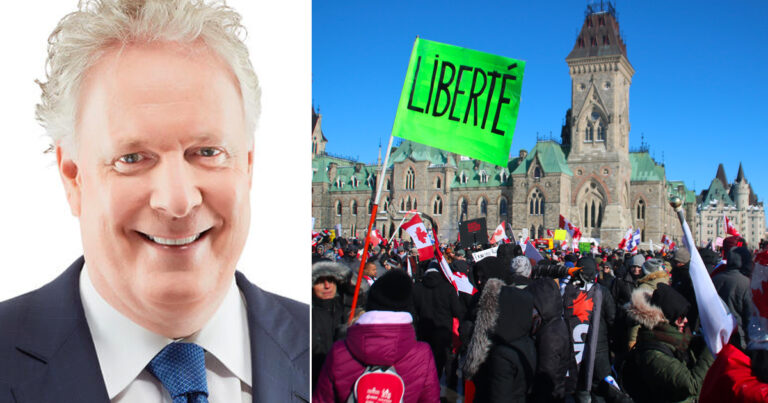
Jean Charest says convoy “laid siege” to Ottawa and Pierre Poilievre “appeals to the fringe minority”

Conservative Party of Canada leadership candidate Jean Charest is claiming the Freedom Convoy “terrorized” and “laid siege to” Ottawa, and that his rival Pierre Poilievre “appeals to the fringe minority.”

The former Quebec Liberal premier made the claims in a campaign mail-out obtained by True North. It appears to have been sent exclusively to Ottawa residents, although Charest’s campaign team would not confirm – opting instead to say that “over 50,000 letters have been sent nationwide so far.” 

“I am on the side of law-abiding Canadians” the mail-out reads, adding that “Pierre Poilievre is on the side of the lawbreakers and illegal blockaders who laid siege to YOUR CITY and our nation’s capital!!”

Charest adds in the mail-out that convoy participants – whom he refers to as “illegal blockaders” – terrorized residents, closed shops and businesses and disrupted daily commutes. 

“But the worst part is these lawbreakers were cheered on by one high-profile – but recklessly irresponsible – local Member of Parliament, Pierre Poilievre, who now says he wants to be Prime Minister!”

Charest also writes that Poilievre isn’t a serious leader and would be unable to win a general election, linking him to the far right and claiming he appeals to “the fringe minority.”

“Pierre Poilievre is the Justin Trudeau of the far right, a celebrity who appeals to the fringe minority and is more focused on building his social media following than building an electable, mainstream Conservative Party,” writes Charest.

Charest also said that he is “holding Pierre Poilievre and his supporters accountable” for attempting to close Canada’s border and occupy Ottawa. 

True North reached out to Charest’s communications director Michelle Coates Mather, who affirmed Charest’s remarks on the convoy. 

“The facts are clear. The downtown Ottawa core was occupied for weeks, critical infrastructure was blocked, businesses were forced to close, people’s ability to get to work was obstructed and all these cost taxpayers $375 million a day.”

Coates Mather added, however, that Charest does not believe that those who participated in the Freedom Convoy are part of a “fringe minority”  – a phrase first used by Prime Minister Justin Trudeau and then by Jean Charest while referring to some of Poilievre’s base.

“He believes the protests in Ottawa and elsewhere this winter expressed real frustration felt by many Canadians about how pandemic restrictions have been handled. He fully supports people’s individual rights to peaceful protests, but the bottom line is that laws were broken,” Coates Mather told True North.

Charest, who calls himself a “law-and-order Conservative,” said he agrees with Ontario premier Doug Ford introducing Bill 100 –  a new law that gives police the power to immediately address protest disruptions at land border crossings and international airports. The bill also gives police the ability to suspend drivers’ licences and vehicle permits and to seize the license plates of vehicles who take part in unlawful blockades.

Charest has promised to introduce a federal Critical Infrastructure Protection Act, which would make blockading, trespassing or interfering with critical infrastructure a criminal offense. He said he would also give law enforcement the ability to clear blockades without obtaining a court injunction.

Additionally, Charest’s proposal would “(a)mend the Income Tax Act to remove charitable status from any group that has accepted foreign funds and has engaged in action related to the new offenses created in this Act.”

Charest added that he was also against the “Shut Down Canada” movement that “tried to block resource development.” 

The Charest campaign said, however, that he did not support Trudeau’s invocation of the Emergencies Act to clear the Freedom Convoy in February. 

Charest “believes Trudeau’s implementation of the Emergencies Act in response to these protests was an overreach, completely unnecessary and divisive. It was a complete failure of leadership,” Coates Mather told True North.

Charest campaign co-chair Tasha Kheiriddin said she would have invoked the act to deal with the convoy had she been Prime Minister, in addition to calling in the military.

The Freedom Convoy was a protest against government COVID-19 mandates and restrictions, including those from the federal government. Charest said back in March that politicians needed to listen to “health experts” when it came to ending federal mandates.

This is not the first time that Charest has claimed that Pierre Poilievre supported an “illegal blockade.” He also made this claim at the 2022 Canada Strong and Free Conservative leadership debate, which resulted in him being booed by the audience.

True North has also previously reported that while Poilievre said he supported the “law-abiding and peaceful truckers”, there exists no record of him supporting border blockades. 

The Conservative Party of Canada will choose its new leader on Sept. 10. The latest poll from Abacus Data puts Pierre Poilievre in first place with 48% support among Conservatives, and Jean Charest in second with 20% support. 
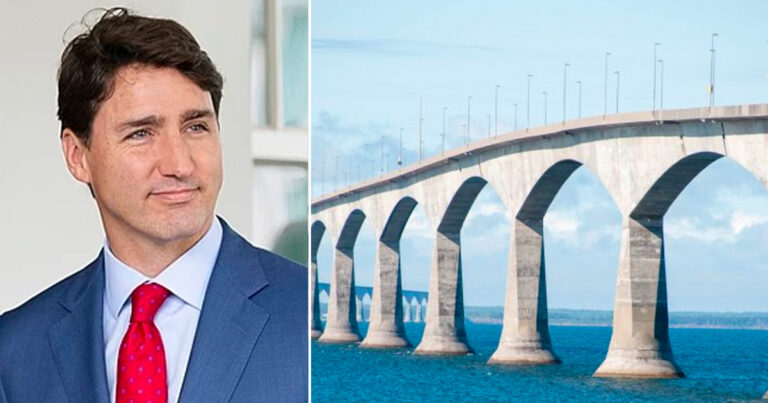
Trudeau government may rename Confederation Bridge “Epekwitk Crossing”

The Trudeau government has told the CBC that it is now considering a request to change the name of Confederation Bridge to Epekwitk Crossing to promote reconciliation with Indigenous groups.

Public Services and Procurement Minister Filomena Tassi confirmed to the state broadcaster this week that the name change for Confederation Bridge – connecting Prince Edward Island (PEI) and New Brunswick – was under review.

“The renaming of the bridge can play an important role in reconciliation by promoting the Mi’kmaw language and culture,” said Tassi. “Further advancing the work of reconciliation is and has been a priority of our government since the get-go. We will continue on this path.”

At the end of April, the PEI government voted unanimously to request the Trudeau government change the name of Canada’s longest and most expensive bridge, calling it “a commitment to upholding the rights of Indigenous people, which are protected under the Constitution.”

“This is a great opportunity,” said P.E.I. Premier Dennis King, whose tabling of the motion was seconded by Opposition Green Party leader Peter Bevan-Baker.  “I’m excited for the process, and I’m excited for what’s to come.”

The motion added, “it is of the utmost importance Indigenous languages are respected and recognized,” adding that 2022 is the International Decade of Indigenous Language.

The New Brunswick government has taken no position, however, saying “(t)his is not a provincial decision, and so the Premier is not going to weigh in on the subject at this time.”

Construction of Confederation Bridge took place between 1993 and 1997, and cost $1.3 billion dollars to complete. At nearly 13km in length, it remains one of the longest bridges in the world, continuing the Trans-Canada Highway between the two northern Maritime Provinces. Before this, travel between PEI and New Brunswick was provided largely by ferries.

The name Epekwitk – anglicized as Abegweit, and the traditional Mi’kmaw name for PEI itself – is already reflected in the name of Abegweit Passage, the narrowest part of the Northumberland Strait, which Confederation Bridge crosses. “Abegweit Crossing” was also one of the original name proposals for Confederation Bridge in 1997, with two ferries taking the name MV Abegweit between 1947 and 1997.

The move to rechristen Confederation Bridge to Epekwitk Crossing reflects an escalating trend on the part of governments to promote Indigenous reconciliation and “decolonization” by renaming Canadian institutions and infrastructure.

Schools across the country named after the Father of Confederation and Canada’s first prime minister John A. Macdonald, for example, have been changed or are under consideration by trustees. Calgary’s Sir John A. Macdonald School is looking at dropping it, while Brampton’s Sir John A. Macdonald Senior Public School has just been renamed Nibi Emosaawdang Public School, after an Ojibwe grandmother and “water-rights activist.”

Toronto’s Ryerson University was also renamed last month to Toronto Metropolitan University after a unanimous vote by its board of governors to hold namesake Egerton Ryerson accountable for his role in the Indigenous residential school system.

Dozens of statues of historical figures – including Macdonald but also Queen Victoria and Elizabeth II – have also been either ripped down during protests or removed by governments in response to issues surrounding residential schools and reconciliation.

Despite saying that it is considering the PEI government’s request to rename Confederation Bridge, the Trudeau government has not provided a timeline for its review.

Tanya Granic Allen on Doug Ford, Sex-Ed and Critical Race Theory

News Forum media personality and former Ontario PC leadership candidate Tanya Granic Allen spoke with True North’s Elie Cantin-Nantel last weekend at the Canada Strong and Free Networking Conference in Ottawa. 

Granic Allen was asked about various current political issues, including Doug Ford’s performance as premier in his first term, as well as the province’s sexual education curriculum and Critical Race Theory in Ontario classrooms. 

She also touched on the Conservative Party leadership race and the expected overturning of Roe v Wade in the United States.

BC school gave kindergarteners masturbation homework assignment

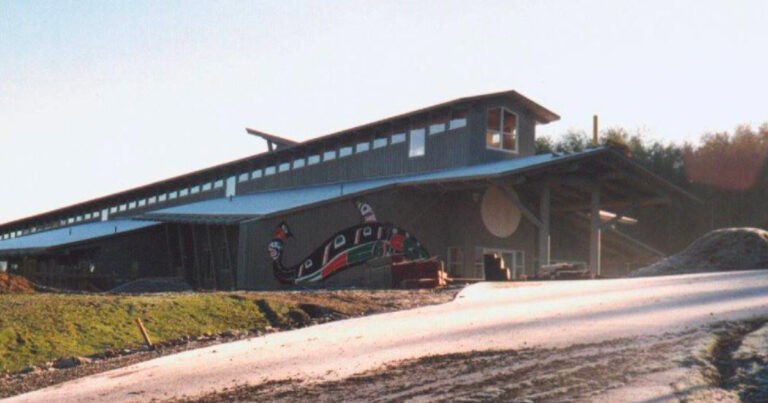
A British Columbia First Nations school is investigating after parents reported that teachers gave 4-year-old kids a homework assignment on masturbation.

The popular social media monitoring platform Libs of TikTok was the first to report the incident at T’lisa̱lagi’lakw School in Namgis First Nation in Alert Bay, B.C. based on a Facebook post. 

Kindergartners sent home with masturbation assignment

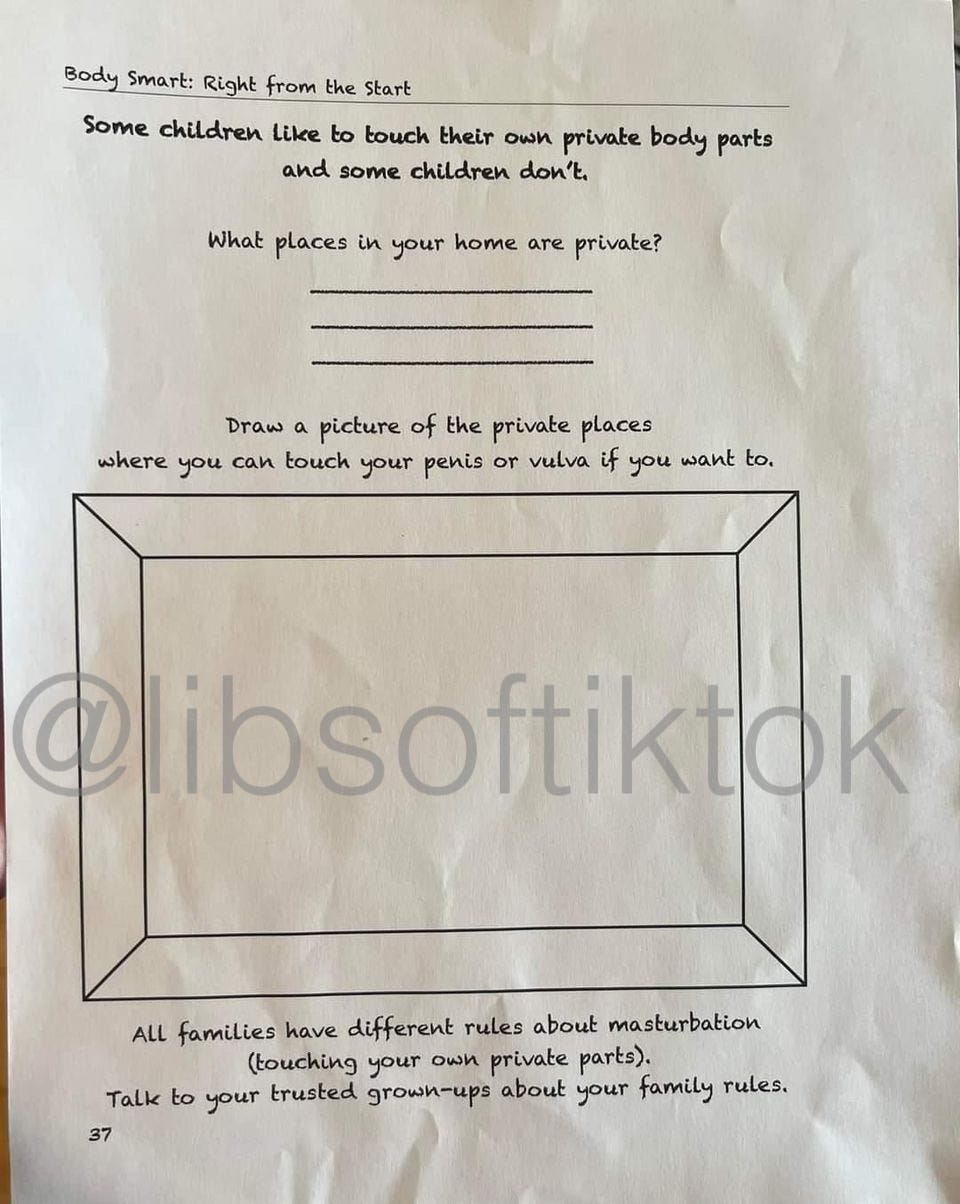
A worksheet from the book Body Smart: Right From the Start asks kids to “draw a picture of the private places where you can touch your penis or vulva if you want to.”

“Some children like to touch their own private body parts and some children don’t,” the assignment states. “All families have different rules about masturbation (touching your own private parts.) Talk to your trusted grown-ups about your family rules.”

A spokesperson for the school reportedly told Libs of TikTok that the “incident is under investigation” but would not comment further. 

True North reached out to the principal of T’lisa̱lagi’lakw School but did not receive a reply by the time of publication. 

School materials on sexuality and gender identity have come to the forefront of debate across Canada and the US in recent months.

As exclusively reported on by True North, a Toronto District School Board elementary school recently hosted a “sexuality diversity in children” workshop.

The JK-Grade 8 Rawlinson Community School seminars explored “Affirmation of Gender and Sexuality Diversity in Children, Youth and Families.” 

The seminars were conducted by the organization 519 Space For Change, which has published several guides full of explicit sexualized language on oral sex, masturbation and prostitution. 

True North fellow Sue-Ann Levy also reported that the Simcoe County school board recently asked kids about their sexuality and gender identity in a recent climate survey. 

In a voluntary survey, 12 to 13-year-old kids were asked to identify if they were queer, fluid, pansexual, questioning or bisexual, and allowed them to pick from 10 sexual categories, 33 ethnic/cultural origins and eight racial categories.

Independent media is running circles around the legacy media

It’s Fake News Friday on The Candice Malcolm Show!

This week, Canadians tuned into the Conservative Party’s boring and uneventful leadership debate. We don’t blame you if you tuned out of the debate, but you may have missed the media scrum with candidates after the debate, in which independent media journalists ran circles around so-called reporters from the legacy media. While the legacy media pushed their favourite pet cause – climate change – independent media asked candidates thorough questions to help Canadians get a better understanding of the candidates.

Plus, Candice dissects a Canadian Press article about Bill C-69 getting struck down by an Alberta court and shows you everything wrong with the legacy media’s fake news.

And of course, the CBC publishes more awful op-eds to push their far-left world view.

Candice and True North producer Harrison Faulkner discuss these stories and more.

SUBSCRIBE TO THE CANDICE MALCOLM SHOW

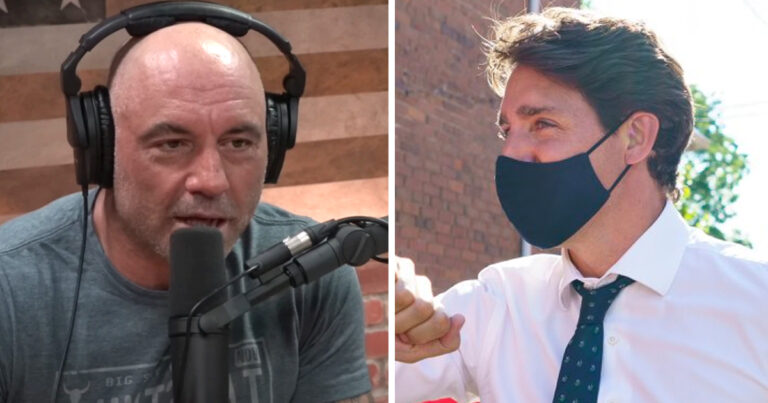
Joe Rogan calls Justin Trudeau a “creepy f***ing dictator”

Popular US podcaster Joe Rogan has blasted Prime Minister Justin Trudeau for his attacks against Canadian truckers during the February Freedom Convoy protests in Ottawa.

Rogan called Trudeau a “creepy f***ing dictator” in an episode of the Joe Rogan Experience with Canadian academic and author Gad Saad on Thursday, saying the prime minister’s behaviour belies Canada’s friendly reputation and his own nice-guy image.

“People were friendlier, it seemed like a great system… but then, when you have a creepy f*cking dictator for a prime minister – that’s what he is. The way he behaves – the way he behaved during this thing – the disingenuous way that he communicated – it freaked me out, because I never thought that guy was like that,” said Rogan.

Rogan went after Trudeau for attacking truckers with “no provocation” before invoking the Emergencies Act to quash the peaceful demonstrations against overreaching COVID-19 mandates. 

“I thought he was a handsome fella with a good vocabulary and seems like a nice guy,” said Rogan. “Before he really leaned into the woke stuff, I thought he was a kind, sensitive guy, and I thought ‘that’s probably a good disposition to be a leader.” 

“The way he did it – he just cast a pejorative label on them with no evidence, with no provocation. It was just like, ‘I’m going to label them this so that I can impose laws to stop them from doing what is essentially a peaceful protest.’” 

Rogan was not the only one to criticize Trudeau for his handling of protesters who oppose his policies. 

During a House of Commons public safety committee meeting on Thursday, former deputy minister of national defence and security advisor Richard Fadden told parliamentarians that Trudeau went too far with his rhetoric when labelling protesters. 

“I don’t think that attacking views is helpful by anybody,” said Fadden. “Not by you, not by me, not by the prime minister. You can disagree with them… but I think the prime minister went a little bit beyond that, and I don’t think it’s helpful.” 

“And it’s the sort of thing that reinforces the sense that they’re not being listened to. I actually disagree with most of the views that were being expressed in that general context, but that’s neither here nor there. We need to find some means of dialoguing… My argument is we cannot start a priori by arguing that they’re wrong.”

Fadden went on to say that politicians needed to find some way to have discussions with the protesters instead of resorting to extreme measures  – otherwise, he warned, it could drive people to resort to extremism. 

“You can argue they must not engage in violence. That’s an entirely different issue, and I want to separate that very carefully. You pass that line, you become engaged in violence, and you gotta do something about it. We need to find some way of talking to them,” said Fadden. 

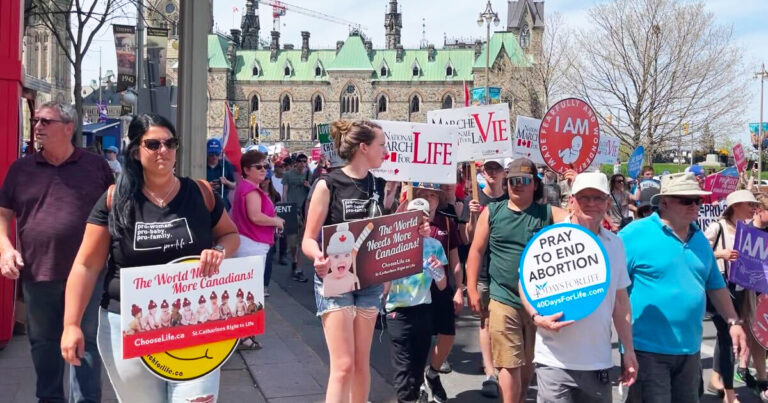
The pro-life movement in Canada reacts to Roe v Wade case

As the US Supreme Court is expected to overturn the landmark Roe v Wade case, the issue of abortion is back in the spotlight in Canada. Leftist politicians like Justin Trudeau and Jagmeet Singh are doubling down on their support for abortion and are pushing for more access to abortion services. Meanwhile, many Conservative leadership candidates attempt to shy away from the issue. 

True North’s Elie Cantin-Nantel was at the 2022 March for Life in Ottawa and asked people what impact they think the overturning of Roe v Wade would have on the Canadian pro-life movement. 

Some of the people interviewed include Yorkton—Melville MP Cathay Wagantall and Christian Heritage Party of Canada leader Rod Taylor.

Canadian Forces veteran still marching despite rumours of arrest

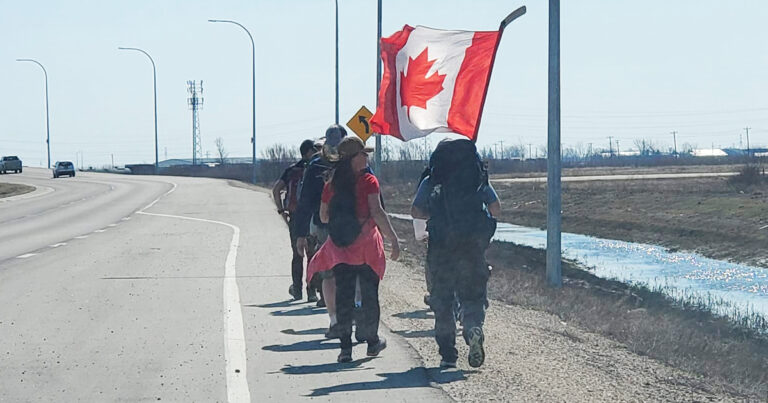
Canadian Armed Forces (CAF) veteran James Topp is reassuring supporters he has not been arrested after legacy media outlets reported on Wednesday he was being charged by the Defence Department for his protests against vaccine mandates.

Topp – whose military career has spanned nearly three decades and included tours in the Balkans and Afghanistan – began marching from Vancouver to Ottawa on Feb. 20.

He spoke from just outside Vermilion Bay, Ont. on Thursday, crediting the legacy media for finally noticing his 4293km trek and explaining that the charges stem from investigations into his original protests back in February.

“I just want to verify to everybody right here right now, I am walking around free as you can be in this society that we live in,” Topp said in a Facebook video.

“Do not mistake these for charges being placed against me by any police service in this country. These are charges that have been placed against me because I went out in uniform and made statements critical to vaccination mandates and mandates in general. So, this is why I’m being charged.”

“So, I am walking around – marching around – and we continue to go to Ottawa because that’s what we’re doing, and that’s our mission. So please get the rumor mill under control.”

Topp now faces two charges under section 129 of the National Defence Act – involving counts of conduct to the prejudice of good order and discipline – for speaking out against vaccine mandates while in military dress. The incidents occurred on Feb. 12 when Topp said he made the decision to appear in full uniform at the Pacific Border Crossing protest in Surrey.

“Anybody can stand there and beak off,” he told True North in an exclusive interview. “But the uniform was the only mechanism I had available to me with the strength of the convictions I now have to get the message out there to people to start doing something.”

“I took my uniform, got in my car, drove down to Surrey – the level of sheer terror I experienced was right up there with jumping out of an airplane.”

Topp then referred to a letter he had posted on his original website, titled “A Letter to Higher.” 

“If I am to be punished for what I have said and done then I accept that,” the letter reads. “While I lament what has happened to this country and the direction that our society is going, as it becomes enslaved by the technology that has the potential to uplift us, I go to the gulag with the ability to hold my head up and look at myself in the mirror. I will rest easy in prison or leave this earth with peace of mind.”

An order by Chief of the defence staff Gen. Wayne Eyre required all military personnel to have received two Covid shots by mid-October – a deadline that was later extended to mid-December. Topp, who is now a warrant officer in the reserves, was also affected by the RCMP vaccine mandate, having worked as a civilian employee for the federal police force.

Topp’s lawyer Phillip Millar – himself a CAF veteran – told the Canadian Press that Topp was initially offered a trial by court martial, which would have allowed his case to be heard by an independent panel or judge. Instead, Topp will now face a summary trial, leaving judgment to his chain of command.

“The opportunity to explore whether or not the policy was, in fact, legal is denied to him,” Millar said.

According to the Defence Department, 13 CAF members have been or are being investigated. Two of the investigations are being done by military police, with four others by individual units. The department has also said that officials chose not to charge the last five, three of whom have since left the military.

Topp, who reached Ontario this week, expects to arrive in Ottawa in early-to-mid June. His progress can be followed on Canadamarches.ca and its social media channels.

Conservative MP slams security officials for ignoring 2021 church burnings

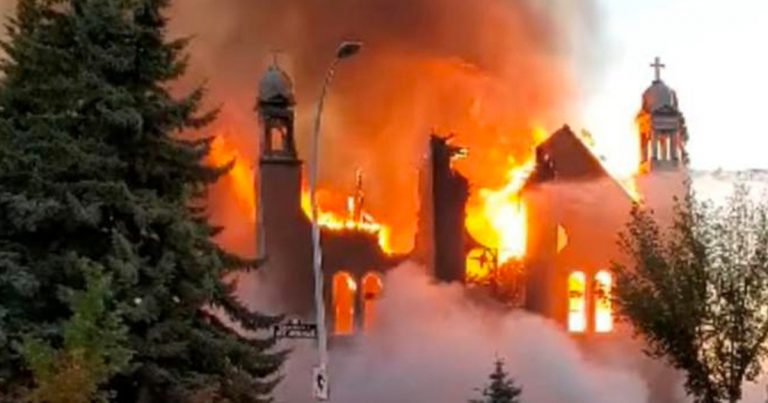
Conservative MP Dane Lloyd grilled officials from the Canadian Security Intelligence Service (CSIS) and Public Safety Canada for ignoring the torching of nearly 30 churches in the summer of 2021 on the heels of residential school grave reports. 

Lloyd questioned three officials with the security agencies during a May 12 Commons public safety committee meeting on ideologically motivated violent extremism (IMVE). 

“Is Public Safety currently investigating the burning of over 30 churches in Canada last year?” asked Lloyd. 

“Public Safety does not have an investigative mandate – that might be better directed towards RCMP,” said the Director General of the National and Cyber Security Branch of Public Safety Canada Lesley Soper. 

“But you said in your testimony that you were given a mandate by this government in 2021 to bring IMVE perpetrators to justice, and now you’re saying you don’t have a mandate to investigate,” stated Lloyd. 

Officials with CSIS also refused to give a straight answer as to why the church burnings were not included in its 2021 threat assessment report. 

“I just find it interesting because you do have extensive stuff in your report about ideologically motivated extremism, religiously motivated extremism, politically motivated extremism and yet 30 churches being burned down in Canada last year didn’t merit a mention,” said Lloyd. 

“Can you tell us if CSIS has ever reached out to show support and solidarity with the 30 church communities that were burned down in Canada in 2021?” 

“What I will say is that the service is always extremely concerned with any violent form of extremist activity – in this case that had already gone into the criminal realm, so the RCMP may have further comments,” said CSIS Director General of Policy and Foreign Relations Cherie Henderson. 

Lloyd responded with reference to the Morinville church fire, which saw the Alberta community’s century-old Catholic church burned down in June.

“It would be nice to have a statement of at least concern for these communities from CSIS considering the fact that at 4 a.m. in the morning in my town of Morinville over 50 people had to be evacuated from their homes because a church was burned down, and there was a massive threat that a senior’s home apartments were going to be burned to the ground,” said Lloyd. 

“This could have been one of the highest mass casualty terrorist event on Canadian soil in our modern history, and yet it doesn’t seem to have merited a single mention by our security service so I want to put that on the record.” 

Last year, True North compiled a map of the nearly 70 cases of arson and vandalism targeting churches across Canada. 

LEVY: Ottawa school trustee mocked for wanting better police response for schools

An Ottawa trustee was bullied, called “racist” and mocked by her woke colleagues at a Tuesday night board meeting for putting forward a proposal to have the board work more closely with police to better respond to schools and staff experiencing a surge in vandalism and attacks.

Ottawa-Carleton District School Board (OCDSB) trustee Donna Blackburn told her colleagues that since the board eliminated the Student Resource Officer (SRO, or police in schools) program a year ago, school administrators, teachers and staff are left to call 9-1-1 or police directly if a concern or crisis arises – and wait sometimes for hours along with everyone else for police to respond.

She said the victims of violence in Ottawa schools are getting “less service” since they eliminated the program.

“We have said the police are not welcome there (on our properties) …this is not working for our students, staff and our communities,,” she told her colleagues, insisting she is speaking for the “silent and silenced” majority.

The Toronto District School Board also eliminated the SRO program in late 2017 following ongoing protests by Desmond Cole and Black Lives Matter activists.

Board officials bowed to pressure even though their own $30,000 survey showed the majority of students, staff and parents found the SROs very helpful. This support came in addition to a long list of school teachers and principals who attended a Police Services Board meeting that year and begged them to keep cops in schools.

At Tuesday’s OCDSB meeting, however, things went quickly off the rails after trustee Catherine Boothby moved to defer Blackburn’s motion indefinitely.

Boothby claimed they’d already set up a process whereby the police, the board and equity-seeking and oppressed groups were supposed to communicate collectively with each other – in alignment with the UN’s International Decade for people of African Descent and the Truth and Reconciliation Commission’s call to action.

“This motion is doing nothing but causing hurt to this community,” she said. 

She did not define what kind of hurt she meant.

OCDSB education director Camille Williams-Taylor – after tripping over her words for several minutes – did admit that conversations with the police hadn’t occurred as quickly as she had hoped. She said that access to the police was “limited” and had resulted in “significant delays” in a police response when it was needed.

“It (911) doesn’t get us the efficiency,” she conceded, indicating they’d been working on how to “reconstitute” the relationship with the police.

Nevertheless, Boothby’s motion set off a ridiculous litany of perceived hurts from the anti-police trustees.

Transgendered trustee Lyra Evans insisted that members of the community have been “hurt” by the police and everytime they reopen the debate, the community relives their “hurts.”

“Why would we knowingly cause pain to our community,” Evans said. “I’m of the opinion we punt this into space and never look back.”

Evans never said what “hurts” or “pain” members of their community are feeling.

Evans’s  partner in crime Justine Bell, another radical NDPer, reiterated that the issue of policing “brings pain to the community” every time they discuss it.

Never mind the victims of crime, of course. Bell, too, never indicated what pain the community is experiencing.

Blackburn left the meeting in frustration before the unanimous vote by the out-of-touch, self-satisfied ( and largely boomer) trustees deferred the motion indefinitely.

She said following the meeting that the people of Ottawa-Carleton should be very concerned that the left wing has taken over the OCDSB. She said she felt many of the trustees backed down on her idea after activists called her a racist for even suggesting it.

“Vandalism is not being addressed, and the cops feel so demoralized,” Blackburn said. “Certain (anti-police) trustees don’t acknowledge the violence.”

While she was surprised that her motion was so quickly stalled, I wasn’t. This has become part of a pattern throughout Ontario school boards.

Anti-police, pro-critical-race-theory and gender-ideology trustees – many of them backed by unions – have set about to deliver agendas that have nothing to do with safety or the quality of the educational experience for students.

Ontario school kids have become merely the lab mice in a dangerous social experiment.