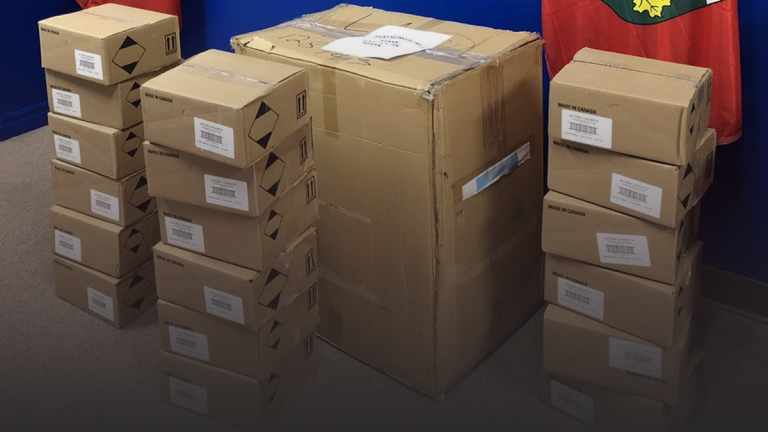
An anonymous donor in Ontario dropped off 3,500 masks and 20 cases of hand sanitizer at the constituency office of Minister of Municipal Affairs and Housing and MPP Steve Clark.
According to Clark, the much-needed supplies will be heading directly to frontline health-care workers.
My sincere thanks to the anonymous donor who dropped off 3,500 masks and 20 cases of hand sanitizer at my Brockville constituency office today. We’ll ensure these supplies get to the local frontline health-care providers who need them. #OntarioSpirit#COVID19pic.twitter.com/ecS7GxkNWz
True North reached out to Clark for comment on the donation and how it would be distributed.
“We respect the donor’s request to remain anonymous and are reviewing which local health-care agencies are in most urgent need of these supplies,” said Clark.
“The generosity is just another example of the incredible Ontario Spirit we’ve seen from individuals and businesses locally and right across the province. These donations are critical to supporting our health-care heroes and everyone on the frontlines in the fight against COVID-19.”
In late March, Ontario health officials were warning that the province was facing a shortage of personal protective equipment such as masks.
“We fear that a mask shortage is imminent. This is a serious and dire situation for our frontline workers,” said the CEO of the Registered Nurses’ Association of Ontario Dr. Doris Grinspun at the time.
Hospitals have had to ration the equipment in order to deal with the shortage while the government races to secure more gear for frontline healthcare workers.
On March 29th, Ontario Premier Doug Ford made a personal trip to a Markham dental supply company to pick up a donation of 100,000 surgical masks.
Ford arrived on location at Dental Brands with his own truck to pick up and personally deliver the gear.
As of Easter Monday, Ontario had 7,470 cases of COVID-19, the second-highest in all of Canada. The virus has also claimed 291 lives since the outbreak first began.
The national news agency Canadian Press has been “pressing” the Liberal government for federal handouts during the coronavirus pandemic.
According to Blacklock’s Reporter, Canadian Press President Malcolm Kirk wrote in a staff memo that the current pandemic relief programs were not “very helpful” to the organization.
“Candidly we are not optimistic these programs will be very helpful to Canadian Press in the immediate term simply because of the eligibility requirements,” wrote Kirk.
“We are pressing Ottawa and the Québec governments on these and other possible initiatives that could support our sector and Canadian Press specifically.”
Last year the agency received $1.3 million from the federal government in licensing fees and an additional $199,990 National Research Council grant.
In 2019, struggling mainstream media outlets were already promised a $600 million bailout package by Prime Minister Justin Trudeau.
The funds would be redeemable through labour tax credits for “qualified Canadian journalism organizations” handpicked by a committee tasked with distributing the sum. News organizations would also be able to apply for charitable status and issue tax receipts.
In March, the government pledged an additional $30 million for media companies as part of a national coronavirus awareness campaign.
“It’s crucial that Canadians can obtain authoritative, well-sourced and factual information related to COVID-19. This is why the government of Canada is taking immediate action so Canadians can continue to access diverse and reliable sources of news,” said Minister of Canadian Heritage Steven Guilbeault.
“Moreover, based on the $30 million invested on our government in a national awareness campaign about COVID-19, this will be invested in Canadian media, whether it’s on TV, in newspapers and magazines or online so that the revenues generated by this campaign breathe new life into our media.”
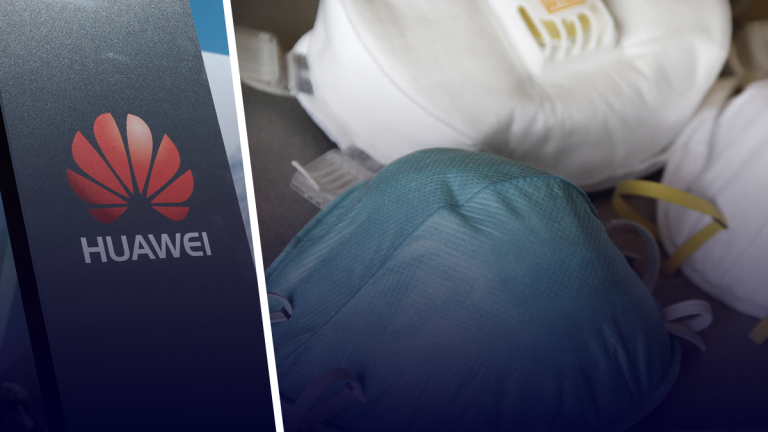
Washington lawmakers are worried that Huawei’s donation of masks to Canada might sway Canadian policy directions.
After Huawei announced it would be donating millions of masks to Canada to help stop the spread of coronavirus, U.S. senators told Newsweek that the move was an attempt by the Chinese government to project soft power.
“Any effort by Chinese-controlled companies like Huawei to lend a helping hand is just an attempt to divert attention from their crimes,” Florida Republican Senator Rick Scott told Newsweek.
“It’s no secret that Communist China uses China-based companies like Huawei to spy on nations and commit intellectual property theft.”
The U.S. is seeking to have Canada extradite Huawei CFO Meng Wanzhou for breaking sanctions against Iran and fraud-related crimes.
While the extradition hearings have been ongoing, Huawei has meanwhile been lobbying the Canadian government to gain access to Canada’s 5G network.
Intelligence experts and Canada’s allies have warned that granting Huawei access could jeopardize intelligence sharing among Five Eyes nations and harm national security by giving Beijing a backdoor to spy on Canadians.
“This Administration’s retreat from multilateralism has been a boon for Chinese soft power,” said Virginia Democrat Senator Mark Warner.
“This latest display by Huawei, almost certainly done in coordination with the Chinese government, is no exception. We all must do everything in our power to protect international security and keep Huawei out of markets.”
When asked about the donation, Prime Minister Justin Trudeau assured Canadians that the gesture would not influence Canada’s decision regarding 5G technology or any other matter.
“We are not expecting these donations to have any impact on our decisions. In fact, they will not affect our decisions on any issues,” said Trudeau in French.
“Receiving goods from a particular company won’t necessarily imply at all that we regard different situations with that company any differently in the future.”
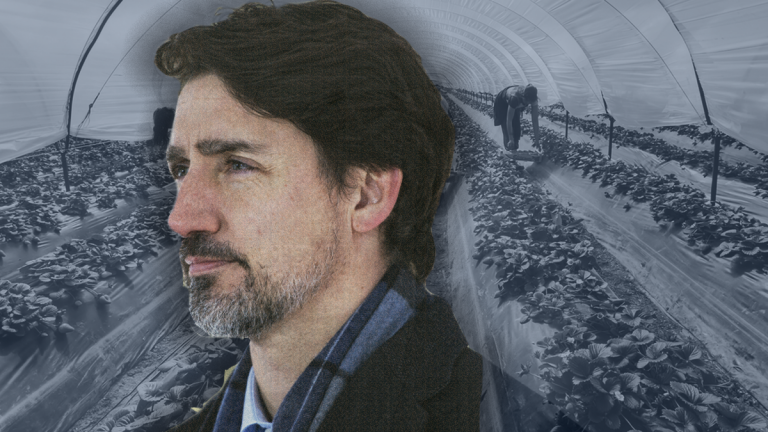
Canadian taxpayers will be footing a $50 million bill to quarantine temporary foreign workers arriving in the country during the coronavirus pandemic.
On April 13 Agriculture and Agri-Food Canada announced that the funding will go to farmers and food production employers to ensure foreign workers follow the mandatory 14-day isolation period.
“Today, the Government of Canada is announcing $50 million to help farmers, fish harvesters, and all food production and processing employers, put in place the measures necessary to follow the mandatory 14-day isolation period required of all workers arriving from abroad,” claimed a government news release.
Instead of relying on Canadian labour and employing young people out of work, the federal government has prioritized temporary foreign workers in these sectors.
Canada lost over one million jobs in March as the coronavirus pandemic has forced countless employers to either lay off staff or shut their doors completely.
“With so many young people out of work — so many of whom are desperate to get work experience, pay off debt and save for the future — it defies logic that our government is paying these young workers to stay at home, while also recruiting temporary foreign workers to come fill jobs that have been deemed essential services,” wrote True North founder Candice Malcolm.
The new funding is intended to compensate employers who will pay for the two weeks temporary foreign workers are required to self-isolate and providing them with missed pay, transportation, supplies and accommodation.
“Recognizing the importance of this responsibility, the federal government will provide support of $1,500 for each temporary foreign worker, to employers or those working with them to ensure requirements are fully met,” wrote the news release.
“The funding is conditional on employers not being found in violation of the mandatory 14-day isolation protocols or any other public health order.”
While the Liberal government has banned non-essential travel to and from Canada, some exemptions have been made for temporary foreign workers and international students.
Currently all temporary foreign workers are exempt from the travel restrictions and can enter Canada by air or land with a valid work permit.
Upon arrival, workers are screened for coronavirus symptoms and then must comply with the mandatory 14-day quarantine order before being allowed to work.
A number of temporary foreign workers were found to have contracted the virus while working at a farm in West Kelowna, BC. The incident involved over a dozen employees at the Bylands Nursery and it was the first large community outbreak in the province.
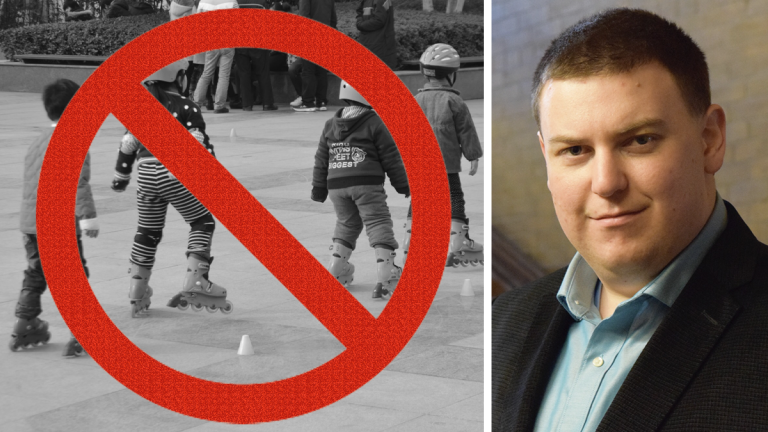
A rollerblading family from Oakville is the latest to be fined for minding their own business during the coronavirus lockdown.
True North’s Andrew Lawton unpacks the social consequences of lockdown and shines a light on a concerning alliance brewing between Apple, Google and governments around the world to use cellphone location data to contain COVID-19.
Watch the latest episode of The Andrew Lawton Show now!
The City of Toronto says that the thousands of faulty masks it had to recall after healthcare workers reported they were “ripping and tearing” were manufactured in China.
“While this investigation remains ongoing, preliminary results indicate that these masks were used in two long-term care homes by approximately 220 city staff,” said Toronto Fire Chief Matthew Pegg about the incident.
“We also initiated a full occupational health and safety investigation to insure [sic] any potential impacts to both our staff and residents are understood and mitigated effectively.”
Initial reports of the recall failed to mention where the masks were manufactured and the City of Toronto has refused to name the vendor involved in procuring the equipment over fears of legal retaliation.
Approximately 200,000 surgical masks were recalled by the city after being distributed to long-term care homes.
Elderly citizens in long-term care facilities are especially vulnerable to the coronavirus and the virus has already claimed numerous lives at various residences.
In Quebec, the coroner’s office launched an investigation into a Montreal long-term care facility after 31 people died while in care at the residence.
Toronto is not the first place to have issues with defective personal protective equipment (PPE) from China.
The Netherlands was forced to recall 600,000 face masks made in China after they were found to not meet safety requirements.
Other countries like Spain, Turkey and Australia have also reported problems with PPE being imported Chinese manufacturers who are making large profits from the increased global demand.
In Australia, border officials have seized 800,000 “dodgy” masks valued at $1.2 million being delivered to the country from China.
The federal government has already confirmed that Canada received “millions” of masks from China to help in its fight against the coronavirus pandemic.
When questioned about whether face masks from China will be inspected for defects after arrival, Prime Minister Justin Trudeau told reporters that there would be “no corners cut” to ensure that they meet health and safety standards.
“At the same time, I can assure people that Health Canada has very strong procedures for evaluating (and) ensuring what we get is up to the necessary standards and there will be no corners cut on this one. We need to make sure that the equipment that our health-care workers rely on to keep them safe as they keep us safe is of a quality that is going to actually do the job,” said Trudeau.
While ordinary Canadians are facing hefty fines for breaking coronavirus-related public health orders, it appears that the same rules don’t apply to the prime minister and his family.
Looks like Justin Trudeau had a nice Easter with his family. He had to break his government’s own rules to do it, but rules are for the little people. pic.twitter.com/YruWe4tErn
On Sunday Sophie Grégoire Trudeau posted pictures of herself with Justin Trudeau and their children on Instagram taking part in Easter festivities. According to the advice of public health officials, Trudeau violated the government’s social distancing rules.
“Even though families across the country are having to get a little creative and celebrate a bit differently this year, we’re all in this together,” Grégoire Trudeau wrote on Instagram.
Since March 29, Sophie Grégoire Trudeau and their children have been living in Harrington Lake, Que. while Justin Trudeau has remained in Ottawa.
As Justin Trudeau and his wife and children now live in separate households, the family should be practicing social distancing.
Social distancing means that individuals should avoid contact with those that live outside their household, including family members.
On Friday Chief Public Health Officer Dr. Theresa Tam told Canadians celebrating Easter and Passover to stay home this year.
“We need to not let down our guard. The safest plan for your holidays is a staycation for the nation,” she said.
Dr Howard Njoo, Canada’s deputy chief public health officer, added that celebrations should be limited to members of your household.
On April 1 the government of Quebec introduced strict travel restrictions across the province, including police checkpoints to prevent unnecessary travel in and out of Quebec.
Since the restrictions began, police have prevented 2,300 vehicles from crossing the Ottawa-Gatineau border.
How Justin Trudeau’s trip to the family retreat in Harrington Lake would be considered necessary travel is not clear.
4/7 Urban dwellers/Cottagers should RESIST THE URGE to head to the #cottage and rural properties as these communities have less capacity to manage #COVID19.
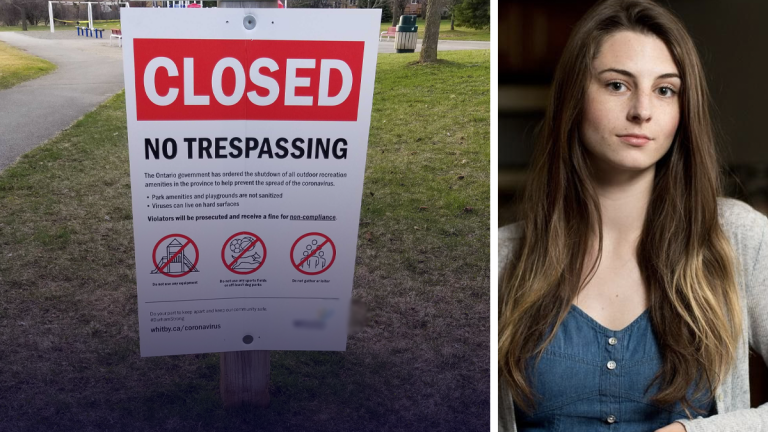
On Friday a family of four in Oakville was fined $880 for rollerblading in a parking lot of a community centre. The family says there was no indication anywhere that they were not allowed to be in the area.
In recent weeks hundreds of Canadians have also been fined for breaking public health orders, most of them for not following social distancing rules.
It seems that the only thing that almost anyone can talk about these days is the coronavirus.
Here are 7 things you need to know to help you keep things in perspective.
1) “Flattening the curve” does not mean that less people will get the virus. So many people have been talking about the necessity of “flattening the curve” in the hopes that somehow it will prevent people from contracting the virus. However, it simply means that less people will get it at the same time, therefore reducing the concurrent load on our healthcare system. This is akin to the load on our electricity and power generation system; if everyone used all their household appliances during the day when factories and businesses are open there would not be enough generating capacity to keep up with demand.
2) This virus is unlikely to go away after we relax the stay home rules. The reality is that there are many people who are asymptomatic and have the virus without knowing. Because these people have little to no symptoms they can spread the virus to other unsuspecting individuals once we resume ‘normal’ life. The moment we fully open the borders again, someone will likely bring it in from another country. It is simply not possible to lock down literally everyone in the entire world for 2-3 weeks.
3) The fatality rates are misleading. Because we are not testing every single person to determine if they have the virus or not, even those who may have symptoms, it is impossible to know the total number of infected. The government of Ontario’s own website questionnaire advises that if you have a suspected case to simply stay home and quarantine for 2 weeks. As such your case would not be counted in the confirmed cases. Currently, we are projecting the fatality rate based on confirmed cases. As such, these figures do not say what most people think. The government of Ontario has projected 1,600 casualties in the province by the end of April. If our fatality rate is 2% like that of South Korea This would mean that there should be approximately 93,000 confirmed cases of the coronavirus in the province. Currently, there are about 7,500.
4) Most, if not all, of us will likely end up contracting the coronavirus eventually. Because people can, and have, transmitted the virus to others without knowing, the confirmed cases only tell part of the story. This means that unless a vaccine comes out in the near future, the virus will begin spreading around once we lift the current societal rules. This is not to mention the possibility of the virus mutating and/or becoming seasonal.
5) Our society isn’t built for social distancing. From getting a haircut to standing in line to taking the subway to work, our cities, and indeed our very lives are not built in a way that can support permanent social distancing. From a simple biological point of view we are social creatures, not designed to live in isolation. Long-term isolation will have it’s own health effects.
6) Things will not go back to the way they were right away, if ever. While it’s true that we can’t stay in isolation or continue this level of social distancing forever, neither can we continue living how we were. We have to radically change the way we think about infectious diseases. The coronavirus virus has an R0 (Basic Reproduction Number) of about 2, meaning that every infected person passes it on to 2 others. The next pandemic could be far worse with a much higher R0.
7) We need rational thinking, not panic. The world is a mess right now, but that means we need more rational and level headed thinking to get us out of this. It’s easy to be overcome by fear and ignore the facts, but it is important that we keep perspective. There is no contradiction between a) Knowing the virus is dangerous b) Understanding that mass unemployment and economic collapse is also dangerous c) Remembering that authoritarian governments with unchecked power have historically proven dangerous.
This week, Statistics Canada revealed that over one million workers lost their job in March, making it by far the worst employment month on record.
But even this doesn’t tell the full story of hardship and suffering as a result of coronavirus lockdowns.
Another 2.1 million Canadians saw their hours reduced by at least 50%, and the total hours worked across all industries fell by 15%.
More than five million Canadians have already applied for the government’s new emergency income support program — that’s about one in every four workers in the country.
The tourism and hospitality sectors have been hit particularly hard, and this has the biggest impact on young Canadians and low-wage workers. A recent Angus Reid found that 45% of those aged 18-24 have been laid off or seen reduced hours.
With so many young people out of work — so many of whom are desperate to get work experience, pay off debt and save for the future — it defies logic that our government is paying these young workers to stay at home, while also recruiting temporary foreign workers (TFW) to come fill jobs that have been deemed essential services.
The Trudeau government announced that it would close its borders to non-citizens and residents on March 16, extending the ban to include Americans on March 20. On March 21, however, they quietly made an exemption for seasonal workers in positions that help ensure food security.
According to CIC News, a newsletter run by Canadian immigration lawyer David Cohen, following the travel ban, “industries that rely on temporary foreign workers pressured the government to not disrupt the flow of essential labour to Canada,” and as a result, exemptions were made for workers in occupations such as “agriculture, agri-food, food processing, and trucking.”
Canada typically welcomes some 60,000 seasonal agricultural workers each year to prep fields, plant seeds, set up irrigation systems, fix farming equipment, prune and trim plants and trees, and so on. These workers earn a good salary — as much as $15 per hour plus room and board.
Spring is here, and farmers are desperate for help during planting season.
But the global pandemic is harming our ability to get workers onto the farms. Visa offices around the world have been closed, applications have dried up, workers who do get here must wait in quarantine for 14 days, and a coronavirus outbreak among TFWs living at a nursery in Kelowna has many worried about workers bringing the disease into Canada — the very reason the travel ban was introduced in the first place.
Now is the time for Prime Minister Justin Trudeau to show leadership and create a national work program to match young Canadians with shortages in the labour market. Instead of bringing thousands of foreign workers to fill jobs on our farms, we should learn from our history and put Canadians to work.
During the Great Depression, the federal government created a system of unemployment relief camps, where in exchange for housing, three meals a day, medical care, clothing and a modest daily stipend, young men worked 44-hour weeks clearing bush, building roads, planting trees and working construction.
The program was not was not without flaws, but it successfully employed 170,000 young men and gave them an important sense of purpose and responsibility during a difficult time.
Trudeau recently told Canadians that they can serve their country by staying home and obeying strict isolation measures. He went so far as to compare our duty to stay indoors to the accomplishments of the courageous soldiers who fought and won at Vimy Ridge 103 years ago.
Trudeau should instead call on young Canadians to serve their country in a more meaningful way — by working to protect food security. It would allow them to work hard, give back and feel productive and useful during this time of crisis and great uncertainty.
One month after the World Health Organization declared the coronavirus outbreak a pandemic, it is almost impossible to keep up with the number of complaints received and fines issued to Canadians who fail to properly socially distance.
Authorities across Canada are instituting stronger measures to keep Canadians isolated and indoors.
True North’s Lindsay Shepherd covers the new developments in the sphere of civil liberties.