Parishioners at Toronto’s Anglican churches will receive communion in bread form only as the diocese responds to the spread of coronavirus.
The Anglican Diocese of Toronto announced Monday that “the time has come to alter our liturgical practices.”
“As was the case during the SARS epidemic of 2003, here in the Diocese of Toronto we are suspending the sharing of the common cup at celebrations of the Eucharist. Presiding celebrants are to consecrate both the bread and the wine, and to consume in both kinds, but to administer only the bread to the rest of the congregation,” Bishop Andrew Asbil said in a statement. “This protocol is effective today and to be continued until further notice.”
Asbil said Anglican teaching dictates that the “whole Christ” is received even if one only partakes in consecrated bread without wine.
The statement also asked parishioners to also avoid hugs and handshakes during the customary Exchange of Peace, instead encouraging “words and smiles only.”
The Anglican Diocese of Toronto is the largest Anglican diocese in Canada with around 230 congregations.
As coronavirus continues to spread across the world with no sign of slowing down, Canadian individuals and organizations have been preparing for a possible outbreak in Canada.
As of Monday, the total number of coronavirus cases in Canada stands at 27 — 18 in Ontario, eight in British Columbia, and one in Quebec.
Religious organizations around the world have put similar restrictions in place to avoid spreading coronavirus.
Similar orders have been issued to Catholic priests in Texas and in many countries with a high number of coronavirus cases. In February a 16,000 member Protestant megachurch in Singapore moved to online services as coronavirus grips that country.
Another company has applied to delay its Alberta oil sands project due to a lack of investment and lack of pipelines.
The Globe and Mail revealed that MEG Energy Corp. sought a three-day delay from the Alberta Energy Regulator just before Teck Resources announced it would scrap its plans to build a mine.
Though a considerably smaller project than the now-cancelled Teck mine, MEG Energy’s May River site would pump approximately 164,000 barrels of bitumen a day. In comparison, the Teck Frontier mine would have produced 260,000.
The project is one of 20 other similar oil sands developments that have delayed investment due to the current industry barriers.
“MEG remains committed to ensuring responsible development of the May River project in the future and is determined to pursue the required regulatory approvals when appropriate,” chief operating officer Chi-Tak Yee told the Globe and Mail.
Alberta’s Energy Regulator has not revealed whether it has approved the company’s bid for a delay.
On the very day the delay request was revealed, MEG Energy stocks fell by 5% on the Toronto Stock Exchange (TSX), making it the top percentage loser.
Teck Resources Ltd. decided to pull its bid for its own oil sands mine on February 23. The $20.6 billion project would have employed a total of 7,000 people during construction and 2,500 during operation.
The project was also estimated to produce $70 billion in tax revenue for the federal government.
In response to the announcement, Alberta Premier Jason Kenney laid the blame on the federal government’s “regulatory uncertainty.”
“This decision is clearly the result of federal regulatory uncertainty and the current lawless opposition to resource development,” wrote Kenney.
The RCMP has arrested one suspect after a building belonging to CN Rail was lit on fire on Sunday afternoon in Prince Rupert, BC.
According to Cpl. Devon Gerrits, the culprit’s motivation is not yet known but it is not believed to be related to the ongoing national rail blockades.
“We were proactive with an investigation that led to the arrest. We noticed some people throughout the day around the area … and from reviewing [surveillance] footage, that led to an arrest,” said Gerrits.
“Definitely not related to the Wet’suwet’en at all. It’s a hot topic, everyone has been asking about that.”
According to an anonymous contractor who spoke to the Prince Rupert-based outlet The Northern View, the facility had highly flammable material inside.
The suspect arrested is described by the police as a “young man,” but no further information has been revealed as his identity is protected by the Youth Justice Act.
Police officers and firefighters arrived at the site at 4 p.m. PT to find the building on fire.
The suspect was arrested on the same day in relation to the alleged arson.
Videos of the incident show the entire facility engulfed in flames as smoke billows out of the rooftop. The building is located near the Kwinitsa train station and was unoccupied at the time of the fire.
Investigators are searching through nearby surveillance footage for more evidence.
The Prime Minister has been gaslighting Canadians for years and accusing everyone of the bad behaviour he displays — all so he can be the victim. Now his abusive behaviour is harming national unity. Canadians need to call him out before the damage can’t be undone.
CN Rail police ticketed a man for walking too close to its tracks while protesters were blockading rail lines with impunity.
Derek Desormeaux of Sudbury was fined $125 by two CN officers for allegedly trespassing on CN property while he was out on a walk with his infant daughter.
According to Desormeaux, the two officers left their vehicle and began questioning him.
“It doesn’t seem fair to just pop out and fine someone a hundred bucks for something they don’t know about,” said Desormeaux.
“A sign is probably a lot cheaper than to have two officers sit in a vehicle all day and giving tickets to people who probably don’t know this law.”
CN Rail told the CBC that Desormeaux’s actions were considered to be “dangerous and illegal.”
“It is dangerous and illegal to trespass on CN Property and trespassers will be prosecuted,” said CN Rail spokesperson Pierre Bergeron.
Desormeaux was ticketed only days after protesters were caught on video trying to sabotage the rail lines.
Last week near Belleville, Ont. protesters lit fires and threw debris on rails as trains were passing by.
Conservative MP Doug Shipley questioned whether the acts constituted a form of terrorism.
“[My constituent] asked me if I knew the definition of terrorist activity according to the Criminal Code … This resident wanted to know if the current illegal blockades that are happening across Canada are being deemed as a terrorist activity?,” asked Shipley.
Public Safety Minister Bill Blair called the actions “terribly unsafe” but refused to classify them as terrorist acts.
“It’s very appropriate that I be careful in doing that because I do not want to interfere with the operational independence of both the police and our prosecutors. But at the same time that was terribly unsafe, deeply concerning. I have confidence in the police to deal with it appropriately,” said Blair.
Doug Ford’s Ontario government announced it has partnered with northern First Nations communities to build the Northern Road Link to the province’s Ring of Fire mining region.
The plan will connect northern First Nations to the province’s highway network and create year-round road access to a number of proposed mining sites.
“Our government is proud to partner with Marten Falls and Webequie First Nations to support the development of reliable, all-season road infrastructure and move forward with our shared goal of bringing economic prosperity to the region,” said Greg Rickford, Ontario’s minister for Indigenous affairs and northern development.
Rickford and Ford made the announcement alongside chefs Bruce Achneepineskum of Marten Falls First Nation and Cornelius Wabasse of Webequie First Nation during a signing ceremony Monday morning.
“Marten Falls First Nation takes seriously our right to make decisions for the betterment of our community. We are moving ahead with this agreement so all communities in the region can connect to the next phase, which is to secure and bring good-paying jobs in mining, construction and other skilled trades to our communities,” said Chief Achneepineskum.
The Ring of Fire region, located 500 kilometres northeast of Thunder Bay, could produce wealth and employment for several generations due to its significant chromite, nickel, copper and platinum deposits.
The federal government has stated it will be conducting a regional assessment of the region to investigate the environmental and Indigenous impacts of the development.
Ford’s decision to move forward with the project comes shortly after federal ministers reached a tentative agreement with the hereditary Wet’suwet’en chiefs who oppose the BC LNG pipeline.
The deal, which was reached on Sunday, would acknowledge certain land rights and claims made by the hereditary leaders.
According to Federal Crown-Indigenous Relations Minister Carolyn Bennett and British Columbia Indigenous Relations Minister Scott Fraser the deal is still being reviewed by the Wet’suwet’en First Nations.
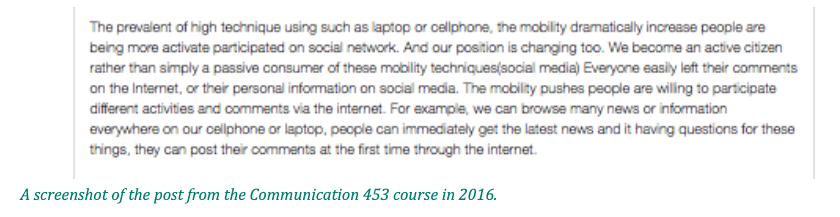
Back when I was finishing up my undergraduate degree, I enrolled in a fourth-year seminar called Issues in the Information Society. In that course, we were to post weekly contributions to the online discussion board about the assigned readings, and respond to the posts of our peers. Although this was in 2016, I remember reading one particular response that made me question the academic integrity and educational standards of my university. The post, written by an international student from China, read:
Upon reading the response, I wondered: how could it be that this student and I were both in a fourth-year course? How had this individual made it through three prior years of their Communication degree – three prior years of writing ten-page and fifteen-page essays – and passed with marks high enough to advance to their final year?
I have heard similar stories from others, who have witnessed presentations by international students struggling with their English language skills, or who have had frustrating experiences completing group projects with students they couldn’t communicate with. But many prefer to shelve these incidents at the back of their minds, as they feel bad for pointing them out.
The International English Language Testing System (IELTS) is used by universities and colleges to assess the linguistic competency of prospective international students, who must obtain a minimum score to gain admission. However, fraudulent IELTS certificates showing inflated scores can be bought online.
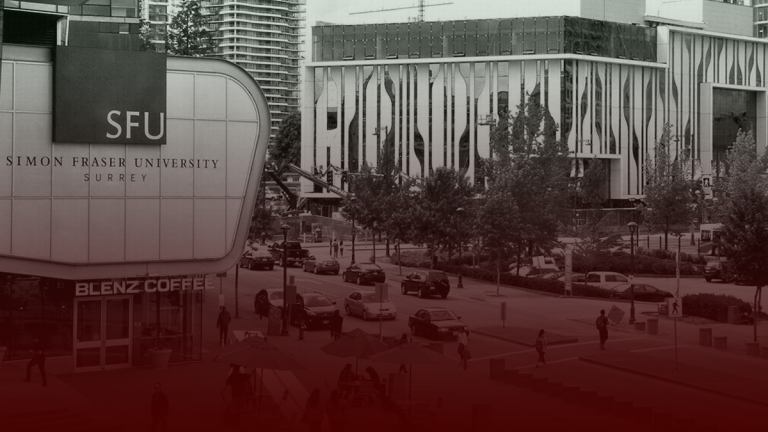
The school where I completed my undergraduate degree, Simon Fraser University (SFU), has a private college called Fraser International College (FIC) connected to it, which funnels in international students who cannot meet the academic or English requirements to be admitted to SFU directly. If they complete a couple of years at FIC, they are guaranteed entry to SFU. FIC advertises itself as “Your pathway to Simon Fraser University.”
Because postsecondary institutions do not receive government subsidies for international enrolment, international students generally pay triple the tuition fees of domestic students. This is what makes them so attractive to universities and colleges.
In fact, SFU received more tuition revenue in 2019 from undergraduate international students ($112.4 million) than it did from domestic students ($103.6 million), despite international students making up only about 20% of the undergraduate student population.
In 2014, the federal International Education Strategy stated it aimed to attract 450,000 international students to Canada by 2022. That goal has long been surpassed: in 2018, 721,205 international students held study permits in Canada.
The government likes to trumpet how international students contribute an estimated $21.6 billion to Canada’s GDP.
However, many stories have come out over the past year highlighting the underbelly of the international student boom. Jobandeep Sidhu, a mechanical engineering student at Canadore College in Mississauga, was deported in July 2019 for working more than the student visa-permitted 20 hours a week at his trucking job.
“The problem is we are paying three times the tuition fees [compared to domestic students] and we have a just 20-hour limitation for working … We’re actually forced to work more to pay for the expenses and the fees,” said Sidhu.
Although the stereotype of international students driving expensive cars and sporting luxury goods is still prevalent, there is a newer class of international students who pay to study in Canada with savings scraped up by their parents, funds borrowed from relatives, and income from work in Canada.
An investigation by the St. Catharines Standard and the Star quoted college instructors as saying “some international students don’t even show up regularly to class because they’re so busy working, often graveyard shifts, at places such as coffee shops, convenience stores, fast-food joints and hotels.” They add that the influx of international students is resulting in grade inflation.
There have also been reports of young South Asian women being subjected to sexual harassment in the workplace by their employers, but who cannot report the incidents because they have worked over their 20 hours a week limit and don’t want their employer to report them to border officials.
Despite the growing collection of these accounts, it is still a worthy pursuit for our postsecondary institutions to host international students, as well as maintain programs for Canadian students to study abroad. Cultural exchange is incredibly valuable.
But in its current form, international student recruitment seems to be about little more than profit and greed. Government policymakers and university officials are so hungry for GDP growth and international tuition dollars that they are turning a blind eye to slipping educational standards and forgetting that international students are humans, not cash cows.
It would be wise for our country to cut back on the number of student visas being issued while we wait for the administrators to sober up from their money high.
The Trudeau government will be taking the province of Alberta to the Supreme Court to try and save the carbon tax after a lower court ruled it unconstitutional.
In a 4-1 decision on February 24th, the Alberta Court of Appeals ruled that climate change is not a national issue that requires the federal government to have the overreaching power to force a tax on Albertans.
The court also called the carbon tax a “constitutional Trojan horse” that would intrude on provincial jurisdiction in multiple ways.
After the ruling, Alberta Justice Minister Doug Schweitzer wrote to the federal government to demand they end the carbon tax and reimburse Albertans.
“Albertans expect the government of Canada to abide by the decision of the court,” Schweitzer wrote to Federal Justice Minister David Lametti.
“If you do not respond accordingly to our demands, the government of Alberta will be forced to consider additional legal recourse to ensure that this unlawful tax on Albertans is removed and fully reimbursed.”
Schweitzer also says that regardless of what the Supreme Court decides, the federal government must stop collecting the carbon tax from Albertans in the meantime.
On Friday, Lametti wrote back to Schweitzer, saying that the federal government won’t do anything until the Supreme Court decides on the legality of the carbon tax.
“The Supreme Court will determine if a federal price on carbon pollution is constitutional, a decision that will answer this important question for our country as a whole,” Lametti said.
“Our government is confident that the price on carbon pollution is within federal jurisdiction.”
The ruling by the Alberta Court of Appeals has encouraged opponents of the carbon tax across Canada. Similar challenges failed in courts in Saskatchewan and Ontario in 2019 in split decisions.
Saskatchewan Premier Scott Moe said that one favourable ruling and two split decisions indicate that the carbon tax fight is far from over.
Several weeks ago, the main message from Canadian public health officials was that everything is under control and that the risk of a spread here was low.
Now, Health Minister Patty Hajdu is recommending we stock up on a couple weeks’ worth of food and officials believe Canada won’t be insulated and that minimizing the damage from a pandemic is now the objective.
This is not something we’re used to hearing. It sounds like it’s out of a movie. Then again, when you play the numbers game, it’s hard to believe this or something like it hasn’t happened sooner.
In recent news coverage of clashes between indigenous groups and the Canadian government, we have been seeing more of the term “settler.”
While it seems like a neutral term to denote “someone who has settled in a new place,” its usage has been politicized. What does the term mean, and should we be skeptical about how it is deployed?
True North’s Lindsay Shepherd gives you the overview.