After telling Canadians that cutting the $11.99/month Disney+ subscription is a tool to fight inflation, Finance Minister Chrystia Freeland has acknowledged her “privilege.” Freeland’s comments come as her fall fiscal update paints a rosier portrait of the government’s deficit projections than the Parliamentary Budget Office’s numbers support. Canadian Taxpayers Federation federal director Franco Terrazzano joins True North’s Andrew Lawton to discuss.
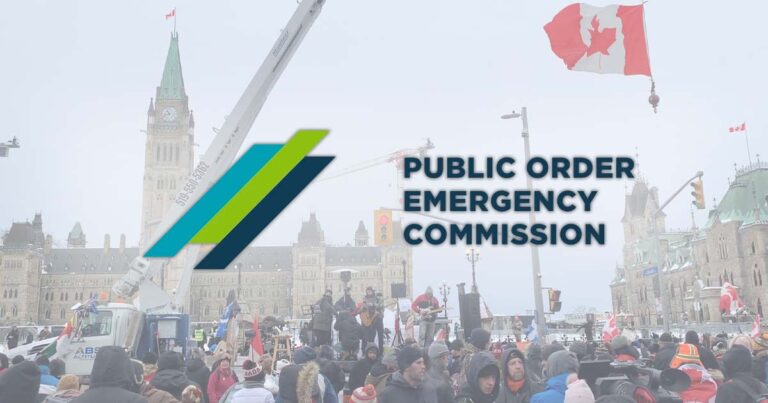
Also, the latest from the Public Order Emergency Commission as Canadians are reminded the Emergencies Act wasn’t needed to clear the Windsor/Ambassador Bridge blockade either.
That’s all I could think of as I visited Vancouver’s now infamous Downtown Eastside twice last weekend — the first time on a rainy afternoon and subsequently on the one afternoon during my stay when the sun came out.
Where do I begin?
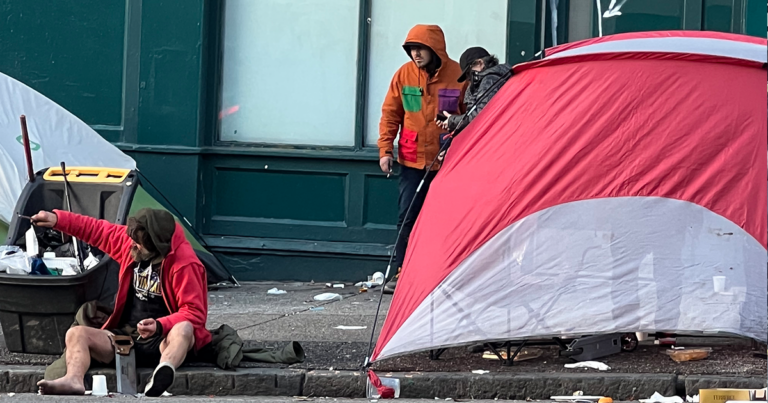
Imagine drug addicts clustered together on the sidewalk under make-shift lean-tos of tarps and rope surrounded by filth, empty food containers, clothes, shoes, garbage bags and bottles.
Cast your mind’s eye to rail-thin emaciated female drug addicts shuffling along East Hastings St. with nowhere really to go, an elderly Asian man dumpster diving (for what I don’t know) and dozens of drugged out people sitting on the sidewalk or cartons staring into space.
Think of trying to manoeuvre public sidewalks that have been taken over pretty much entirely for blocks by those makeshift lean-tos, scores of bikes, walkers, wheelchairs, wagons, shopping carts and of course the addicts.
As you pass, you observe one man standing in a drug-induced pose and several others shooting up with impunity in broad daylight.
The stench of urine, feces and pot is everywhere and at certain points along the street on the sunny afternoon, goods (perhaps stolen?) for sale were laid out on blankets.
This continued for blocks and blocks — the area growing sketchier the more I moved away from the corner where West Hastings turned into East Hastings.
It was like watching a horrifying multi-vehicle accident. I wanted to unsee the decay and the mass of zombie-like drugged out people clustered together. But I couldn’t take my eyes off this Apocalyptic scene.
I later told a colleague that it reminded me of a third-world country, as bad as the slums of Soweto in South Africa I visited 20 years ago.
It was hard to believe that a mere 20-minute walk away from this hellish site lay Canada Place, Vancouver’s seaport and the tony Coal Harbour area.
But this is proof of the harm of safe injection sites, a permissive out-of-control drug culture, politicians who have let the problem escalate and social justice do-gooders who are doing more harm than good.
I wanted very much to see for myself what has happened to the Downtown East side since InSite opened its first safe injection site in 2002.
Just prior to 2017 in Toronto — when the board of health and its chairman Joe Cressy did a sales job for the same permissive model here — a woman came to council from Vancouver to warn that the area was becoming a Dante’s Inferno.
I spoke to police officials in Vancouver at the time who contended that without enforcement and mandatory rehab, the SIS model wouldn’t work.
That was seven years ago. Vancouver’s East Side has turned into a horror show and even the streets surrounding it as far as Gastown have a sketchy feel.
In November of 2017 Cressy gleefully announced that the federal government had approved three safe injection sites for Toronto — insisting repeatedly the sites save lives.
Now Cressy has left his Councillor job and left the mess to others, as has Mike Layton and Kristyn Wong-Tam, all of whom pushed for the drug enabling sites.
That has grown in five years to nine supervised consumption sites and a variety of others located in hotel shelters under a program called I-Phare (Integrated Prevention and Harm Reduction Initiative) — a kind of one -stop shopping for drug addicts.
There’s no doubt these initiatives have attracted drug dealers and crime to the neighbourhoods where they are located.
Because they are more spread out than Vancouver, the addicts aren’t camped on the sidewalks of several blocks of East Hastings.
At least not yet.
But they certainly have wreaked havoc on the neighbourhoods where they are located.
Take the Bond Hotel shelter on Dundas St E., where I shot a video a few weeks ago while dealers plied their trade right behind me and zombie addicts occupied the sidewalk outside the shelter.
I spent considerable time outside the Street Health safe injection site, also on Dundas St. E., and The Works on Victoria St., both of which have severely changed the characteristics of the neighbourhoods they are in.
Dirty needles, crime, transients hanging out outside both sites and an increasingly sketchy vibe at Yonge-Dundas square and in Cabbagetown where hookers trade sex for drugs has been the norm.
Mayor John Tory and councillors have turned a blind eye to the increasing crime and refuse to connect the dots that lawlessness is on the increase because of these drug enabling philosophies.
The few Vancouverites who dared to speak up about InSite and Vancouver Coastal Health— which runs the safe injection programs —cited stats that deaths from overdoses have actually increased since 2002 and that a mere 3% of InSite users are referred for rehab.
They were loudly attacked by the harm reduction activists.
Now five years later, Vancouver’s East Side is a depressing and horrifying mess — one that will take extreme political will to ignore the noise of the activists and to clean it up.
It should certainly be a wake-up call for Toronto’s politicians.
If they think it can’t happen here, they’re sadly misinformed.
More agriculture experts are warning that the Liberal government’s arbitrary 30% fertilizer emission reduction for farmers could impact Canada’s food security.
During an Oct. 26 meeting of the House of Commons agriculture committee, Director of the Agri-Food Analytics Lab at Dalhousie University warned that the initiative could compromise Canada’s ability to grow food.
Charlebois explained to parliamentarians that “some of the discourse” around the targets was “quite concerning” to his lab and farmers as well.
Director of Dalhousie's Agri-Food Analytics Lab says he's "deeply concerned" about PM @JustinTrudeau's 30% fertilizer emission reduction target for farmers.
"Some of the decisions we're making may compromise our ability to grow food, and that's certainly one example." #cdnpolipic.twitter.com/mVCtLIpTKK
“I would say that I’m deeply concerned about the tone related to fertilizer emissions. Ask any farmer, whether in Saskatchewan or elsewhere, and it’s the fuel they need to support their soil in order to increase yields and better our food security situation. It’s quite essential,” said Charlebois.
“It’s important to do things to counter the impact of climate change and to make sure that we meet our gas emissions targets. At the same time, we also have to recognize that some of the decisions we’re making may compromise our ability to grow food, and that’s certainly one example.”
In 2020, the Liberal government first introduced the voluntary target which would require farmers to cut fertilizer emissions 30% below 2020 levels.
Board Chair of the Saskatchewan Wheat Development Commission Brett Halstead also testified before the committee. According to Halstead, the federal government has failed to recognize that the science around measuring emissions as a result of fertilizer use remains experimental.
“Fertilizer is essential to increasing production to improve global food security. The committee has recommended that the Government of Canada ensure access to affordable fertilizer to maximize yield benefits,” explained Halstead.
“Policy-makers must recognize the current limitations of scientific knowledge, the data and the regional and individual levels regarding fertilizer emission.”
Halstead’s comments reflect past statements made by agricultural groups, including past committee testimony by Founder and CEO of AGvisorPRO Robert Saik.
“There are a number of measurement devices that are being experimented with right now. If I was asked categorically if there was one that you would depend upon, I would say no,” Saik told parliamentarians on Oct. 4.
“They’re still trying to do regression analysis to find out if these measurement devices…. Satellite imagery to ascertain carbon in soils is still a long way off.”
In response to concerns from farmers that reaching such targets would harm food yields, Liberal Minister of Agriculture Marie-Claude Bibeau has blamed farmers for spreading misinformation.
Both provincial and municipal governments have taken steps to call on the federal government to drop the target. The latest group was the Saskatchewan Association of Rural Municipalities, which put forward a motion calling for the policy to be abandoned earlier this month.
“The Federal Government is planning to reduce fertilizer emissions by 30% by 2030 for Canadian agri-businesses,” the motion reads.
“Saskatchewan is an agriculturally based province, and such a reduction will have a major impact on food production and farm viability.”
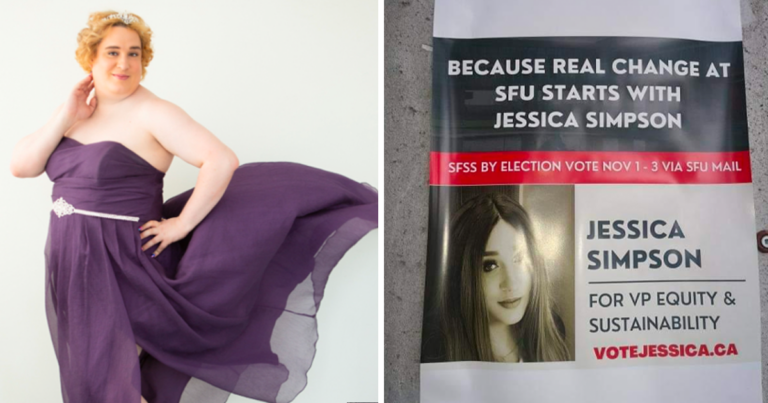
Controversial British Columbia transgender activist previously known as Jessica Yaniv – whose legal name is now Jessica Simpson – lost her recent bid to be a vice-president on the Simon Fraser University student union.
Official results released by the Simon Fraser Student Society show Yaniv placed second last in the by-election for VP Equity & Sustainability, receiving only 17 votes. The winner of the by-election received 142 votes.
Controversial B.C. trans activist Jessica Yaniv (who now goes by Jessica Simpson) came in second last in the Simon Fraser University student union VP for Equity & Sustainability election. #CampusWatchpic.twitter.com/55n8BsQnO0
Yaniv shared her intentions to run for the student union in an October Facebook post. Photos posted to social media show that posters for Yaniv’s campaign made an appearance on Simon Fraser’s campus.
"Jessica" Yaniv is running to be elected VP Equity of the Simon Frasier University Student Union. pic.twitter.com/TusZmPPfqv
Yaniv’s platform included advocating for an “increased permanent hiring of Black, Indigenous, Transgender, and other underrepresented communities Counsellors” at the university’s health and councilling services.
Yaniv, who is currently studying criminology and gender studies, also pledged to “deliver on the undelivered promises of SFU administration to finally get sanitary product dispensers (which are sustainable and free) installed in all restrooms on all campuses.”
Yaniv is back in the news, running for the Simon Fraser University student union. Here is one of their campaign graphics, featuring a tampon… pic.twitter.com/qhbBjx2ZSC
One of Yaniv’s campaign graphics featured an image that resembled a bloody tampon. Prior to the results being released, Yaniv had accused the Simon Fraser Student Society of election rigging and voter fraud.
FINALLY my platform has been published by @SFSS1, with just 12 hours left to vote. So essentially, 60 hours of fraudulent, rigged voting. https://t.co/WM0kp3cM7p
The transgender activist had been previously embroiled in several controversies that garnered national media attention – most notably, the filing of human rights complaints against multiple aestheticians who refused to wax her male genitalia.
The human rights complaints were dismissed by the tribunal, and Yaniv was ordered to pay three beauty salons a total of $6000.
As reported by the National Post, the tribunal’s ruling stated that Yaniv “targeted small businesses, manufactured the conditions for a human rights complaint, and then leveraged that complaint to pursue a financial settlement from parties who were unsophisticated and unlikely to mount a proper defence.”
Yaniv was also arrested and charged in 2019 after brandishing a taser during a heated livestream with American conservative transgender YouTuber Blaire White. Yaniv later pleaded guilty to a prohibited weapons charge.
True North reached out to Yaniv for comment and was told to “f**k off.”
Canadians have been on the hook for over $156 million in the form of raises and bonuses for CBC staff since 2015.
According to the Canadian Taxpayers Federation (CTF), employees received an average of $14,200 per year in the form of bonuses while salary raises averaged at $1,800 a year.
In total, the state broadcaster lavished its staff with $51 million in bonuses and raises during the pandemic.
“If the CBC has enough money lying around to hand out millions in bonuses and raises during a pandemic, then taxpayers shouldn’t be forced to fork over more money,” said CTF Federal Director Franco Terrazzano.
“The CBC should stop handing out bonuses and raises instead of taking more money from taxpayers.”
The revelation comes shortly after Prime Minister Justin Trudeau promised an additional $42 million for the CBC in the federal government’s 2022 Fall Economic Update.
Hidden within the plan is a pledge to give the broadcaster $21 million over two years to “offset revenue losses related to the ongoing impact of the Covid-19 pandemic.”
A recent report by the Auditor General of Canada presented to the CBC’s Board of Directors shows that the CBC received $1.24 billion in funding from taxpayers in 2021-2022.
“The CBC shouldn’t be taking more than $1 billion from taxpayers every year,” said CTF Alberta Director Kris Sims.
“It’s tone deaf for the CBC to hand out pay raises and bonuses while many workers in the private sector took pay cuts and lost their jobs.”
In the audit, the Auditor General also blasted the CBC for having poor disaster recovery and business continuity plans.
“The corporation had IT disaster recovery and business continuity plans, as well as a policy and procedures related to its business continuity plans,” the Auditor General concluded.
“However, the corporation did not require testing of disaster recovery and business continuity plans at set intervals. The plans were tested in specific situations, such as the implementation of a new system or during real-life scenarios—for example, when the COVID-19 pandemic reached Canada.”
British Columbia’s Coroners Service (BCCS) released a grim report on Monday showing that over 1,600 Canadians died from illicit drugs in the first nine months of this year.
According to chief coroner Lisa Lapointe at least six British Columbians are dying each day from overdoses.
“Both those who use drugs occasionally and those who are substance-dependent are at risk of sudden death from the unpredictable illicit market,” warned Lapointe.
“Individuals who have been abstinent for a period of time or those who normally use stimulants are at increased risk. Their opioid tolerance is low and the prevalence of fentanyl in the illicit supply is high.”
In total, a record 1,644 people died in the first nine months of 2022. Drug deaths are the leading cause of unnatural death in BC with 10,505 people dying since a public health emergency was first declared in 2016.
The highest numbers of deaths occurred in Vancouver, Surrey and Victoria – three municipalities that all saw new mayors elected in the 2022 municipal election.
Addiction and homelessness were key issues for voters this year, especially in Vancouver.
Mayor-elect Ken Sim defeated incumbent and one-term mayor Kennedy Stewart after the ballot question heavily shifted toward discussions surrounding public safety.
While running for ABC Vancouver, Sim promised that he would prioritize hiring 100 additional police officers to the Vancouver Police Service as well as 100 mental health workers.
“100 new police officers and 100 new mental health workers is (my) commitment, 25 counsellors is the Kennedy Stewart commitment,” said Sim on Sept. 21.
“Vancouver needs leadership that recognizes the fact that our City is in crisis.”
Sim’s run received the endorsement of the Vancouver Police Union – a move which many progressive critics criticized as damaging to the independence of law enforcement.
Vancouver is holding its inaugural council meeting on Monday evening.
Doretta Wilson wasn’t at all surprised to see Ontario education workers’ recent strike action shut down schools for a couple of days. The former executive director for the Society for Quality Education, Wilson’s been advocating for change in the system since the days when education unions were taking issue with the Liberal government of Premier David Peterson in the 1980s.
“This is nothing new. This happens every negotiation,” says Wilson, reflecting on the long saga of education strife in the province, in an interview with True North.
“We’ve got to get around all of this constant labour strife. The way to do that is to offer some competition in the system and school choice is that competition,” says Wilson.
The thinking is that more choice allows parents who can’t afford private schools the ability to depart the current rigid public system if they’re unhappy with the quality of it or the way labour negotiations are empowered to hold kids hostage. The public boards will then be encouraged to up their game if they know there is competition.
Wilson has been a proponent of school choice for decades — pointing out how there were hopes of it happening in the Mike Harris Progressive Conservative government as well as rumours of it in the works under the Dalton McGuinty Liberal government. But it never came to pass.
“My belief is that it stopped because the unions control education in Ontario,” Wilson observes.
How school choice can work in Ontario, is the government grants charters for independent schools to open and funds them on an amount that’s set per student.
“School choice isn’t just about sending kids to private schools,” Wilson explains. “Alberta has chartered schools. They’re public schools, it’s just that they operate independently from the regular school system.”
Alberta long capped the number of charter schools in the province to 15, but as demand grew former Premier Jason Kenney’s government recently expanded the number. The charter school model has been applied in the United States, United Kingdom, Sweden and other countries.
“Charter schools were originally started in the United States by teachers so teachers would have the freedom to teach methods that they knew would work,” Wilson says, adding that such schools are often specialized, whether it involves a focus on a particular subject (say, STEM-based or arts-based) or one more rooted in a particular religion.
The past few days in Ontario have seen education union activists offer aggressive critiques on social media of school choice and claim that Ontario Premier Doug Ford plans to somehow privatize the education system.
“The reason teachers’ unions don’t like them is because they’re not unionized,” Wilson adds. “They have much more freedom and flexibility in how they operate.”
Wilson points out that in practice charter schools are more accountable than public schools in that they can lose their charter license if they run afoul of financial rules or academic achievement. “When have we ever brought any public school board or school to task for not being financially or academically accountable?” she says.
But while school choice may seem like a no-brainer to anyone outside of the education union message machine, a source familiar with government thinking on the matter told True North that the Ford government is not in fact currently planning to implement school choice.
It looks like real change will only happen once the people demand it.
“We’ll continue to go through [these strikes] until there’s an alternative,” says Doretta Wilson.
It’s Tuesday November 8, 2022 and this is the True North Daily Brief. We’ve got you covered with all the news you need to know.
On Day 18 of the Emergencies Act hearings, documents revealed that Canadian intelligence officers told Prime Minister Trudeau that invoking the Emergencies Act would lead some protesters to become violent toward law enforcement officials.
Plus, as education workers in Ontario return to work today, a school board is demanding that the government discourage values such as “love of country” and “Judeo-Christian morality.”
Finally – are you struggling with high food prices? No need to fret. Chrystia Freeland says just cut your Disney+ subscription!
Tune into The Daily Brief with Anthony Furey and Jasmine Moulton.
Two troubling pieces of legislation are set to become law, and could have drastic implications for how Canadians access the internet. Bills C-11 and C-18 would give the government unprecedented powers to regulate what type of content Canadians are able to view online and stifle free speech.
The government claims that more regulation of the internet is needed in order to combat hate speech and protect vulnerable groups. It’s time for a reality check.
On this episode of Reality Check, Jasmine explains how both bills are redundant and counterproductive. Jasmine says Canadians can choose what they want to say and hear and that this shouldn’t be up to the government to decide.
Tune into the final episode of this season of Reality Check with Jasmine Moulton!
On Day 18 of the Emergencies Act hearings, documents revealed that Canadian intelligence officers told Trudeau that invoking the Emergencies Act would lead some protesters to become violent toward law enforcement officials.
Under questioning from Convoy lawyer Brendan Miller, Windsor mayor Drew Dilkens was presented with a document from the Canadian Security Intelligence Services (CSIS) that indicated that they cautioned Prime Minister Justin Trudeau prior to invoking the never-before-used Act, saying that its invocation would “galvanize” protesters towards violence.
The document states that CSIS officials attended three cabinet meetings prior to the invocation of the Emergencies Act (EA) and that on February 13th – the day prior to invoking the Act – CSIS told cabinet, “the implementation of the EA would likely galvanize the anti-government narratives within the convoy and further the radicalization of some towards violence.”
The document also states that in that same February 13th meeting with cabinet, CSIS advised the government that although invoking the EA would “likely lead to the dispersing of the Ottawa protest”, the invocation would push Canadians to believe that “violence is the only solution to what they perceive as a broken system and government.”
Convoy lawyer Brendan Miller shows Windsor Mayor Drew Dilkens a document from CSIS predicting that if the Emergencies Act was invoked it may cause protesters to become violent.#POECpic.twitter.com/cuLbi93Dks
In prior testimony to the Commission, Ontario Provincial Police intelligence chief Pat Morris testified that there was no evidence of violence that had occurred on the part of the protesters throughout the Freedom Convoy, despite multiple acts of violence on the part of law enforcement officials when clearing the Ottawa protest.
Despite this, Public Safety Minister Marco Mendicino accused protesters at a February 16 press conference of committing “acts of violence.” Mendocino even went as far as to accuse the protesters of “threats of rape” toward Ottawa residents before having to walk back his accusations after not being able to present supporting evidence.
Earlier on in the day, Dilkens told Commission lawyers that the City of Windsor didn’t need to use any of the measures in the Emergencies Act to clear the blockades since the Ambassador Bridge was already cleared prior to the government invoking the act.
Protesters in Windsor blockaded the border crossing at the Ambassador Bridge on February 7. The bridge reopened to border crossings the next day, but a blockade on the bridge continued until February 13 – a day prior to Trudeau invoking the Act.
“The (Ambassador Bridge) blockade was cleared and the bridge reopened before the Emergencies Act was invoked, is that right?” a lawyer representing the Commission asked Dilkens.
“The 13th, around midnight, into the 14th I think the bridge opened so the Emergencies Act was invoked on the 14th, so yes. The answer to your question is yes,” the Windsor mayor replied.
“So none of the measures in the Emergencies Act were used to clear the blockades since it came after, correct?” the lawyer asked.
“Correct,” the mayor responded.
Mayor of Windsor Drew Dilkens testifies that none of the measures of the Emergencies Act were used to clear the blockades on the Ambassador Bridge during the Freedom Convoy. #POECpic.twitter.com/zLiCYHVRIg
Later on in the afternoon, the Interim Deputy Chief of the Windsor Police Service Jason Crowley reiterated Dilkens’ answers to Commission lawyers by saying that none of the powers in the Emergencies Act were used to clear the Ambassador Bridge blockade.
“Is there anything that the Emergencies Act added to the situation or helped you in any way to clear the blockade?” a Commission lawyer asked Crowley.
“I can’t imagine it didn’t dissuade people from coming back, but that’s just speculation. We did not use the Emergencies Act at all.” Crowley replied.
Interim Deputy Chief of the Windsor Police Service Jason Crowley testifies that they did not use any powers given to them after the Emergencies Act was invoked to clear the Ambassador Bridge protest in Windsor.#POECpic.twitter.com/nq0ai0pb4n
Meanwhile, a federal judge in Toronto ruled that Ontario Premier Doug Ford shouldn’t be forced to testify at the hearings in front of Commissioner Paul Rouleau In Toronto. Judge Simon Fothergill reasoned that Ford and Deputy Premier Sylvia Jones are granted immunity from taking the stand due to “parliamentary privilege”.
Judge Fothergill wrote, “The privilege provides the premier and minister with a lawful excuse not to comply with the summonses issued by the commissioner on Oc. 24, 2022.”
The Judge however agreed with Commissioner Rouleau’s right to summon the defiant Premier and concluded that Ford and Jones would have valuable information to provide the commission if they chose to testify.
“I am satisfied that the commissioner had jurisdiction to issue the summonses. The matters in respect of which the premier and minister have been called to testify are within the scope of the commissioner’s mandate, and it appears that both witnesses may have valuable evidence to offer.”
What happens next?
Police officers from the OPP, Toronto Police and the Alberta RCMP are scheduled to testify this week along with protesters from the Coutts Border Blockade.
Hearings resume tomorrow morning at 9:30am ET.
True North will continue to provide daily coverage of the Emergencies Act hearings.