Chinese ambassador urges Liberals to approve Huawei 5G tech

China’s Ambassador to Canada Cong Peiwu urged the Liberal government to allow Huawei technology onto its 5G network during a Centre for International Governance conference on Tuesday. 

According to Cong, security concerns around the Chinese company were “invented by the United States and the main purpose is to crack down on Huawei.”

Cong also stated that he “hoped that lessons will be learned” by the Canadian government from the Meng Wanzhou incident. 

Earlier this year, the US Justice Department struck a deal with the Chinese government to secure the release of Huawei CFO Meng, who was being held in Canada over allegations that she broke US sanctions on Iran. 

In return for Meng’s release, China freed Michael Kovrig and Michael Spavor, who were detained by Chinese authorities in retaliation to Meng’s arrest. 

Numerous experts have cited concerns regarding Huawei’s relationship with the Chinese government. As a Chinese company, the corporation is bound by laws passed by Beijing requiring private entities to cooperate with the country’s intelligence operations. 

Former CSIS director Ward Elcock is among those who have raised the alarm about the potential threats of allowing Huawei onto Canada’s network.

“The state in China being what it is, even though Huawei is an independent company … [the government] would have the capacity to ask and demand Huawei’s assistance in collecting intelligence,” said Elcock in 2020.

Prime Minister Justin Trudeau has dragged his feet on a Huawei ban for some time now, making Canada the only Five Eyes nation to not have prohibited the company. 

Several telecommunications companies including Bell and Telus have already committed to not use Huawei hardware in their 5G infrastructure over concerns that Beijing could use the tech as a backdoor to spy on Canadians. 
Only nine countries more restrictive than Canada with COVID measures

Canada is the tenth most restrictive country in the world when it comes to overall government COVID-19 measures, according to the University of Oxford’s COVID-19 Government Response Stringency Index. 

The index compares the strictness of pandemic “lockdown style” restrictions.The score, which ranges from 0-100 – with 100 being the most stringent measures possible – takes into consideration policies like school closures and travel bans. 

Currently, Canada’s score sits at 69.91, making it more restrictive than countries such as Iran (61.57), Russia (60.65) and China (59.72). 

Leading the pack is Germany, which has a stringency score of 84.26. Currently, the German government is considering making COVID-19 vaccination mandatory for its citizens. 

Incoming Chancellor Olaf Scholz has also called for a “lockdown of the unvaccinated” in Germany, and the country’s Bundestag will soon debate the prospect of nationwide compulsory vaccination. 

Austria scored a stringency rate of 73.15. It too is considering a compulsory mandate, including a potential €7,200 fine for those unwilling to get vaccinated.

While Canada has not yet openly considered a nationwide vaccine mandate, its existing COVID restrictions have reached into many areas of public and private life. 

Many sectors now require proof of vaccination for employees, and a federal mandate recently came into effect that bars unvaccinated Canadians from boarding planes and trains nationwide. 

The Justice Centre for Constitutional Freedoms (JCCF) is challenging the travel ban in court. 

Unvaccinated Canadians cannot leave the country even though the CBSA has confirmed to True North that unvaccinated migrants are being escorted into Canada. 

On Friday, Conservative MP Stephen Ellis blasted the federal government for “alienating millions of unvaccinated Canadians with more and more restrictive mandates.” 

“Unfortunately, we do hear from them over and over that they are losing their jobs, they are losing their pensions, they are concerned about losing their house and how they are going to provide for their family,” Ellis continued. “Those are not the types of policies that are going to help us fix this situation.”

Canadian provinces fail to crack top ten places for gas and energy investments

Oil and gas investors are looking elsewhere to invest after Canada’s energy industry has been dogged by constant development delays and illegal protests. 

The Fraser Institute’s 2021 Canada-US Energy Sector Competitiveness Survey surveyed 71 senior petroleum executives and found that gas-producing Canadian provinces didn’t make their top ten list of places to invest.

All ten spots went to US states, with Texas coming in as the most desirable place to invest in energy and petroleum.

Alberta and Saskatchewan ranked 12th and 11th respectively. Newfoundland came in 16th, British Columbia landed in 18th place and the Northwest Territories came in 20th. 

“Policies matter, and when investors are clearly indicating they would rather invest in American states instead of Canadian jurisdictions, policymakers should take note,” said Fraser Institute policy analyst Jairo Yunis in a press release

The major concerns investors cited with regard to investing in Canada were “uncertainty concerning environmental regulations, regulatory duplication and inconsistencies, and the cost of regulatory compliance as major areas of concern in Canadian jurisdictions compared to U.S states.”

Investors were also concerned about Canada’s political stability as well as its inability to ensure the security of energy development personnel and equipment. 

In recent months, tensions at the BC LNG Coastal GasLink site came to a head after illegal protests resulted in company equipment being sabotaged and destroyed. 

Protestors also blockaded road access to the development site in Northern B.C., leaving 500 pipeline workers stranded without access to food and water.

The events prompted the RCMP to move into the area and clear the protests on a court-ordered injunction. 

Prime Minister Justin Trudeau’s latest commitment to cap Canada’s oil and gas sector emissions was blasted by Alberta Premier Jason Kenney for targeting the industry unfairly. 

“I don’t know why they would make such an announcement without consulting the province with the most oil and gas reserves in Canada,” Kenney said.

“The (federal government) has zero chance of achieving its greenhouse gas reduction goals without Alberta’s oil and gas industries. Let’s be a partner in that.”

Elected officials silent on New Brunswick barring unvaxxed from grocery stores

Four days after the New Brunswick government announced that grocery stores are allowed to ban unvaccinated Canadians, elected leaders have remained mute.

True North reached out to numerous politicians and their offices – named below – for comment. People’s Party of Canada (PPC) leader Maxime Bernier was the only political figure who responded to condemn the measure.

“Mr. Bernier absolutely believes this measure violates our fundamental rights, and doesn’t think it is reasonable at all,” PPC spokeperson Martin Masse told True North. “It’s simply another authoritarian measure to put pressure on unvaccinated people to get vaccinated and has no scientific basis in terms of preventing the spread of the virus.”

“Even worse, people who live in rural areas with few stores and none that offer home delivery could be left with no easy access to food. This is completely reckless and immoral on the part of the N.B. government.”

Bernier also tweeted at the New Brunswick government, calling them fascists and saying this was “a red line.”

True North reached out to Conservative leader Erin O’Toole’s office, the Prime Minister’s office, the office of the Premier in New Brunswick and the People’s Alliance of New Brunswick caucus. None offered comments by deadline. Conservative New Brunswick Senator Rose-May Poirier also failed to respond.

True North spoke twice with Conservative New Brunswick MP John Williamson’s assistants but received no comment after being told Mr. Williamson would review the requests.

True North also spoke with the media coordinator for the People’s Alliance of New Brunswick but heard nothing from MLAs Kris Austin and Michelle Conroy.

Even Canadian intellectual Jordan Peterson has noticed the silence, asking “Canadian Conservatives … Where have they gone?”

The Justice Centre for Constitutional Freedoms (JCCF) announced Tuesday that it had sent a warning letter to the New Brunswick justice minister.

In addition to the vaccination requirements for grocery stores, the JCCF opposes the government’s order that certain faith gatherings such as weddings and funerals require proof of vaccination while non-faith gatherings do not.

The JCCF condemned New Brunswick’s measures in stark language, referring to food as “a fundamental Human Right enshrined in various international instruments.”

“An invitation to the private sector to consider such egregious discriminatory practices triggers historic Charter violations,” said JCCF lawyer Andre Memauri. “Potentially depriving citizens of food constitutes an act of cruelty. It is discriminatory, unconstitutional, and likely an offence under international law. No one should be barred from the ability to purchase food to feed their family.”

“Canada is better than this,” Memauri added.

The province’s winter action plan, including the measure involving grocery stores, went into effect on Dec. 4.

Bank of Canada suspends unvaccinated employee who works from home

A work-from-home Bank of Canada employee who asked for a religious exemption from the COVID-19 vaccine has been suspended without pay, according to Blacklock’s Reporter. 

“It hurt so badly,” former Bank of Canada IT project manager Evelyn Egboye told Blacklock’s Reporter. “I just wanted to work. How can someone tell me I cannot work?”

Egboye, who has been working at the Bank of Canada for four years, was suspended last week. 

Egboye said she was not going into the office because she had been working remotely since March 15, 2020. She had been advised since that time to not go into the office. 

The Bank of Canada has threatened to suspend or fire employees who refuse to disclose their vaccine status or who cannot prove they have been vaccinated against COVID-19. 

Management claimed it would consider religious exemptions – as required by the Treasury Board of Canada’s vaccine policy –  but it rejected Egboye’s request. 

Egboye explained in her request dated Oct. 28 that she was a born-again Christian, and she cited nine passages from the Bible explaining her opposition to mandatory vaccination. 

Her request was accompanied by a letter from her pastor confirming she belonged to a congregation “commanded to live in light of God’s moral commands,” including resistance to mandatory vaccination programs. 

The bank rejected her request without explanation. 

Egboye said she has since been locked out of her computer, her credentials have been suspended and she has lost her benefits. 

“The Bank was a very friendly place to work, very understanding,” she said. “These are not the people I knew.”

The Treasury Board said in a memo from Oct. 6 that religious exemptions must be granted to employees regardless of whether their place of worship has any teaching on vaccination. 

This suspension seems to contradict a landmark decision by the Supreme Court of Canada that ruled the state has no right to arbitrate religious beliefs. 

The decision came where Orthodox Jews in Montreal were accused of breaching condo bylaws by erecting sukkahs on their balconies. The ruling stated that condominium managers had no business questioning whether tenants’ convictions complied with Jewish law. 

Salvation Army short on 1,500 volunteers after mandating COVID-19 vaccine

The Salvation Army is looking for volunteers to fill 1,500 shifts in Edmonton after the charity made vaccines mandatory for its Christmas kettle volunteers.

The organization’s website states that “some volunteer opportunities within The Salvation Army Edmonton locations are currently suspended due to Covid-19 precautions.” 

They are seeking to raise $600,000 by Christmas Eve.

“We’re quite dependent upon the support of the public during the Christmas season in this campaign to keep our homeless shelters open and running,” Salvation Army spokesman Jamie Locke told the Edmonton Journal.  

“We know that’s reflective of all the challenges that we’re collectively facing in trying to get back out and being in public settings. So it’s helpful to try and get the word out there that the Salvation Army needs volunteers. Without our volunteers and supporters, there is no way the mission of the Salvation Army could be accomplished.” 

As exclusively reported by True North fellow Andrew Lawton, the organization confirmed earlier this month that it would turn away unvaccinated volunteers. 

“All Salvation Army staff (employees, officers, volunteers) providing on-site and in-person services are required to be fully vaccinated against COVID-19,” Salvation Army spokesperson and lieutenant-colonel John Murray told True North.

“The Salvation Army continues to follow all provincial and federal public health policies and guidelines as it relates to COVID-19 because our number one priority remains the health, safety and well-being of our clients, employees, officers, volunteers, guests, donors and communities.”

The vaccine mandate went into effect on November 15, 2021 and applies to ushers, greeters and Sunday school teachers. 

As a result of the decision, Williams Lake Salvation Army in BC lost 80% of its volunteers forcing the organization to close its drop-in centre and discontinue feeding the homeless. 

“I am beyond hurt that my own church is engaging in medical segregation,” Salvation Army member and 25-year volunteer Connie Fournier told True North. “That goes against everything William Booth (and Jesus, for that matter) represented. The Salvation Army was formed to minister to the most downtrodden and socially rejected members of society. Today, they themselves are doing the rejection.”

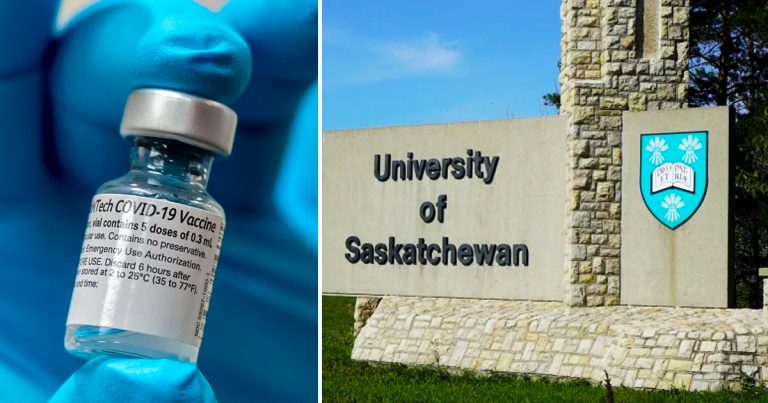
University of Saskatchewan introduces its own three-dose vaccine policy

Students will need “at least two doses” of COVID vaccine to avoid being kicked off the University of Saskatchewan campus in January, and will require a third dose whenever they’re “eligible.”

The announcement comes as the school plans to deregister students who do not “show proof of receiving at least two doses” of COVID vaccine by Jan. 4. Rapid testing, which was allowed in the fall term, will no longer be accepted.

The university website provides its own “USask definition” of what it is to be fully vaccinated, including “three doses of a COVID-19 vaccine not approved by Health Canada.”

According to the “winter term vaccination requirements,” students already fully vaccinated don’t need to do anything “at this time.”

“However, when you are eligible for your third COVID-19 booster shot, proof of that will be required for you to continue to be considered fully vaccinated.”

The university encourages students to keep an eye on the government’s announcements for their eligibility.

The Saskatchewan government has made no mention that people being eligible for a third dose will require it to be considered fully vaccinated.

The government’s booster roll-out announcement is simply about “permitting eligible age and at-risk groups to receive their booster or third dose.” These groups were expanded on Tuesday to include 50 year-olds.

The university’s policy comes even as it reports “outstanding” vaccination rates, including 97% of students and 98% of faculty and staff.

The Justice Centre for Constitutional Freedoms (JCCF) has recently filed a lawsuit against the University of Saskatchewan for its upcoming vaccine restrictions.

Saskatchewan Polytechnic reversed its “vaccine-only” policy after similar pressure but has announced that the cost of rapid tasting must now be borne by the recipient. The JCCF puts these costs at $200 per week or more.

JCCF lawyer Andre Memauri called the schools’ policies not only a violation of basic rights but also irrational.

“Education is an essential service and at this point, with the emerging data and scientific literature, Universities have no valid justification for discriminating against students based on their private medical choices,” said Memauri.

Ethan Fisher opposes the University of Saskatchewan’s policy. He is a first-year law student at the school, as well as a regional coordinator with Students for Liberty.

“We were going to take our tests,” he told True North. “We did it often. It was clear that we were not bringing COVID onto campus. People who are vaccinated can still transmit the disease, and this is well borne out by the data. If someone had been confirmed to not have the disease within a day or two, it’s probably a lot more reliable an indicator than if someone had the vaccination six months ago.”

The vaccine-only mandate will come on top of pre-existing practices, including indoor masks, distancing and enhanced cleaning. This will be the case as the pandemic “is projected to continue … for the next several months.”

Poll shows most Canadians support private health options

A majority of Canadians support health care reforms including private options and private-public partnerships, according to a poll released by SecondStreet.org on Monday. 

These reforms include governments hiring clinics to reduce wait times, allowing patients to pay for services they want at private clinics as well as better data-gathering when it comes to patients dying while waiting for government health care services. 

The poll was conducted for SecondStreet.org by Leger between Nov. 26 and 29. 

SecondStreet.org president Colin Craig said that health care wait lists have never been longer, and it is causing problems for patients. 

“Our new poll shows Canadians are open to reform,” said Craig. “That’s positive as Canada could improve results by copying what some other countries do.”

The poll suggested 67% of Canadians support provincial governments hiring private clinics to provide health care to reduce waitlist backlogs. There were 18% of respondents who said they oppose hiring private clinics, and 15% of them do not know. 

A private-public partnership is being used by several provinces to reduce their backlogs, but it has faced some opposition. 

The poll claimed 62% of Canadians “strongly support” or “support” allowing people to spend their own money for health care services at private clinics. There were 26% of respondents who oppose allowing people to spend money at private clinics, while 12% of them do not know. 

Support for this option has gone up since the beginning of the pandemic, which was at 51% in March 2020. 

The poll goes on to show that 79% of Canadians think governments should monitor cases where patients die while waiting for health care. Meanwhile, 9% of respondents oppose data monitoring, and 12% of them do not know. 

SecondStreet.org research has shown that such data is often not tracked by health bodies. 

Conservative Leader Erin O’Toole said in an interview during the 2020 Conservative leadership race that he supported health care reform. 

“We need to ensure universal access remains paramount,” said O’Toole. 

Deputy Prime Minister Chrystia Freeland posted a doctored version of the interview to Twitter in August, claiming O’Toole wanted to bring private for-profit health care to Canada. 

Freeland’s tweet was flagged as manipulated media soon after it was posted. 

The hypocrisy of protecting critical infrastructure

Why is it illegal to protest outside a hospital, but not illegal to block highways, pipelines and forestry projects?

Why is the radical left allowed to wreak havoc on the economy, stop critical infrastructure and block blue collar and First Nations workers from accessing their job sites? Why are radical environmentalists allowed to break the law with impunity?

On today’s episode of The Candice Malcolm Show, Candice is joined by British Columbia independent journalist and aspiring politician Aaron Gunn to talk about the total absence of common sense in today’s politics.

SUBSCRIBE TO THE CANDICE MALCOLM SHOW

China manipulating Canadian media, CSIS warns Trudeau

China is currently manipulating Canadian media using foreign interference tactics, the Canadian Security Intelligence Service (CSIS) has warned. 

The warning stems from a briefing CSIS Director David Vigneault had with Prime Minister Justin Trudeau a few months ago. The intelligence agency cautioned that interference by foreign powers in Canada’s affairs has become “more sophisticated, frequent, and insidious.” 

According to briefing memos obtained by the CBC, Chinese-Canadian media outlets are a prime target for communist China’s propaganda. 

“In particular, PRC media influence activities in Canada have become normalized,” the memo states. 

“Chinese-language media outlets operating in Canada and members of the Chinese-Canadian community are primary targets of PRC-directed foreign influenced activities.”

The buck doesn’t stop at diaspora media, however. CSIS spokesperson John Townsend warned that China’s foreign influence operations have also targeted legacy media outlets to spread coverage favourable to Xi Jinping’s authoritarian regime.

“Mainstream news outlets, as well as community sources, may also be targeted by foreign states who attempt to shape public opinion, debate, and covertly influence participation in the democratic process,” Townsend told the CBC.

“Considering Canada’s rich multicultural makeup, foreign states may try to leverage or coerce individuals within communities to help influence to their benefit what is being reported by Canadian media outlets.”

The latest target of a foreign interference campaign was former Steveston–Richmond East Conservative MP Kenny Chiu, who faced a targeted misinformation operation during the 2021 federal election. 

Various Chinese-language outlets and social media groups on the popular app WeChat falsely painted Chiu and the Conservatives as being anti-Chinese.

In reality, the Conservative Party has taken a hard line against human rights abuses perpetrated by the communist Chinese regime against the country’s Uighur and Turkestani minorities.

“If that’s the normal behaviour, then we should really become concerned,” said Chiue. 

“I just felt, first of all, very sad. I feel ridiculous. I feel sad because some of my fellow Canadians of Chinese descent, why would they even believe in this information?”

Chiu narrowly lost the election to Liberal candidate Parm Bains.