
As we approach nearly two years of intermittent lockdowns and restrictions, it’s clear the advisors surrounding Canadian lawmakers are not concerned with the implications of these measures beyond case counts. Lockdowns have created economic, legal and medical challenges that seem to have gone unnoticed by many of the so-called expert. True North’s Andrew Lawton spoke to Irvin Studin, president of the Institute for 21st Century Questions, who’s assembled a committee of science and policy experts to put forth a real, concrete reopening plan to end lockdowns for good.
Canada’s cyberspy agency warns of Russian cyber attacks

Canada’s top cyber security agency has warned that Russia could launch high-tech attacks on critical infrastructure.
In a statement put out by the Canadian Centre for Cyber Security, Canadian companies are urged to be vigilant and to watch out for cyber attacks.
“The Canadian Centre for Cyber Security encourages the Canadian cybersecurity community — especially critical infrastructure network defenders — to bolster their awareness of and protection against Russian state-sponsored cyber threats,” the agency wrote in a statement.
This comes as Western nations prepare to respond to Russia amassing thousands of troops and military equipment at its eastern border with Ukraine.
The embattled Eastern European country has called for the assistance of the international community to head off a possible invasion.
Canada and other nations have banded together to impose sanctions on President Vladimir Putin’s Russia in response to the situation, but Russia’s Ambassador to Canada Oleg Stepanov downplayed their effect.
“Actually, in Russia, and the Russian government, and I can tell you frankly, nobody cares about Western sanctions anymore…because they don’t work and they don’t bite, they don’t inflict any real influence or any practical outcome,” Stepanov told CTV News.
Most recently, a small group of Canadian special forces were dispatched to Ukraine to provide the country with assistance in the worst-case scenario.
“The goal is to make sure that we can contribute to their increased capacities, capabilities, in light of the Russian threat and also a further invasion from Russia,” said Foreign Affairs Minister Melanie Joly.
“Russia is the aggressor and we need to make sure we stand shoulder-to-shoulder with Ukraine.”
Canada has been long-involved in the country through Operation UNIFIER, as well as with training Ukraine’s new federal police force. As part of the operation, Canada sends 200 Canadian Armed Forces members to Ukraine every six months.
“As of September 30, 2021, 30,076 Security Forces of Ukraine (SFU) candidates have participated in the training provided via 623 course serials spanning all lines of effort since the start of the mission in September 2015. This number includes members of the National Guard of Ukraine (NGU). To date, the CAF has provided training to 1,951 members of the NGU,” the Department of National Defence website claims.
Ontario Liberals demand vaccine passports require three doses

The Ontario Liberals called on Ontario Premier Doug Ford to mandate booster shots for vaccine passports on Thursday.
The press release said this measure is being proposed to ensure Ontario’s reopening announcement does not lead to another lockdown.
“Ontarians have been doing our part to fight COVID-19 and we deserve a plan to beat the fifth wave so we can safely return to doing the things we all love,” said Liberal leader Steven Del Duca. “That’s why we are calling on Doug Ford to make the booster shot a requirement for vaccine certificates.”
The Liberals are requesting the Ontario government add more supports for small businesses that “continue to face restrictions that have been brutal for the livelihoods of so many entrepreneurs.”
Del Duca said that while he is happy 5.7 million Ontarians have received booster shots, more people have to take them to “ensure a safe long-term reopening.”
“So let’s make third doses a requirement in indoor public settings, support our struggling entrepreneurs and get as many people vaccinated as possible so we can end the fifth wave and return to doing the things we love,” he said.
Ontario chief medical officer of health Dr. Kieran Moore asked double-vaccinated Ontarians to stay away from elderly family members who have taken a booster shot in December.
“I personally would advise you to avoid social contact with anyone older even with two doses,” said Moore. “If you are going to interact I would do it outdoors with masking and distancing in place.”
Quebec became the first province to announce three-dose vaccine passports on Jan. 6.
Quebec health minister Christian Dube did not provide an exact date for the change but said it would be made once all Quebecers were eligible for a third dose.
All Quebecers 18 years old and up have been able to receive booster shots since Jan. 17.
Vancouver Police Board defends testing accommodation for unvaxxed members
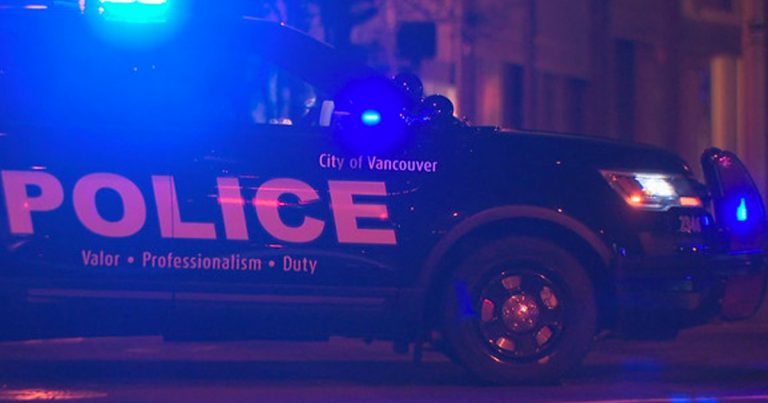
The Vancouver Police Board (VPB) is standing firm on allowing unvaccinated Vancouver Police Department (VPD) members to continue rapid testing rather than force them off the job.
The board met Thursday to review three public complaints over its decision last month to encourage, but not require, COVID shots for currently serving members.
“Our workplace is safe for all employees,” said Deputy Chief Steve Rai, announcing that a little over 97% of staff were fully vaccinated.
Inspector Tyrone Sideroff added that the remaining personnel were undergoing regular rapid testing “on their own time and at their own cost,” and that compliance with the vaccination/testing policy was at 100%.
Sideroff said this testing comes in addition to numerous other protocols, including masks, capacity limits for rooms and other screening requirements. He added that proof of full vaccination was still required for non-VPD members working in VPD facilities, as well as for new members entering the service.
One of the complaints against the VPD was from someone who claimed to be “a resident and family member of a VPD member.”
“I’d like to register my disappointment with the decision to not require vaccination for VPD officers,” the complaint read. “This decision further reduces public trust in the VPD, at a time when trust is in short supply. I’m sure you’ve seen the news headlines about it, and I hope you change your policies soon.”
Another complaint alleged, “it is unfair that health-care workers are mandated to get vaccinated whereas the police are not required.”
“Unvaccinated officers can enter into premises and engage in physical contact with people who are unvaccinated,” it said. The complaint went on to call the board’s decision, “a blatant disregard to public safety and further shows that the police do not answer to anybody, not even the citizens of Vancouver.”
After hearing Rai and Sideroff’s presentation, the board moved to consider the complaints processed. Stephanie Johanssen confirmed in an email to True North that this meant the matter was concluded, though complainants can still request an appeal.
The board had decided in December to allow serving VPD members to opt for rapid testing rather than get COVID shots. The decision put the VPD out of step with most Canadian police services. These include the RCMP, Ontario Provincial Police and Toronto Police Service, Canada’s largest agencies.
Complaints against the VPD over allowing unvaccinated officers come as frontline services across Canada experience staffing shortages and burnout due to the pandemic. Both the Winnipeg Police Service and the Victoria Police Department declared states of emergency earlier this month due to the number of staff booking time off sick.
Last month, it was reported that the Toronto Police Service was still experiencing COVID outbreaks even after axing its unvaccinated members.
Rai told the VPB Thursday that the current policy had allowed the VPD to avoid staffing and service challenges faced by other agencies.
“Now what that has accomplished is optimal compliance with the standards that are expected and may be voiced in a few of these complaints, but we’ve achieved the same results without any unnecessary over-the-top disruption in the organization impacting public policing which you have seen play out in other cities where lines were drawn,” Rai said.
A frontline officer speaking to True North said that agencies declaring staffing shortages during the pandemic were unlikely to be meeting the demands placed on them, despite their best efforts and reassurances.
He said redeploying members from specialized units to the frontlines – as Winnipeg and Victoria had to do – carried its own set of challenges.
“It takes a willingness to do that, and if you have people that are unwilling and sometimes unable because they’ve been in a specialist position for so long, then it’s very difficult for them,” he said. “While they’re not doing their actual job, that work is piling up, and it puts more pressure on the people that are left behind in the specialist divisions, trying to fill the gaps there as well.”
“It’s going to decrease service in many ways to the public. If you start reducing staffing, the time it will take someone to get to you if you call 911 is most likely going to be increased.”
Canada needed to reopen yesterday
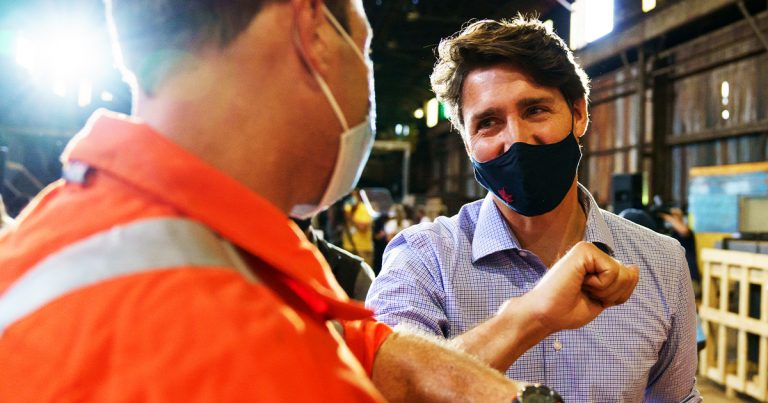
As the United Kingdom moves to lift nearly all Covid restrictions, most Canadians are still living with vaccine passports, mask mandates, and a range of other public health measures. The worst part is that some Canadians are all too happy living with indefinite restrictions, True North’s Andrew Lawton says. Also, a Quebec television cheers on children who want the unvaccinated jailed, and a new poll shows 27% of Canadians actually want that too.
Plus Irvin Studin of the Institute for 21st Century Questions joins to discuss a new committee dedicated to getting the country reopened for good.
SUBSCRIBE TO THE ANDREW LAWTON SHOW
Ontario extending vaccine passports and mask mandate indefinitely
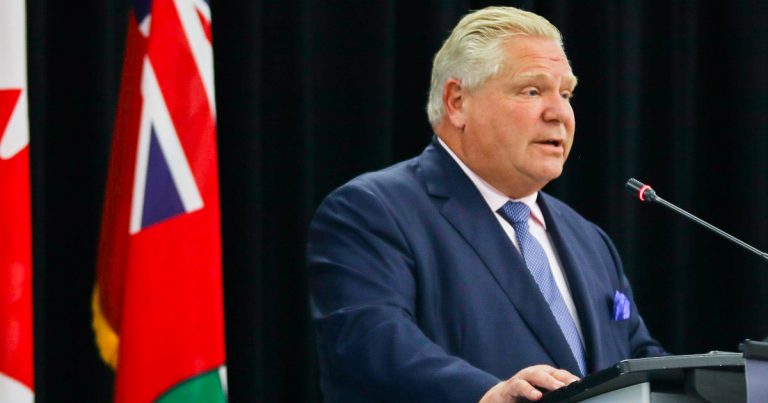
The Ontario government announced on Thursday that it would be lifting various COVID-19 restrictions over the next two months but made no mention of ending vaccine passports or masking.
“The evidence tells us that the measures we put in place to blunt transmission of Omicron are working,” said Ontario Premier Doug Ford in a press release. “We can be confident that the worst is behind us and that we are now in a position to cautiously and gradually ease public health measures.”
According to the press release, Ontario will take a phased approach to ending COVID-19 restrictions, with 21 days between each step.
The first phase, set to begin on Jan. 31 includes increasing social gathering limits to 10 people indoors and 25 people outdoors; requiring places such as bars, restaurants and gyms to operate at 50% capacity; and allowing sport and concert venues to operate at 500 people.
The second phase, set to commence on Feb. 21, will see increased social gathering limits of 25 people indoors and 100 people outdoors; capacity limits removed at places such as bars, restaurants and gyms; and sport and concert venues allowed to operate at 50% capacity.
The third phase, starting on March 14, will see social gathering limits of 50 people indoors with no limits for outdoors and capacity limits lifted in any remaining indoor public settings.
People will continue to be required to show vaccine passports with QR codes and wear masks during all three phases, according to the press release.
Ontario’s original reopening plan would have seen vaccine passports start to be lifted on Jan. 17, with the mask mandate ending on March 28.
True North journalist Andrew Lawton mocked the Ontario government for opening public spaces without removing the passports.
“To recap, the vaccine passports that didn’t make restaurants and cinemas safe enough (in government’s view) to avoid being shut down in the first place will remain in place when these venues are deemed safe enough to reopen at full capacity,” said Lawton. “Got it.”
Surrey hospital closes maternity ward over “staffing issues”

The Surrey Peace Arch Hospital has closed its maternity ward indefinitely to pregnant mothers after citing a staffing shortage.
The Fraser Health Authority has said that they do not have an approximate date for re-opening and that expectant mothers “who have pre-existing plans to deliver at Peace Arch Hospital (are) to attend Langley Memorial Hospital for their deliveries.”
BC Liberal MLA Trevor Halford said on Thursday that the situation was entirely avoidable.
“The community has actually fundraised millions of dollars for this particular ward, and to have that sit empty and to now increase the amount of people going to Langley, to Surrey Memorial, to Royal Columbian, we’re overstretching their system,” Halford told CityNews.
“It is stressful enough when you’re about to have a child. Adding this at the last second is completely wrong and I think it’s very troubling. It’s the place where I had my daughter, and I can tell you it’s a beautiful maternity ward and we’re very proud of it out here in our community.”
While it is unclear what caused the staffing issues, the B.C. government announced last year that they had fired 3,325 unvaccinated healthcare workers. More specifically, the Fraser Health region lost 587 healthcare professionals due to the COVID-19 vaccine mandate.
The health authority has claimed that the closure is the result of an “unexpected leave.”
Halford said he has trouble believing that claim.
“The information that I’ve gotten from people who are fairly close to it is that there is not an unexpected leave, and I’ve heard that not from one person, I’ve heard it from numerous people that are now reaching out to me and telling me that. And my question directly to the minister is, he’s got to clear that up,” said Halford.
“I spoke with the minister at length on this. There were staffing concerns at the time, and we were both hopeful that those would get resolved. Obviously that hasn’t, and my plea to him is that we make this a priority and ensure that we have the proper staff there to have that functioning.”
A protest has been scheduled outside of the hospital for next Wednesday at 10 a.m.
“Join us as we rally to re-open the PAH maternity ward and demand Fraser Health prioritizes stable, long-term obstetrical and pediatric care in our community,” an event description reads.
Viewers push back against Quebec TV show where kids called for forced vaccination

Two days after a Quebec TV show featured children calling for the arrests and forced vaccinations of Canadians who haven’t had COVID shots, a petition calling for the show to be taken off the air has gained over 45,000 signatures.
The Change.org petition was started by Mikael Boutin, who claims the Jan. 18 episode of the talk show La semaine des 4 Julie used children to promote hateful propaganda against Canadians.
Boutin is hoping his petition will send a message to the director of the show’s network Noovo that hateful content is unacceptable and that the show’s host Julie Snyder no longer deserves to be in the public eye.
Snyder caused outrage after questioning her child guests – a girl and a boy, both around ten years old – about COVID-19 vaccination. The two children appeared alongside elementary school teacher Marie-Ève Lévesque.
Snyder first asked the children if they had been vaccinated against COVID-19, to which the girl replied that they had both received their first dose. Snyder then asked whether they supported making the vaccine mandatory, to which both kids responded “yes.”
Snyder went on to ask the children their thoughts on what should be done with those who do not want to be vaccinated.
The boy said the police should be called on them.
The girl said that if people “don’t have their vaccine, it can put a lot of people in danger.” She then added, “so like the government is doing right now, we have to cut things from them little by little until they’ve had enough and get vaccinated.”
Their answers prompted applause from the audience and praise from Snyder herself, who said, “it looks like we have future politicians beside us.”
Since the show aired, the Canadian Broadcast Standards Council (CBSC) say they’ve received a large number of complaints. They have since stopped taking them, however, claiming the high volume is affecting their technical capacities.
The controversial segment has received condemnation from some Canadian politicians, including People’s Party of Canada leader Maxime Bernier, who called it “fascist propaganda.”
The Conservative Party of Quebec also commented on the matter, stating in a French tweet “you thought there was nothing more embarrassing for Quebec’s image than the video of “influencers” partying on a plane?”
The outrage led to an eventual apology from the show’s host.
“I apologize to those who were offended by this. I am very sorry,” tweeted Snyder on Wednesday.
However, True North has learned this isn’t the first time Snyder has had kids on her show to “discuss” COVID-19 issues.
A segment from another episode of La Semaine des 4 Julie found on Facebook shows children in a classroom setting promoting lockdowns and masking.
“We have to lock up people in their homes because if not, they will start to talk and touch each other and they will all give each other the virus, and then give it to others and others, which will just mean that everyone will have it and many people will die,” said a young girl.
When asked about ways to protect himself from COVID-19, a boy replies that we should “always wear a mask, like when you see a friend, because your germs can go onto the person.”
La Semaine des 4 Julie is the same talk show where Prime Minister Justin Trudeau made his controversial comments about unvaccinated Canadians, calling them “extremists, misogynists, and racists.”
The incident is only the latest controversy out of Quebec, which has brought in some of the harshest measures in North America to fight COVID-19.
The Quebec government announced earlier this month that it would be levying a “significant” health tax on the unvaccinated and that a third dose would be required for its vaccine passports.
New poll shows support for government COVID measures waning
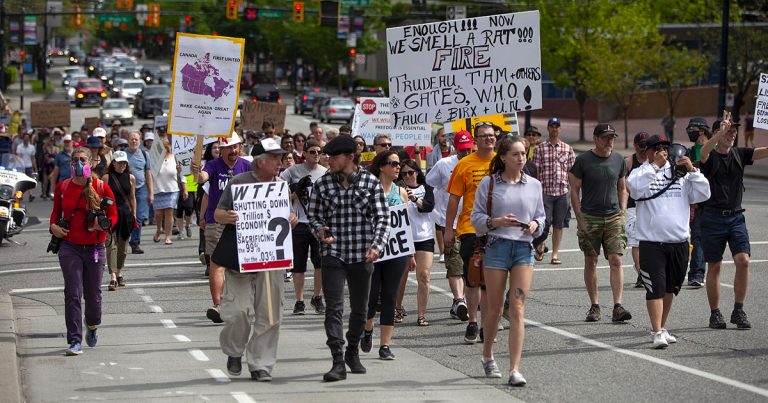
Fewer Canadians now support lockdowns and other government COVID-19 measures, a new Ipsos poll has found.
Since December, approval of Prime Minister Justin Trudeau’s handling of the pandemic has dipped by five percentage points. Only 49% of those polled now say they approve of Trudeau’s response to the Omicron variant.
When it comes to support for lockdown measures instituted by provinces, approval has tanked even further. Compared to July, when over two-thirds of Canadians were calling for lockdowns, only 52% of Canadians currently support them.
“This isn’t just pandemic fatigue, it’s pandemic frustration,” said Ipsos Public Affairs CEO Darrell Bricker.
“When this pandemic started a couple of years ago, there was really this sense that we were all in it together. … Now, that sense that (Canadians) were rallying behind our political leadership has definitely declined.”
1,000 Canadians were surveyed by Ipsos in the online poll which was conducted between Jan.14 and 17, 2022. The poll is accurate within +/- 3.5% or 19 times out of 20.
Support for Canada’s premiers has also dropped, with Quebec premier Francois Legault seeing a 9% decline, while Ontario premier Doug Ford dropped 6%.
In Quebec, 46% of those polled said that the nighttime curfew and other lockdown restrictions put in place by Legault were too strict.
“What’s happened is that people are either thinking that this (pandemic) will be going on for a long time and that we’re going to have to learn to live with it, or they have just checked out from evaluating it anymore,” Bricker said. “It’s just being factored into the way that they’re living their lives.”
Alongside its extremely restrictive measures, Quebec has announced a vaccine mandate for all of the province’s residents. Those who are not vaccinated against COVID-19 will face an unspecified health tax.
When Trudeau was asked what he thought about Legault’s decision to punish people for their own personal health decisions he said that he supports “incentives and strong measures.”
Budget watchdog calls for restraint on ballooning federal spending
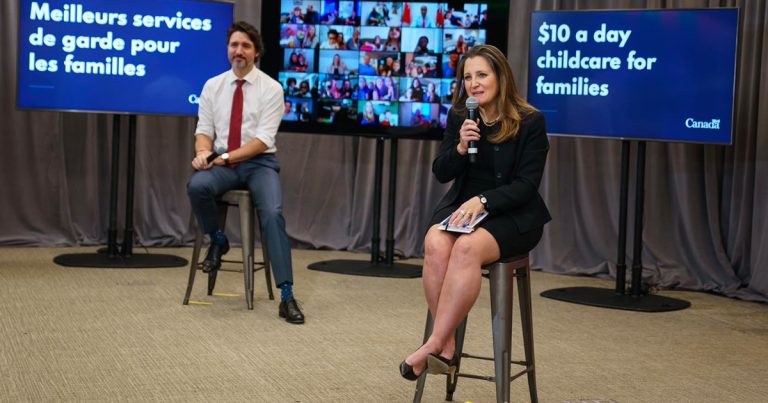
Canada’s independent federal budget officer is telling the Trudeau government to rein in its out-of-control spending.
According to Blacklock’s Reporter, the Parliamentary Budget Office (PBO) noted that the government spent half a trillion dollars since COVID-19 began, including billions of dollars that had nothing to do with the pandemic.
In its report titled Economic And Fiscal Update 2021: Issues For Parliamentarians, the PBO found that $69.2 billion went towards programs unrelated to COVID. These included $49.9 billion on Prime Minister Justin Trudeau’s plan to “build back better,” $24.2 billion in compensation to First Nations kids and $33.3 billion on other policies.
“Since the start of the Covid-19 pandemic the government has spent, or planned to spend, $541.8 billion in new measures. There is an upside risk to the deficit,” read the report.
The PBO researchers observed that any rationale the government may once have had for its spending seems to have fallen by the wayside.
“The government’s previously identified fiscal guard rails and their benchmarking would suggest ‘stimulus’ spending should be wound down by the end of the 2022 fiscal year,” the report reads. “Thus it appears the policy rationale for additional spending over 2022 to 2024 that was initially set aside as stimulus spending has changed.”
Yesterday Trudeau was questioned by reporters about whether uncontrolled spending was actually hurting the economy rather than improving it.
The prime minister avoided a straightforward response.
“We are continuing to work to support Canadians through this challenge,” said Trudeau.
Canadian Taxpayers Federation federal director Franco Terrazzano has called out Trudeau for reckless spending on numerous occasions.
“Years of borrowing means taxpayers will lose out on nearly $200 billion by 2027 just to pay for interest charges on Canada’s debt,” he said earlier this month. “That’s money we can’t use to hire more nurses or lower taxes because it’s going to bond fund managers to service the government’s debt.”
A recent Fraser Institute report has found that out of the world’s 35 most advanced economies, Canada has ranked as the sixth most miserable to live in.
The ranking is driven by higher inflation rates and growing unemployment.
“Canadians are rightly concerned about the country’s high inflation and unemployment rates, and when compared to other developed countries, Canada is not doing well,” said Fraser Institute executive vice-president and report co-author Jason Clements.
Just this week, Canada’s inflation rate rose to 4.8% which is a new 30-year high.
Conservative Finance critic Pierre Poilievre has been outspoken about the Liberal government’s responsibility when it comes to making life more unaffordable in Canada.
“The biggest increases for consumer products have been those that we source right here at home, not those that depend on foreign supply chains,” said Poilievre.
“Home price inflation is a home-grown problem… The more (Trudeau) spends, the more things cost.”