Toronto’s 11th homicide of 2020 is being considered a terrorist act by crown prosecutors according to the Toronto Sun.
30-year-old Saad Akhtar brutally bludgeoned to death a 64-year-old woman on the streets for apparent “terrorist reasons.”
Hang-Kam Annie Chiu was attacked by Akhtar on Sheppard Ave. E. and Markham Rd while she was walking alone.
A note found underneath Chiu’s body prompted investigators to consider the murder as being committed for alleged “terrorist reasons.”
The victim and the suspect had no prior relations and the attack was completely unprovoked.
After beating Chiu to death with a hammer, the accused turned himself in at a local police division.
The police station was evacuated after Akhtar notified the police that he was carrying an explosive device.
A man who killed a pedestrian with a hammer in Scarborough over the weekend allegedly did it as a terrorist act, the Sun has learned: https://t.co/tYwIRCUGGW
Akhtar is being charged by the crown with first-degree murder including terrorist activity. He appeared in court on Tuesday morning to address the charges.
His charges were upgraded to include the terror-related charge after an investigation involving the Toronto Police and the RCMP.
“Today’s announcement is a result of the good work that is done when the dedication of our members, the assistance of the public, and the involvement of our intelligence partners comes together to investigate an incident of national security,” said Supt. Christopher deGale.
“We will continue to support the Toronto Police Service as we remain focused on the safety and security of Canadians.”
Police believe the incident was isolated and there is no ongoing threat to the safety of Canadians.
Records show that the University of British Columbia was warned over its close cash ties with Huawei by the Canadian Security Intelligence Service, according to Blacklock’s Reporter.
This was revealed by Conservative MP Garnett Genuis during a hearing of the Special Committee on Canada-China Relations, which has been tasked with investigating the ongoing tensions between the two countries.
A Jan. 22, 2019 faculty email sent to the executive director of university’s China Council, Prof. Yves Tiberghien, referenced CSIS’s concerns regarding UBC’s dealings with the Chinese company.
“[CSIS] has issued warnings already about the risks of research and other collaboration with Huawei in particular,” said the email.
According to Genuis, UBC and Huawei have up to $7.6 million worth of partnerships over a period of three years. Part of the school’s relationship with Huawei includes paid trips by the university to visit the company’s headquarters in China.
While testifying before the committee, Tiberghien initially denied ever received warnings from Canada’s spy agency on the university’s dealings with Huawei.
After being confronted with the email correspondence, Tiberghien said the record was taken “out of context.”
“This is picking one little thing out of a hundred others,” said Tiberghien. “I have three hundred, four hundred [emails] a day.”
CSIS was warning universities as early as 2010 to avoid using technology from Huawei or developing close relationships with the company. In an academic outreach report from May 2018, CSIS cautioned that relations could compromise the security of academic institutions and their research.
“Beijing will use its commercial position to gain access to businesses, technologies and infrastructure that can be exploited for intelligence objectives, or to potentially compromise a partner’s security,” wrote CSIS.
Shortly after Huawei CFO Meng Wanzhou was arrested by Canadian authorities over an extradition request by the US, UBC scrambled to assess the damage to its international relations with China.
Faculty pondered whether the university should come out against hostility towards China and UBC’s dean of science insisted that the university should “keep doors open to our colleagues in China.”
As the coronavirus spreads around the world, public health officials are cautioning that it will be difficult to prevent the spread of the virus in Canada.
Canadian Chief Public Health Officer Dr. Theresa Tam said Monday Canada will likely not be able to stop coronavirus from entering the country if it becomes a global pandemic.
“These signs are concerning, and they mean that the window of opportunity for containment, that is for stopping the global spread of the virus, is closing,” she said.
“It also tells countries like Canada, who have been able to detect and manage imported cases thus far, that we have to prepare.”
Dr. Tam said the public, as well as businesses and governments, should be prepared if a coronavirus outbreak does occur.
Canada has increased monitoring and screening efforts as outbreaks of coronavirus in Italy, Iran, and South Korea raise fears the virus is no longer containable.
Canada currently has recorded 11 cases of coronavirus as of Tuesday, the latest being a young woman who recently arrived in Toronto from China.
On Monday a man who had recently been in contact with an infected person on a recent trip to Iran became British Columbia’s seventh confirmed case.
British Columbia is now warning travellers to watch for the symptoms of coronavirus “no matter where they were in the world.”
Globally there are 79,331 confirmed cases of coronavirus globally, most of which are in China. Over 2,600 people have died worldwide.
Dr. Vera Etches, the City of Ottawa’s top health officer, agreed with Dr. Tam, saying that fully containing coronavirus is becoming unlikely.
“It looks like it is going to be more and more difficult to contain this virus and it may well evolve into a pandemic. That would change the efforts to contain every last case and contact,” she said.
With the probability of stopping a coronavirus outbreak in Canada becoming slimmer, Dr. Tam said she would like to slow the spread of the virus in Canada – especially with existing influenza risks this time of year.
“We are trying to push past (the) winter respiratory season. That will help a lot,” she said.
Free market solutions to climate concerns are not only possible but likely more efficient. The activists don’t want you to know that. That’s because an open source response to climate change, as opposed to the current authoritarian one, takes away their influence, control and financing.
The Paris accord conversation is dominated by the very same people who are pushing to shut down the Canadian economy and our energy projects. That’s just wrong. Let’s shut them down instead.
Another Wet’suwet’en First Nations leader says the five hereditary chiefs leading the anti-pipeline protests do not represent the views of his people.
Hereditary Wet’suwet’en subchief Gary Naziel told the Globe and Mail that the protest leaders are bending traditional laws for their own ends.
“These five so-called hereditary chiefs, who say they are making decisions on behalf of all Wet’suwet’en, do not speak for the Wet’suwet’en,” said Naziel.
“They are neither following nor abiding by our traditional laws. They are changing them to suit their own purposes, to benefit themselves.”
Naziel also served for eight years as the elected band councillor of the Witset First Nation, which has signed an agreement with Coastal Gaslink alongside 20 other elected bands and five Wet’suwet’en councils.
Naziel’s comments come after Wet’suwet’en matriarch Rita George’s opposition to the blockades went viral last week.
“I want the world to know why I am stepping forward as a matriarch. The world thinks the matriarchs are behind all the protests going on and that’s not true. None of the matriarchs were contacted,” said George.
Gary Naziel (Maxlaxlex') is proud to be working as a grader operator on his own territory. As a Wet'suwet'en hereditary chief in Laksilyu clan, he sees the value in jobs and training opportunities for his people. Filmed 2.13.20. #cdnpoli#bcpolipic.twitter.com/WMuEk7OKZc
Despite calls from Prime Minister Justin Trudeau for dialogue, the small number of chiefs who oppose the pipeline have stopped communicating with the federal government and refuse to meet with ministers to discuss a solution to the situation.
Last week, the RCMP extended an olive branch to the demonstrators, offering to leave the pipeline site to a nearby town as long as protesters removed the barricades.
Due to the lack of communication from the protesters, Trudeau announced the blockades “must come down.”
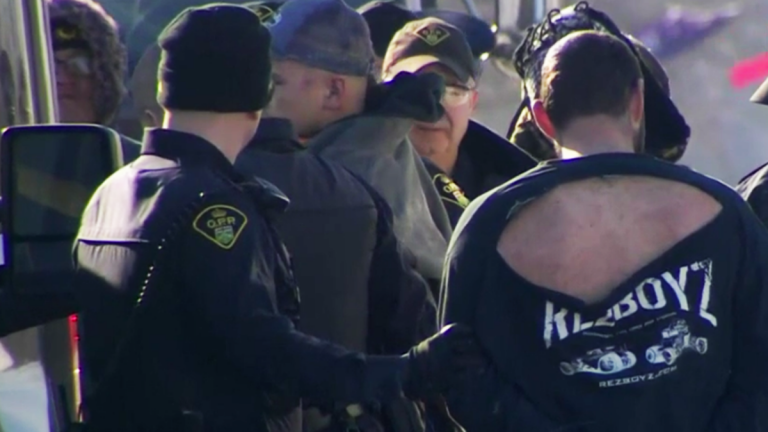
On Monday morning, Ontario Provincial Police officers moved into the Belleville blockade and arrested several protesters. Similar operations were underway in Quebec, where protesters abandoned the site after police arrived to enforce a court injunction.
In a groundbreaking decision, a majority of judges from the Alberta Court of Appeal have ruled that Justin Trudeau’s federally-imposed carbon tax is unconstitutional.
The 4-1 ruling was passed down on Monday afternoon. The court found the tax is “a constitutional Trojan horse” that encroaches on provincial jurisdiction.
Among those who ruled in favour of the tax being unconstitutional were Chief Justice Catherine Fraser, and justices Elizabeth Hughes, Thomas Wakeling and Jack Watson. Only Justice Kevin Feehan dissented.
Incredible news! Alberta's Court of Appeal finds in a 4-1 decision that Justin Trudeau's carbon tax is unconstitutional. https://t.co/OHYWDog28R
“The Act [Greenhouse Gas Pollution Pricing Act] is a constitutional Trojan horse. Buried within it are wide ranging discretionary powers the federal government has reserved unto itself. Their final shape, substance and outer limits have not yet been revealed,” claimed the ruling.
“Almost every aspect of the provinces’ development and management of their natural resources, all provincial industries and every action of citizens in a province would be subject to federal regulation to reduce GHG emissions.”
Of the three provincial challenges to the tax, the Alberta ruling is the only one to find the Greenhouse Gas Pollution Pricing Act unconstitutional. Courts in Saskatchewan and Ontario found the act to be constitutional in split decisions. The Supreme Court of Canada is expected to hear appeals of these rulings next month.
An important paragraph in the decision about the importance of protecting provincial jurisdiction. pic.twitter.com/JjqtK5BBVG
Alberta Premier Jason Kenney, who promised he would abolish his province’s carbon pricing scheme prior to being elected, tweeted a statement in response to the decision.
“Very pleased that Alberta’s court of appeal has ruled the federal carbon tax to be unconstitutional,” tweeted Kenney.
“We urge the Trudeau government to respect the ruling of the court, and scrap their carbon tax immediately on Alberta families.”
After Kenney repealed the provincial tax, the Trudeau government imposed a carbon tax on the province at the beginning of this year.
Very pleased that Alberta's court of appeal has ruled the federal carbon tax to be unconstitutional.
We promised to take meaningful action on climate change without punishing Alberta families for driving to work and heating their homes. pic.twitter.com/clfseHWxHc
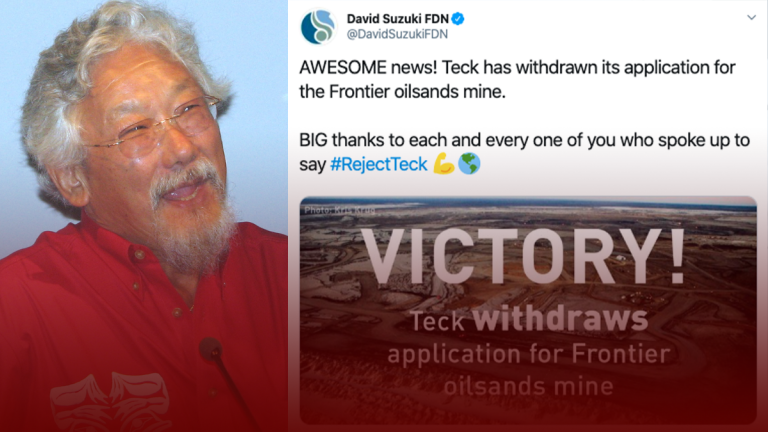
The David Suzuki Foundation celebrated the loss of thousands of potential jobs in Alberta after Teck Resources Ltd withdrew its bid for the Frontier oil sands mine on Sunday.
Less than a day after Teck pulled its application for the project, the David Suzuki Foundation’s official Twitter account declared “victory.”
AWESOME news! Teck has withdrawn its application for the Frontier oilsands mine.
The company will be filing a $1.13-billion writedown on the $20 billion project and cited the need to reconcile resource development projects with climate change.
“Global capital markets are changing rapidly and investors and customers are increasingly looking for jurisdictions to have a framework in place that reconciles resource development and climate change, in order to produce the cleanest possible products,” said a statement by Teck President and CEO Don Lindsay.
“This does not yet exist here today and, unfortunately, the growing debate around this issue has placed Frontier and our company squarely at the nexus of much broader issues that need to be resolved.”
According to estimates, the project would have contributed a total of $70 billion in tax revenues to the Canadian economy.
During the construction phase, Teck Frontier was expecting to hire 7,000 people and then another 2,500 employees to operate the mine.
The mine also had the support of 14 First Nations in the area and had passed through all necessary regulatory and consultation hoops. The federal government was expected to make a final decision on the project by the end of February.
According to senior Liberal sources, the Trudeau government was preparing an aid package for Alberta in the case of a rejection.
Premier Jason Kenney warned Trudeau that a rejection of the mine could lead to a “boiling point” in Western alienation.
“There is quite simply, no reason specific to this project that would justify denying federal cabinet approval for the Frontier project,” wrote Kenney at the time.
Kenney has since called the decision by Teck to withdraw their application “a grave disappointment.”
“The factors that led to today’s decision further weaken national unity. The Government of Alberta agreed to every request and condition raised by the federal government for approving the Frontier project, including protecting bison and caribou habitat, regulation of oilsands emissions and securing full Indigenous support,” wrote Kenney.
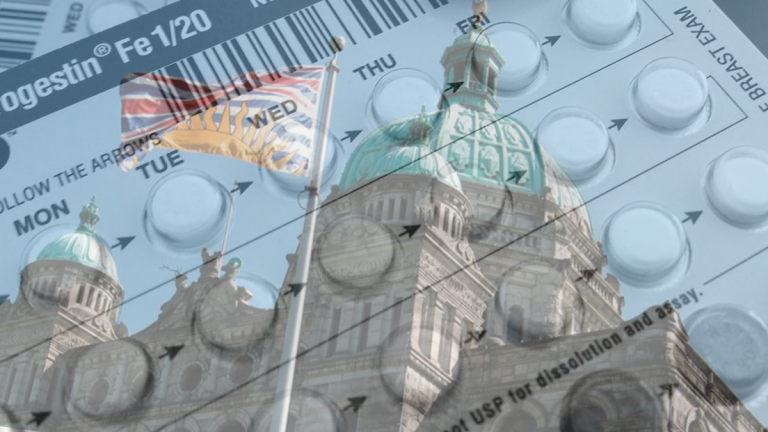
A handful of organizations and individuals in British Columbia are advocating for free universal contraception for all “women and people with uteruses” in the province.
But many of the arguments employed by the birth control advocates seem to convey anti-family, anti-reproductive messaging.
True North’s Lindsay Shepherd discusses.
You can’t depend on the mainstream media to report the truth. This is why True North is so important. Support independent media in Canada: http://www.tnc.news/donate/
Ontario Provincial Police (OPP) have moved to break up a rail blockade near Belleville.
On Monday morning, a large number of officers and vehicles arrived near the rail blockade in Tyendinaga, Ont. after protesters ignored the midnight deadline to abandon their blockade.
Several protesters were taken away in handcuffs by police.
Protesters have been blocking rails since Feb. 9, effectively cutting off rail travel between Ontario and Quebec.
In a statement, the OPP says they have been regularly meeting with protest leaders to try to find a peaceful resolution, but to no avail.
“Unfortunately, all avenues to successfully negotiate a peaceful resolution have been exhausted and a valid court injunction remains in effect,” the statement said.
“Enforcement of the injunction may include arrest of those who choose not to comply, however, use of force remains a last resort.”
The protesters blockading railways across Canada are acting in solidarity with the handful of Wet’suwet’en hereditary chiefs who oppose the Coastal GasLink LNG pipeline being constructed on their traditional territory. All elected chiefs and most hereditary Wet’suwet’en chiefs approve of the pipeline project.
The blockades forced Via Rail and CN Rail to lay off 1,500 staff across Canada, and have led to shortages of crucial products like propane in many parts of Canada.
Prime Minister Justin Trudeau and several premiers have called for the blockades to be removed.
Trudeau met with his Incident Response team Monday morning.
This story will be updated as more information becomes available.
When did the police in this country become emasculated? I may have missed the transition, but that is sure the way things appear.
The far-left protesters blockading the main rail line connecting Eastern Canada to Western Canada, despite being served with a court injunction last Wednesday and despite the Prime Minister saying on Friday that “the blockades must come down,’ are still there.
They are saying they will remain, come what may, until the RCMP leave Wetʼsuwetʼen territory where the Coastal Gas pipeline is to be constructed.
The OPP, who has jurisdiction in conjunction with the CN Police, seems to be ignoring their duty, again, in spite of what the Prime Minister said.
There is a history in Canada of violent confrontations with indigenous groups from Oka, to Gustavson Lake to Ipperwash to Caledonia. One thing history has taught us is that trying to appease these groups usually doesn’t end well.
Neither can police go in guns-a-blazing so to speak.
Police today are much more enlightened and more aware of indigenous rights and concerns. Having said that, they cannot allow individuals to continue to break the law.
We also know that bad behaviour left uncorrected leads to more bad behaviour. Every parent knows this. So does every dog owner. Not that I am equating the keepers of the barricades to children or puppies, as I am sure some critics will imply. I am saying that the blockading of the major rail line connecting this country is unacceptable behaviour and cannot be tolerated.
If it takes the power and authority of the state to open the rail line and restore the transport lines and thus the economy of the nation, then that’s what must happen. Even the clueless Prime Minister seems to have realized that.
There are a few things wrong with all of this. Not the least of which is the Wetʼsuwetʼen First Nation, along with 20 other First Nations along the pipeline route approve of the project and have said so in several elections on the subject.
The pipeline company has spent more than five years in consultation with the First Nations to get their approval and sign off of their leaders.
The fact that five of the so-called hereditary chiefs of the Wetʼsuwetʼen people are against it is a problem that has now infected Canada. The hereditary chiefs don’t speak for the First Nation. In fact, they are a non-profit group that is deeply in debt and funded primarily by the Tides Foundation and the Pembina Institute, two enviro-loony groups dedicated to being against any Canadian energy development.
Longtime members of the Wetʼsuwetʼen First Nation believe the hereditary chiefs are against the project because they cannot control any part of the project and the proceeds of which go directly to the band and not through them. This, of course, means they can’t take any of those proceeds as they have historically done with other projects put together by members of the First Nation.
This is turning into a battle between members of the Wetʼsuwetʼen First Nation and the self-designated hereditary chiefs. And all the usual suspects on the political left who seem to believe it is a David and Goliath battle against a huge energy company have joined in sympathetic protests across the country.
This is officially out of control.
Any opportunity the government had to seize control of the situation melted away while the Prime Minister was gallivanting around in Ethiopia and Senegal stumping for support for his vanity seat on the UN Security Council.
Justin Trudeau has proven that he’s no leader at a time when the country desperately needs one. The economy has taken a major hit in the past two weeks with the shut-down of the rail lines, the very thing that defined who we were as a country.
The Prime Minister has abdicated his responsibility when he initially said the government doesn’t tell the police what to do. Then at his Friday press conference, he said the barricades need to be taken down.
Well, I’m not entirely sure how he squares that circle, but he can and should order that police enforce court injunctions. Their operational logistics are up to them, but that’s why they are the professionals. A failure to do so might just spell the end of this confederation. That’s how serious this crisis is.