Conservative candidate and former cabinet minister Pierre Poilievre sat down with True North’s Andrew Lawton to talk about the 2021 election campaign, including its rocky start for the Liberals, as well as the steep inflation digging into Canadians’ pocketbooks, and what a Trudeau majority would look like. Canadians go to the polls on September 20.
Liberal Party Leader Justin Trudeau and his peers have slung a wide array of insults and divisive remarks towards Canadians over the years.
From calling people “neanderthals,” to alleging that Canadians were racist and implying veterans were too greedy, the Liberals have smeared ordinary people in numerous ways.
True North has compiled a list of the eight worst insults and remarks that the Liberals have used against Canadians.
Referring to unvaccinated Canadians as “those people”
"Those people are putting us all at risk!" @JustinTrudeau
Trudeau demonizes 1 out of 5 Canadians, claims they are endangering children & the vaccinated who are not at risk, refers to freedoms as "privileges", and attacks @ErinOToole for supporting free choice. #elxn44#cdnpolipic.twitter.com/oBsrfHANZj
During a campaign stop in August, Liberal Party Leader Justin Trudeau referenced unvaccinated Canadians as “those people” and suggested that they are putting everyone at risk, including children. Currently, approximately 28% of the Canadian population has yet to receive one dose of the COVID-19 vaccine.
“Everyone needs to get vaccinated and those people are putting us all at risk,” said Trudeau.
“And Erin O’Toole is siding with them? Instead of with Canadians who did their part and stepped up.”
Spending $3.3 million to lecture Canadians about how they’re racist
Prior to the 2021 election being called, the Liberal government announced a $3.3 million national ad campaign to lecture “non-racialized Canadian middle-aged adults” on how Canada is racist.
The government hopes to target alleged “racism hotspots” such as Thunder Bay and Hamilton with the program.
Calling people “neanderthals” for questioning the Liberal budget
WATCH this exchange in Ottawa yesterday, where conservative Lisa Raitt challenges finance minister Bill Morneau over his fake-feminist budget, Morneau responds by saying he finds her questions "OFFENSIVE" and then goes on to call her a "NEANDERTHAL." What a pathetic little man. pic.twitter.com/PgHrM2f1xc
During an exchange in the House of Commons Finance Committee in 2018, former Liberal finance minister Bill Morneau called people “neanderthals” when being questioned about the government’s budget at the time.
“Aren’t you just buying votes, minister? Isn’t this what this whole budget is about? It’s a cynical political gesture, that you are saying these words because you do not, at all, emulate, or try to foster any of the things that you talk about in your budget either in your past corporate life, in your own department or even in your own ministerial staff,” asked former Conservative MP Lisa Reitt.
“We’ll continue to do this. If people like you don’t buy into it, that’s a problem that we’ll have to face. But my view is that we will be more successful collectively if we’re actually able to successfully promote women into leadership roles. We will drag along the neanderthals who do not agree with that, and that will be our continuing approach,” responded Morneau.
Saying law-abiding gun owners in the firearms lobby were “extremist”
During a Liberal Party policy convention in April 2021, Public Safety Minister Bill Blair claimed that “extremists” were part of Canada’s gun lobby.
“Not every person who is in the gun lobby is an extremist, but anybody extremist is in the gun lobby,” said Blair during a panel.
In response, the Canadian Coalition for Firearm Rights slammed Blair for slandering hard working Canadians who make up the gun lobby including parents, teachers, lawyers and others.
Calling Canadians Islamophobic for worrying about terrorism
Justin Trudeau is talking about re-integrating ISIS terrorists into Canadian society. Today I asked: what could such a program possibly look like? pic.twitter.com/OJPGNruOjM
While fielding questions from former Conservative Party leader Andrew Scheer on the Liberal government’s plan to handle returning ISIS fighters, Trudeau implied it was Islamophobic to worry about the security threats they posed.
“The Prime Minister is using a broad spectrum that includes poetry and podcasts, and all kinds of counselling and group hug sessions,” said Scheer. “When will the Prime Minister take the security of Canadians seriously and look for ways to put these ISIS fighters in jail?” asked Scheer.
“They ran an election on snitch lines against Muslims, they ran an election on Islamophobia and division, and still they play the same games, trying to scare Canadians,” said Trudeau.
Thanking Indigenous protestor for their donation as they were dragged out
In 2018, Trudeau told a First Nations mercury poisoning protestor that he was thankful for her donation as she was being dragged out of a Liberal fundraiser in Toronto by security guards.
A video of the incident shows Trudeau telling her “Thank you for your donation” as the female protestor is hauled from the stage.
Saying its “not Canadian” and “dangerous” to be concerned about the refugee crisis
Things got testy today at the federal-provincial immigration ministers' meeting in Winnipeg. @HonAhmedHussen said Ontario is "victimizing and demonizing" asylum seekers. @MacLeodLisa said the federal minister was trying to intimidate her and called for an apology. Take a look. pic.twitter.com/wPwfphDVvs
At the height of the 2015 Syrian refugee crisis, then Liberal immigratoin minister Ahmed Hussen said it was “not Canadian” to be concerned about the cost of housing asylum claimants in Toronto.
Hussen made the comments after Ontario Progressive Conservative Cabinet Minister Lisa MacLeod expressed concerns about the matter.
Hussen said that the comments “divisive, it’s fear mongering and it’s not Canadian, and it’s very dangerous.”
Telling veterans that they are asking more than the government can afford
During a 2018 town hall meeting, Trudeau was questioned by former Canadian Armed Forces corporal Brock Blaszczyk on why his government continues to fight veterans in court while bringing former ISIS fighters back to Canada and awarding Omar Khadr several million dollars.
In response, Trudeau told Blaszcyk that veterans were asking too much of him.
“Why are we still fighting against certain veterans’ groups in court? Because they are asking for more than we are able to give right now,” said Trudeau.
The Liberal Party released their platform on Wednesday, which pledges $78 billion in new spending. However, what the platform fails to mention even once is balancing the budget.
The Canadian Taxpayers Federation (CTF) immediately released a statement criticizing the Liberals for staying “on the runaway spending train.”
“The Liberals want to spend more on everything, but there’s no plan to repair our national finances and chip away at the $1-trillion federal debt,” said CTF Federal Director Franco Terrazzano.
“The Liberals are betting the farm that nothing will ever go wrong with the economy and it can contain the debt problem, but what if reality isn’t as rosy? The Liberals are doing nothing to get off the runaway spending train, and that’s reckless.”
The Trudeau government has created a monumental deficit of over $350 billion with no plan to decrease spending or balance the books. As a result of Trudeau’s spending, Canada’s debt is now over $1 trillion. According to the International Monetary Fund, Canada has the fifth-highest gross debt to GDP ratio among 29 industrialized countries.
The Parliamentary Budget Officer projected deficits until 2070 on the Trudeau government’s trajectory even before taking election promises into account. If that were to happen, Canadians would have to pay $3.8 trillion in debt interest charges by 2070.
CTF also criticized Trudeau for backtracking on an earlier promise not to increase taxes. The Liberal platform includes a number of tax increases such as higher taxes on banks and insurance companies, higher income taxes for “the 1%,” an anti-flipping home tax and a global corporate minimum tax.
The Liberals also backtracked on a 2015 promise to balance the budget by 2019 and instead kept running deficits. Terrazzano said that “with this plan, it’s a good bet the Liberals will never balance the budget.”
In August, Trudeau shrugged off a question about inflation rates and the Bank of Canada and said he doesn’t “think about monetary policy.”
“I don’t know. When I think about the biggest, most important economic policy this government, if re-elected, would move forward. You’ll forgive me if I don’t think about monetary policy,” said Trudeau.
The Conservative campaign hit six provinces in four days this past weekend, with a couple of stops in Quebec, where leader Erin O’Toole laid out his proposed “contract” with the Quebecois. True North’s Andrew Lawton joined the Conservative tour as a journalist, putting questions to O’Toole on free votes in caucus, foreign interference in Canadian elections, free speech, and other issues the legacy media hasn’t been covering. Also, Conservative candidate Pierre Poilievre sits down to talk about corruption, inflation, skyrocketing debt.
Candice Malcolm is reporting on location in beautiful Vancouver, British Columbia.
Vancouver-proper has long been a Liberal strong-hold, just as college-educated mothers in urban areas are key Liberal voters. But, as Candice reports, these voters are increasingly turning on Trudeau and the Liberals.
It’s no wonder. After 18 months of Liberal lockdowns and years of Trudeau pitting Canadians against each other, many of these once-loyal Liberal voters are turning on their former party.
The Canadian Federation of Independent Business (CFIB) is raising the alarm on the massive amount of debt small business owners in Canada have had to take on during the COVID-19 pandemic.
The CFIB released a report revealing that small business owners have had to rack up $138 billion in debt to stay afloat.
The numbers were revealed in its latest study titled, Small Business Debt: The COVID-19 Impact. It questioned up to 4,950 small business owners across Canada.
“Actual repayment of this debt will be the next big obstacle small businesses will face. Many are still seeing a slow pickup in revenues, capacity restrictions and uncertainty heading into the fall and winter,” said CFIB Senior Vice-President Corinne Pohlmann.
On February 25, 2020, the CFIB reported that small businesses had a cumulative debt of $135 billion.
According to the study, the hospitality sector saw each owner take on an average of $333,174 in debt. Meanwhile, individual retailers took on $160,985, while contracts reported $141,754 in debt and wholesalers were taking on $93,265.
“This estimate may not capture the complete picture. As we are now well over a year into the pandemic, many other highly indebted survey respondents from February may have already gone out of business,” the report claimed.
“Half of entrepreneurs, 50%, say that repaying their debt is one of the biggest challenges their business is facing on the road to recovery.”
Early on in the pandemic, Prime Minister Justin Trudeau claimed that the Liberal government “took on debt, so Canadians wouldn’t have to” while justifying his government’s ballooning deficit and spending programs.
“It’s pretty bad. My little not-for-profit association took 78,000 calls from business owners last year to try to provide them with guidance and support: 78,000. And these calls are dark. These business owners are really at their breaking point,” said CFIB CEO Dan Kelly.
“They are not going to be forgiven in most circumstances. And there will be an anchor around the neck of the business owners as the economy begins to recover.”
The newly unveiled Liberal Party election platform includes a pledge of an additional $400 million in taxpayer funding for the CBC/Radio-Canada.
According to the 82-page document, the funds are meant to offset the financial pressure the state broadcaster has been facing due to a plummet in advertising revenues as more Canadians continue to tune out.
“Decreasing advertising revenues for all broadcasters are putting Canada’s public broadcaster under increasing pressure,” the Liberal platform claims.
“(A Liberal government will) provide $400 million over 4 years to CBC/Radio-Canada so that it is less reliant on private advertising with a goal of eliminating advertising during news and other public affairs shows.”
The platform also pledges to update the broadcaster’s mandate, while also attempting to bring CBC content to the international audience.
The Liberals have been hinting at increased funding for the CBC for some time now despite the fact that the public broadcaster already receives $1.2 billion in funding from taxpayers, making up over 71% of its income.
According to an April 20th briefing note, the federal government noted that the broadcaster was under “immense pressure” with regard to its workforce and finances.
CBC ad revenues and viewership numbers have been falling steadily over the past few years as the broadcaster struggles to retain interest from the Canadian public.
The network’s latest corporate plan revealed that over the last year the CBC lost 18% in advertising revenues, worth roughly $204.8 million.
Additionally, last year the CBC reported a considerable decrease in viewers. Records show that in 2019, CBC-TV viewership fell below 4% nationally for the first time in history.
In comparison, Conservative Party Leader Erin O’Toole has pledged to “review the mandate” of CBC English Television, CBC News Network and CBC English online news.
Canadians’ lives are getting harder, not easier under Justin Trudeau’s watch, according to Conservative leader Erin O’Toole.
O’Toole reacted to a new Statistics Canada report showing the Canadian economy is facing serious roadblocks on its road to economic recovery.
“Under Justin Trudeau, Canada’s economy is getting worse, not better,” said O’Toole.
“The reports give us a sobering reminder of the fragility of our economy. It confirms what Canadians already knew… Life is getting harder, not easier. Under Justin Trudeau, we’re heading further down the road of recession, not the road to recovery.”
According to the Statscan report, the Canadian economy unexpectedly contracted in the second quarter (Apr. 1 to June 30) and again in July. Canada is the only G7 country to experience a deceleration in the second quarter, according to an Organisation for Economic Co-operation and Development (OECD) report.
Real GDP declined 0.3% from April to June due to declines in home resale activities and exports. A preliminary estimate shows a further 0.4% fall in real GDP in July. The main decreases in the second quarter were in manufacturing, construction and retail trade.
Inflation and affordability are also becoming bigger issues for Canadians as the cost of everyday goods for Canadians has increased. An August StatsCan report shows that Canada’s inflation rate in July was 3.7% — almost double the 2% target.
Speaking to reporters on Tuesday, Trudeau claims that while parts of the economy remain weak, the economy overall is roaring back.
O’Toole believes that the Conservatives’ recovery plan “will stop the out of control spending, borrowing and debt that’s gotten us into this mess.”
According to the Conservative plan, if elected, an O’Toole government will recover one million jobs that were lost during the pandemic and balance the budget within a decade.
The Trudeau government has created a deficit of over $350 billion with no plan to rein in spending or balance the books. As a result of Trudeau’s spending, Canada’s debt now exceeds $1 trillion.
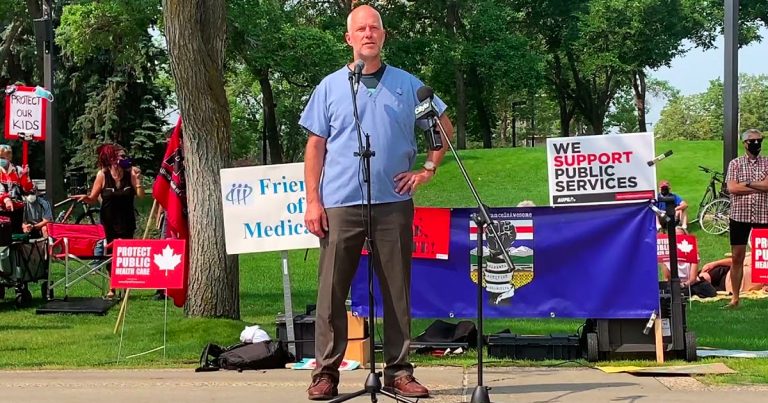
A Calgary doctor who led protests against the Alberta government’s decision to lift most public health measures recently said that it would be “impossible to vaccinate our way out of the pandemic.”
Dr. Joe Vipond made the comments during a COVID-19 livestream hosted by the group Protect Our Province Alberta while discussing the spread of the Delta variant. According to Dr. Vipond, the solution to combating the Delta variant is to institute more restrictions.
“If I can opine a bit on some of the causes of this situation, it seems that our policymakers have put all their eggs in the vaccination baskets. It was basically, we have enough vaccinated population that we no longer need to do any of the other mitigation measures,” Dr. Vipond claimed.
“And most of the smart scientists on COVID that I follow would suggest that because Delta is so infectious that it is impossible to vaccinate our way out of this pandemic, that we really do need those other simple mitigation measures. And the ones I would point out would be mask mandates. Thank you, Edmonton,” he continued.
“Restriction of mass gatherings like weddings and funerals through this wave. We need to consider closing indoor dining temporarily, indoor drinking temporarily.”
True North reached out to Dr. Vipond to give him an opportunity to clarify his remarks but did not receive a response by the deadline given.
McKenzie Kibler, who is the Issues Manager for the Alberta Minister of Health, told True North in an emailed statement that the COVID 0 approach Dr. Vipond is advocating for has been unsuccessful in curbing cases elsewhere.
“Vaccines work, full stop. They protect us, our families, and the wider community, and they are the only way out of the pandemic. Dr. Vipond’s recommendations are based on aiming for “COVID 0”, an approach that hasn’t worked for other jurisdictions, including some that are now seeing cases ramp up among the unvaccinated,” said Kibler.
“We continue to have confidence in Alberta’s Chief Medical Officer of Health and the advice she provides. Municipalities and other institutions have always been able to adopt their own measures, including mask mandates. While we will continue to monitor the situation, our current health measures remain in place, including requiring masks for health care and transit workers.”
As exclusively reported by True North earlier this month, Dr. Vipond was revealed to be an extensive donor to the Alberta NDP. Records show that Dr. Vipond has donated nearly $20,000 to that party since 2014.
When confronted with the donations, Dr. Vipond denied having a conflict of interest and maintained that he had no ties to the NDP other than the said contributions.
Despite his extensive support for the NDP, legacy media outlets such as Global News and CTV News continue to cite him as an expert without disclosing those ties.
Following Alberta’s decision to curb quarantine requirements, Dr. Vipond called for the resignation of Alberta’s Chief Medical Officer of Health Dr. Deena Hinshaw.
To date, 78% of Alberta’s eligible population has received at least one dose of a COVID-19 vaccine, while 69.8% have been fully vaccinated.
Recently, the Alberta government rolled out a third vaccine booster dose for specific segments of the population such as seniors in long-term care facilities and immunocompromised people.
Alberta’s economy is expected to return to pre-pandemic levels this year thanks to surging oil prices filling up government coffers with higher than expected resource royalties.
A fiscal update released Tuesday by Alberta finance minister Travis Toews projects the province’s deficit will be slashed by more than half, with Alberta set to lead Canada in economic growth in 2021.
The Alberta government is now forecasting a deficit of $7.8 billion at the end of the 2022 fiscal year—$10.5 billion lower than Budget 2021 estimates.
Alberta’s gross domestic product (GDP) is expected to rebound to 6.7% in 2021, outperforming the previous estimate by close to 2%. By next year, the province’s GDP is expected to return to 2014 levels before Alberta’s economy was battered by low commodity prices and the COVID-19 pandemic.
The update states that this surge in revenue and economic growth can be attributed to “global oil prices strengthening faster than expected, job creation lowering unemployment, and increased energy and non-energy exports, such as lumber and chemical products.”
Despite the good news contained in today’s update, there are still challenges ahead for Alberta’s beleaguered economy. The unemployment rate remains stubbornly high at 8.5% and the province’s debt is still expected to top more than $100 billion this year. Debt servicing costs are also expected to climb to $2.6 billion for the year.
The update warns that “the rate of change in the economic outlook and government revenue once again displays the volatility faced by Alberta, the need for economic diversification, and for caution in fiscal planning.”
The Alberta government has committed to returning to balanced budgets once the COVID-19 pandemic has ended.
Alberta Institute President Peter McCaffrey told True North that “it is great news for Alberta that oil prices are increasing again, but that is not something that the provincial government controls.”
“Albertans need a government that will cut spending, not increase spending slightly slower than in the past,” McCaffrey said.